Kathmandu
Tuesday, July 21, 2026





Weakening monsoons, rising temperatures, and escalating drought risks threaten Nepal's agriculture and livelihoods as experts warn of a looming 'Super El Niño' by late 2026.

KATHMANDU: In Nepal, the monsoon usually enters around mid-June and remains active until late September/ early October. Around 80 percent of the annual rainfall occurs during this period. This time is an opportunity for everything from transplanting rice, the main crop, to water storage and groundwater recharge.
However, this year’s monsoon in Nepal is projected to experience below-average rainfall and rising temperatures. As the monsoon rains weaken, causing drought and intense heat, it appears that agricultural production and overall public life will be affected this time.
The factor causing the weak monsoon and temperature rise in Nepal this time is ‘El Niño’, a climate cycle generated by abnormal changes in the surface temperature of the Pacific Ocean. Due to this climate impact, the South Asian Climate Outlook Forum (SASCOF) projects that the monsoon will be weak this year in the South Asian region, including Nepal.
The ‘Monsoon Climate Outlook’ released by the Department of Hydrology and Meteorology on May 8 also shows a 55 to 65 percent probability of below-normal rainfall in the southern parts of Koshi, eastern parts of Madhesh, most parts of Lumbini, and southern parts of Karnali. Bibhuti Pokharel, senior meteorologist and spokesperson of the department, says, “The impact of El Niño in this monsoon will cause less rainfall, drought, and rising temperatures, which will affect all sectors related to rainfall.”

As less water falls, concerns have increased about a food crisis due to decreased agricultural production caused by drought. Since most parts of the country lack adequate and reliable irrigation facilities, Sudha Sapkota, senior agricultural scientist at the Nepal Agricultural Research Council, states that this year’s dry monsoon will further affect the farming system dependent on rainwater. “Since less rain will fall even in areas including the Terai-Madhesh, which is considered the granary, there is a possibility that the production and productivity of rice, the major food crop, will decrease this year,” she says. “Because of this, internal production might be insufficient, potentially increasing food imports.”
Water resources expert Ajay Dixit states that at a time when global temperatures are rising due to increasing carbon emissions from human activities, ‘El Niño’ will bring further deviations. “We are entering a more unstable type of seasonal variation,” he says. “By the end of this year, i.e., December 2026, the phase of ‘Super El Niño’ (a temperature rise of more than two degrees Celsius is called ‘Super El Niño’) will arrive, and projections are being made that this will bring an even greater disaster next year.”
What is ‘El Niño’?
Studies have described ‘El Niño’ as a natural climate cycle related to the sea surface temperature of the central and eastern parts of the Pacific Ocean. Madan Lall Shrestha, Academician at NAST and former Director General of DHM, states that this is an important phase of the climate cycle called ‘ENSO’ (El Niño-Southern Oscillation).
He says, “It alters Earth’s atmospheric system, changing global temperatures, rainfall, and weather patterns, and the impact of ‘El Niño’ during the monsoon brings less water to South Asia, including Nepal.” A study conducted by Shrestha in the year 2000 also showed that rainfall decreases in Nepal during the ‘El Niño’ phase.
Climate scientist Shobha Poudel states that even though Nepal is far away from the Pacific Ocean, it will be troubled by risky events like extreme heat, drought, and wildfires caused by the ‘El Niño’ that develops there. “That is exactly what is being seen this year,” she says.

Photo: Nepal Photo Library
‘El Niño’ is not a climate cycle that appears suddenly; it develops gradually. “The Climate Prediction Center of the United States has said that there is a high probability of El Niño appearing soon and it could reach its peak in December 2026,” Shrestha said in a telephone conversation on June 1. “Projections are being made that it will reach the Super El Niño phase by December.”
The World Meteorological Organization (WMO) issued a notice on Tuesday (June 2) to adopt preparedness for the ‘El Niño’ phase as the sea surface of the Pacific Ocean has begun to warm abnormally. ‘This will affect the global temperature and rainfall cycle, increasing the risk of extreme weather events,’ the WMO mentioned.
Recent forecasts show an 80 percent probability of the ‘El Niño’ effect appearing from this June to August. Similarly, by November, this probability will increase to 90 percent or higher. Although the impact and duration of ‘El Niño’ remain to be confirmed, most forecasting models have indicated that it could be at least moderate and potentially strong. El Niño is classified into four categories based on the increase in Pacific Ocean surface temperatures: weak, moderate, strong, and very strong.
According to a press release issued previously by the WMO on May 28, it warned that ‘El Niño’ would be fully developed by the end of 2026, creating further extreme weather events next year.
‘El Niño’ occurs on average every two to seven years. It typically lasts from nine to 12 months. The ‘El Niño’ phase, formed by abnormal temperature increases in the Pacific Ocean, affects weather conditions worldwide. It increases extreme weather conditions and climate-induced events in some regions. ‘El Niño’ causes flooding in the Horn of Africa and the South American region. It brings unusual drought and heat to Southeast Asia, Australia, and Southern Africa.
Along with ‘El Niño’, another climate cycle called ‘La Niña’ runs in the Pacific Ocean. According to a research article titled ‘Impact of El Niño and La Niña on Global Weather’ published in the Global Social Science Review journal in 2022, the condition where the surface temperature of the Pacific Ocean becomes abnormally warm is called ‘El Niño’. Exactly opposite to this, the condition where the temperature of the same region becomes abnormally cold is called ‘La Niña’.
The vicious cycle of drought
The major drought events seen in Nepal are directly linked to the ‘El Niño’ that develops in the Pacific Ocean. A study by Damodar Bagale, an Assistant professor at the Central Department of Hydrology and Meteorology, Tribhuvan University, has shown that each occurrence of ‘El Niño’ weakens monsoon rainfall and triggers drought.
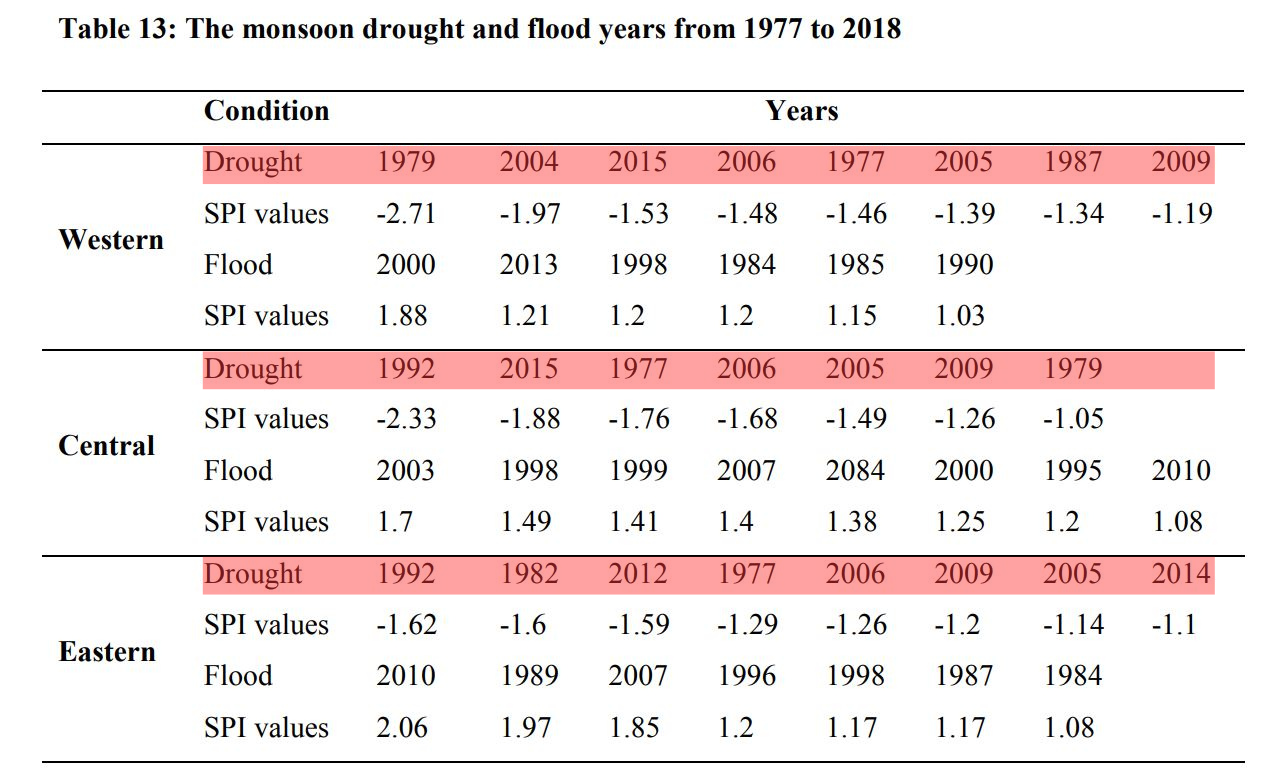
Source: Drought Detecting and Monitoring over Terai and Mountain Region of Nepal, 2023
Bagale’s study, which analyzed 42 years of weather data from 1977 to 2018 during his master’s thesis, was published in 2022. According to his study, due to ‘El Niño’ in 1992, Nepal received 19.29 percent less rainfall than average. This is known as the worst drought year in Nepal’s history. Following this, in 2015, the rainfall was 17.59 percent below average.
Droughts occurred due to low rainfall in 1982 and 2009 as well. The droughts of 1982, 1992, 2009, and 2015 occurred during ‘El Niño’ years. In an ‘El Niño’ year, monsoon rainfall is generally about nine percent less than average. However, although 1987 and 1998 were ‘El Niño’ years, they received above-average rainfall. Out of the 42 years (1977–2018) of analyzed weather data, Assistant professor Bagale has classified 1982, 1983, 1987, 1991, 1992, 1997, 1998, 2002, 2004, 2009, 2015, and 2016 as ‘El Niño’ years.
Not all drought events observed during the monsoon are linked solely to ‘El Niño’. Local and regional winds, the impacts of climate change, and other weather systems observed in the Indian and Pacific Oceans also bring droughts during the monsoon season. Monsoon droughts in 1977, 1979, 2005, and 2006 were recorded in non-El Niño (normal) years.
Bagale says, “El Niño, however, brings a harsher type of drought than other droughts.” If a region experiences below-average annual rainfall for many months, dryness occurs. This is also called meteorological drought. Drought reduces the water level because water sources, wells, ponds, and wetlands are not recharged. The flow and volume of water in streams and rivers decrease. Consequently, agricultural production and livestock output decrease due to a lack of water for farming activities.

Drought in Madhesh Province during the 2025 monsoon period. Photo: UNICEF
Drought was observed in Nepal during the monsoons of the year 2025 and previously in 2023. During the 2025 monsoon, drought occurred in most parts of Madhesh, and some parts of Koshi, Bagmati, and Gandaki. Since it did not rain in most parts during the main season for rice transplantation, the government declared Madhesh a drought-hit area in August 2025.
In the year 2023, moderate drought occurred in the central and western parts of Madhesh Province, the southern part of Bagmati, and some parts of Karnali Province. The Department of Hydrology and Meteorology has classified a situation with 25 to 50 percent less rainfall than average during the monsoon as a moderate drought. TU Assistant Professor Bagale states that the monsoon drought of 2023 is linked to the ‘El Niño’ effect.
According to the WMO, El Niño last appeared from July 2023 to April 2024. The 2023/24 El Niño was one of the five strongest ever recorded. During this period, damages worth 103.3 billion US dollars occurred in regions including Asia, Australia, and Africa. The WMO stated that the 2023/24 El Niño contributed to making 2024 the hottest year on record so far and 2023 the second hottest year on record so far.
Nepal receives an average of 1570.4 millimeters of rainfall during the monsoon. According to the records of the Department of Hydrology and Meteorology, the 2023 monsoon received only 91.2 percent of rainfall, which is below average. In that year, the average maximum temperature was 27.9°C, which was 0.6°C higher than the average annual maximum temperature.
Senior meteorologist of the department, Pokharel, claims that the 2023 monsoon was not affected in Nepal because the 2023/24 El Niño had already reached a neutral state. However, since the monsoon occurs in Nepal from June to September and El Niño was observed during that period, the claim that it had no effect is not strong.
According to the United Nations, the 2023/24 El Niño caused the worst drought in South Africa in the last hundred years. The drought destroyed more than half of the crops. Not only was the food storage emptied, but the prices of food items skyrocketed in the market. Twenty million people in this region had to face severe hunger. More than 3.9 million children suffered from malnutrition, among whom 1.1 million children became victims of severe acute malnutrition.
Multidimensional impacts
Droughts occurring during the monsoon and winter seasons in Nepal have put agriculture-based livelihoods in the first line of fire. In the ‘National Climate Change Survey, 2022’ published by the National Statistics Office, 65.4 percent of farming households also stated that they were facing the brunt of drought.
A total of 6,508 households across the country participated in the survey conducted through direct interviews. Residents aged 45 or older who had been living in the same locality for 25 years were included in the survey.
Senior meteorologist of the department, Pokharel, states that the ‘El Niño’ phase is forming more frequently due to climate change. Because this brings extreme weather systems, it adds challenges to weather forecasting. She says, “One factor is that we do not have long-term data to show trends, and on top of that, extreme weather systems are appearing more frequently, adding uncertainty to forecasting.”
‘El Niño’ brings extreme heat, heatwaves (Loo), and droughts to many parts of the world, increasing the risk of wildfires. Environmental science researcher Uttam Babu Shrestha says, “El Niño used to happen in the past as well, but now due to climate change, its frequency and speed have increased.” It is estimated that the current generations (Gen Z, Alpha, Beta) will be more affected by the impacts of climate change than previous ones.The impact of ‘El Niño’ in South Asian countries, including Nepal, is devastating and multidimensional. Since it increases global temperatures, the challenges of heatwaves and drought are added to this region. It also brings unusual changes in the weather. Drought leads to a decline in agricultural production and destroys crops.
Food shortages occur, and consumer goods become expensive in the market. Problems such as the drying up of drinking water sources and food shortages due to low yields induce migration. Due to extreme heat and flooding, health problems such as epidemics like cholera, respiratory diseases, malnutrition, and heat stress increase.

Raising awareness about climate change. Photo: UNICEF
As mentioned in the ‘Dryland Management Resource Book’ of the Department of Forests and Soil Conservation, the impacts of climate change have been clearly visible in Nepal over the last few decades. Analysis of weather data from 1970 to 2013 shows that the average annual rainfall here is decreasing at a rate of about 1.3 millimeters per year. In some places, however, abnormally high rainfall and continuously low rainfall situations have also been observed.
Long periods without rain, sudden heavy rainfall, and rising temperatures have increased dry droughts. The study of Nepal’s temperature from 1970 to 2013 showed that the annual average temperature growth rate is about 0.0560°C per year.
Another climate expert, Sudip Thakuri, who is an associate at the Central Department of Environmental Science, Tribhuvan University, states that the rate of glacier melting will increase due to rising temperatures during the ‘El Niño’ phase. “It has come to light that this year’s El Niño will be of a severe kind. If the heat increases in the mountains, the rate of snow melting will increase, and the risk of avalanches may also increase,” he says.
The department forecasts that since there is a possibility of below-average temperature rise across the country this year, there is a risk of monsoon-related disasters such as glacial lake outburst floods (GLOFs) in high mountain areas, leading to floods, landslides, inundation, land erosion, and flash floods in downstream areas.
There is a risk of extreme heat or ‘Loo’ in the Terai-Madhesh region. According to the department, there is a 55 to 65 percent probability that the maximum temperature across the country will be higher than average.
Ignoring the silent disaster
According to climate expert Ngamindra Dahal, the impact of drought is not limited only to water sources and access. He states that problems like forest fires, crop loss, air pollution, decline in productivity, and lack of sanitation are linked to prolonged drought. He says, “Drought is a major disaster that manifests silently. It is not discussed publicly; even the media speaks and writes very little about it.”
Water resources expert Dixit states that even though the burden of drought is compounding every year due to the intense impact of climate change and ‘El Niño’, the government’s attention has not reached toward mitigating the damage. “The government is as prepared as ever to respond to floods, but there is no preparation for drought,” he says. “Even though debates take place regarding the impacts of climate change, they are focused only on climate financing, grants, electric vehicles, and building infrastructure structures; we need to practice climate adaptation, but attention has not reached this direction.” Instead, he states that altering the natural form of streams and forests in the name of constructing infrastructure has promoted climate-induced disasters.
Climate scientist Poudel states that although the government has formulated policies related to climate adaptation and disaster risk reduction, they have not directly addressed the impact of ‘El Niño’. “There is a monsoon action plan, but preparation to face the drought caused by El Niño during the monsoon is inadequate,” she says. “Even the Department of Hydrology and Meteorology has not been able to provide spot-on weather forecasts.”
To mitigate the impact of extreme weather events on farmers and the general public, she suggests that the government must make weather forecasting reliable and amend existing policies on climate adaptation and disaster risk reduction so that they can cope with the ‘El Niño’ phase.

Worried farmers in Matihani village of Mahottari due to the lack of rain for a long time. Photo: Nepal Photo Library
Shanti Mahat, Under Secretary and Spokesperson of the National Disaster Risk Reduction and Management Authority under the Ministry of Home Affairs, states that solutions have been initiated by making a nationwide action plan to cope with drought.
“We have assigned responsibilities from the federal to the local government level and concerned agencies in the action plan, and we will move forward responding to the drought accordingly,” she says. The government has started preparedness, anticipatory action, and rapid response for drought only from this year (2026 CE).
The national action plan on drought includes 10 points, such as mapping drought risks in every local unit to identify drought hotspot wards and preparing drought contingency plans, and formulating and implementing programs related to rainwater harvesting, source protection, and construction of small and medium reservoirs.
Similarly, plans have been included to plant drought-resilient crops, construct alternative crop calendars, and manage emergency budgets to provide immediate relief to drought-affected people.
Likewise, the National Agroforestry Policy, 2019 contains provisions to encourage the use of drought-tolerant agricultural crops, organic fertilizers, and modern technology in areas lacking irrigation. However, farmers have not been able to derive adequate benefits from this.
Sapkota, senior agricultural scientist at the Nepal Agricultural Research Council, says, “For nine to ten years, we have been encouraging farmers to plant drought-tolerant rice; the publicity needs to be increased a bit.” The Ministry of Agriculture, Forestry, and Environment has also recommended planting drought-tolerant rice varieties such as Sukkha-1, Sukkha-2, Sukkha-3, Sukkha-4, Sukkha-5, and Sukhha-6.
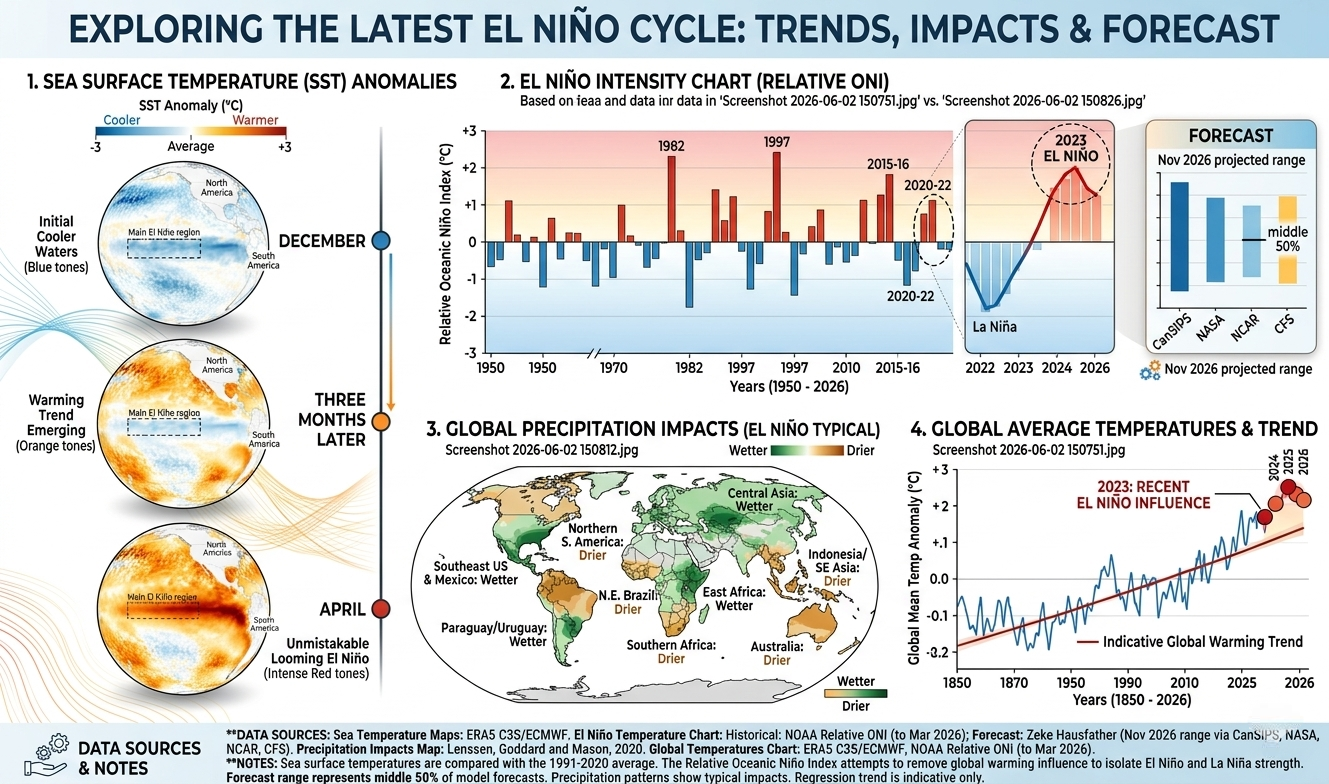
El Niño temperature chart