Kathmandu
Thursday, July 2, 2026





As unpredictable climate patterns wreak havoc across Nepal, the multi-dimensional impacts—from devastating floods and landslides to "silent" droughts—are challenging the nation's resilience.
KATHMANDU: “The mud and filth have cleared, the rains have vanished,
Goddess Bhawani is worshipped, and talks of joy abound.”
This excerpt from the famous poem “Dashain” by Poet Laureate Lekhnath Paudyal does not just describe the grandeur of the Great Dashain festival; it also speaks to the seasonal characteristics of that time. According to the poem, once the monsoon ends, people immerse themselves in the festivities of Dashain amidst a comfortable weather environment.
However, it has been a long time since Nepalis have been able to celebrate the festival in such favorable weather without clouds, rain, and mud. In recent years, heavy rains during Dashain have triggered disasters like floods, landslides, and inundation.
This was the case for the family of Narendra Singh from Chiuri, Jayaprithvi Municipality-1, Bajhang, during the Dashain festival of 2024. The festive excitement had begun. His son, Nabin, a Bachelor of Agriculture student at Rampur Campus in Chitwan, was preparing to return home in a few days. Having completed his final year and finished his OJT (On the Job Training) in Dolpa, Nabin had gone to the campus to submit his report.
Following a family discussion to pick up his sister, who was studying in Kathmandu, and reach home before Ghatasthapana, he was heading to Kathmandu on September 27, 2024. The bus he was traveling in was buried by a landslide at Jhyaple Khola in Dhunibesi Municipality-9, Dhading. Just one week before Ghatasthapana, the Singh family was plunged into the grief of losing a son.
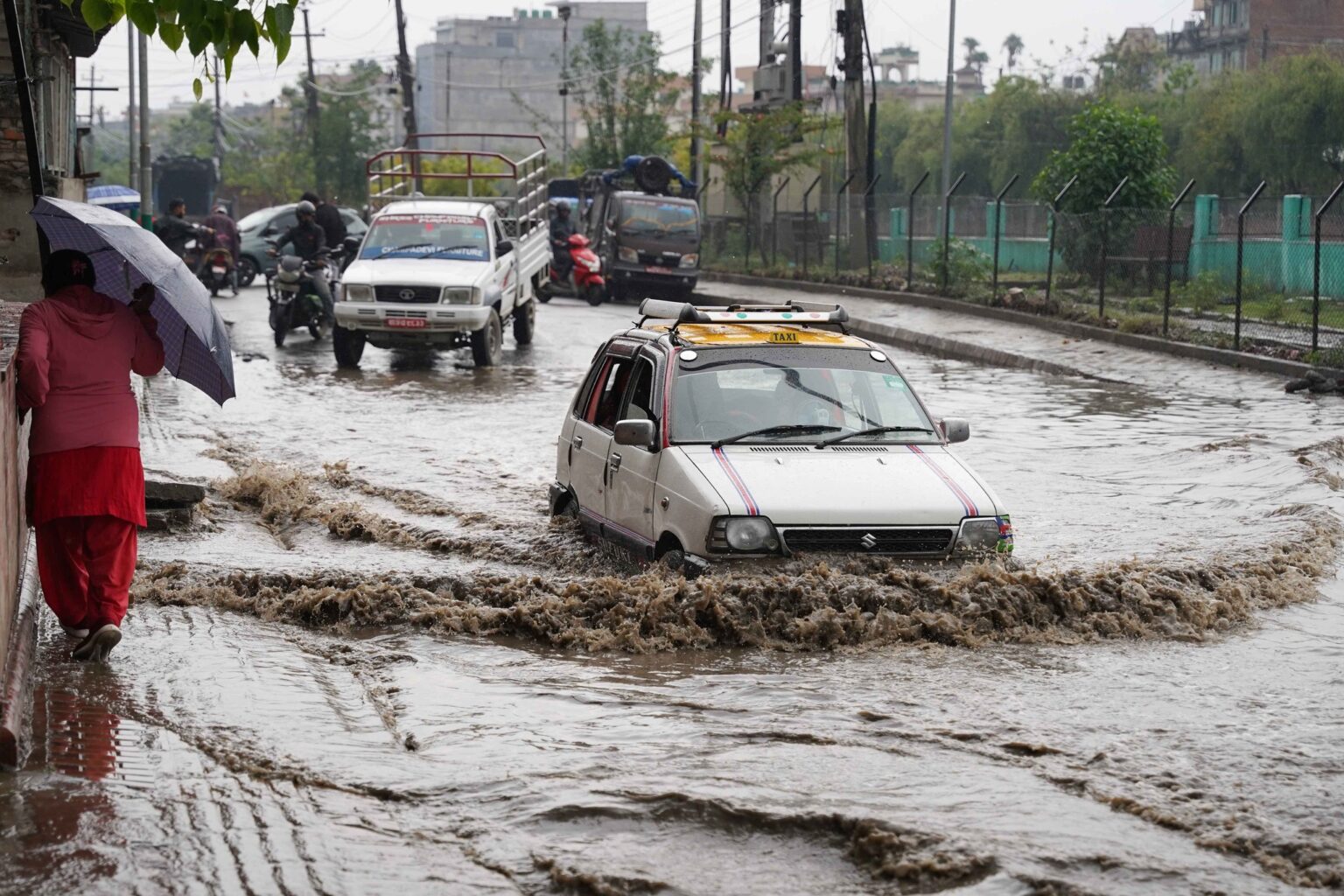
Traffic affected due to waterlogging in the Kankeshwari area of the Bishnumati Corridor road, Kathmandu Metropolitan City-19, on May 6, 2025 . Photo: Nepal Photo Library
The family received this news only three days later. Recalling his son’s final words, Narendra says, “He called in the evening saying, ‘I have submitted the documents; there is talk of heavy rain tomorrow, so I’m leaving for Kathmandu.’ After that, contact was lost. It was only three days later that we heard the vehicle he was in had been buried by a landslide.”
Having lost his only son, the pain of bereavement pierces his heart even more during every Dashain.
Extreme or unpredictable weather systems have caused massive damage in Nepal over the past decade. The impacts of such weather characteristics are multi-dimensional. Due to irregular monsoons, droughts during the rainy season, extreme precipitation (catastrophic rainfall), and lack of or minimal rain in winter, there has been loss of life and property, damage to physical infrastructure, and an impact on agricultural production.
Monsoon-related disasters
The landslide at Jhyaple Khola in September 2024 did not just snatch away the children and relatives of Narendra’s family, but many others as well. Following sudden heavy rains on September 27 and 28, 2024, 35 people, including Nabin, died on the spot when landslides buried buses and other vehicles stopped along the Tribhuvan Highway. Despite weather forecasts predicting heavy rain, the police and administration failed to take precautionary measures like stopping nighttime traffic in the highway area, leading to such high human casualties.
The relentless and torrential “bucket-pouring” rains towards the end of the monsoon between September 26 and 29, 2024, caused massive human and physical loss due to floods, landslides, and inundation. According to the National Disaster Risk Reduction and Management Authority’s (NDRRMA) ‘Monsoon 2024’ report, those three days of heavy rain claimed 250 lives across the country, while 18 went missing and 178 were injured. Bagmati Province suffered the most damage.
The unpredictable weather patterns seen in recent decades have begun to cause immense destruction. According to the Department of Hydrology and Meteorology’s records on monsoon onset and withdrawal, the monsoon usually stays in Nepal for an average of 112 days. During this period, 80% of the total annual rainfall occurs. Driven by water-vapor-laden winds from the Bay of Bengal, the monsoon typically enters through eastern Nepal on June 13. However, the 2024 monsoon arrived two days earlier than average on June 10 and withdrew 13 days late on October 12. This means the 2024 monsoon lasted for 125 days.
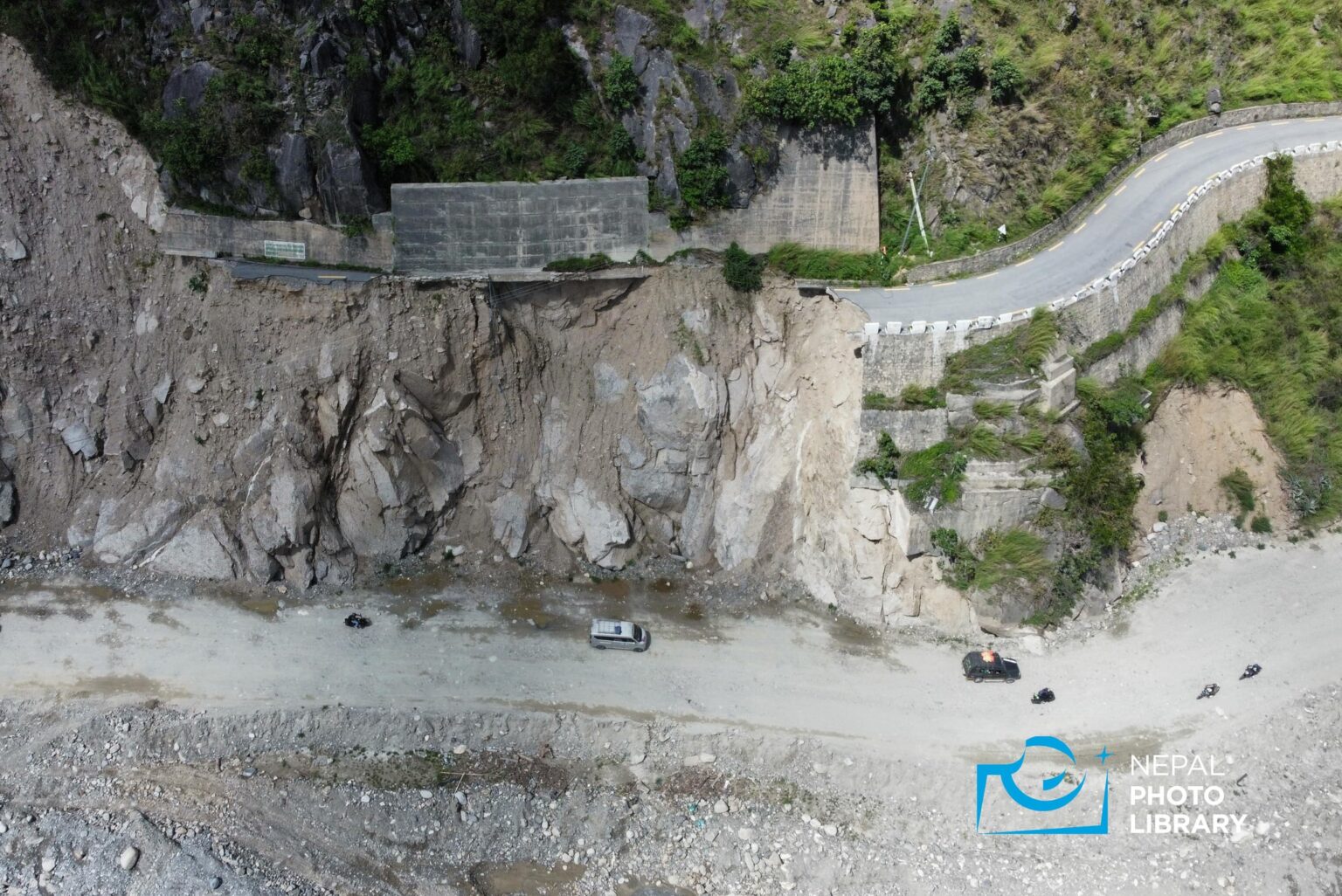
The BP Highway devastated by floods last October. Photo: Nepal Photo Library.
Weather and disaster risk experts consider such monsoonal shifts as abnormal weather conditions. Disaster risk reduction researcher Dinanath Bhandari says, “This situation is painful, disaster-prone, and causes much suffering. It is also called extreme or ‘extreme’ weather conditions.”
The World Meteorological Organization defines an extreme weather event as one that has unusual characteristics in terms of recurrence, location, timing, or spread. Such weather events can vary by location and time and are seen rarely. However, in Nepal, abnormal monsoon conditions have started recurring almost every year for nearly a decade. According to the analysis by the Department of Hydrology and Meteorology, the monsoon period is lengthening, with earlier onsets and later withdrawals than average. Since 2017, seven monsoons (2017, 2018, 2020, 2021, 2022, 2024, and 2025) entered earlier than average. Since 2016, the monsoon has been withdrawing late.
Late withdrawal and heavy rainfall in short durations have led to significant losses from disaster events. At the end of the 2025 monsoon, something similar happened in Ilam during Dashain. On October 4, two days after Tika, 39 people died in Ilam due to floods and landslides following heavy rain. According to the Department of Hydrology and Meteorology, 332.6 mm of rain fell at the Himali Gaun center in Ilam between 8:45 AM on October 4 and 8:45 AM on October 5. This was a record-breaking rainfall after 42 years.
The 2024 monsoon also saw the heaviest rainfall in Nepal’s 77-year history. As heavy rains triggered disasters like floods, landslides, and inundation, damage exceeding Rs 46.68 billion was recorded across physical infrastructure (roads, bridges, hydropower), agriculture and livestock, education, health, and irrigation, according to the NDRRMA’s ‘Preliminary Assessment of Loss and Damage’ report.
Multi-dimensional impacts of changing weather
According to the World Meteorological Organization, events such as rainfall significantly higher than normal, high precipitation in a short time, extreme heat, prolonged droughts, heatwaves (Loo), cold waves, hailstorms, windstorms, and unusually high snowfall are considered extreme weather events.
Disaster researcher Bhandari explains that extreme weather events are not new and have occurred since ancient times. However, he notes that in recent years, climate change has increased the frequency, destructive capacity, and uncertainty of when these events occur. “Some extreme weather events have moved to new locations. For example, hilly valleys are now experiencing scorching heat,” he says. “On the other hand, haphazard infrastructure construction on land and settlements in risk zones have increased the overall economic and social impact.”
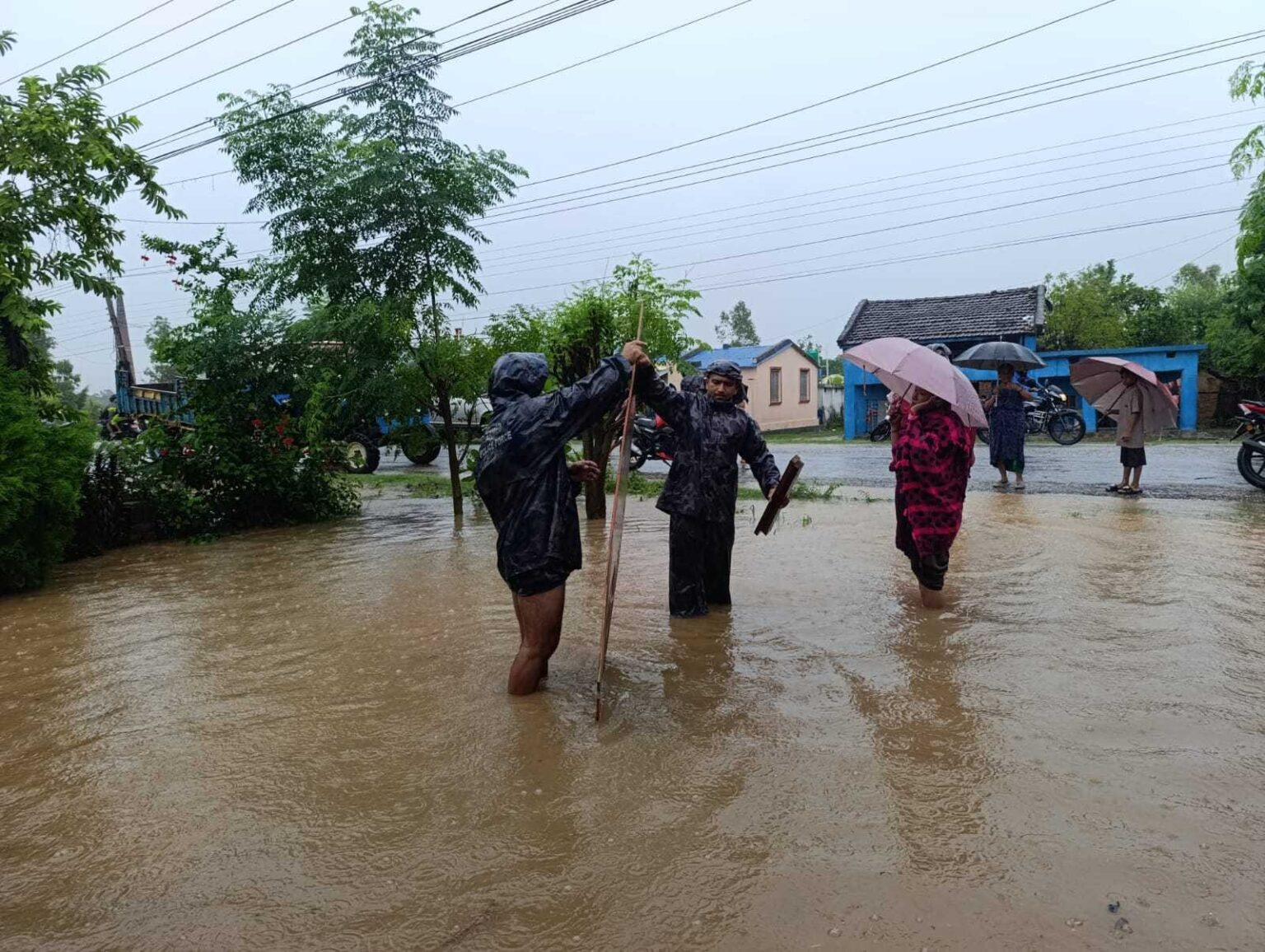
Security personnel rescuing locals affected by inundation in Kailali due to continuous rain on June 20, 2025. Photo: NDRRMA
The impacts of extreme weather events—such as excessive rain, monsoon-related disasters, floods following glacial lake outbursts, extreme heat and cold, and droughts—are not limited to one area; they are multi-dimensional. Loss of life and property has increased due to these changing weather systems. Problems range from delays in rice planting due to lack of rain to crops being submerged just as they are ready for harvest, affecting agricultural yields. Infrastructure such as roads and hydropower projects suffer damage worth millions of rupees. The shifting monsoon period has disrupted the atmosphere of major festivals like Dashain.
The NDRRMA’s Annual Progress Report 2024/25 mentions that the impact of climate change has added environmental challenges, including risks of floods, landslides, droughts, glacial lake outbursts, and unstable weather systems. Saroj Karki, a researcher in Nepal’s water resources and irrigation sector, says that as global temperatures rise, the melting of snow and glaciers and the risk of glacial lake outburst floods (GLOFs) have increased. “Droughts and water crises have deepened. Agricultural production has declined. As this affects livelihoods, migration, social conflict, and cultural shifts have increased,” he says.
Bhandari suggests that since effective technology to directly control extreme weather events has not yet been developed, the focus should be on improving the climate. He says, “Global efforts to reduce greenhouse gas emissions over a long period could improve the climate system, which would reduce the impact of extreme weather.”
Drought as a ‘silent disaster’
Climate expert Ngamindra Dahal states that drought is emerging as a bigger disaster for Nepal than excessive rain. “Drought is a silent disaster; its impact is not limited to water sources and access,” he says. “Forest fires, crop loss, air pollution, decrease in productivity, and lack of sanitation are all linked to long droughts.”
The ‘National Climate Change Survey 2022’ published by the National Statistics Office pointed out that life based on agriculture has been affected by droughts in both winter and summer. Among the 6,508 households nationwide that participated in the survey through direct interviews, 65.4% said they were experiencing drought. Additionally, 54.3% reported new pests and diseases in crops, and 87% felt a change in seasonal rainfall patterns.
The survey included individuals over 45 years old who had lived in the same place for at least 25 years.
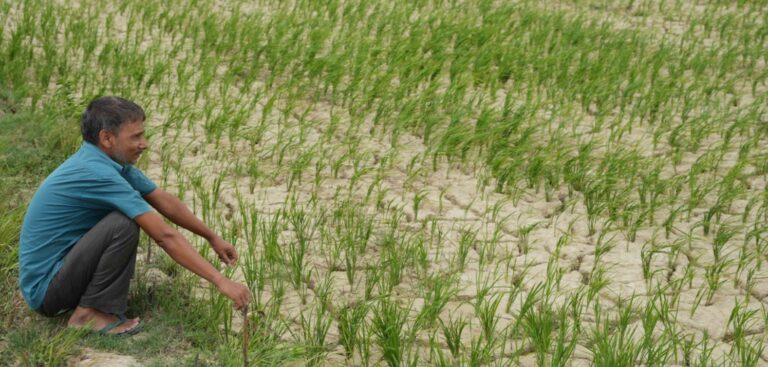
Concerned farmers in Matihani village, Mahottari, after a long period without rain. Photo: Nepal Photo Library
Another climate expert, Madhukar Upadhya, states that this is the fourth consecutive year the entire country has faced drought without even average winter rains. “Since 2022, average winter rainfall has not occurred consecutively,” he says.
Madan Sigdel, an associate professor at the Central Department of Hydrology and Meteorology, Tribhuvan University, suggests that since drought primarily leads to a decline in crop production, there should be a shift toward alternative crops that can withstand dry conditions.
During long droughts, the risk of fires and forest fires is equally high. According to the Disaster Portal records under the Ministry of Home Affairs, fire caused the most damage in the decade from 2016 to 2025. In one decade, damage worth Rs 24.61 billion occurred. This accounts for 75.74% of the total damage from all types of disasters recorded on the Disaster Portal.
Similarly, in the last decade, physical infrastructure and livestock worth Rs 32.50 billion were lost to fires, earthquakes, floods, landslides, storms, heavy rain, forest fires, lightning, animal attacks, and snowfall.
Melting snow, rising glacial floods and landslides
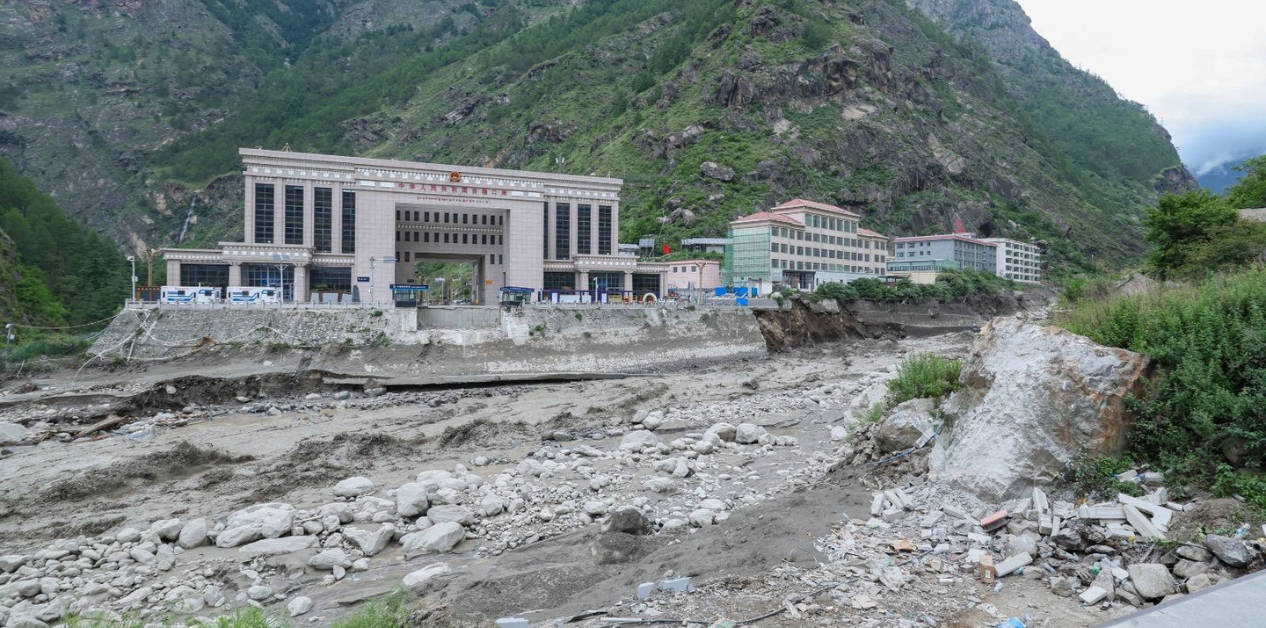
Losses from glacial floods and avalanches are repeated annually. On July 8, 2025, sudden water drainage from a supraglacial lake (formed on the surface of a glacier) in the Pyurepu Glacier in the Tibetan region, about 35 km above the Nepal-China border, caused massive destruction in the Lhende Khola (Bhotekoshi River). Eighteen people went missing in the flood; 11 bodies and human remains were found in the Trishuli and Narayani rivers from Rasuwa to Nawalparasi (Bardaghat Susta Paschim).
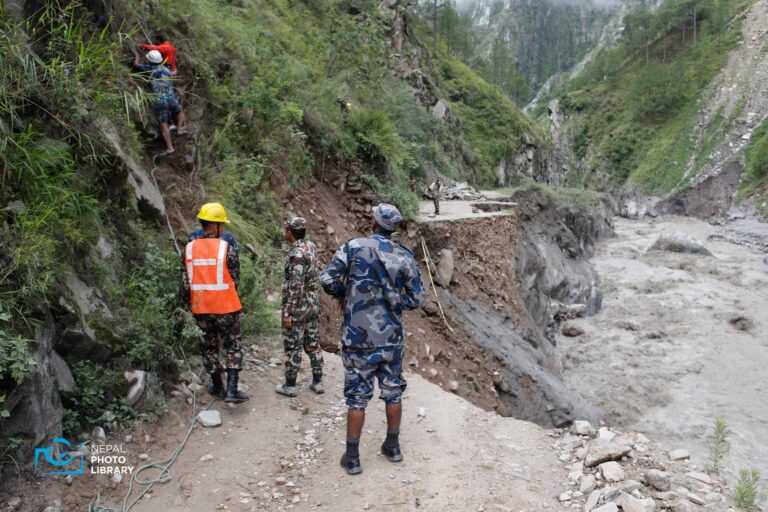
The condition of the Syabrubesi-Timure road after the Lhende Khola flood on July 10, 2025. Photo: Prakash Chandra Timilsena/Nepal Photo Library.
The NDRRMA study report on the incident states: ‘Due to rising temperatures and the rapid expansion of glacial lakes, glacial lake outburst events are increasing, and glacial floods have caused serious damage to important infrastructure.’
In the event named the Rasuwa Glacial Flood, the Nepal-China Friendship Bridge at Rasuwagadhi, the Syabrubesi-Rasuwagadhi road section, a large portion of the Rasuwagadhi dry port, and three hydropower projects in the area were damaged. Trucks, containers, and electric vehicles waiting for customs clearance were swept away or submerged. About 16 kilometers of road from Syabrubesi to Rasuwagadhi was completely blocked.
Similarly, on May 15, 2025, floods and landslides occurred without any rain, displacing 32 people from 18 houses in Til village, Namkha Rural Municipality, Humla. Five wooden bridges over the Tilchung Khola were swept away. Two houses and a 15-kilowatt hydropower plant were damaged. An irrigation canal covering about 400 ropanis (203,488 square meters) of land was destroyed, along with the village’s drinking water line.
A joint preliminary analysis by the NDRRMA and the International Centre for Integrated Mountain Development (ICIMOD) showed that the incident was caused by ‘thermokarst.’
According to ICIMOD, ‘permafrost’ refers to rocks, soil, and debris that have remained completely frozen underground for a long time in high mountain regions. The process of permafrost melting and flowing due to temperature rise is called thermokarst. According to the then-spokesperson of the NDRRMA, Ram Bahadur KC, the temperature in Humla had risen from 15 to 22 degrees Celsius on the day of the flood.
Arun Bhakta Shrestha, a senior climate change specialist at ICIMOD, says the Til village flood and landslide is a new phenomenon in the context of Nepal. “This incident in Til village suggests that the problem of permafrost degradation is starting to appear in Nepal as well,” he says.
The technical study team found three glacial lakes at an altitude of 5,350 meters above sea level. According to then-spokesperson KC, after the underground portion melted, erosion occurred at a weak point, and the flood entered the village.
On August 15, 2024, a glacial lake outburst flood in the Thame area of Khumbu Pasanglhamu Rural Municipality-5, Solukhumbu, completely destroyed 25 houses and guest houses, a school, a health post, and a bridge. According to the study report ‘Thame Valley Glacial Flood 2024: Causes, Impacts, and Future Risks’ by the NDRRMA and ICIMOD, two glacial lakes named Upper Ngole Cho and Lower Ngole Cho above Thame burst, bringing a flood of mud and debris.
Since the flood occurred during the day, there were no human casualties, but 135 residents of Thame village were displaced.
The flood deposited large amounts of stones, sand, and debris, destroying much of the village’s fertile land. Other glacial lakes in the area have supraglacial lakes without clear drainage, posing future risks. The report states: ‘As the ice in its dam is melting, there is a possibility that this lake could become larger and burst in the future.’
Similarly, an ICIMOD report titled ‘Changing Status of Glacial Lakes in the Hindu Kush Himalaya,’ published on March 19, 2026, revealed that between 1990 and 2020, the area of glaciers decreased by 12% and snow storage by 9%. Large glaciers are melting and splitting into smaller fragments. While the number of glaciers smaller than 0.5 square kilometers is increasing, their total area is continuously decreasing.
The melting of snow has intensified, particularly after 2010, due to temperature rise. This is expected to directly affect settlements along major rivers like the Ganges, Brahmaputra, and Indus. In Nepal’s three major river basins, the rate of glacier melting has increased. The total glacier area has declined by 25.4% in the Karnali basin, 21.4% in the Koshi basin, and 18.5% in the Gandaki basin.
Sudip Thakuri, an associate professor at the TU Department of Environmental Science and a glaciologist, says it is necessary to identify risks by conducting sufficient studies on small glacial lakes and those formed on the surface within the ice. “As the ground temperature rises, it has become essential to study water bodies like glacial lakes within the ice in the Himalayan region to identify risks and adopt mitigation measures,” he says.
The ICIMOD report suggests that since glaciers in the Hindu Kush Himalayan region, including Nepal, span multiple countries and the rivers flowing from them connect many nations, regional and transboundary water cooperation is necessary to reduce risks and damage related to glacial lakes.