Kathmandu
Saturday, July 4, 2026





Seeking a powerful collective claim on public spaces from 10 PM to midnight, this expanding movement empowers female citizens to comfortably navigate the city streets together while actively challenging deep-rooted patriarchal control
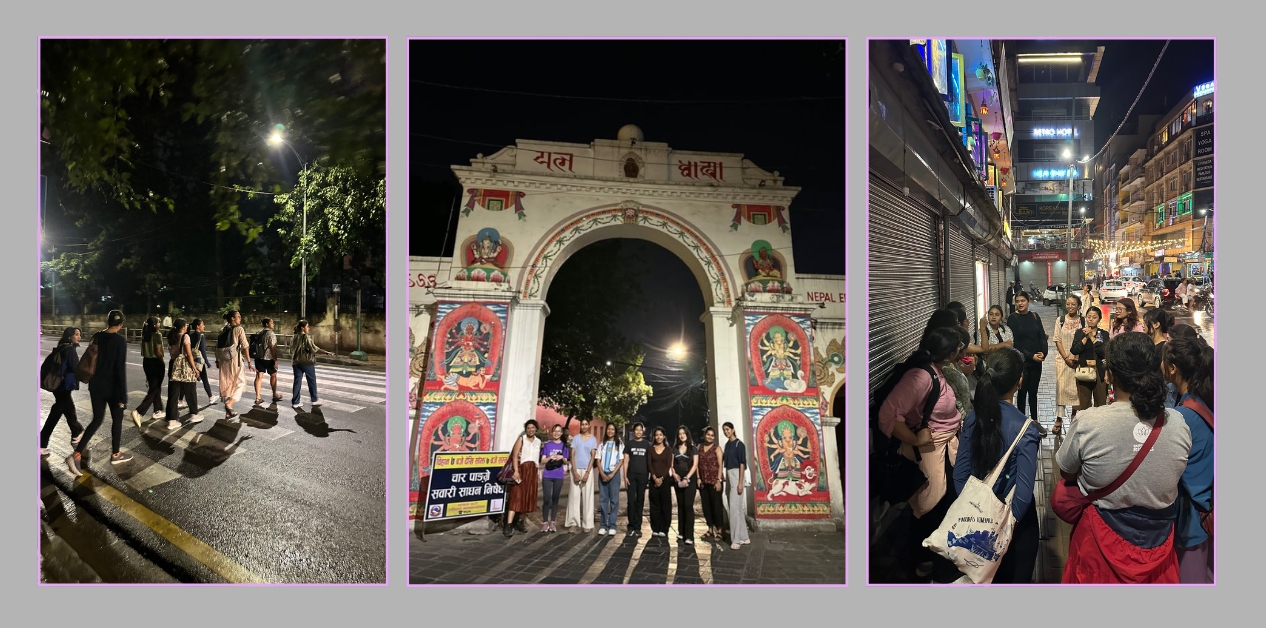
KATHMANDU: Shubheksha Maharjan of Sundhara, Patan, used to confidently visit her friends’ houses until 9-10 PM at night during her childhood. Returning home late at night from her maternal uncle’s house in Gabahal was also a normal thing for her. She even found it enjoyable to walk the main roads and alleys of Patan during the night. As she grew older, Shubheksha’s freedom began to shrink.
After many years, a post she saw on Instagram in July last year revived Shubheksha’s desire to walk at night. That post was about ‘Women Walk at Midnight KTM’ (Women’s Midnight March) scheduled for July 25. Even if it meant lying at home, she participated in the walk held in Patan. Many women like her participated in the walk, who, despite wanting to, were not getting out of or being able to step out of their houses at night.
Rinku Kumari Thakur from Birgunj is one of them. Although she is currently in Birgunj, she was in Kathmandu last year. She loves the evening and night hours but lacked the confidence to walk in the dark. She says, “Since it was an event where only women participated, I felt comfortable and joined. My desire to walk at night was fulfilled.”
Due to hesitation, fear, insecurity, or the control of home and society, many women like Shubheksha and Rinku are deprived of experiencing night walks, which the Women Walk at Midnight campaign is attracting. And it is motivating women to step out of their homes at midnight in various parts of the city.
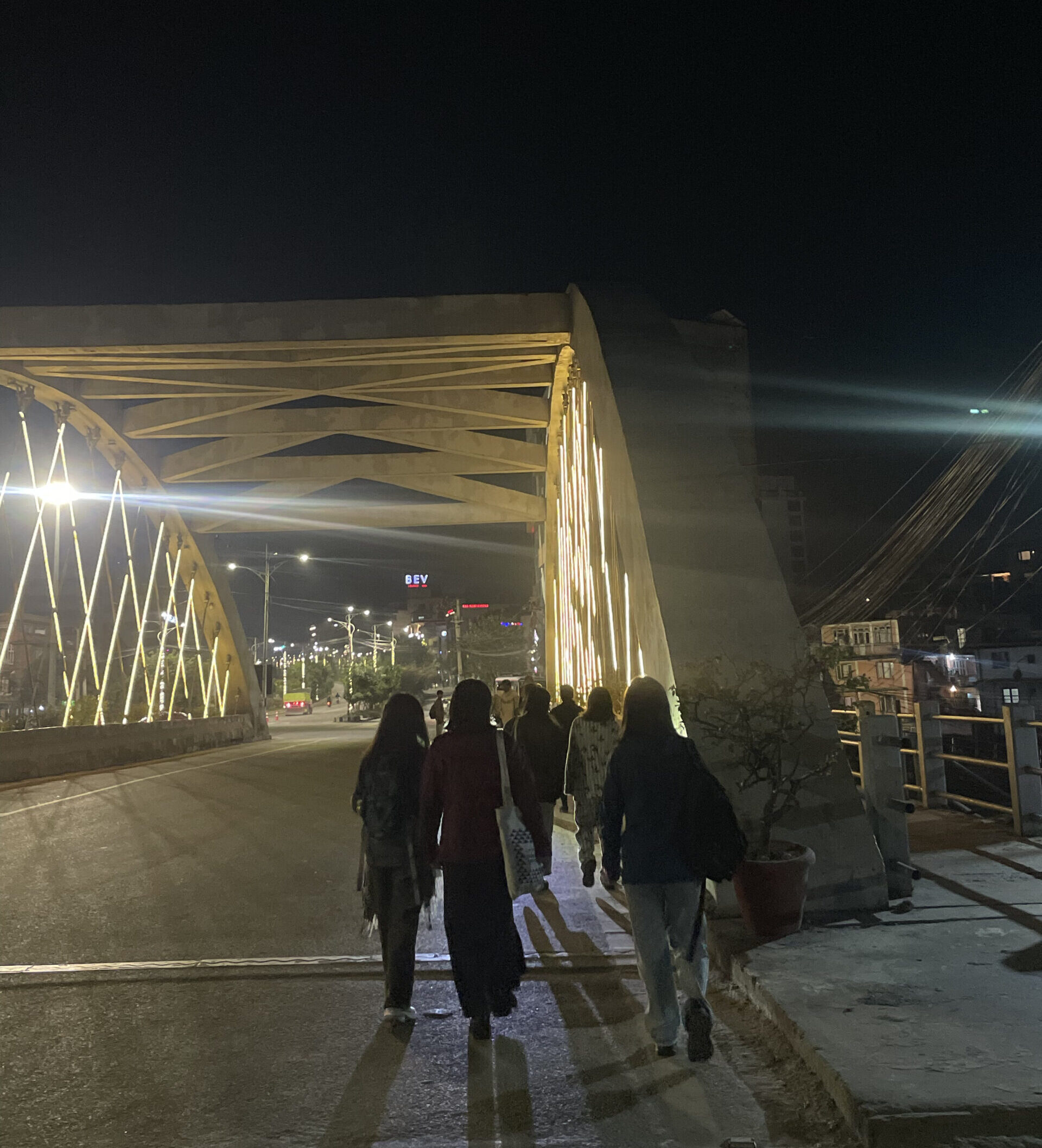
Participants of ‘Women Walk at Midnight’ at the Bijulibazar Bridge
‘Women Walk at Midnight KTM’ is an activity that started in Kathmandu. Launched exactly one year ago in June 2025, the objective of this campaign is to motivate women confined within their homes to step out, that too at midnight.
The work of inspiring women to step out of their homes is being done through the Insta page ‘@wewalkatmidnightktm.’ All activities of the campaign are co-led and organized by three friends: Samiksha Bhattarai, Manjita Gurung, and Asmita Pandey.
According to Bhattarai, midnight walks have been organized in eight different places across the Kathmandu Valley within a period of one year. The first walk, which started from Darbar Marg at 8 PM, reached Thamel via Ratna Park, New Road, and Asan, concluding at 10 PM. Since then, this walk has been completed in places like Swayambhu, Maharajgunj, Patan, Jawalakhel, and Lokanthali.
“Initially, we wondered if even 10 people would show up. However, 23 people participated in the very first program. The number of those who registered was even higher at 36,” says Samiksha. “That was a much bigger start than our expectations.”
In a situation where there is no space for only women to sit and spend time in Kathmandu, this campaign seems to have become a ‘comfort space’ for the participants of the walk.
Manjita adds, “A reel made by one of the participants in the first walk went viral. After that, many people started asking when the next walk would be. It was only after that we created the @wewalkatmidnightktm page on Insta.”
“We release the poster about one week before the walk. Interested participants fill out a form. After that, we send the meeting location, route, and some basic information through a WhatsApp group,” says Asmita.
Many participants of the midnight walk, which has been completed in Kathmandu, Lalitpur, and Bhaktapur as well, belong to different age groups or different backgrounds; some are college students, some are employed, while others are women who have already raised their children.
‘Today, for the first time, I felt free while walking at night. I had never walked this peacefully even during the day.’ This common feedback given by the participants of the walk makes the meaning and importance of walking at night for women crystal clear.
The decision of women to step out of their homes at night also challenges the belief that they should only walk for specific tasks. In a patriarchal structure, women stepping out of the house is a leap forward. In our society, women walking at night is associated more with fear, violence, and negative incidents rather than fun, relaxation, or freedom. Or, as soon as night life is mentioned, clubbing or the lifestyle of a limited class of women might cross many people’s minds.
However, nocturnal public life is not limited to that. Samiksha considers it a natural right for women to step out of the house, stroll, or sit and chat at will without any specific work, whether it is day or night. “Being able to walk at night, chat with friends, go for tea, or experience the city is also a part of public life,” she says.
The ones who ask the most questions during such walks are the police. They say, “Why are you walking at night? Go home, you shouldn’t walk like this at night.”
She prefers to call the walk a practice rather than a movement. Although it is a campaign against the patriarchal mindset that keeps women away from public spaces, the participants of the walk do not chant slogans, block roads, or engage in any activity that makes others uncomfortable. They confidently walk four to five kilometers, reclaiming their right over public spaces.
Shubheksha, who has participated four times, says, “Through ‘@wewalkatmidnightktm,’ I feel like I have regained the freedom that I experienced in my childhood but lost since adolescence. Therefore, this walk is a reclamation of public spaces for me.” She states that it has kindled confidence in other participants as well that they can step out of their houses at night.
The organizers and participants experience that the more women walk in public spaces, the more comfortable other women feel in that space.
“I used to feel scared even to walk in the evening. It felt uncomfortable to walk alone. Due to mental fear, we cannot enjoy walking freely. Walking in a large group during the walk, I felt like I found a safe space,” says Rinku. “On that day, however, there was no fear, terror, or discomfort. I did not feel even zero percent fear. Being able to walk confidently like that made my mind feel very light and free.”
Because safety is guaranteed, some women walking on the road have even joined the group of walkers. Samiksha considers the safe space given to women by the walk the most important achievement.
Often, if any untoward incident happens when a girl walks at night, the blame is pinned on the woman herself. She is instead bombarded with questions about why she stepped out at night. In a society that discourages this, not all experiences of stepping out of the house are sweet.
Samiksha states that they had to face problems even while walking in a group during the walk. “Boys riding motorbikes have harassed us repeatedly. Once, a man continuously followed us from Ratna Park to Singha Durbar. We were 16-17 people, which is why we were able to ask why he was following us. If someone were alone, that would not have been possible.”
Often, if any untoward incident happens when a girl walks at night, the blame is pinned on the woman herself. She is instead bombarded with questions about why she stepped out at night. In a society that discourages this, not all experiences of stepping out of the house are sweet.
The ones who ask the most questions during such walks are the police. They say, “Why are you walking at night? Go home, you shouldn’t walk like this at night.”
The walk takes place from 10 PM to 12 AM (midnight). Some participants come on their own motorcycles or scooters, while some use ride-sharing services. Even participants who are strangers at first become friends by the time they return. At times, those who do not find vehicles even stay overnight at the rooms of those same participants or organizers.
During a walk that started from Lokanthali, after a storm blew up, many people stayed in the same place all night. A participant who wished to remain anonymous says that spending that night playing games and eating with women she met for the first time was the freest experience of her life. In a situation where there is no space for only women to sit and spend time in Kathmandu, this campaign seems to have become a ‘comfort space’ for the participants of the walk.
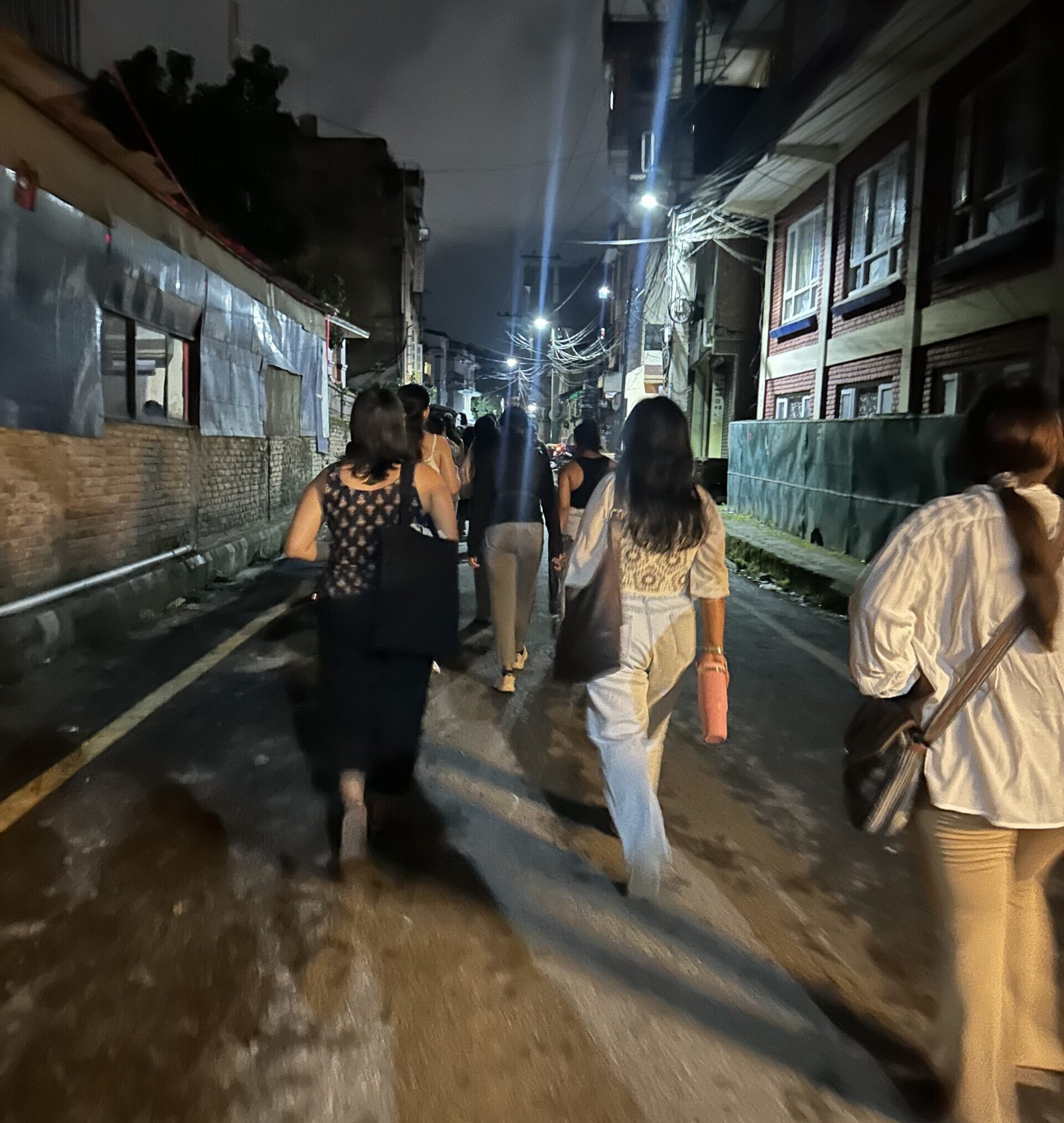
A glimpse of ‘Women Walk at Midnight’
It is natural for the walk to strengthen the bond among participants. It has also connected many stranger women emotionally and ideologically. For this reason, the number of women interested in conducting similar activities in other parts of the country is currently increasing. In Damak, this campaign has already started. Rinku says, “I wish such a program could be organized in Birgunj too because women in Madhesh are forced to live under greater societal control.”
This is also the desire of Samiksha, Manjita, and Asmita that this practice, organized in an informal style, spreads to many places across the country. The more groups of women step out of their houses at night, the more normal the idea of women walking at night will become. And a day will certainly come when no woman will have to feel unsafe while walking at night.
The practice of women collectively participating in midnight walks started in New Delhi, India, a decade before (2016) it began in Nepal.
The background of the walk held in Delhi under the name Women Walk at Midnight is linked to the Nirbhaya gang rape incident that took place in Delhi in 2012. Following the rape, as a protest demonstration, theater artist Maya Rao walked alone from the gate of Jawaharlal Nehru University (JNU) to Munirka (the place where Nirbhaya boarded the bus) to give an artistic performance. The state of a woman walking alone at night was shown in that performance.
After that demonstration, another artist, Mallika Taneja, started the practice of walking alone at night regularly. From that experience, she reached the conclusion that it is truly difficult for women to walk alone on the streets of Delhi after dark. After that experience, she started the collective walking campaign, Women Walk at Midnight. Samiksha had heard about this campaign while studying at JNU. According to her, the group that conducts the walks in India has also assisted in the promotion of the campaign started in Nepal.
After Delhi, this campaign has already spread to Indian cities like Bengaluru, Kolkata, and Chandigarh. Apart from India, it is also being conducted regularly in cities like Johannesburg and Cape Town in South Africa. No matter which city in the world it is, symbolic resistance is at the center of this practice.
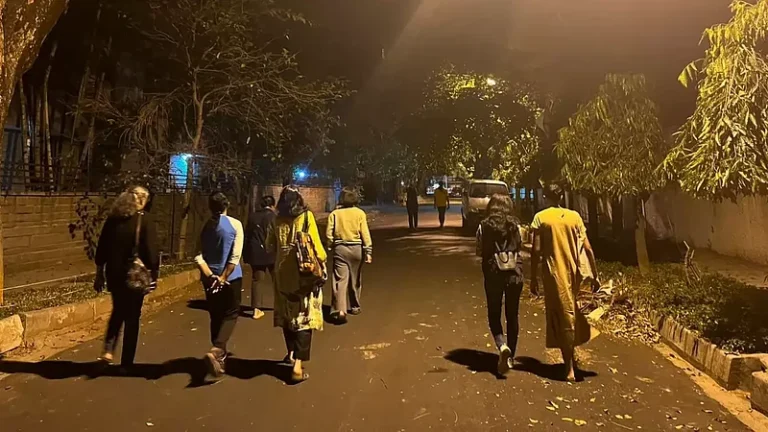
Participants of ‘Women Walk at Midnight’ in Bengaluru, India. Photo: Outlook
During the walks held in Kathmandu, the organizers and participant women have gained not only the freedom to walk but also women’s space. Samiksha, who is doing her MPhil in Gender Studies, says, “We had not been able to experience what the city we always walk in during the day looks like at night. The practice of walking at night has given a new perspective to look at the city.”
Observing the neighborhoods, alleys, and surroundings of the capital while walking, they have also been able to understand the limits of the city’s nightlife. Samiksha concludes that the infrastructure of nightlife is limited in the capital city Kathmandu, which lacks infrastructure such as public toilets, roads, lights, and vehicles.
Although this walk, started with the initiative of three friends, has attracted many people, this activity appears limited to the urban young women’s group. Accepting the fact that the campaign needs to be made even more inclusive, Samiksha adds, “Such practices must start spontaneously in different cities and communities. The campaign can become inclusive and sustainable only when the community itself takes ownership of it.”