Kathmandu
Saturday, July 4, 2026





Highlighting the triumphs of Sanjiv Shrestha running a highway eatery to Indrajit and Devi Gurung establishing a trout farm along the Marshyangdi, these culinary success stories prove that honest, hard work can unlock boundless opportunities right inside our country
KATHMANDU: “Today there is a local buffet with special buffalo meat available.” When the hotel owner said this, all of us who were sitting down to eat rice were completely dumbfounded. After crossing Bimalnagar on the Prithvi Highway, before arriving at Dumre, comes the road going to Chyangli of Gorkha; it is a matter concerning the hotel located right there. While the owner was serving rice, we were whispering among ourselves, “We have heard of local chicken, but what is this local buffalo meat (commonly known as buff in Nepal)?”
We had to go to Besisahar, the district headquarters of Lamjung, in connection with work. To avoid the crowd of vehicles leaving early in the morning, we had set out from Sitapaila, Kathmandu, toward Dharke. I was in the company of brothers and sisters who were much younger than me but had reached high positions in international organizations. “Did you come after eating something, elder brother?” a brother asked, and seeing me shake my head, he answered himself, “What could you have eaten at 6 AM in the morning anyway? We might have to do tea and snacks somewhere in between.”
Perhaps because it had rained at night, as we were descending down from Bhimdhunga, a thick fog had completely set in. Piercing through the summer mass fog, we moved forward while watching the houses and sheds slowly sprouting in the paddy fields. Since the rainy season was about to arrive, perhaps for that reason, the brick kilns that had been driven away from Kathmandu and shifted to Dhading were quiet. We stopped the vehicle at the U-Turn Cafe, where I had come three-four times before. While taking sips of tea, we started chatting while enjoying chickpeas and boiled eggs. Dharke was at a distance of a few hundred meters, after which, awaiting us, were the potholes of the road that had been dug up for expansion. While driving the vehicle and dodging those very potholes, the brother said, “We will eat rice at Naya Phool, elder brother. Whenever I travel this road, I always eat there.”
Since our stomachs were full with eggs and chickpeas, we did not care much and sat quietly, thinking it would be some eatery across the Mugling Naya Phool. Only upon arriving did we find out that it was actually a restaurant named Naya Pul opened at Chun Pahara of Tanahun, this side of Chyangli, Gorkha. Utilizing the time it took for the rice to whistle in the cooker, while giving spiced green soybeans to keep our mouths busy, the owner there whispered and asked whether we would eat local buff.
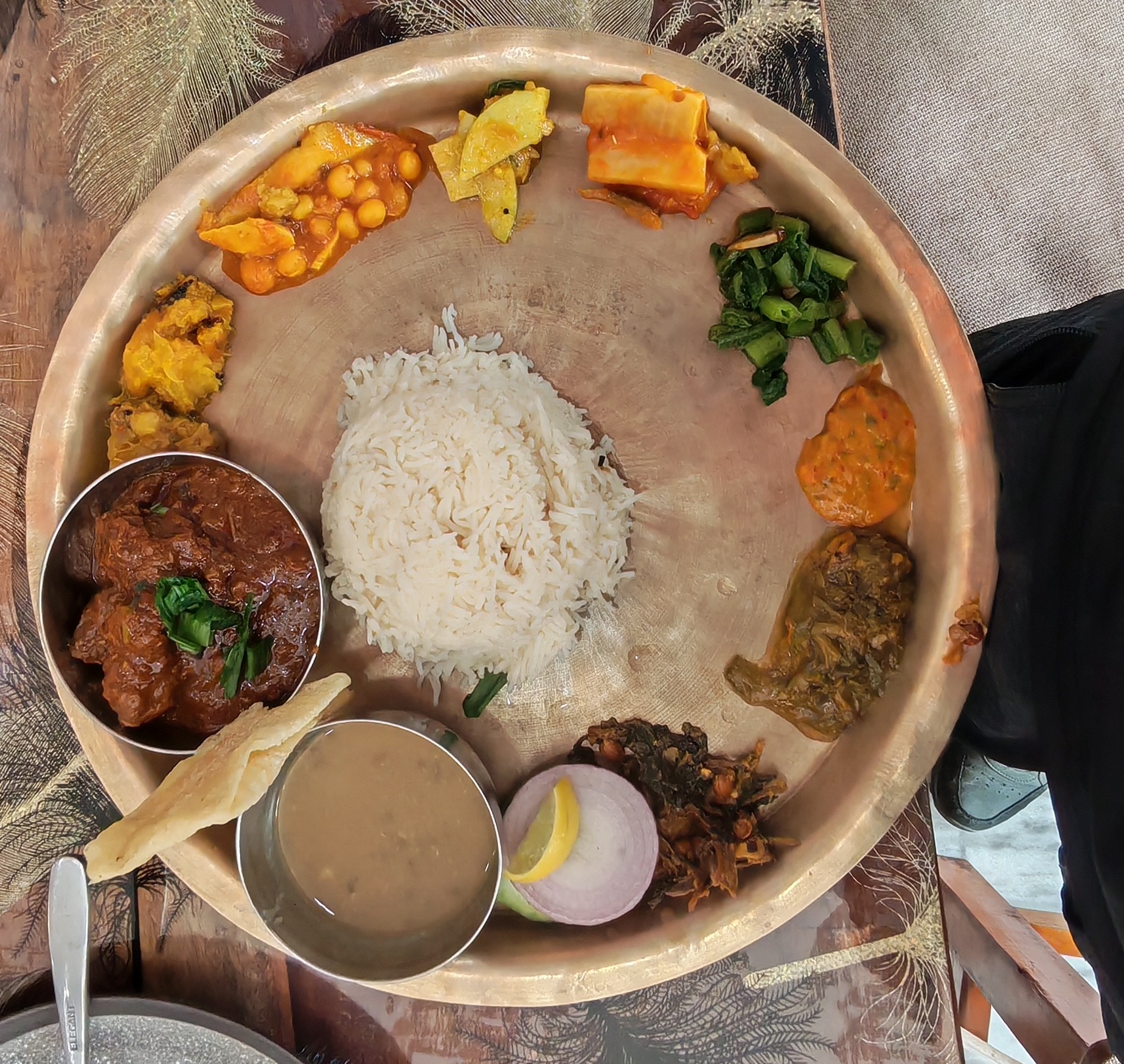
A wholesome traditional Nepali platter
Perhaps because he was not giving it to everyone, he said it secretly. Thinking that we must order at least one plate, we ordered one. In our minds, we thought that thick buffalo meat soup called “dyakula,” like in Kathmandu, would arrive. However, what arrived was thick-gravy meat. Due to the fried onions and spices, its appearance had become like the thick-gravy meat of a castrated goat, but upon eating, it was exceedingly tender, as if it would melt right in the mouth. The reason why the hotel owner called it “local buff” was that instead of being a buffalo imported from India like those found in the markets of Kathmandu, it was the meat of a local young male buffalo slaughtered locally.
The food set was also amazing. Broad mustard greens, taro leaves, fermented leafy green pickle, tomato chutney, radish-tomato pickle, fermented bamboo shoots, pumpkin, black lentil, and other seasonal vegetables and rice were all delicious. Along with it, to provide cooling in this summer heat, there was an arrangement of buttermilk; it was not yogurt mixed with water, but buttermilk from which butter had been extracted by churning yogurt.
In this restaurant run by Sanjiv Shrestha, everything from Asala fish of the Marshyangdi to hornets was made available. Having started from a small business, he has gradually run a grand hotel with the help of his family. Throughout the path, we entertained ourselves with the talk of local buffs itself. Since everyone heard the term ‘local buff’ for the first time, there was also a lot of laughter. After reaching Besisahar, work started immediately. Throughout that whole day and until the next day at noon, there was no leisure time to remember the food. After the uniform work was completed, suddenly there was a talk of eating something delicious in the evening. Then it was decided to head north along the banks of the Marshyangdi and eat trout.
As soon as we moved forward crossing the Sahaji Bus Park of Besisahar, the summer rain started falling. At a time when it was suffocatingly hot due to the heat, the rainwater started providing relief. Turning off the vehicle’s AC and opening the windows a little, we started moving forward while following the Marshyangdi. The Marshyangdi was crossed, and we moved forward after entering inside a small tunnel way built by a hydropower project.
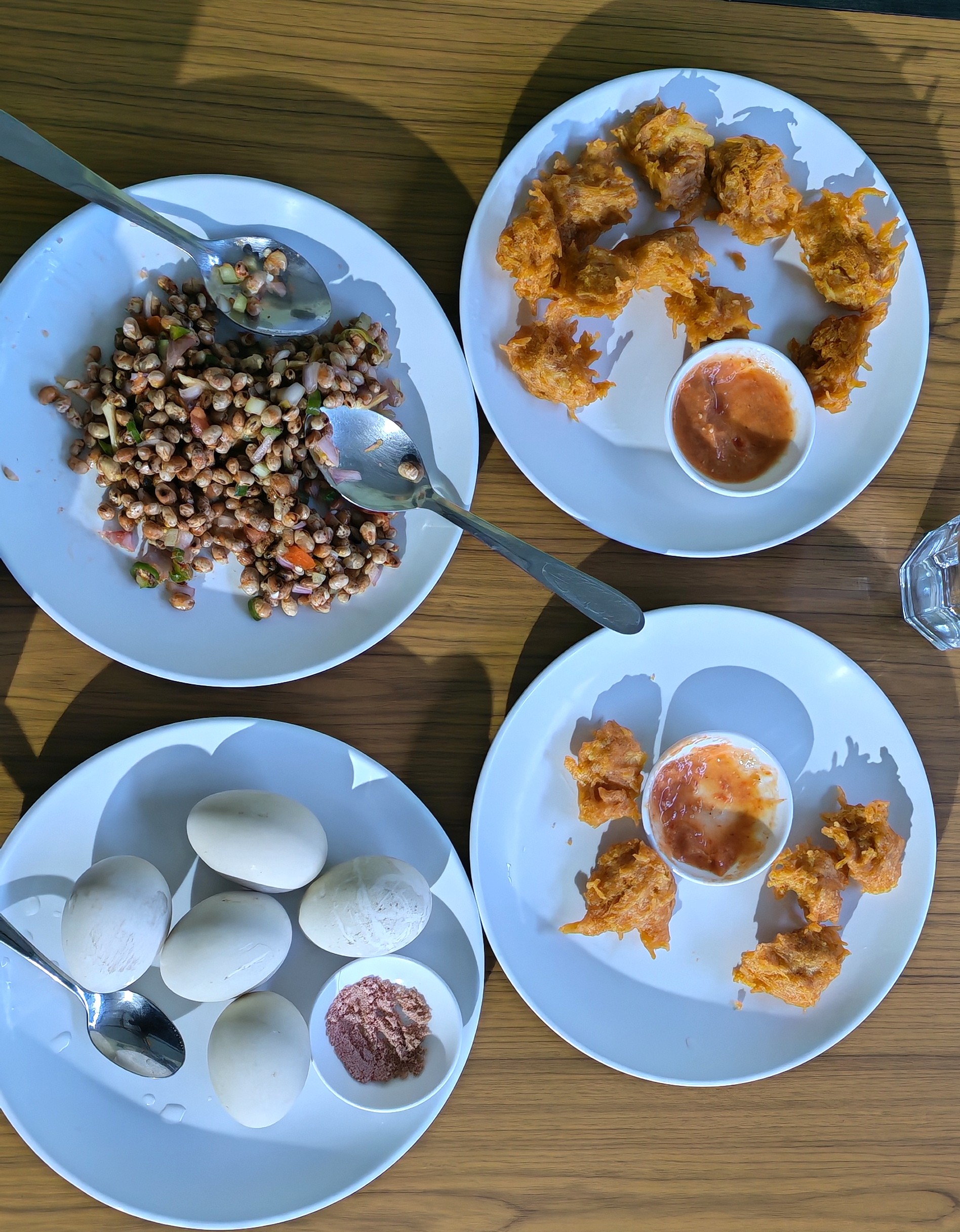
soya beans salad, fried onions (Pakodas) and boiled eggs
The rain started pouring harder and harder. Because it was filled with water, it became difficult even to gauge the potholes on the road. Since we had already told them to cook the food beforehand, there was no luxury of returning from the middle either. With great difficulty, we arrived at Ngadi Bazar. Located right in a corner was the restaurant we had to go to. On the path, a complete torrent of floodwater was flowing. Even so, taking a risk, the vehicle was driven in. After reaching four meters ahead, the vehicle neither goes forward nor backward. It had become stuck in a crevice of stones covered by the floodwater. Now, getting completely drenched in the rain, going to Ngadi Bazar, and begging for help was the only alternative left.
In Ngadi Bazar, the farm laborers who had arrived tired from the day’s work were engaging in merrymaking while giving rest to their bodies. With great difficulty, one tractor was seen. It took some time to find its driver. He agreed to help. To evaluate the situation, he came to the place where our vehicle was. The rain was pouring down heavily. He looked at the vehicle, and we kept looking at him helplessly.
Ultimately, he made a phone call and called three-four young brothers. The talk of “the vehicle is small, let’s lift and move it” came up. All of us joined together and started chanting ‘hoste haise’ to pull together. The vehicle was lifted up instantly and moved to a slightly easier spot. The vehicle also started, and then it was brought down toward the bazaar. Those who helped us were all Chaudhary brothers who had come from Dang and Bardiya to work in Lamjung. They refused to take remuneration, but saying “it can be used for merrymaking,” it was forced upon them. Experiencing a small example of the big hearts of the Tharu people, we headed uphill.
Within a few moments of walking, we reached our destination, which is the Y Square Marshyangdi Trout Farm. The piping hot pakodas ordered by the friends who had arrived ahead of us were welcoming us. The hot pakodas provided a lot of relief to our rain-drenched bodies. And along with it were the eggs of ducks raised right there and spiced soybeans. We started eating rapidly. The friends joined with the hotel owners and started catching trout. While they were catching fish, I, on the other hand, was actually remembering the fishery scientist Doctor Tek Bahadur Gurung, whom I had never met but knew only by reading about him in newspapers and magazines.
The credit for introducing trout fish to Nepal goes to Dr. Tek Bahadur Gurung. In October 1987, Dr Tek Bahadur of the Fisheries Research Center located in Pokhara was in Japan for training related to aquaculture. He took training there in Kobayashi City for nine months. The governor, who was highly impressed by his presentation at the closing ceremony of the training, asked, “What gift should I give you, Tek Bahadur?”
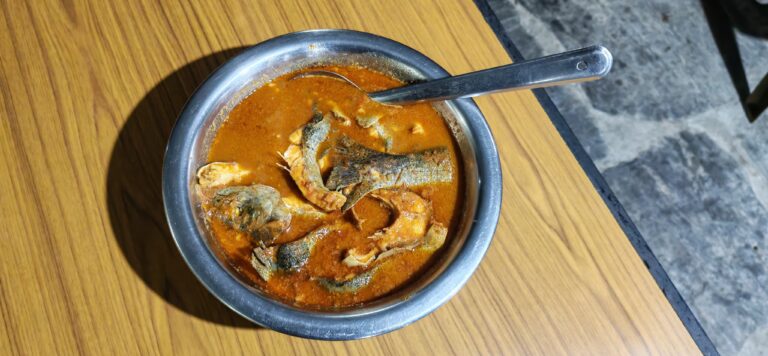
Rainbow Trout Soup
At that time, he had reportedly said, “We Nepali have a deficiency of protein. If I could take trout fish to Nepal, perhaps it would solve that problem? Since the weather and water of Nepal and Japan are similar, trout might flourish?” His words were accepted.
After returning to Nepal, Dr Tek Bahadur Gurung prepared the necessary government paperwork, and through the Government of Nepal, he sent an official letter to Japan. After four months, Japan sent 50,000 ‘fertilized’ eggs to Nepal. For that very purpose, he was deployed to the Fisheries Research Center located in Godavari, and 99 percent of the eggs that arrived in Nepal were successfully hatched. However, many of those fry died due to not getting fed.
After that, 100 adult breedable fish were sent to Trishuli, where Japanese volunteers also worked. Only after producing their own feed and constructing a hatchery was the private sector permitted to start trout farming from the year 1995.
If Dr. Tek Bahadur Gurung had talked about personal benefits when the Japanese asked ‘what gift should I give,’ where would trout fish be found at this time in the ponds built on the terrace edges of this Marshyangdi Rural Municipality? Why only here, and where would the rainbow trout fish farming that has been spreading across the whole of Nepal flourish?
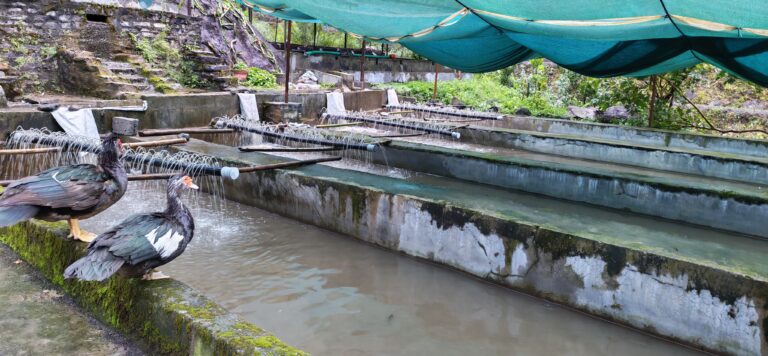
Rainbow Trout Soup farm
The story of the Y Square Marshyangdi Trout Farm is also equally interesting. Indrajit and Devi Gurung were living happily after settling down in Amar Singh, Pokhara. The ancestral home of Indrajit Gurung is actually Ngadi. Devi, on the other hand, belongs to Kaski. Indrajit used to work in Singapore. The children grew up and went their own ways. The mind of Indrajit, at times, used to return toward the village. He would remember his aging mother and father and cry. And he would make plans to return to the land of his ancestors on the banks of the Marshyangdi and do something. Suddenly, the COVID-19 pandemic shook the world. It might have been very painful for others, but it gave an opportunity to Indrajit Gurung. After that, on 3306.76 square meters of ancestral land, it started the Y Square Marshyangdi Trout Farm.
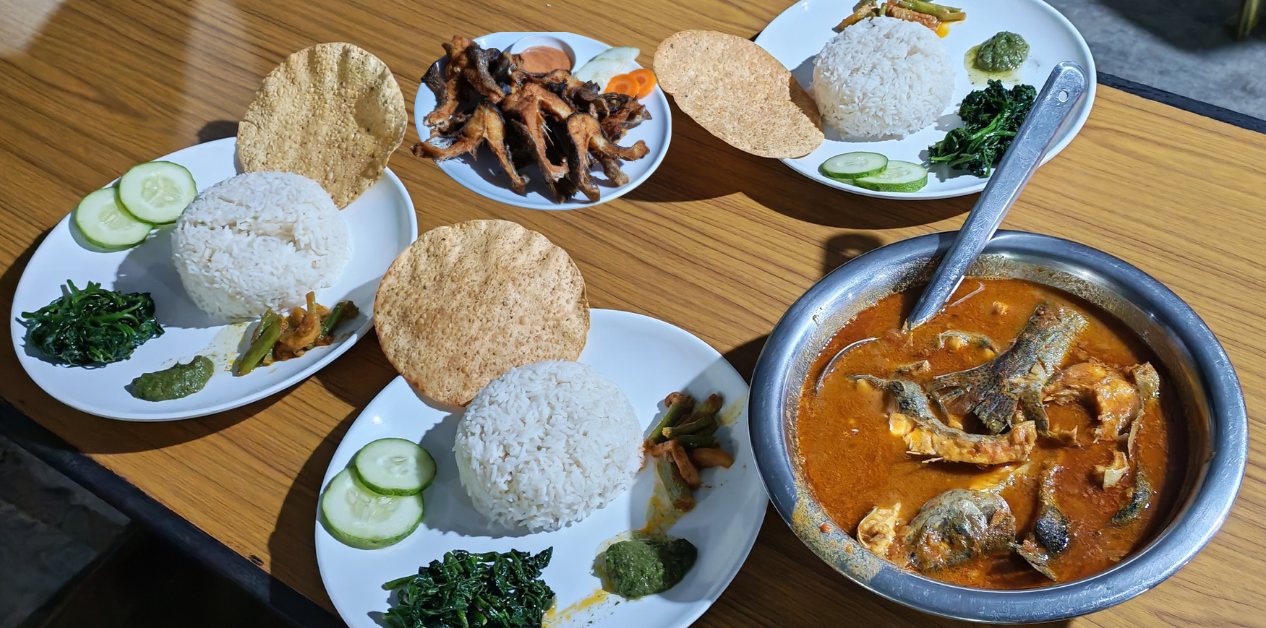
While engaging in this much chat, the fried rainbow trout arrived. Named rainbow trout because of having the seven colors of the rainbow on its scales, this fish has become crisp after frying. Because it was fried so nicely that even the tiny bones could be chewed comfortably, about three plates of fish were eaten effortlessly. And then arrived the fish soup, talked about all along the way, and on the plate, rice of local paddy, watercress grown around the stream, coriander chutney, and black-eyed pea vegetables. Everyone ate delightfully, taking helping after helping.
When cooking fish, many Nepalis put an excessive amount of spices, and then the taste of spices comes more than the fish. Some, on the other hand, put an excessive amount of tomatoes and make it like eating tomato soup rather than fish. However, in this fish soup, the spices had not been able to overpower the taste of the fish. Indrajit Gurung said, “We do not put many things; we put only a little ginger, garlic, and coriander. Our secret spice is village fruit extract, that too of a lemon.”
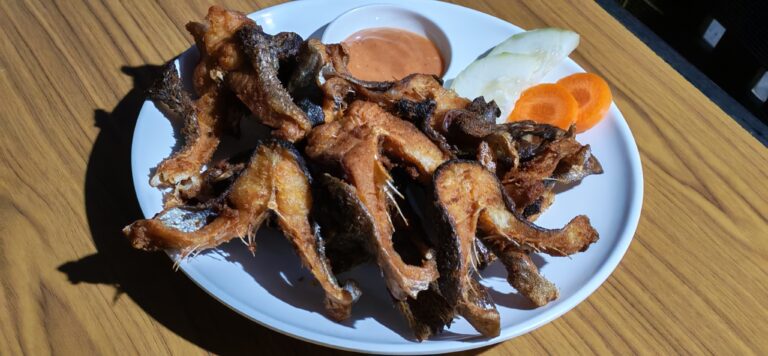
Fried Rainbow Trout
This fish farm of Indrajit and Devi Gurung has not been able to sustain the demand of the market. Indrajit says, “The demand has simply not been met at all.”
The hot fish soup had provided a lot of relief to the drenched bodies. Due to eating to our fill, our stomachs were also bloated. Our eyes had started dozing off with sleep. However, we had to return to Besisahar for our lodging. Thanking Indrajit and Devi Gurung and offering gratitude in our minds to the fishery scientist Dr Tek Bahadur Gurung, we set out on our path.