Kathmandu
Saturday, July 4, 2026





KATHMANDU: As I was growing up and slowly building my interest in politics, I soon developed a fascination for federalism.
It was not just me but it was a common rally crying for the people living around me.
Back home in the nineties the suburbs of Milan, in northern Italy, a thriving and dynamic metro area where I was born and lived for all my young life, federalism was a big thing.
It was not just trendy across the people, it was a necessity to ensure the development of our cities and regions.
In short, what was at stake was our future because most of the people I knew were unhappy with politics in Roma, the capital.
Those were particular times.
It was in the aftermath of a series of trials against what was a systemic party corruption system at national level based on corruption, commission and kickbacks that became famous as Tangetopoli or “Kickback City”.
This was a huge scandal that brought to the exile of a very powerful former Prime Minister, the total collapse of the dominant political parties, and opening of the door to the entry in politics of Silvio Berlusconi.
In this chaos, people in the North of Italy were fed up and wanted more and more autonomy.
Then, Italy was still a fairly centralized polity.
There was a system of local and regional governance in place but their level of autonomy, especially of fiscal nature, was relatively minimal and most of the money were ending in Rome and in other areas of the nation.
Rome was seen as an inefficient and corrupt place and the entire political class was blamed for this status of affairs.
Frustration and desperation among the people, especially in the north, were real because they could not digest a political system that was not doing enough to deliver the social contract that had brought Italy prosperity during the boom time following the Second World War.
The north of the country has always been more industrial and dynamic while most of the rest of the country was seen as taking advantage of this imbalance.
So people were left with having hope in two things.
On one hand, there was Europe, whose political project of unification was still in early age but there was optimism in having a common market and freedom of movement.
On the other hand, there was federalism seen as a panacea against ineffective politics and even high school students like me were strongly supporters of it.
Fast forward to these days in Nepal.
The governing party, the Rastriya Swatantra Party (RSP), in its recent general convention in Chitwan, announced bold plans to reform the federalism system in the country.
In theory, citizens should be hopeful about improving what has been an ambitious project of transforming the political system that has shown some cracks and weaknesses.
After all, it is not surprising that the shift from a highly centralized system like the one in place before the promulgation of the 2015 Constitution to a highly ambitious federative model, would have been difficult and challenging.
Yet the RSP’s talk of reforming federalism is disingenuous and misleading because the whole proposition would be centered on doing away with the cornerstone of federalism: the provinces.
This intermediary institution between the Centre and local government is the most important aspect of federalism.
These entities, called “provinces” in Nepal but in other nations, are referred to as “ states” or “Cantons” or “Länder” or “Comunidades” or “Regioni”, are at the core of any federative model of governance.
In Nepal, provinces have been at the center of a wave of criticism and in fairness, most of it, it is fully justified.
To start with, a consistent pattern of political instability has marred not only their performance but even their legitimacy in the eyes of the citizens.
The frequent changes in government, at the same time a mirror of the dominant model of parties’ politics and a result of national shenanigans in Kathmandu pre September Uprising, has also dented their image.
How many citizens, after all, can recall the names of the Chief Minister of their own provinces?
What about the names of key provincial ministries in charge of key essential services like education and health?
There are many issues with the ways provinces work and govern themselves but the solution is neither depriving them of essential funding as observed, for the Kathmandu Post, by Khim Lal Devkota, one of the most prominent experts on federalism in the country
While the lack of resources won’t bring a sudden death of the provinces, it can lead to a longer term demise by design.
It is a clear strategy to stifle the provinces.
Over the last few months, there have been lots of rumors about the RSP’s real positions on federalism.
There were already strong voices within the party criticizing the role of Provinces and even outright calls for their abolition.
But in the last few months, there was an impression that the party leadership had come around in accepting the role of the provinces.
Perhaps this was a deliberate tactic to confound people.
Imagining this possibility should be taken seriously because, last week’s policy paper presented in Chitwan by RSP Vice President Swornim Wagle, called, out of blue, for an abolition of the Provinces.
At least now the cards were played and now everyone discovered the bluff.
Now it is time for the citizens of Nepal to question the reasons why the governing party wants a reform of federalism that would actually bring to its whole demise.
There is no federalism without provinces and it is delusional to think that local governments can replace them.
And here we come with one of the weakest points of the current federalism model, the fact that local governments were tasked with over ambitious responsibilities.
For example, look at education and health.
How can these two fundamental responsibilities of the state be entirely trusted with municipalities?
How can the social contract based on the 2015 constitution, underpinned by inclusive (at least on the paper) federalism be upheld when two of the most important tasks of the state are given to the local units of governments?
It is one thing to run education and health programs in the Kathmandu Metropolitan City, a local government that could on its own be turned into a city state.
This is a model that applied in Germany with the three Stadtstaaten or city-states of Berlin, Hamburg, and Bremen and in Switzerland with Basel-Stadt (Basel) and in practice with the cities of Genève and Zürich.
It is not a secret that most of the smaller local unitsof governance, both municipality and rural-Municipality, cannot effectively run education and health services.
There is a scope for them to have a role, especially in the maintenance of public buildings in these two areas or co-designing some aspects of the school curriculum, but it is clear that ensuring quality health care and quality education is often way beyond the capabilities of local bodies.
So the key issue is to find a way to start a conversation about really and seriously reforming federalism in the country rather than throwing a blanket, one size fits all approach that would simply do away with federalism by way of erasing the provinces.
Back to Italy.
Till now, the country cannot fully consider itself a federal nation.
The judiciary is still centralized and likewise, law enforcement is still mostly run by central agencies with municipalities in charge of local police offices that, basically, are an upgraded version of traffic police.
The Italian journey towards federalism is complex with some regions having obtained more autonomy and power than others.
But the slowness of the process of transforming a central state into something supposed to be closer to the people can also be a cautionary tale for Nepal.
In Italy, health is perhaps the area where the intermediary bodies between the central government and the local municipalities, locally called “Regioni” have the most important role to play.
Even though the news cycle is still mostly dominated by what is happening in Rome, the Regioni have considerable power and also significant resources to manage and every citizen is aware of who is in charge in the Regioni’s level.
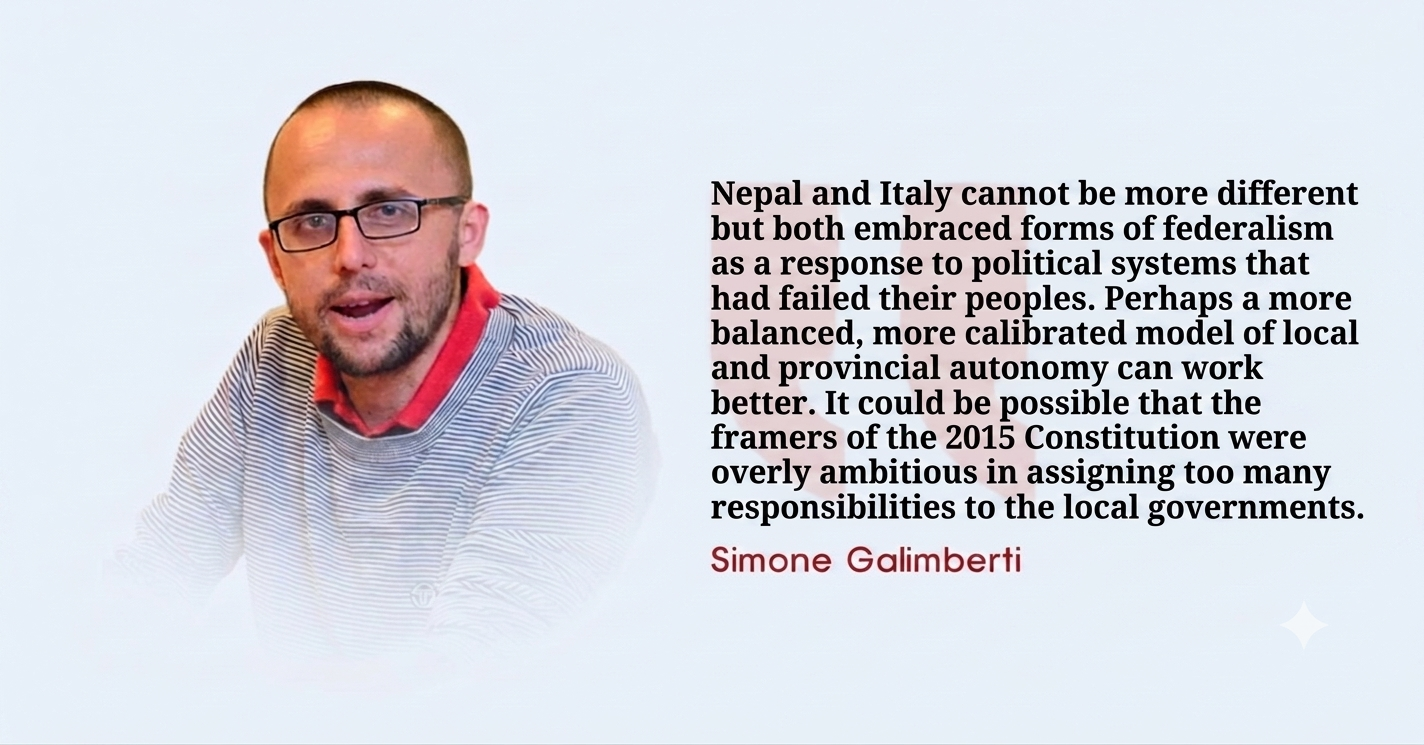
Nepal and Italy cannot be more different but both embraced forms of federalism as a response to political systems that had failed their peoples.
Perhaps a more balanced, more calibrated model of local and provincial autonomy can work better.
It could be possible that the framers of the 2015 Constitution were overly ambitious in assigning too many responsibilities to the local governments.
Strengthening the Provinces, meaningfully reforming them, is a wide ranging process that could start with a different electoral system that would insulate them from the national politics.
This is something successfully experimented in Italy where the governors of the “Regioni” are directly elected, therefore “protected” by the chronic instability that used to characterize the Italian political system for years.
Most importantly is the fact that empowering the Provinces won’t cause a weakening of local governments.
These two units, each co-sovereign together with Singha Durbar, the “executive federal center”, can complement each other in the provision of essential services for the citizens.
They could even shape a new local governance social contract that, besides ensuring better public services, could also entail working together to give the citizens new forms of inclusive public participation and involvement in the civil life.
Let’s not forget that offering people a better and stronger say in public life was one of the key goals of federalism when the 2015 Constitution was promulgated.


![100 days of government “success” leaves Kathmandu’s landless in limbo [Photo feature]](https://english.nepalnews.com/wp-content/uploads/2026/07/Sukumbashi-Holding-Center-16-scaled-1.jpg)