Kathmandu
Saturday, July 4, 2026





Mahayug is presented as a sweeping literary work that transforms women's historical suffering into creative power, blending fiction, philosophy and spiritual consciousness into an epic narrative.
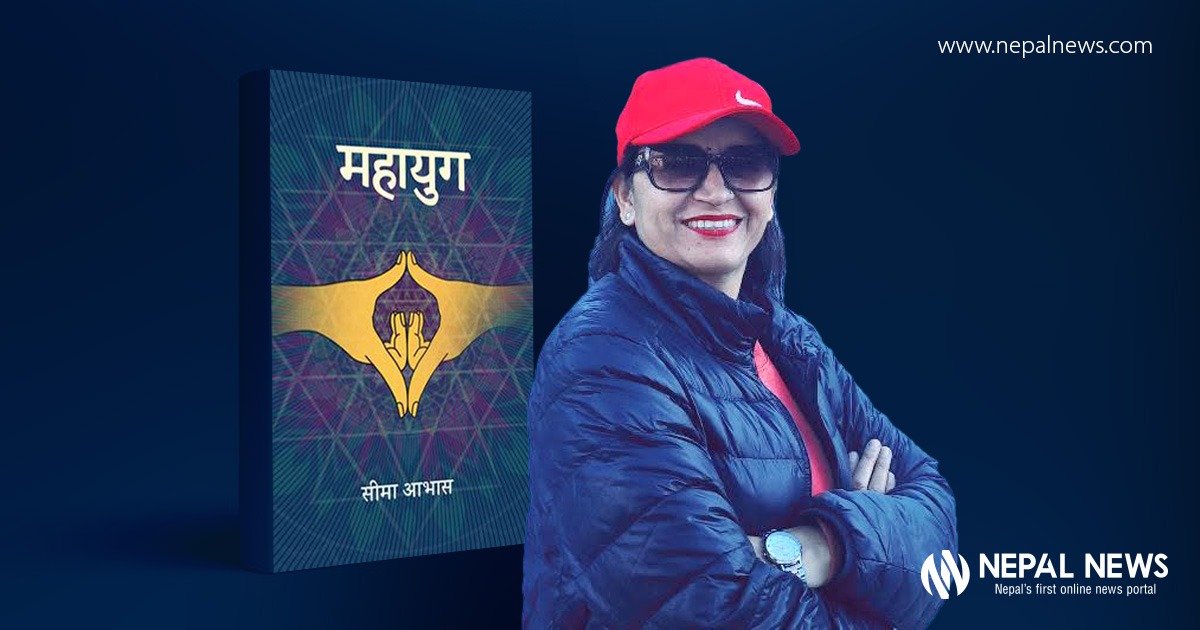
KATHMANDU: This is not merely a review of the plot of Seema Aavas’s fiction, Mahayug . The spiritual experiences gained while studying the novel, my ideological understandings, and the experiences of my own life journey are also integrated into this as shadows.
Mahayug is a grand document of woman-consciousness in the history of Nepali literature. Within the pages of the novel lies a world where the lines of time are drawn differently from traditional history.
The grand woman-journey of four generations
The core soul of the novel is the grand story of a magnificent journey from Bishnumaya to Chhayadevi and Nilanjana, and onward to Yakshini and Ritwija. In the foregoing part, the sacrifice, unprecedented struggle, and the rise of Nilanjana as an achievement, along with her vivid story, are depicted in a very touching manner. In the latter part, the web of mental-social relations of Nilanjana’s own life journey and the male characters connected with her—such as Aakhye, Abbe, and the young Sadhu—is woven.
The second section is the beginning of the grand journey of the pure ‘Mahayug’, its difficult turns, and the journey of Yakshini as the ultimate achievement of that grand journey.
The terrifying and pathetic journey of Chhayadevi—described in the first section—from being a daughter, daughter-in-law, and wife to becoming a laborer and a mother, severely disturbs the reader’s mind. However, this is precisely where the author’s prowess is revealed—where does Nilanjana’s journey begin so easily without labor pain and without a background? It is only when the Chhayadevis fall into the dark shadow of thousands and millions of hardships, insults, and injuries, that the Nilanjanas are born from the foundation of those sorrows. This confirms that when sorrow transforms into consciousness, the war for self-existence and independence is born. In the novel, the background of Nilanjana’s birth, her childhood curiosity, the movement of her adolescence and youth, her journey as a pregnant mother, and her relationships as well as struggles are drawn in a sensitive and philosophical manner.
How did Nilanjana become pregnant? From which perspective should we analyze her biological, psychological, and emotional relationships with her close friends Aakhye and Abbe, and the mysterious young Sadhu? Should it be viewed through the touchstone of traditional morality created by society, or through the eyes of natural freedom or supernaturalism? Here, the readers are left utterly bewildered .
The inner conflict of the biological, psycho-social, and psycho-cultural environment that comes with time moves forward through Nilanjana and her supporting characters. The way Nilanjana’s massive and extraordinary life journey ends is something hardly any reader can imagine when starting the novel. Readers themselves end up becoming ‘shadow characters’ of Chhayadevi and Nilanjana. Remembering their own life experiences, they begin to internally transform and intermingle. This is the greatest artistic and ideological strength of the novel.
The way the biological, psychological, and emotional aspects of a menstruating (Rajowati) and pregnant mother are dissected, just like a skilled psychiatrist and surgeon to weave the loom of the story, is wonderful. Author Seema Aavas has presented all these characters and aspects—love, life, offspring, lover, friend, and husband—in an extremely meticulous and balanced manner.
The biological-psychosocial process of Chhayadevi becoming pregnant and giving birth to Nilanjana is itself questionable and complex. Even more terrifying than that, Nilanjana’s menstruation and pregnancy journey is all the more mysterious and astonishing.
How did Nilanjana become pregnant? From which perspective should we analyze her biological, psychological, and emotional relationships with her close friends Aakhye and Abbe, and the mysterious young Sadhu? Should it be viewed through the touchstone of traditional morality created by society, or through the eyes of natural freedom or supernaturalism? Here, the readers are left utterly bewildered.
Is Nilanjana’s pregnancy journey a supernatural or mysterious process like that of Kunti in the Mahabharata, or is it a specific link in normal biological rules? It is natural for such questions to arise in the reader’s mind. The search for the ‘Self’ through Yakshini’s spiritual and soulful journey, alongside her physical and biological journey, is very complex. This novel is a guiding journey carrying both questions and answers for all women travelers of today and tomorrow.
In the novel, these women waging ideological and spiritual wars across four generations irrigated a whole near-dead era with their blood, sweat, and consciousness, completely transforming it into a grand journey. And, ultimately, they made it a ‘Mahayug’.
Entangled in many roles and multidimensional relationships, Nilanjana and Yakshini stand as a powerful answer to how difficult, challenging, and extraordinary a journey women can undertake. Despite the limitations of natural resources and the encirclement of traditional relationships, Nilanjana’s life journey keeps moving forward as a Mahayug. To an ordinary reader living in traditional thinking, patriarchal narrow-mindedness, and the existing superstitious social order, this journey might initially seem unimaginable and even impossible. But, as one dives into the depths of the story, this very journey begins to feel like the ultimate truth.
Yakshini’s journey is linked with spiritual and environmental consciousness. The work of giving her journey a high insight into spiritual power has been done by characters carrying indigenous and natural consciousness, including Yalahangma. The role of Muni Betrawati is crucial in elevating woman-consciousness above traditional boundaries and imparting cosmic knowledge. Characters like Ripumardini Devi have been helpful in providing willpower and insight while breaking through the mental and physical obstacles encountered during the journey. Such profound characters, who introduce the unlimited power of the female soul and the true capability of woman-consciousness, have strengthened Nilanjana’s grand journey.
No matter how grim the circumstances, social boycott, and natural adversities, for a pregnant mother to continuously remain on a journey—becoming vaster than this earth, the Himalayas, and the sky, and firmer than time and an entire era—is an epic phenomenon. It is from the womb of this very grand journey that a powerful, enlightened daughter and the hero of the new era, Ritwija, is born. In the novel, these women waging ideological and spiritual wars across four generations irrigated a whole near-dead era with their blood, sweat, and consciousness, completely transforming it into a grand journey. And, ultimately, they made it a ‘Mahayug’.
Why did Nilanjana set out on the difficult journey of Mahayug? Was it necessary? How and why was she compelled to become Yakshini, or did she choose her own self-journey? Inside this lies such a beautiful mixture of reality and mystery, which connects the ‘Tantra and spirituality’ of Eastern philosophy with modern psychology. It is futile to compare who is greater or lesser among the great female characters of those four generations. All those characters are extremely capable, competent, and revolutionary in accordance with their respective times, environments, limitations, and challenges. Hidden within each character is their own type of sacrifice, unprecedented struggle, silent or vocal rebellion, renunciation, and novel achievement. At the same time, all at once, Yakshini succeeded in becoming a biological mother (who gives birth to a child), a natural mother (who protects the environment), a spiritual mother (who transmits consciousness), and the embodiment of the socio-cultural transformation journey—that is, a ‘multidimensional mother’.
To readers accustomed to reading traditional realistic fiction, this might bring extreme curiosity and, to some extent, even seem unbelievable. In some instances, the question also arises whether there has been over-idealization in the plot and characterization of the novel, and whether the story has been forcefully brought to a happy or safe landing.
Most importantly, a bold attempt has been made in the novel to reinterpret topics traditionally hidden or considered impure, such as menstruation (Rajaswala) and the science of pregnancy. Establishing that menstruation is a celebration of creation, a ‘re-engineering of the human soul’ has been carried out here within the framework of social and cultural transformation. In this way, an effort has been made to create and build a completely egalitarian land and a new human era.
The novel has irrefutably proven the historical contribution and results of women based on their multidimensional capabilities and strengths. Here, female suffering and historical sorrow are transformed not into weeping, but into creative power. The novel does not just demand rights from patriarchy; it envisions its own original authority where concepts like female language, female script, female calendar era, female currency, female system (Tantra), and female era are introduced to establish the universal question of female power.
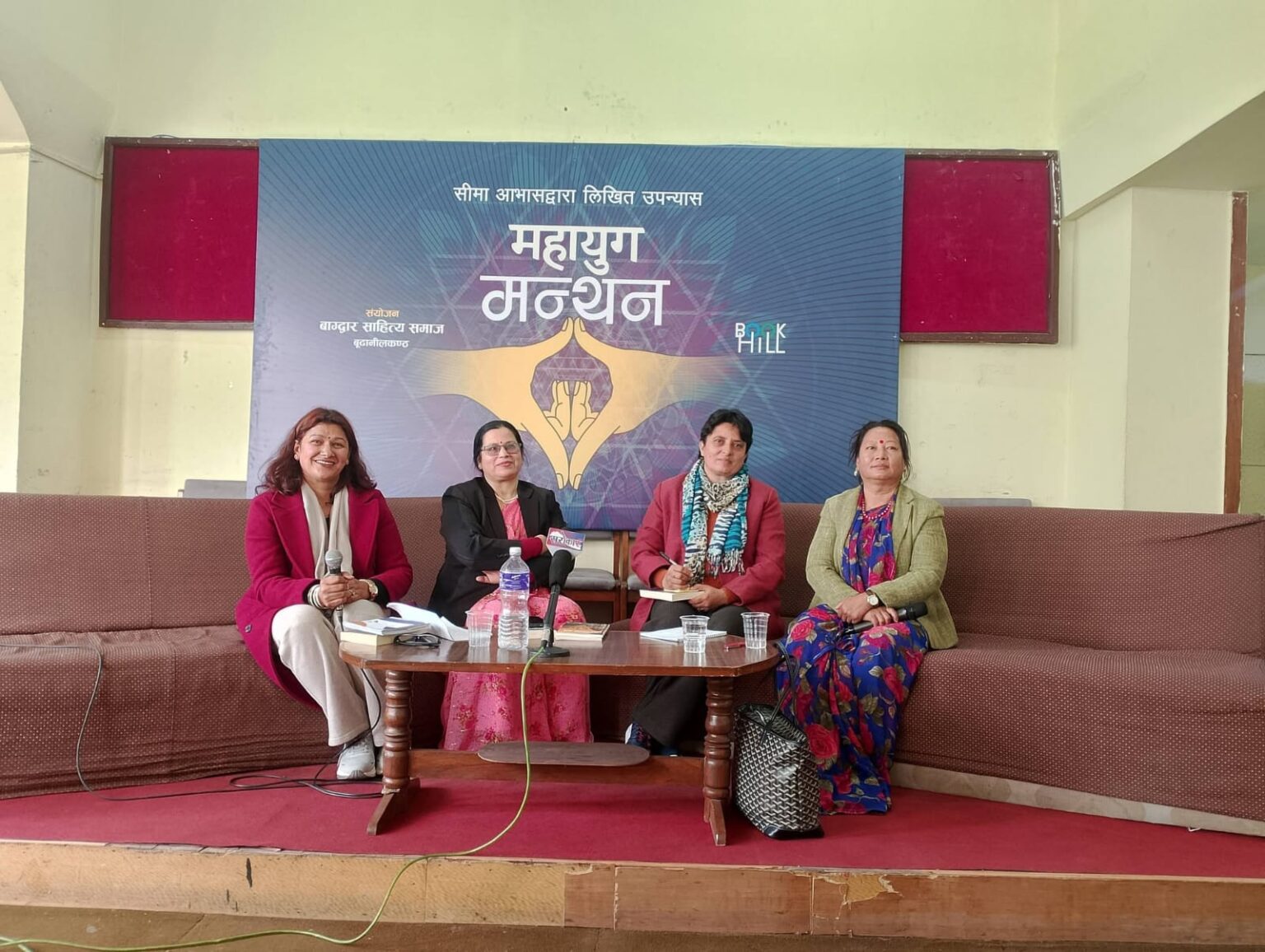
Author Seema Aavas (second from right) at the Mahayug discussion program in Kathmandu.
Particularly because the sequence of the story in the second section of the novel contains the highest culmination of imagination and philosophical flight, it may bring extreme curiosity and, to some extent, seem unbelievable to readers accustomed to reading traditional realistic fiction. In some instances, the question also arises whether there has been over-idealization in the plot and characterization of the novel, and whether the story has been forcefully brought to a happy or safe landing.
It also does not seem irrelevant for reader feedback to suggest that within a single novel, there is actually enough plot and aspects to make two separate novels. This is because, in the first part and the second part, the reader finds an entirely different taste, style, and craft of the plot. In the first section of the novel, there is a familiar taste with a dense presentation of traditional, domestic, and social stories that we have been seeing and experiencing in Nepali society. Upon reaching the latter section, one finds an entirely novel spiritual journey, an alternative psycho-social perspective, a cultural-natural journey, and the vision of an ideal female life.
The natural harmony of characters and events, and the weaving aspect of the plot, are polished. The author’s level of consciousness, insight, and imaginative capacity appear refined. Since the flow of the plot runs consistently like a pristine river, readers easily adjust themselves to those characters and move forward in the reading journey of the novel. Gradually, readers also find answers to the questions raised in their minds along with the flow of the story. This work has succeeded in becoming a solid historical document encompassing the female voice, female power, female capability, female role, female limitations, and her unlimited dimensions.
At the end of the novel, an effort has been made to give a dignified place to the identity, choices, and collaborative lifestyle of heterosexual, homosexual, sexual, and gender minorities. This has elevated the work above the touchstone of modern and post-modern consciousness.
Another beautiful aspect of this novel is that in the Nilanjana section, various dimensions of romance, sexuality, and love relationships between men and women are presented in an extremely sweet and polite manner. Through the female character, the loving description of the physical, biological, and emotional aspects of the male characters is done very artistically.
That sweet intermingling of love and romance among Aakhye, Abbe, and the young Sadhu shows a serious attempt in the novel to respect gender and maintain biological balance. On the other hand, there is a touching and sympathetic depiction of even the male characters who are victims of patriarchy themselves in society. Conversely, heaps of questions are piled up against female machinations, the exploitation of women by women themselves, incapacity, and weaknesses, which saves the novel from being one-sided. Here, instead of traditional hostile behavior toward male characters, an ideological and psychosocial war and co-journey have been undertaken with distinct capabilities.
Creative assistance from spirituality, characters endowed with Tantra-Mantra-Yantra, and mythological myths has also been taken in the novel. In this, a completely natural journey and environmental creativity have been utilized by using human chakra science, Kundalini awakening, environmental forces, and the elements of the five great elements (Pancha-Maha-Bhuta: Earth, Water, Fire, Air, Space). A balanced analysis of a woman’s physical journey and her social as well as material journey is its specialty.
Without considering the blood of menstruation and the power of conception as any sin or curse, it has been made an entirely scientific and natural celebration. Through the human chakra science of self-awakening, the characters are guided on an ideal path. Adopting the path of spiritual and psychological empowerment to transform the painful story of women struggling for generations is an original experiment in itself. Matters ranging from child production to the uterus, and from menstruation to blood, are served without hesitation in the novel, which shatters the narrow thinking prevalent in society regarding this subject.
The core philosophy of the Mahayug novel is indeed the shared journey of male-female cooperation, co-existence, and generational transition. It does not negate the existence of man; rather, it inspires him to become more dignified and responsible. This novel is established in Nepali literature as a unique and rare confluence of social, cultural, and spiritual science. Tracing the serious problems, impacts, and long-term paths of solution due to female machinations, the novel ultimately creates a character who has achieved ‘female Buddhahood’.
Women are the landowners; they are the main creators of creation. But, since history, when the ownership of land did not belong to women, what kind of terrible consequences emerged? Steering upon the historical and philosophical roots of those very consequences, a daughter who is the hero of the era, capable of creating a new land through Yakshini and giving it autonomy, is envisioned here.
At the end of the novel, an effort has been made to give a dignified place to the identity, choices, and collaborative lifestyle of heterosexual, homosexual, sexual, and gender minorities. This has elevated the work above the touchstone of modern and post-modern consciousness.
Women are the landowners; they are the main creators of creation. But, since history, when the ownership of land did not belong to women, what kind of terrible consequences emerged? Steering upon the historical and philosophical roots of those very consequences, a daughter who is the hero of the era, capable of creating a new land through Yakshini and giving it autonomy, is envisioned here. The novel appears successful in creating the biological, material, psychosocial, cultural, and spiritual foundations of the female era through the establishment and autonomy of land.
The author has succeeded in establishing her ‘super ego’ through the characters. She has not forcefully stood the characters up in the timeline of the novel. In a natural and artistic manner, she has brought about a ‘safe landing’ for the ego and super ego among the author, reader, and character.
However, this is also a search for a new-existence from co-existence. This novel is not a hostile journey against patriarchy or good male characters. This is indeed an entire human campaign, an original creation of female philosophy.
It attempts to find the path of liberation through spiritual ‘Yoga’ rather than ‘sensual enjoyment’ by rising above lust, anger, and attachment while holding onto human values, love, peace, and non-violence. This has given the fiction a spiritual color instead of making it scientific, realistic, and politico-economic, which can also be considered a weakness of the book.
The over-idealization of female characters and power is also another weakness. In terms of love and relationships, it is also not understood why the author sought an easy landing instead of being open like other aspects.