Kathmandu
Friday, July 3, 2026





WMO warns of a rapidly intensifying El Niño that could weaken the monsoon, reduce rainfall, disrupt rice cultivation and worsen heat-related risks, while experts say Nepal remains poorly prepared.
KATHMANDU: The ‘El Niño’ phenomenon that has already developed in the Pacific Ocean is expected to grow even stronger in the coming months. According to the global weather update released Friday by the World Meteorological Organization (WMO), El Niño is projected to develop rapidly from July to September and reach its peak stage between November 2026 and February 2027.
Various weather forecasting models show that the sea surface temperature of the Pacific Ocean could rise more than two degrees Celsius above average.
The WMO has warned that a rapidly intensifying El Niño could exacerbate extreme heat, droughts, heavy rainfall, and other extreme weather events across many parts of the world. Meteorologists state that because this will weaken the monsoon system, the risk of below-average rainfall has increased in South Asia, including Nepal.
According to Bibhuti Pokharel, the spokesperson for the Department of Hydrology and Meteorology, the department has already forecast below-average rainfall for this year’s monsoon. “In line with our forecast, rainfall during the monsoon appears set to be below average,” she says.
However, less rainfall does not mean it will simply not rain anywhere. Even when it rains, it could be irregular. There is also a possibility of heavy rainfall within short intervals in certain places, which is not particularly useful for agriculture. “Our regular weather observations show heavy rainfall in some isolated areas. Therefore, it is necessary to state this for public awareness,” Pokharel says.
She notes that even though two weeks have passed since the arrival of the monsoon this year, farmers are beginning to feel disappointed due to the lack of rainfall suitable for farming. As El Niño continues to strengthen, the likelihood of receiving less water has increased further. “The WMO does not officially use the term ‘Super El Niño’, but the probability of a Super El Niño occurring is becoming very high,” says Pokharel.
Breaker: El Niño affects not only rainfall but also temperature. The Department of Hydrology and Meteorology has already forecast that temperatures this year will be above average. An increase in scorching heat impacts human health and can raise the risk of various diseases.
A situation where the Pacific Ocean’s sea surface temperature reaches more than two degrees Celsius above average is generally referred to as a “Super El Niño.”
According to Madan Lal Shrestha, a researcher at the Nepal Academy of Science and Technology (NAST), the ‘ENSO’ or El Niño-Southern Oscillation system that develops in the eastern Pacific Ocean exerts a massive influence on Nepal’s monsoon climate. “The impact is already beginning to show in Nepal. A low-rainfall situation is becoming visible,” he says.
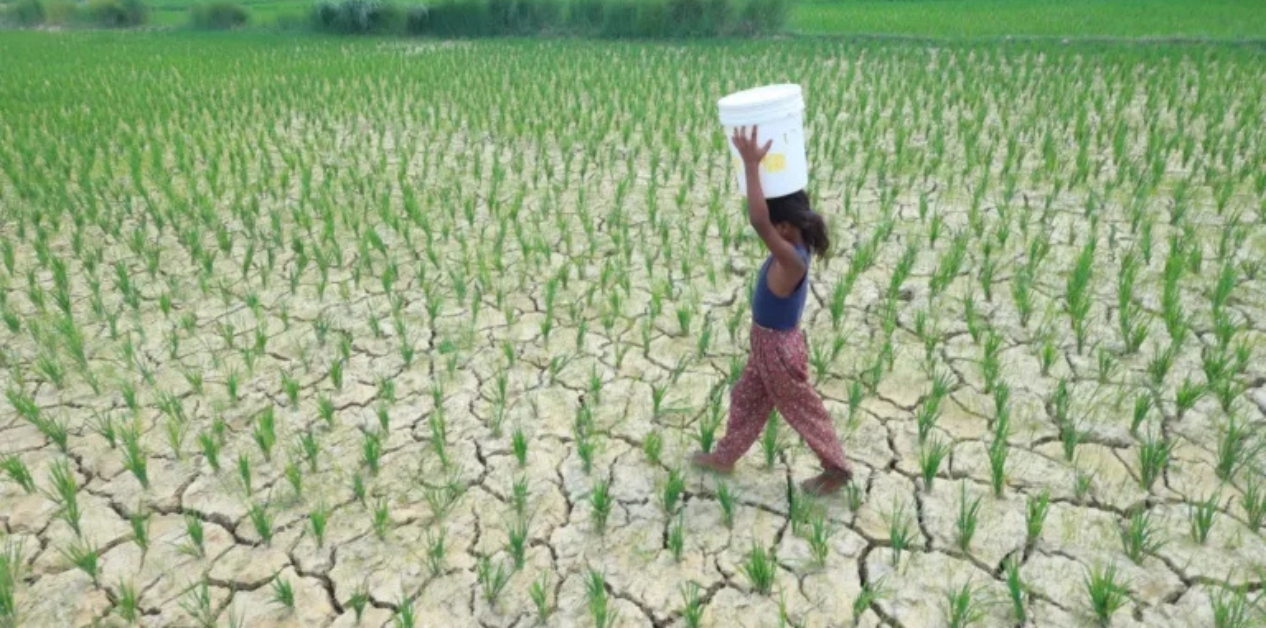
Since Nepal’s primary monsoon period falls between July and September, receiving less water during this specific time elevates the risk of drought. Currently, rice transplantation is underway across the country. If there is insufficient water during the phase when rice saplings are transplanted and growing, it could severely hit production.
Hemu Kafle, the founder and director of the Kathmandu Institute of Applied Sciences, views this as a risk of ‘agricultural drought’—meaning a drought that directly impacts agriculture. “This year, the monsoon arrived five days later than average. Looking at it so far, we are receiving less water. This signals a minimum amount of rainfall,” she says. “Since the monsoon water itself will be low, there is a risk of agricultural drought, meaning a drought that harms agriculture.”
According to Kafle, while irrigation might be possible in some parts of the Tarai through canals or deep boring, the problem could manifest more severely in hilly terrains that rely entirely on rainwater. “In the Tarai, irrigation might happen via canals or by deep boring. But in hilly terrains that must rely solely on rainwater, the irrigation problem for crops looks set to be severe,” she says. “No matter how much water falls compared to Nepal’s annual average rainfall, it may not be useful for agriculture.”
El Niño affects not only rainfall but also temperature. The Department of Hydrology and Meteorology has already forecast that temperatures this year will be above average. An increase in scorching heat impacts human health and can raise the risk of various diseases.
The impact of extreme heat could be more visible in Nepal’s urban areas. Although streams, rivers, and greenery help reduce temperatures slightly, urban areas feature unmanaged and dense settlements.
Reports have currently emerged showing an increased mortality rate in some European countries due to extreme heat alone. Last month in June, reports surfaced that more than two thousand people died in Spain and France due to the heat. Stating that temperatures could reach up to 44 degrees Celsius in the coming days, some countries have started preparedness measures to mitigate the impacts of the heat. Several countries had begun preparations as soon as the discussions surrounding El Niño started.
In Nepal, however, such preparedness remains weak, Kafle notes. “We do not have such preparedness here. Our actions are always limited to distributing relief after a disaster has already occurred,” she says. “Overall, El Niño could place a heavy toll on farming this year.”
The impact of extreme heat could be more visible in Nepal’s urban areas. Although streams, rivers, and greenery help reduce temperatures slightly, urban areas feature unmanaged and dense settlements. While appliances like air conditioners can control temperatures, Kafle notes that the heat will trouble vulnerable, poor, marginalized, and minority communities more, as they cannot afford to purchase such equipment.
The government does not appear to have given adequate attention to mitigating the impacts of El Niño. According to Lal Kumar Shrestha, Senior Agricultural Economist at the Ministry of Agriculture, the government is currently limited only to regular public awareness programs. “Right now, the annual program to raise this awareness is being continued,” he says.
According to him, agricultural bulletins are being issued through the Nepal Agricultural Research Council (NARC) and the Agricultural Information and Training Center to encourage farmers to plant drought-tolerant crops. “If further problems appear later, solutions may come at that time,” Shrestha says.
The WMO, meanwhile, has urged all countries and stakeholders to focus on early warning systems and preparedness to mitigate the risks that El Niño could inflict on climate-sensitive sectors like agriculture and health, as well as on vulnerable communities.