Kathmandu
Monday, July 6, 2026





When I think of Phurba, a question haunts me. What if I had been born in his place? What if my mother tongue wasn't Nepali? What if my home was also a three-hour uphill climb? What if I, too, had to carry household goods alongside my schoolbooks? Would I be where I am today?
Once upon a time, I used to think I was born into an ordinary family. I studied at a government school. I worked hard, and that is why I succeeded in getting good marks in exams.
It never occurred to me that hearing the school bell ring right from one’s house is a privilege. Having Nepali as a mother tongue is a birthright advantage. I never thought that it wasn’t a normal thing for teachers and friends to refrain from laughing at my Nepali pronunciation. It never crossed my mind that not having to carry anything other than books when returning home from school wasn’t a universal experience for everyone.
A book I read recently left me so shaken that I began questioning myself: everything I achieved in life—did I truly earn it all, or did I receive most of it simply by birth?
Sanjeev Uprety’s book Structural Dividends compelled me to re-read my own life. I traveled back to my teenage years.
My village is Namadi in Ramechhap. There was a small market near my house. When I was in school, my daily routine consisted of waking up in the morning, eating my meal, grabbing my bag, and walking to the school that was practically connected to my house. During the afternoon break, I would have a round of snacks. Upon returning in the evening, another round of snacks would be waiting for me. At that time, studying, studying, and studying from morning till night was my biggest responsibility.
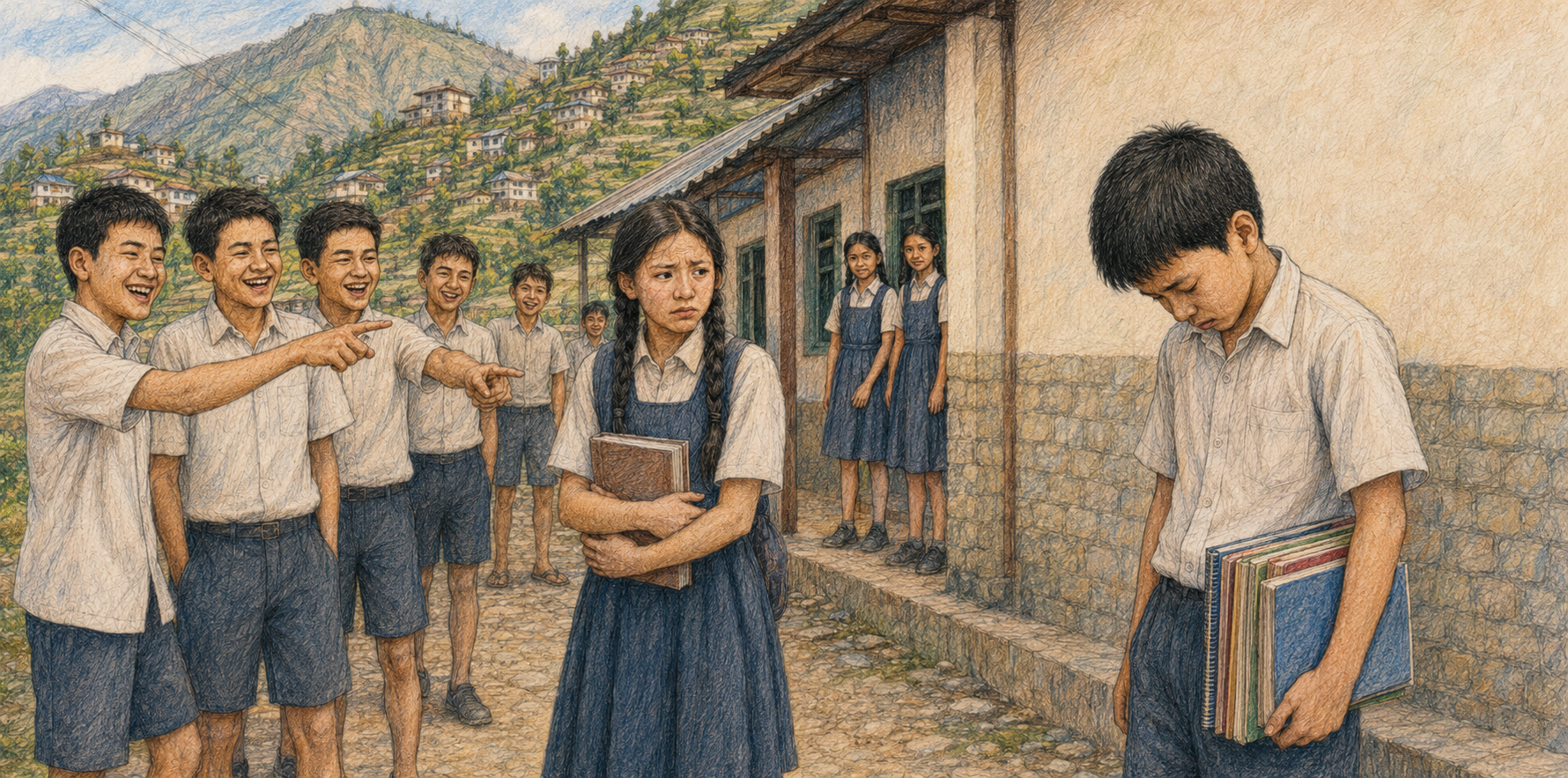
There was a classmate of mine—Phurba Tamang. Tamang was his mother tongue. While reading, he would stutter over Nepali words. I used to think he just hadn’t prepared well today, that he wasn’t paying attention to his studies.
Everyone would join in to tease him: “Hey Phurba, does Ram go (janchhin – feminine) to school or go (janchha – masculine)? Does Sita go (janchha) to school or go (janchhin)?”
“You used ‘come respectfully’ (aaunubhayo) for a dog and ‘come casually’ (aais) for your brother-in-law, didn’t you Phurba?”—the mockery would stretch to such lengths.
Hearing this, everyone would laugh. I would laugh along too.
In the village, there was a common saying about Tamang people—that they are hot-tempered, walk around carrying khukuris, and fight with everyone.
I, too, accepted these notions from childhood. But no child is born with prejudice. Prejudice, just like language, is something taught from childhood. That is why we learned the alphabet at school, but alongside it, we also learned the language of categorizing people.
We weren’t just taught mathematics there; we were also made to calculate who stands higher and who stands lower in society. We read history. But we did not read, nor were we taught, about the structural violence embedded in history. It took me many years to understand it.
After completing grade 10 at Shree Kamaladevi Secondary School alongside Phurba, I came to Kathmandu for my Plus Two education. I attended college. Since my childhood was spent in the village, I deeply loved the forests and hillsides. I would often go wandering around the hills surrounding Kathmandu.
During that phase, a thought suddenly crossed my mind one day: I am climbing the hills of Kathmandu every week, but I haven’t even properly walked the trails of my own village. When I was in school, I had no idea what the world outside the textbooks looked like.
A few years ago, while visiting home, I decided to go for a hike in my own village. Since I hadn’t walked very far along the village paths, I headed uphill accompanied by my paternal aunt. The higher we climbed, the more unfamiliar the trails became. I had become like a tourist in my own village. The steep incline felt endless. One hour. Two hours. Three hours. After climbing for about three and a half hours, we reached a place called Kande. There, I saw a familiar face.
I stopped. As I looked closer, I realized it was none other than the mother of my school friend, Phurba.
“Where are you girls headed?” she asked.
“Towards Tatne Danda, Mother,” my aunt replied.
“And where are you heading?” I asked her, quite surprised.
“Our home is right here,” she replied with a smile.
With her answer, the illusion of a shared, equal world that I had imagined between Phurba and me during our adolescence completely shattered.
It turned out Phurba had been commuting to school every single day by treading that massive distance. In the evening, he would return up the same path, carrying heavy loads of rice, salt, and oil from the market.
And what about me? I would reach school in just a few minutes. When returning home, I carried nothing but a bag of books.
That day, I realized that although we studied in the same school, the journeys we made were completely different. We sat for the same examination, but the question paper handed to us was not the same.
As I continued uphill after meeting Phurba’s mother that day, countless thoughts flooded my mind. In my memory, Phurba had always been just a classmate studying in the same grade. But on that day, I began recalling numerous small scenes from school.
Phurba would arrive late to school. He wouldn’t have notebooks or pens. He always looked exhausted. He often fell asleep in class. At that time, none of us ever asked him: “Why are you late? Why do you always look so tired? Why don’t you have notebooks and books?”
Instead, we read plenty of books. Yet, sitting in the same classroom, we never bothered to read his world. Because back then, I believed that everyone in school was equal. The teachers were the same, the books were identical, and the exam administered to everyone was the same. Therefore, the opportunities available to everyone must be equal too.
Now I realize—it was an invisible head start granted to me by my birth, geography, language, caste, family, and society. I knew how to speak Nepali, but that wasn’t an achievement I had earned. My house was near the school, but I hadn’t worked for that. The teachers didn’t mock my pronunciation of Nepali words, but that wasn’t a special talent of mine. I wasn’t exhausted when I reached school because my bag held no heavy burdens of rice, salt, or oil alongside my books. I hadn’t chosen any of these circumstances.
I was simply born into that situation, and I took all those privileges for granted. This is precisely the most invisible form of structural dividend. The very privilege that feels entirely normal to us is a luxury that is never accessible to many people. I, too, had grown up within that bubble of normalcy. Perhaps this is what a structural dividend truly means.
We were both given the exact same question paper, a practice we label as “fair”. In reality, both of us had already taken entirely different exams long before the school test even began. Neither his language nor the stories of his festivals existed in the curriculum or the examinations.
When Phurba spoke Nepali, I joined the crowd in laughing at him. Perhaps many mistakes are made not out of individual cruelty, but simply by walking blindly with the crowd. In the midst of peer influence, even discrimination starts to feel like a harmless joke.
Back then, we only listened to his pronunciation and saw his weak command over the Nepali language. But we failed to see his immense courage as he stepped from the world of his mother tongue into the world of another language. We failed to see a teenager’s self-confidence slowly breaking down inside that mocking crowd.
Perhaps that is why, for years, he kept coming to school carrying the heavy burden of being labeled “hot-tempered” (an adjective) rather than being known by his own name. Structural violence renders so many things invisible. It misinterprets someone’s anger as merely an individual character trait. In most instances, it fails to understand that such behaviors could be manifestations of historical, social, political, and economic oppression endured for generations. It fails to recognize that it is the resistance of a community facing continuous humiliation and exclusion.
When I think of Phurba, a question haunts me. If I had been born in his place, if my mother tongue had not been Nepali, if my house had been a three-hour climb up the mountain, and if I had to carry household supplies along with books on my way to school, would I be in this position today? Would I be teaching journalism?
Certainly not. That is precisely why I no longer have the courage to claim, “I reached here solely through my own hard work.” It was the structure that made my hard work possible; it gave me time, gave me the language, provided a nearby school, and granted me self-confidence. But it did not provide those very things to Phurba in equal measure.
Years later, a profound sense of respect has awakened within me for that teenager who kept coming to school despite climbing that steep hill, who sat in class while navigating a second language, and who never quit his education despite facing ridicule. I realize now—Phurba was not weak. He was covering the exact same distance as me, but while carrying a far heavier burden.
For many years, I believed that changing society was the job of the government, the laws, and the schools. What can an ordinary person even do? What difference does it make if we speak up? But silence, too, speaks volumes. Transforming society begins with the simple act of refusing to laugh at a joke made at someone else’s expense. It stems from the awareness of not mocking someone when they speak in their mother tongue. And most importantly, it comes from the firm decision to be thoroughly honest with one’s own past.
We absorb structural violence from our daily lives—through the conversations of adults, through jokes, through religious interpretations, and through social behaviors. Eventually, we ourselves begin to speak that very language of discrimination.
Phurba, perhaps you know about this article, or perhaps you don’t. You might read this piece someday, or you might never read it. It is possible that life has carried you somewhere far away. It is equally possible that you are still climbing those steep slopes of the same mountain.
But I want to tell you one thing. I want to apologize to you. Because for all this time, I remained silent. I failed to see your hardships. I didn’t understand your journey. I didn’t see your struggle with the language. I didn’t feel your exhaustion. Sometimes, the person who fails to see injustice and remains silent is more guilty than the one committing the injustice. I was one of them.
Phurba, you didn’t write an article like I did. You didn’t give any speeches in the classroom. Yet, remembering your life today has allowed me to grasp the greatest lesson I ever learned from a book. Justice is not merely about making everyone stand at the same starting line of a race. It is also about looking back to see where they began their journey. Perhaps if I hadn’t met your mother, I would have never questioned my own silence.
For that very reason, this article is not just an apology sought from you; it is an honest introspection into my own adolescence. It is a dialogue with society. It is a promise I make to my students and the generations to come. I will make an effort to engage in dialogues with them about asking questions, rather than speaking the language of discrimination. Perhaps on that day, this apology sought for the Phurbas of the world will truly find its meaning.