Kathmandu
Monday, July 6, 2026





As local municipalities race to push roads up fragile mountain ridges, encroaching bulldozers threaten to permanently disrupt the ecology, ancient indigenous heritage, and eco-tourism potential of eastern Nepal’s premier trekking corridor.
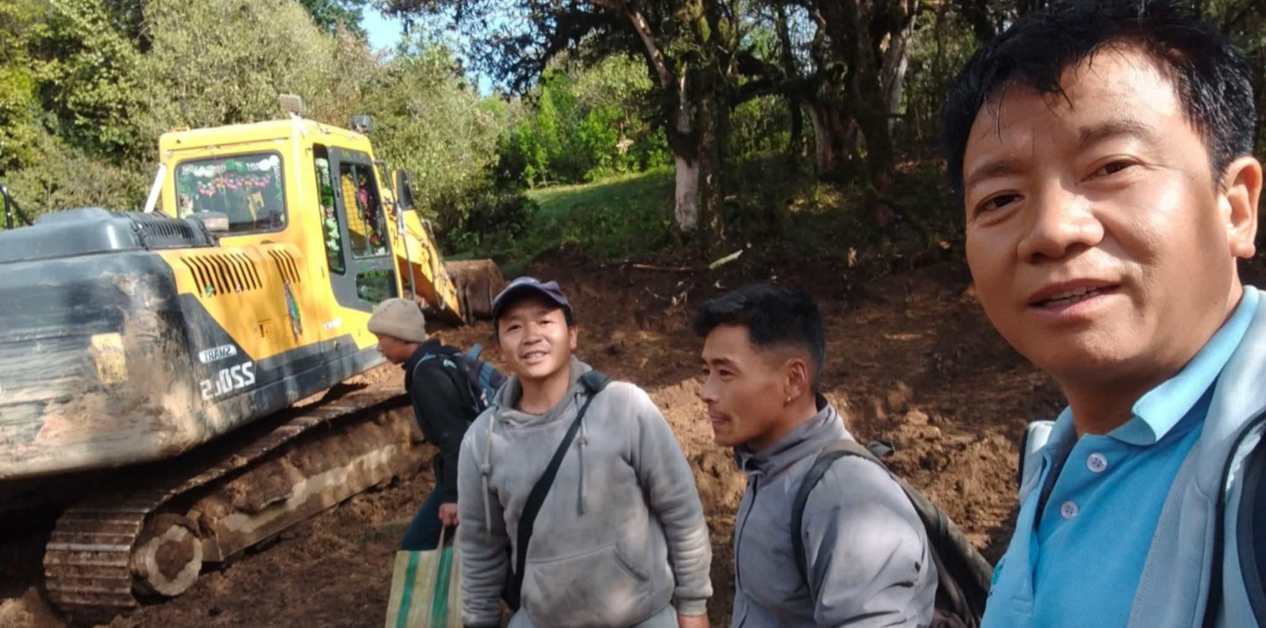
KATHMANDU: As soon as the parliamentary elections of last March concluded, news spread to the villages below that a bulldozer from the direction of Shadananda Municipality in Bhojpur was about to reach Saune Chuli. Digging a road from Talkharka in Shadananda Municipality-9, the bulldozer was making its way uphill toward the peak. Completely oblivious to how sensitive this area is, the bulldozer operators were thrilled, claiming that their dream of crossing Maiyung by motor vehicle was finally about to come true.
Saune Chuli is a grassy peak located in the core territory of the Mundum Trail, which has been under construction and promotion for a decade. Standing at an altitude of 3,333 meters above sea level, this hill can be described as a natural view tower. This hill possesses numerous identities and characteristics. This place is culturally a Mundumi site for the Kirat Rai people of Bhojpur and Khotang. According to Mundum myths, it is a joint holy place of worship for the Kirat and Naga peoples. Socially, it is the venue where the region’s famous Ranke Bazaar takes place. Spiritually, it has been a meditation site for sages. It is a pasture dearly loved by chauris and sheep. Ecologically, it is a natural repository for dozens of rare Himalayan and hill medicinal herbs.
The trail was delineated with core objectives and policies aimed at keeping the surrounding areas—spanning Silichong, Salpa, Laure, Maiyung, Merung, and Pakhuwa—free from road networks, avoiding large-scale structures, ensuring physical infrastructures reflect local culture and remain eco-friendly, encouraging animal husbandry, and transforming herding sheds into tourist-friendly spaces. Accordingly, infrastructure development has been ongoing with funding from all three tiers of government and foreign assistance. This region has increasingly become a preferred choice for trekking enthusiasts.
In such a place, news of a bulldozer flattening the mountain and heading straight up toward the peak was grim. Following widespread protests, the bulldozer turned back from just below Saune Chuli. However, its retreat is not permanent; it will climb back toward the peak the moment a favorable opportunity arises. After all, “development” is demanded at all costs! And “development,” it seems, means vehicles running along the ridges of Maiyung, scaring the wits out of wildlife and birds.
The envious tendency
In the last fiscal year, three million rupees was allocated in the federal government’s budget under the heading of the Pangkham Road. It was unclear which specific road the budget was meant for. A consultation took place in the village, and it was decided to construct a new road from the village toward Maiyung. Maiyung, located in Temkemaiyung Rural Municipality, is the core zone of the Mundum Trail. It is often said that the Mundum Trail must not be impacted by roads, and that bringing a road to Maiyung means destroying the very soul of this place. Everyone understands this, yet a question arose: if a road can go from Rimchim to Dhotre, and from Sumlikha to Ekrate, why can’t it go from Pangkham to Tarulbari?
The herding pasture known as Tarulbari lies about one kilometer away from the Mundum Trail. Public opinion among the residents of the former Ward No. 3 was divided. Most people from the Sawa side maintained that not a single step of the road should be built beyond Gufadanda at the top of Pangkham. Their worry was that the homestays established in Sawa, which are already struggling to survive, would completely dry up.
Similarly, business owners in Chakhiya and surrounding areas feared that if the road moved upward from Pangkham, travelers coming from the Terai targeting the Mundum Trail would branch off from Setibagar and head up that way, ruining their businesses. On the other hand, the core argument of the people from Pangkham was, “We are not saying we will take the road all the way to Maiyung. We will only dig up to a point below Maiyung. We understand the need to save Maiyung better than anyone else.”
Aiming for Tarulbari, the bulldozer began clearing bushes and digging up soil as it headed uphill. An anonymous complaint was filed at the District Forest Office in Bhojpur, alleging widespread deforestation in Pangkham. By order of the Forest Office, the bulldozer’s operations were halted. Following a discussion among all parties at the district headquarters, a consensus was reached: the road would be dug, but not up to Tarulbari—only up to Baishakhe, a herding pasture situated lower down. While it would have been 6.5 kilometers to Tarulbari, it became 5 kilometers to Baishakhe.
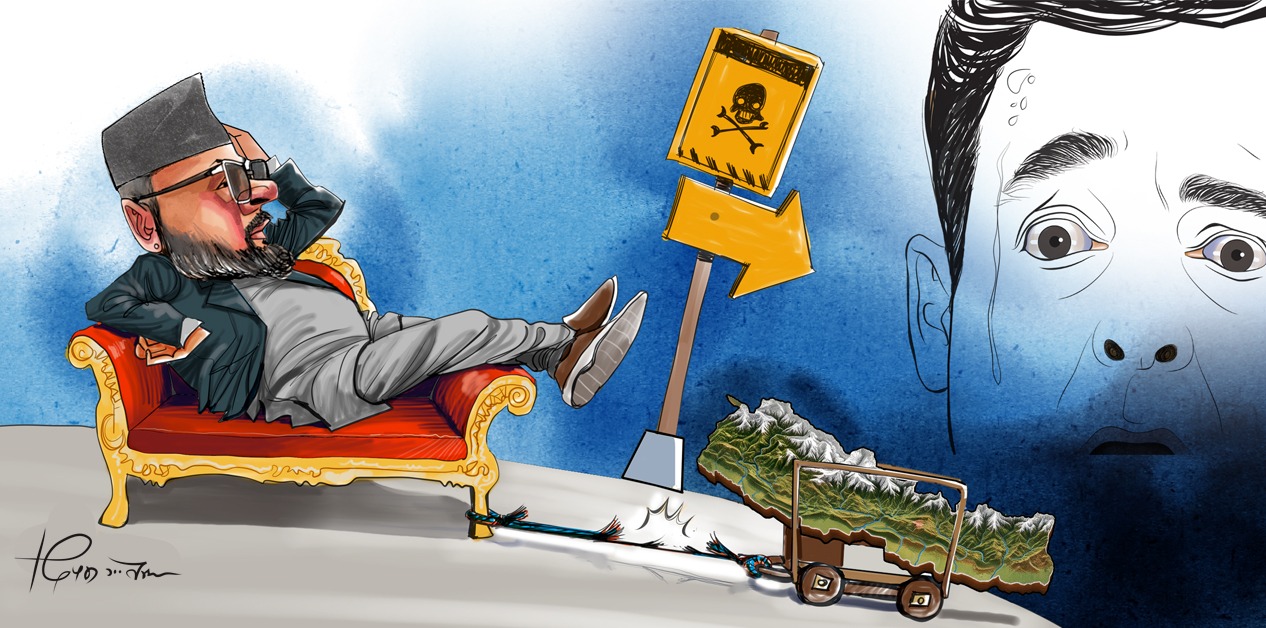
The track has now been dug up to Baishakhe. Now, the business of upgrading the road begins, and it will go on year after year. It is like a buffalo giving birth; it will keep yielding milk for as long as it lives.
From almost every neighborhood across the nine municipalities spanning from Salpa near the Bhojpur-Solukhumbu border to Tawa Bhanjyang between Bhojpur and Khotang, bulldozers are pushing uphill, threatening to demolish the newly built stone steps and resting platforms of the Mundum Trail. Because the Mid-Hill Highway already passed through Chakhiya before the concept of the Mundum Trail was conceived, Chakhiya became the primary gateway to the trail, leading to its commercialization.
After the trail was delineated, the Rimchim–Chhimalung–Submde road was opened through its middle section. The road from Sumlikha in Temkemaiyung through Pakhuwa to Surke in Shadananda and toward Bhojpur has also already opened. This road cuts across the trail at Pakhuwa, Deuse, and Chautara. These were not made into major points of contention because the primary objective was specifically to preserve the Maiyung–Salpa zone in its natural state, as these are the core areas of the trail. Until now, this area had survived the onslaught of road construction.
However, once the bulldozer threatened to reach Saune Chuli itself, it turned controversial. Bulldozers from the lower villages have already started climbing, eyeing Balaute Bhanjyang and Rawadhap. Whether they reach right there or are stopped further down depends on whether the Mundumi consciousness of the upper region’s residents triumphs over their monetary consciousness.
A trend has grown in these areas where bulldozers dig upward from one village while residents of another village protest and file complaints. Those digging roads talk about infrastructure needs, while those protesting try to appear as nature lovers. Yet, the underlying tendency of both sides is the same: envy. One feels compelled to do exactly what the other side does, while simultaneously trying to stop the other side from doing what they themselves have done. One faction harbors the mindset of, “They have already brought the road all the way up, so why should we stay confined to the bottom?” The other faction worries, “If their road becomes busy, we will fall behind; people will travel through there, and our area will dry up.” Consequently, a race of viewing one another as middlemen and brokers within the same village, accompanied by a blame game, has emerged alongside the road disputes.
Lack of standards
While the idea of preserving natural heritage sounds pleasant, it remains abstract in practice. The efforts to expand the Mundum Trail and the competition to construct roads that cut through or touch the trail are running parallel to each other. The local levels touched by the Mundum Trail have not established any integrated standards regarding how far or to what distance roads can be extended.
Temkemaiyung Rural Municipality had formulated a standard to allow roads only up to a distance of three kilometers away from the Mundum Trail. Even within that rule, it was unclear whether this referred to aerial distance or ground distance factoring in the rugged terrain. Now, a race to extend roads higher and higher is taking place within that very rural municipality.
Meanwhile, a few years ago, Mahakulung Rural Municipality of Solukhumbu had brought forward a proposal to build a road along the ridges all the way from Salpa to Beltar in Udayapur. The idea was that motor vehicles carrying people would run down the middle of the road, while trekkers carrying backpacks would walk along its edges. This way, transport access would be achieved, the Mundum Trail would be promoted, and the preferences and choices of the people would be addressed. Provincial assembly members from that region and some local level chiefs even scrambled to secure a budget for a comprehensive survey based on that proposal. However, after protests from several other local levels and Mundum Trail activists, the proposal was shelved.
If the Mundum Trail is to be protected and preserved for eternity, clear standards must be established for every physical structure built in that region. Among these, road-related standards are the most critical. They must be strictly implemented. There should not be standards like the ones formulated by Temkemaiyung Rural Municipality, which nobody listens to and which the elected representatives themselves flout. Today, a monetary vision is stirring inside many who claim to understand the Mundum Trail. Even those who have built an identity as activists are bending their fingers to scoop out the clarified butter from the container.