Kathmandu
Monday, June 29, 2026





How the initial steps of an absolute majority rule clear the path for widespread institutional control, leaving behind a nation depleted of wealth, confidence, and credibility
KATHMANDU: I have started to feel very scared lately. I remember someone writing recently, “Traditional intellectuals are scared.” In a way, I felt glad thinking that symptoms of being an “intellectual” were appearing in me too. Then again, since it also said “traditional,” I did not find it pleasant. If one is to be an intellectual, why not be modern? Why be traditional? Let it be, there is no need to be such an intellectual. I am fine as I am. Perhaps the train of thought did not align; if I am not an intellectual, why am I scared then? There must be a reason to be scared, which is why I am feeling scared. The proverb says that shared joy increases, and shared grief decreases. What happens if fear is shared? The proverb says nothing. Even so, I want to share my fear here. Are you also feeling scared?
Before saying anything about fear, I must also clarify that there is no specific reason for me to be scared. I earn an average income, and that earning is not illegal. Therefore, I do not fall within the jurisdiction of the Property Investigation Commission recently formed by the government. In the future, let alone such commissions, even if the fathers of commissions are formed, it will not make any difference given my situation as of today’s date. The future is uncertain anyway. I have not accumulated wealth that would attract thieves and robbers, if only I had enough to save! I have no fear of wild animals, I live in the city. I do not have work that requires walking around in the dead of night. While riding a motorcycle, one falls a few times, and there is a reassuring principle of one’s own that one dies a few times too. Yet, I have not died even once so far.
Just like how sleeping together leads to getting kicked, though I have occasional minor tiffs with relatives, friends, and colleagues, there is no enmity severe enough to be scared of. I have not made such extraordinary progress that others would pull my legs or cut off my head. Whatever I have done in my profession, there may be a thousand questions about my capability, but I have not left any room to raise a finger against my honesty. I have not done social service because I am unable to, contracting because I lack money, and politics because I do not like it. Unlike those involved in politics, I have not done something completely different after promising to do one thing. After saying this much, you must be reassured that there is no reason for me to be scared.
All the things mentioned above were my personal matters. My fear is not created by my own reasons. It is generated by the social situation. Before speaking about that social situation, I will talk about a pattern in which a harmonious relationship can be seen between events occurring one after another. Such harmony is seen much better the further one stays away from it than staying right inside it, just like looking at the cascading paddy fields while sitting up on a hill.
A dozen years ago, in a neighboring country, just like in our country a while back, governments were formed by coalitions of parties facing ten different directions. Naturally, there were stories of corruption, there was poverty, and there was social disorder there, just like in our country. Amidst this, an agitation against corruption suddenly arose in the capital. Its demand was that an institution named Lokpal should be legally established. Many students, teachers, professors, lawyers, social workers, and journalists joined it. This happened on the eve of the election.
Arrangements were made to bring some important central bodies of the state, which ought to remain independent, under the authority of specific individuals. A situation arose where the entire state power became confined to just two individuals, which also started to be heard jokingly as the “government of two people.” Adding two business houses to that, the saying “we two, our two,” popular in family planning, began to be used as satire in society.
The election swept away the ruling parties there. Even before the election, the chief minister of a province was glorified as the ideal and alternative-less candidate for prime minister. At that time, the newly expanding social media and traditional audio-visual media publicized it grandly. In that process, some bad things were skillfully covered up. Especially during the time that character was the chief minister, the mainstream media did not even want to talk about the role of the state government in the communal riots that occurred in that state, and the mysterious deaths of social workers, witnesses, and prosecutors who worked to make the state accountable after the riots, as well as some judges hearing those cases.
Some religious and ethnic organizations dedicated themselves to polarizing the citizens at the grassroots level of society in favor of the said political party. In the name of an “IT cell,” a mechanism was built to disseminate controlled information in favor of the said party (considering the nature of the work, however, it would be appropriate to call such a mechanism an “IT jackal” because this mechanism delivers information originating from a fixed place to the general public through its committed members, just like how when one jackal howls “hoo-oo” from one place, all the jackals that hear that sound howl “hoo-oo” all at once, and the perimeter of that howling expands and spreads).
Since the said party was not in the central government during that election, it is logical to assume that the government machinery of that level was probably not involved in this process. The arrogance of retired government servants, however, was worth watching. A public announcement of that time was amusing: the money kept in foreign banks through corruption by those in previous governments would be brought back and distributed to every citizen at the rate of 1.5 million. Of course, the concessions announced for people of low economic status were also attractive.
The election took place, and the same party won with an overwhelming majority. After the government was formed, the talk of 1.5 million cooled down, some concessions announced for people of low economic status were implemented, some were partially implemented, and some just remained as they were. Following that, the same party won the election two more times.
In this process, it is relevant to mention some major works that took place visibly. The government carried out “demonetization.” The declared reason for abruptly stopping the circulation of 500 and 1,000 denomination notes was to render useless the wealth accumulated through corruption by those previously in government. Two results of this were clearly visible: first, since large-denomination notes were suddenly stopped, the small-denomination notes sufficient to replace them were inadequate, making it impossible for small and medium traders doing cash transactions to stand up for a long time. Second, a large portion of illegal earnings was exchanged through limited banks, and they made huge profits from it. Naturally, a large portion of that was used again to make the same party strong. What needs to be remembered here is that before doing the demonetization, a situation had already been created forcing the head of the Nepal Rastra Bank (NRB), the institution that formulates and implements monetary policy, to resign, making that institution favorable to them.
State-sponsored or state-encouraged social tensions were created, and a situation was established where ordinary people had to either become their supporters or be deprived of facilities and remain prepared for any kind of punishment. While gradually discouraging the scientifically sound consciousness established in society, pseudoscience began to be promoted.
The work of gradually making permanent institutions that formulate, implement, and regulate policies in various sectors of the state and other areas that should work for public interest, favorable to them, continued. In this process, the media (nowadays there is a practice of calling them lapdog media), the judiciary, educational institutions, crime investigation and security agencies, specialized institutions working in various fields of science, technology, and trade, and a large portion of the intellectual sector were made favorable to themselves.
State-sponsored or state-encouraged social tensions were created, and a situation was established where ordinary people had to either become their supporters or be deprived of facilities and remain prepared for any kind of punishment. While gradually discouraging the scientifically sound consciousness established in society, pseudoscience began to be promoted. A large portion of grants given for educational research was spent on flying projects based on pseudoscience. A situation was prepared where the control of party-supported business houses over national property would gradually take place.
Arrangements were made to bring some important central bodies of the state, which ought to remain independent, under the authority of specific individuals. A situation arose where the entire state power became confined to just two individuals, which also started to be heard jokingly as the “government of two people.” Adding two business houses to that, the saying “we two, our two,” popular in family planning, began to be used as satire in society.
Religious-communal polarization and nationalism became the biggest tools used by the government to mesmerize the public. These tools proved useful emotionally to win elections. Two tools of manipulation were added to voting machines and voter lists. By removing members of communities unlikely to vote for them from the voter list itself and swapping voting machines in election constituencies where they seemed to lose, the number of votes was turned in their favor in every election.
Using the state machinery, works were done to harass opposition party cadres, discourage them, and force them to join their party. Arrangements were made so that the state machinery could not touch individuals affiliated with their own party, and a situation was created where even a person considered corrupt while in another party would be cleansed after entering their own party. To depict such a situation, the phrase “washing machine” came into use.
It began to be revealed that the prime minister of the country went on foreign visits not for national interest but for the commercial interest of the businessmen of his side. Gradually, due to national institutions becoming weak and attention being paid to small private commercial interests, matters of national interest began to be overshadowed. This gradually weakened the nation’s diplomatic power and credibility.
The government formed a committee to investigate that and conducted an investigation. The government did not think it necessary to make public what that report was like. Without making the report public, the committee not only gave a clean chit, saying he was proven innocent, but also reappointed him to the same position.
The fact emerged that the state purchased and used a mobile app to spy on opposition party leaders, big businessmen, media persons expressing votes against them, and intellectual individuals. Due to focusing on some extremely casual decisions and things that would build their immediate image, national security matters became weak.
As a result of all these things, a country that should appear strong on the global political stage is indeed turning into a helpless country finding it difficult to sustain the burden of its own population. However, there is still no sign of improvement in the main trend anywhere. This situation is the result of the specific pattern discussed above, in which it can be said that activities such as creating a false image and acquiring state power on the strength of an agitation, maintaining control over state institutions after acquiring power, keeping the public in delusion, intimidating and harassing intellectuals and opponents, focusing on the interest of businessmen close to them instead of national interest, and promoting pseudoscience by barring scientific thinking take place.
The reason for discussing this specific pattern seen in the politics of a neighboring country at such length is not because the reason for my fear is personal, but rather because thinking about how such a deviation coming into politics causes the entire country to lose its self-confidence and prestige and become confused, unable to identify the direction of progress, a fear created by the sound of a broad social decline.
Has my society then reached a state where it must be scared like this? My society has not yet reached the horrific situation discussed above, but looking at the direction taken by the government over an overwhelming majority of about three months, sufficient ground has been prepared to say that we are on that path. I will try to state that in a few points below.
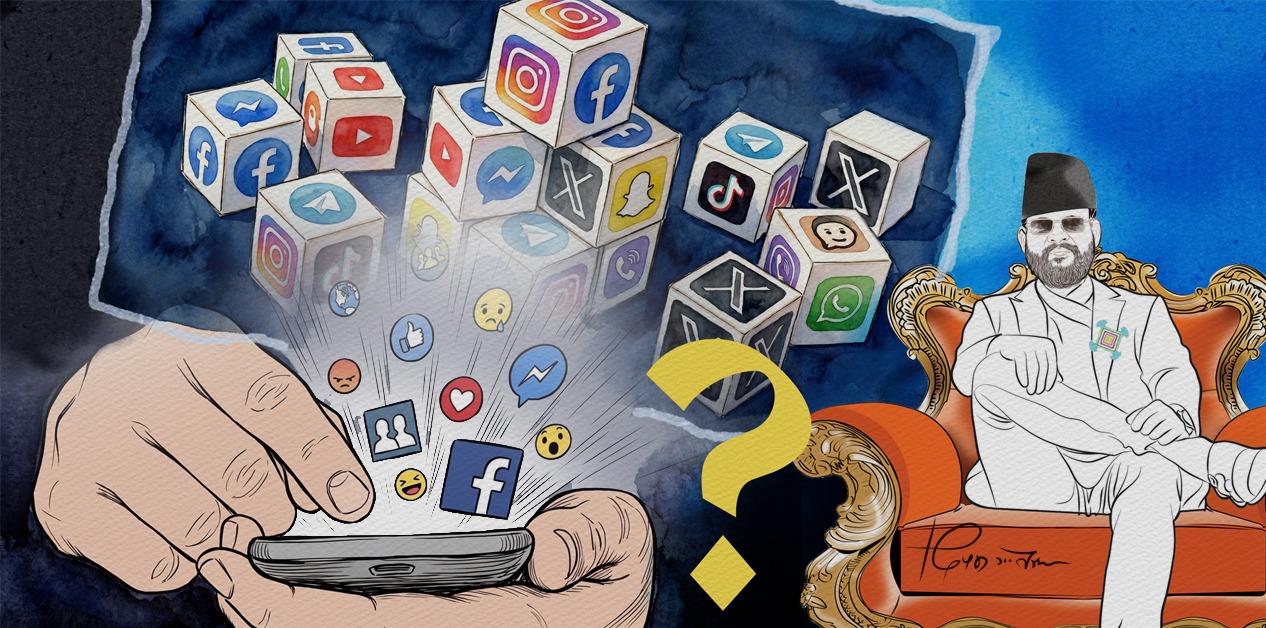
An agitation took place in Nepal on September 8 and 9, 2025. Four aspects of it are worth noting: first, the environment for that agitation was prepared on social media; second, the main target of that agitation was corruption; third, some known former high-ranking chaotic individuals (you have not forgotten them saying “legs should be broken” after reaching the hospital, right?) were seen in support of that agitation (some of whom also captured important positions after that); and fourth, the agitation slipped out of the hands of its conveners.
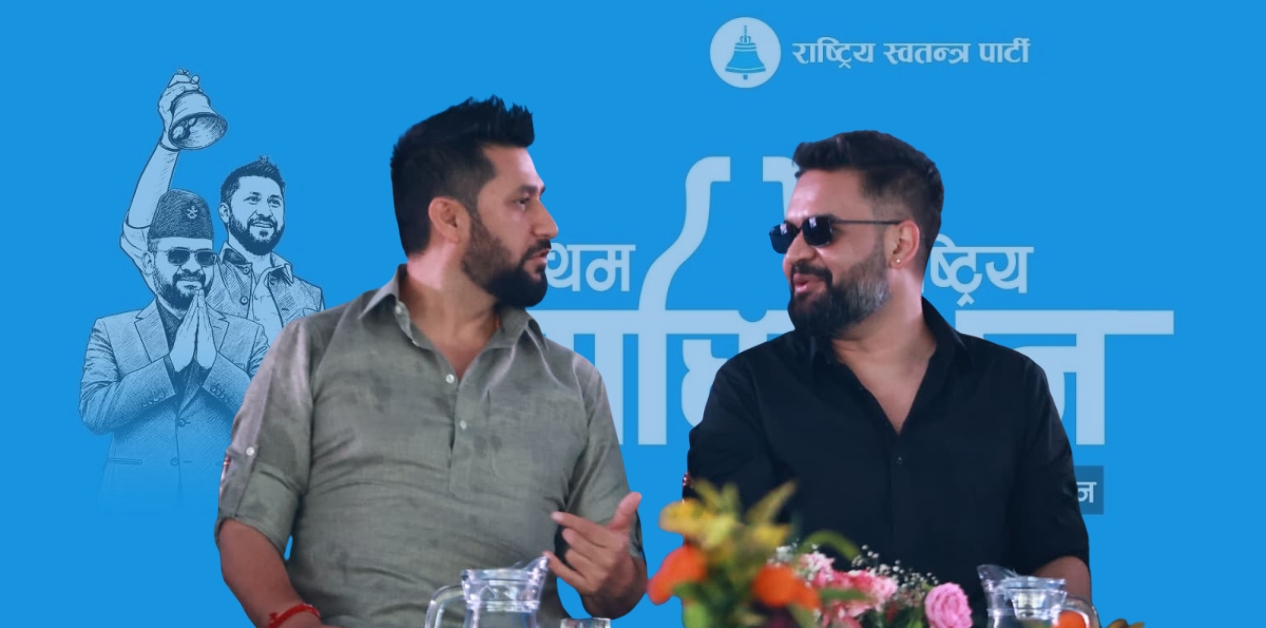
Long before this agitation took place, social media, some traditional audio-visual and print media, and even some “intellectuals” were continuously involved in building the image of a journalist and a lyricist-singer as ideal political figures.
Through the election, a party obtained around a two-thirds majority of seats in the House of Representatives. In a way that seems unusual in a parliamentary system like Nepal’s, the prime minister had been declared even before the election. Therefore, after the victory, the proposed individual naturally became the prime minister, and the government was formed. Constitutionally, the prime minister’s oath-taking program made a specific religious-communal partisanship clear. Perhaps it also gave some indication of the future.
Even before this government came, a commission was formed to investigate the events of the agitation period. A report said to be of that commission came out in the media, but it was not officially made public. Without entering into the most destructive events in Nepal’s history, that commission, focusing on the events of the first day of the agitation, recommended action against those within the state machinery. The government, which did not even think it necessary to make that report public, started arresting and jailing people left and right without following due process in the name of its recommendation. The court had not yet come under control, which is perhaps why it stopped that due process-lacking crackdown.
The Home Minister of the government met a foreign ambassador and requested cooperation to search for money hidden in the banks of that country through corruption from Nepal.
News about some suspicious financial activities of the government’s home minister emerged, and he resigned in 13 days. The government formed a committee to investigate that and conducted an investigation. The government did not think it necessary to make public what that report was like. Without making the report public, the committee not only gave a clean chit, saying he was proven innocent, but also reappointed him to the same position.
Meanwhile, after the meeting of the parliament had already been called, it was stopped, and many ordinances were brought all at once. A writ was filed in court stating that several of their provisions conflicted with the provisions of the Constitution. The judges were divided in their opinions on whether to keep it in the status quo or not. The opinion of one side was that since the matter of making laws belongs to the parliament, the parliament itself will decide when this ordinance is presented in the parliament, so the court does not need to do anything right now. From this incident, my faith in the court has been shaken, not because the government should not bring ordinances and also not because the matter of accepting or rejecting an ordinance does not belong to the parliament, but because whether it is an ordinance or an act, it must not conflict with the Constitution; therefore, because instead of the court determining by itself and immediately whether the provision of the ordinance conflicted with the Constitution or not, it was left saying the parliament will look into it anyway.
One of the ordinances was regarding the Constitutional Council. In that, an arrangement was made where a majority would be considered towards whichever side three people, including the prime minister, out of six members belonged to. As it happens, it has also become public just recently that the general secretary of the same party said, “even if the points are equal, one additional point will be added for the person who supported the party.” Such an arrangement and practice of adding an extra point to one side even when points are equal is contrary not only to politics but also to mathematics itself.
Recently, the prime minister publicly shared the names of three people running the country with pictures. In the course of time, who the specific individuals (usually businessmen or professionals) taking advantage of this entire process of violating due process are will also become public. This shows that the day of saying “we three, our three” also appears close.
Following this, the process of appointing the chief justice in the Supreme Court moved forward. Bypassing the senior, the junior was recommended. Some data was shown as the basis for this, the truth of which has been questioned. Now, the sign of the court becoming favorable has been seen from the incident where the Supreme Court administration refused to register a writ against the proposed chief justice.
Through the medium of ordinances itself, more than 1,000 people were removed from office at the same time from various government and public institutions. Right now, those institutions are leaderless, and the appointment process is ongoing. Meanwhile, the expression of the aforementioned general secretary, which is of a nature that pressures one to be loyal to their party, came out. This is a strong start to the step of controlling government institutions.
The language used by the prime minister and ministers, which has come out publicly in parliament and elsewhere, is not cultured politically under any circumstance. Such expressions used to intimidate the opposition party and those holding opinions different from theirs are also signs of intolerant politics. The behavior of the prime minister, the speaker, and lawmakers of the ruling party in parliament is seen to have degraded rather than enhanced the dignity of the parliament.
A ministry named the Ministry of Science, Technology, and Innovation has been formed this time. Although science and technology existed before, innovation is new. Even so, almost all bodies related to information technology are under the prime minister. This indicates that the prime minister wants to utilize information technology as a tool to control state power and citizens.
News has just been made public that all officials of the Commission for the Investigation of Abuse of Authority were called to the Prime Minister’s Office and pressured to issue arrest warrants against specific individuals. This attempt to control a constitutional body with a status parallel to the government is another example of the tendency to control the government machinery. What is even more serious is that it is said that not the prime minister but only his assistants were involved in this act. Since the prime minister is a person elected by the people and sworn in for the national interest, he is responsible to the people and the nation for every work he does, but his advisors and assistants do not have such responsibility. It is a matter of serious concern that irresponsible individuals are dominating the governance of the state.
Recently, the prime minister publicly shared the names of three people running the country with pictures. In the course of time, who the specific individuals (usually businessmen or professionals) taking advantage of this entire process of violating due process are will also become public. This shows that the day of saying “we three, our three” also appears close.
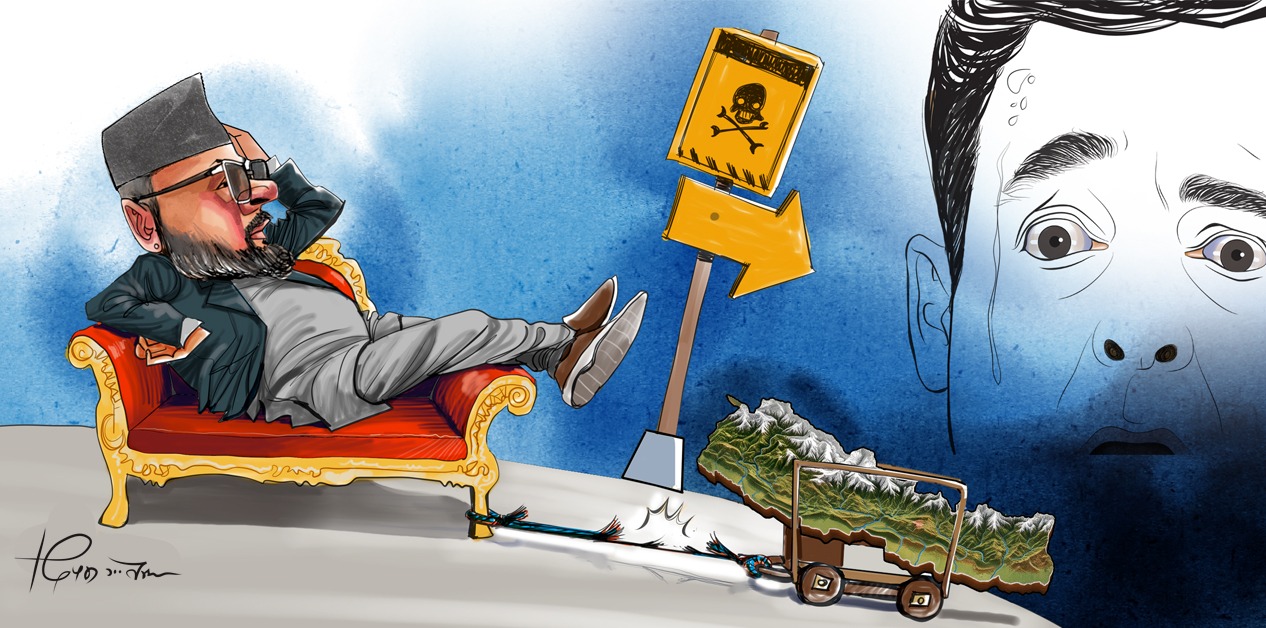
There is a kind of consistency among the points I have mentioned above. They essentially point toward a single thing, complete control over the state by a single party and its limited individuals. This aligns completely with the pattern seen in a neighboring country that I mentioned above. The results have started to appear there in about a dozen years. In our country, however, it is in its initial stage. Whether this aspiration of complete control over the state is fulfilled or not depends on the level of consciousness of society, awareness of one’s rights over the state, and the readiness toward it.
My fear, however, is that my country, which has had the good fortune of being ruled by a government with an overwhelming majority, might gradually go downhill and in a few years become even poorer, with further reduced self-confidence, and even more helpless. If you are also feeling scared in the same way, come, let us share our fear. Who knows, perhaps fear also decreases once shared, just like grief!