Kathmandu
Sunday, June 28, 2026





In the era of AI, the question is not how well we can make an old axe; the question is: what is the ‘new axe’ of our time?
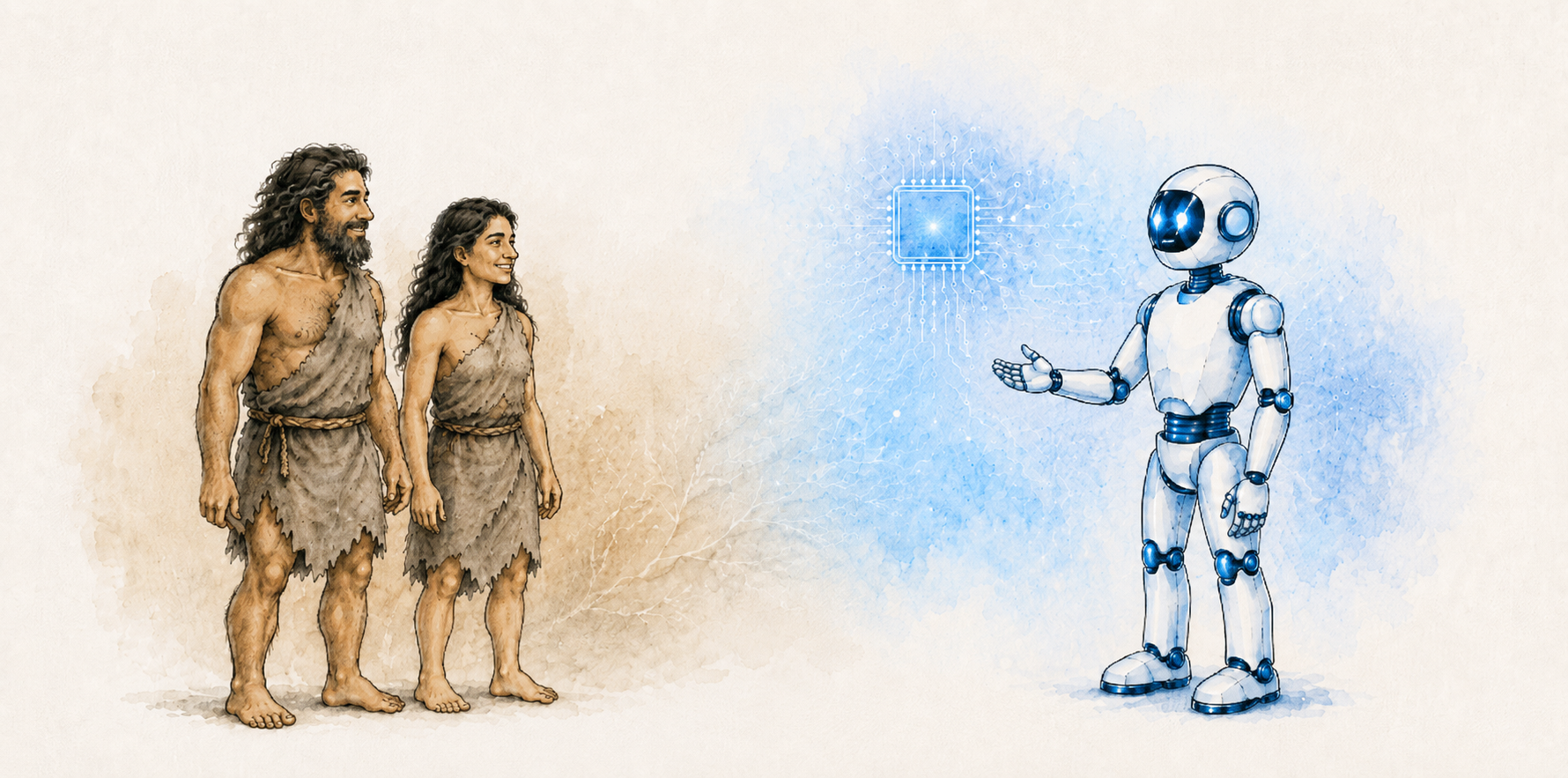
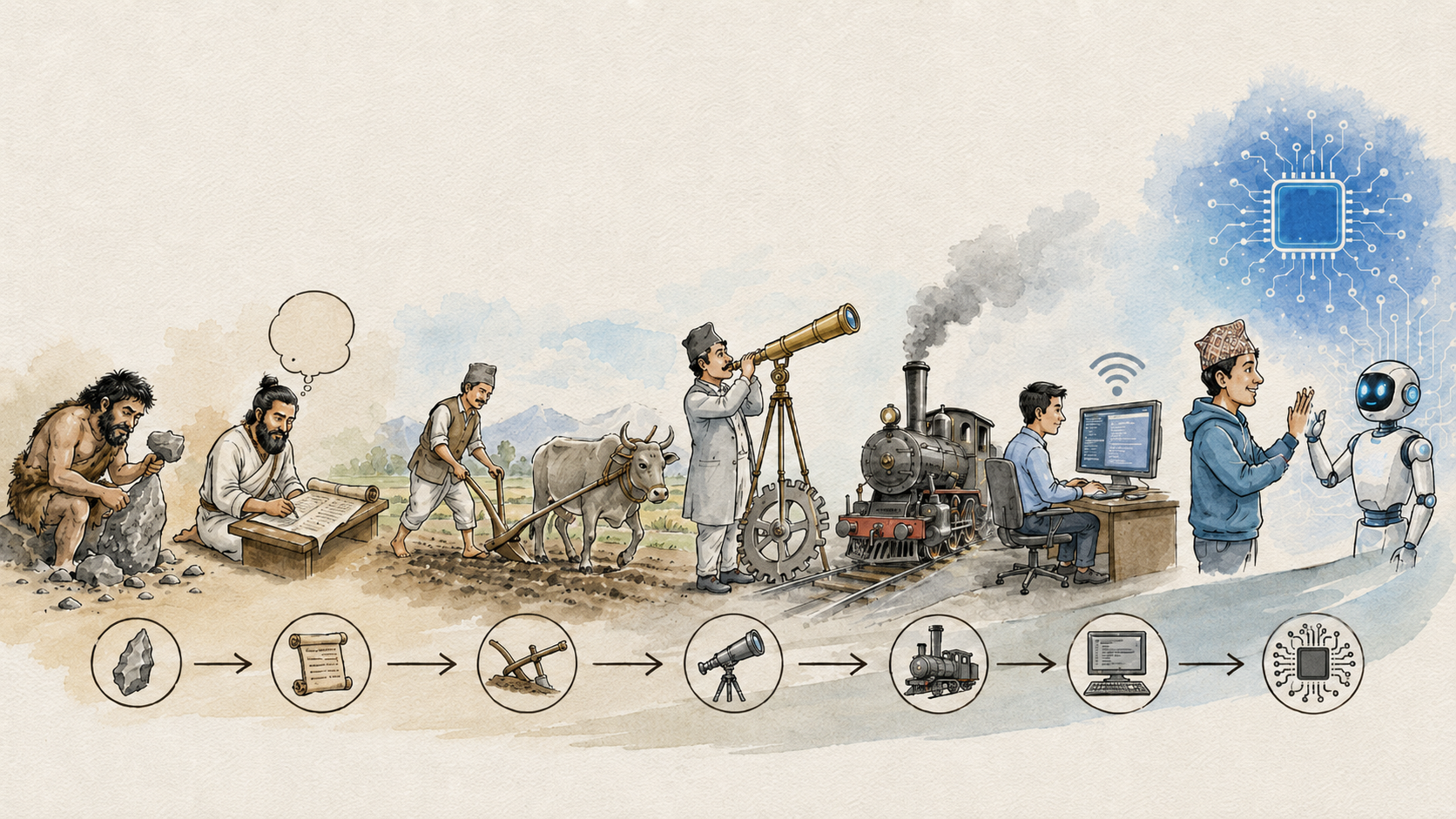
KATHMANDU: If we look at the entire history of human progress from a single angle, it is a history of science, technology, and innovation. Today, we have arrived in the era of artificial intelligence (AI), gene editing, and space exploration. But this journey did not start overnight. It is a continuous flow of human civilization developing over millions of years. Three million years ago, an unknown human ancestor picked up a stone, struck it against another, and used the sharp fragment for a specific purpose. That moment was probably one of the most significant in human history. For the first time, a human did not just use an object provided by nature but transformed it according to their own needs and imagination. The journey that began at that very moment has progressed from stone tools to the plow, the steam engine, the computer, and now to AI.
Humans were not the strongest creatures on Earth. The lion ran faster, the elephant was stronger, and the rhinoceros was more powerful. Yet, none of them developed agriculture, built telescopes, brought about an industrial revolution, or launched spacecraft. What made humankind the dominant species on Earth was not physical strength, but rather the unique capacity to create knowledge, preserve it, and pass it down to the next generation. The entire history of science, technology, and innovation is an expansion of this very capacity.
The birth of language, logic, and scientific consciousness
Language enabled humans not just to communicate, but to organize and preserve thoughts. Without language, the development of complex concepts, long-term planning, or collective memory would have been impossible. With the evolution of language, what one generation learned began to be passed on to the next, and knowledge accumulated gradually. Anthropologists and biologists argue that the primary reason for human success is this culture of accumulation—the ability to accumulate and expand knowledge across generations.
Some other animals also use tools. For instance, chimpanzees use stones to crack nuts, and certain monkey species use simple tools to obtain food. However, such skills remain within a limited scope because they have not developed a complex linguistic system to describe their experiences in detail, construct new concepts, or store accumulated knowledge. Consequently, their tools remain identical to what they were thousands of years ago. Meanwhile, humans have traversed a path starting from a stone axe all the way to spacecraft and AI.
Along with language, logic developed. Humans began seeking cause-and-effect relationships among world events. Why does it rain? Why do people fall ill? Why do planets move across the sky? Such questions pushed humanity beyond the boundaries of myth and superstition, gradually guiding them toward observation, testing, and research. This curiosity birthed distinct traditions of knowledge across various civilizations, giving a new direction to human intellectual growth.
We often talk about science, technology, and innovation in the same breath. From government policies and documents to university speeches, these three words are heard together as if they mean the same thing. But they are not identical. To comprehend how the progress of human civilization became possible, it is essential to understand the relationship and differences among them.
This intellectual journey was not confined to a single country or civilization. Ancient India, Greece, China, and Islamic civilizations all made significant contributions to the quest for knowledge. In ancient Indian literature, the Nyaya philosophy discusses logic, evidence, and methods of acquiring knowledge in great detail. The invention of the zero and the decimal system propelled mathematics to new heights. In ancient Greece, philosophers attempted to understand nature through logic rather than myth. Socrates, Plato, and Aristotle developed a structured tradition of thinking regarding knowledge, logic, and natural phenomena. Euclid’s geometry and Archimedes’ mathematical and physical principles strengthened the foundation of scientific thought.
Similarly, during the Islamic Golden Age, places like Baghdad, Damascus, and Cordoba became international hubs of knowledge. Muslim scholars preserved, translated, and expanded upon texts from Greek, Indian, and other civilizations. Modern algebra developed from the mathematical works of Al-Khwarizmi. In this manner, various civilizations added their own bricks to the edifice of knowledge over thousands of years. The scientific consciousness of human civilization is not the achievement of a single individual, nation, or civilization; it is the shared intellectual property of all humankind.
The birth of modern science, however, is linked to the Scientific Revolution in Europe. In the seventeenth century, two great thinkers steered the path of human knowledge in a new direction: Galileo Galilei and René Descartes. Galileo used the telescope to observe the sky. He presented evidence showing that there are mountains on the moon, moons orbiting Jupiter, and dark spots on the surface of the sun. His greatest contribution was establishing the standard that claims about nature must be tested through observation and experiment, not on the basis of authority or tradition.
Descartes made systematic doubt and logical analysis the foundation of knowledge. His famous dictum, “I think, therefore I am,” is not just a philosophical phrase; it was a symbol of faith in the power of logic and analysis. While Galileo established a culture of experiment and observation, Descartes demonstrated the importance of logical structure. Modern science evolved from the intersection of these two traditions—experiment and logic.
Through this very process, Isaac Newton’s physics, Charles Darwin’s theory of evolution, and later, modern chemistry, biology, and astronomy were born.
Science and technology: The Relationship between knowledge and application
We often talk about science, technology, and innovation in the same breath. From government policies and documents to university speeches, these three words are heard together as if they mean the same thing. But they are not identical. To comprehend how the progress of human civilization became possible, it is essential to understand the relationship and differences among them.
The objective of science is to understand the world. When Galileo turned his telescope toward the sky, he was not trying to develop a commercial product. When Darwin presented the theory of evolution, he had no plans to establish an industry. Similarly, the Indian mathematician Srinivasa Ramanujan dedicated his life to analyzing and understanding deep mathematical problems. Many of the mathematical formulas he developed saw no immediate practical utility, yet some are used today in computer science, cryptography, and modern physics. The common feature of all these examples is that they were trying to understand the fundamental laws of nature or mathematics, not making products for the market.
Technology, on the other hand, is the application of science. Science explains the nature of electricity; technology transforms it into lightbulbs, computers, and the internet. Science explains the principles of flight; technology builds airplanes. While science seeks to understand the world, technology asks how this knowledge can be put to practical use.
They were searching for answers to the question of how nature works. Science provides theories and explanations like gravity, evolution, or the structure of an atom. It asks why and how. The utility of a scientific discovery might only become apparent decades later, but the foundation of human knowledge is built right there.
Technology, on the other hand, is the application of science. Science explains the nature of electricity; technology transforms it into lightbulbs, computers, and the internet. Science explains the principles of flight; technology builds airplanes. While science seeks to understand the world, technology asks how this knowledge can be put to practical use.
Nevertheless, the relationship between science and technology has not always flowed in a single direction. Historically, many technologies existed long before scientific explanations were developed. For example, silk production technology had been developed in ancient China for thousands of years. However, the microscopic structures of silk and the principles of materials science were understood much later. Similarly, humans learned to smelt iron, build boats, and use medicinal plants well before a scientific explanation of why those processes worked was available. Early technology was primarily based on experience, trial and error, and knowledge accumulated over generations. The hallmark of the modern era is that science and technology are drawing closer than ever—science opens up new possibilities, and technology translates them into practice.
Another crucial difference between science and technology is visible in the dissemination of knowledge. The ideal of science is openness. Once a scientist makes a new discovery, it is published, tested, and other scientists worldwide can use or challenge it. The progress of science relies on a culture of sharing knowledge.
The history of technology is slightly different. For a long time, technical knowledge was considered a source of power and wealth, which is why it was kept secret. For instance, ancient China maintained a near-monopoly on silk production technology for over two thousand years. The knowledge of how to produce silk was considered a state secret. Anyone attempting to smuggle silkworms or their eggs out of the country faced severe punishment. Europeans consumed silk, but they did not possess the technology to produce it.
Today, this trend has not entirely disappeared. While the results of scientific research are usually published publicly, many technical details regarding new medicines, computer chips, industrial processes, or AI remain protected as patents, trade secrets, or proprietary knowledge within companies. Therefore, a country cannot become technologically leading simply by reading scientific papers; it must also develop practical knowledge derived from laboratories, industries, a skilled workforce, and hands-on experience.
AI generated image
For this reason, scientific knowledge can be universal, but competitive advantage in technology often remains concentrated in the hands of limited groups or nations. This distance between the pursuit of knowledge and its application has fueled technological competition throughout history.
Innovation: Every era’s own ‘New axe’
The power to rapidly transform society, however, resides in innovation. Innovation is not just about discovering a new scientific law; it is about using available knowledge and technology in a novel way to create additional value. As historian and author Walter Isaacson demonstrated in his book The Innovators, most revolutionary technologies were born not from the genius of a single individual, but from a new combination of old ideas and technologies. Most of the basic technologies of a smartphone had been developed long before. Yet, combining them into a single device to radically transform communication, commerce, entertainment, and access to knowledge was innovation. Thus, the essence of innovation lies in creative application rather than new discovery.
The progress of a society does not happen simply by copying old inventions. Genuine progress occurs when a society identifies the problems of its time and creates new solutions for them.
There is another vital point about innovation: it changes with time. An object or an idea does not remain an innovation forever. It is an innovation only in the context of its era. Imagine a human community thousands of years ago making a strong stone axe for the first time. That was not just a tool. It made it possible to clear forests, hunt, build houses, and eventually expand agriculture. For that time, it was a revolutionary innovation.
Over time, the form of innovation changed. In the agricultural era, it was the plow and irrigation systems; in the industrial era, the mechanical weaving loom and the steam engine; in the digital era, the computer and the internet; and in today’s era, AI and quantum computing are transforming society. Today, if someone recreates a stone axe or a mechanical loom, it cannot be called innovation. Those were innovations of their time; today, that knowledge has become the shared property of human civilization. Recreating them is not creating new knowledge, but merely repeating what is already known. Therefore, every era has its own innovation. The state-of-the-art technology of the agricultural era was the axe and the plow. The cutting-edge technology of the industrial era was the loom and the steam engine. The computer and the internet became symbols of the digital era. Today, in the era of AI, the question is not how well we can make an old axe; the question is: what is the ‘new axe’ of our time?
The progress of a society does not happen simply by copying old inventions. Genuine progress occurs when a society identifies the problems of its time and creates new solutions for them. Every era of history has its own axe, its own loom, and its own computer. The challenge is not to reconstruct those old tools, but to identify the next big innovation of our time.
Economist Joseph Schumpeter considered innovation to be the primary engine of economic development. According to him, the process of societal advancement is a process of “creative destruction,” where new ideas consistently displace old methods and structures. Many historical transformations have been achieved through the new application of old knowledge and technology rather than the discovery of new scientific laws.
In the context of Nepal, understanding this difference is all the more necessary. For example, manufacturing, repairing, or delivering agricultural equipment to farmers that has been used abroad for decades is undoubtedly important, but it cannot automatically be called science or innovation. Such activities are examples of technology transfer or technology dissemination.
This does not mean that the value of such efforts is minor. Expanding agricultural mechanization, providing affordable equipment to farmers, or increasing access to technology is a major social and economic contribution in itself. However, if a group redesigns those tools according to the Nepali hilly terrain, makes them suitable for small farms, or finds a new solution to a local problem, that can be considered innovation. Replicating something exactly as it is is primarily an example of reverse engineering or technology transfer.
Nepal needs an environment for innovation
When debates about science, technology, and innovation take place in Nepal, one question arises repeatedly: how does the country benefit from this? But the value of science cannot always be measured by immediate economic returns. History shows that many discoveries that made the modern world possible were born out of curiosity-driven research. When scientists were researching electricity, magnetism, or atomic structure, they could not even imagine smartphones, the internet, or AI. Even the World Wide Web, which forms the bedrock of the internet, was not built by a commercial company; it was developed to ease the exchange of information and research materials among scientists at the European Organization for Nuclear Research (CERN).
It is easy to be a consumer of modern technology; however, building the capacity to create, improve, or adapt such technologies to local needs requires decades of education, research, an engineering culture, and institutional development.
Hence, governments should not view science purely through the lens of profit and loss. Investing in science means investing in future possibilities. On the other hand, private investment, banking, and entrepreneurship are equally vital for projects aiming to bring new products or services to the market. The primary role of the government is not to run businesses, but to build an environment where innovation becomes possible.
In this context, a serious contradiction that Nepal faces must also be understood. We desire to ride cutting-edge electric vehicles like Tesla or BYD, we use 5G smartphones, and we converse with AI like GPT. Yet, that same society has not been able to extensively mechanize its agricultural sector. Many places lack a reliable supply of clean drinking water, and basic technical issues—such as oxygen supply systems in hospitals or the maintenance of medical equipment—frequently surface. On one hand, we are in the era of AI, and on the other, we are struggling to modernize basic public services.
This does not mean that the technology is unavailable. The problem lies in the lack of knowledge, institutions, and human capital. It is easy to be a consumer of modern technology; however, building the capacity to create, improve, or adapt such technologies to local needs requires decades of education, research, an engineering culture, and institutional development. The progress of a country cannot be measured solely by how many modern devices it uses; it must be measured by how much scientific, technological, and institutional capacity it has built to solve its own problems.
The experiences of South Korea, Japan, China, and Taiwan demonstrate exactly this. Those countries achieved success not by manufacturing every single product themselves, but by making long-term investments in education, research, infrastructure, and industry-friendly policies. Taiwan invested in semiconductor education and research for decades, which ultimately gave birth to world-class industries like the Taiwan Semiconductor Manufacturing Company (TSMC).
The challenge for Nepal is not to search for a single successful project. The challenge is to build an environment where students want to study science, researchers can ask new questions, entrepreneurs can take risks, and engineers can develop solutions centered on local problems. Ultimately, a nation’s prosperity depends not on a single successful invention, but on the capacity and environment to continuously generate new ideas. Science, technology, and innovation do not emerge from a single government program; they are born from an ecosystem built on curiosity, education, independent thinking, and long-term investment.
– Seoul, South Korea