Kathmandu
Thursday, June 25, 2026





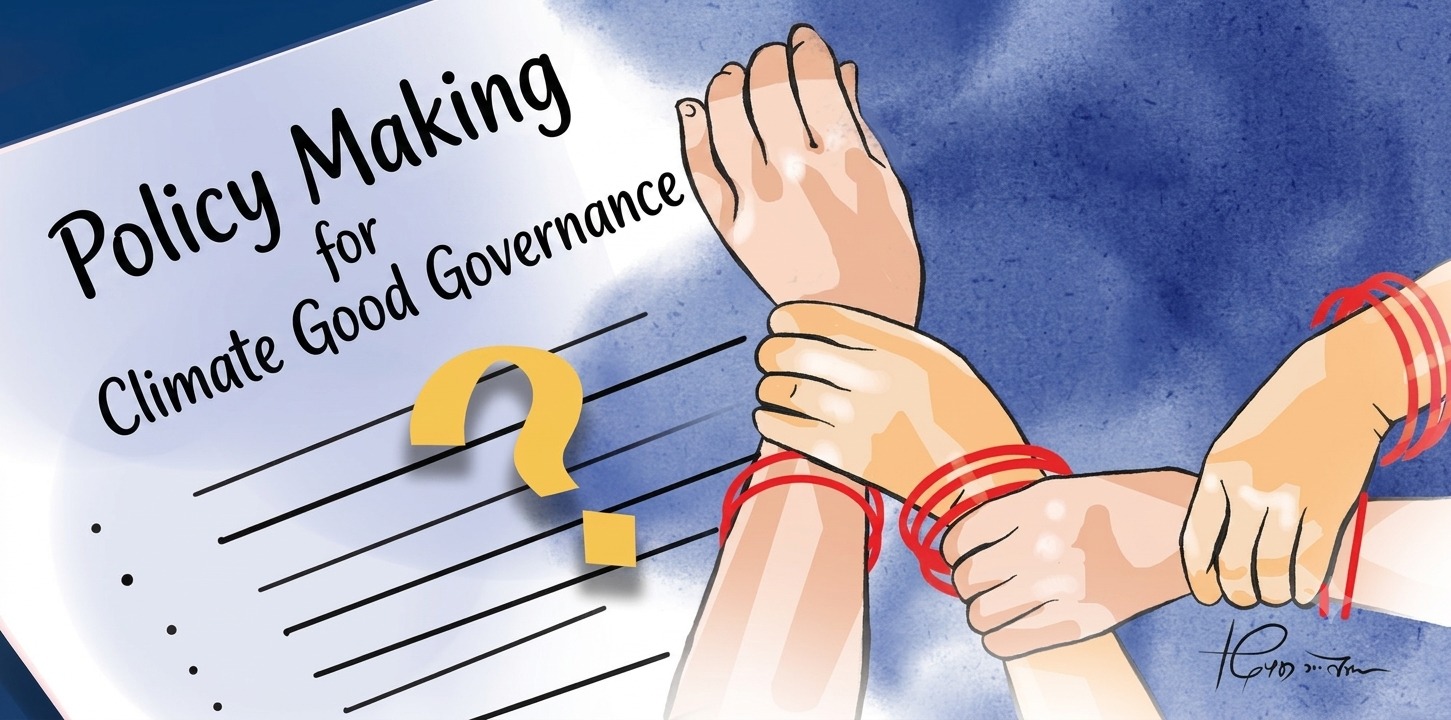
Until the climate change debate is extracted from the confines of physical infrastructure construction and linked with human rights and public health, the journey toward sustainable development and good governance in any sector cannot be completed.
KATHMANDU: The principles of good governance guarantee the fundamental rights of citizens. This includes the right to health enshrined in Article 38 of the Constitution of Nepal, as well as the Safe Motherhood and Reproductive Health Rights Act, 2018. However, the implementation of these legal provisions of good governance has been disrupted by disasters triggered by climate change. When roads and health posts are damaged due to landslides in hilly districts and floods in the Terai, access to emergency obstetric care and safe abortion services is severed.
Due to climate-induced disasters, water sources are drying up in the hills, and safe, separate toilets are lacking in temporary camps for those displaced by floods in the Terai, depriving women of menstrual hygiene management. Consequently, their right to health and the right to live with dignity are violated. When agriculture is devastated by climate change, economic insecurity rises. As a result, incidents of child marriage, school dropouts, and gender-based violence have increased in the Terai region.
When observing the multidimensional impacts of climate change in Nepal, it is evident that it profoundly affects not only geographical boundaries but also social and gender lines. As Nepal progresses in practicing federalism, the interrelationship between ‘climate governance’ from the grassroots to the center and the gender perspective therein is not just a matter of policy debate; it is directly linked to the daily survival and adaptive capacity of citizens at all levels. Its vibrant practice and reality from the local level to the federal government can be understood as a continuous process.
Using Lumbini Province as an example, this article presents federal arrangements and policy recommendations, focusing on how existing climate governance frameworks address the sensitivities of reproductive health and identifying the policy and structural gaps that exist.
Climate governance in Lumbini province
Climate governance is the system that ensures transparency, accountability, public participation, and adherence to the rule of law in decision-making processes intended to mitigate and adapt to the impacts of climate change. It emphasizes equitable development by optimally utilizing climate funds and resources. The Government of Nepal has prepared a framework for climate governance down to the local level through the National Climate Change Policy, 2019 and the Local Adaptation Plan for Action (LAPA) Framework, 2019. The Lumbini Province government has formulated its policies accordingly. However, numerous weaknesses regarding good governance are visible in those policies. There is an absolute lack of policy or implementation coordination between the Ministry of Industry, Tourism, Forest and Environment, which oversees climate policy and budgets, and the Ministry of Health, which oversees reproductive health.
In the climate policy, health is covered only as a general point, failing to specify reproductive health and gender sensitivity. Under federalism, the responsibility for health and disaster management is delegated to local governments (per the Local Government Operation Act, 2017). However, many local levels in Lumbini Province lack the technical capacity and legal consultation required to formulate integrated plans that incorporate the interrelationship between climate and health.
Financial governance and budget allocation
The strongest indicator of good governance is the equitable and transparent distribution of budgets. Although the concept of gender-responsive budgeting exists in Nepal, it has not been effectively applied to climate finance. Our budgeting remains infrastructure-oriented. Local levels spend more than 80 percent of their climate adaptation or disaster management funds on road blacktopping, embankment construction, and filling gabion wires. Budgets are not allocated for primary public health matters, such as the Minimum Initial Service Package required for women during disasters. Due to a lack of transparency and accountability, information regarding where and how funds coming from international climate funds and the national budget to the provincial and local levels are spent fails to reach the targeted groups—women and marginalized communities. This represents a severe drought in financial governance.
Climate change is no longer just a global crisis; it has become a compelling reality in the daily lives of Nepal’s villages and towns. In some places, fields lie fallow due to the lack of timely rain; in others, unseasonal rains have destroyed paddy crops; and elsewhere, age-old water sources are suddenly drying up due to drought. Highly diverse in its geography, Lumbini Province is not immune to this environmental crisis. Stretching from the fertile plains of the Terai to the hills of the Mahabharat Range, the impacts of climate change are manifesting differently across this province.
To tackle the climate change crisis and enhance the adaptive capacity of local communities, the Government of Nepal introduced the Local Adaptation Plan for Action (LAPA). What is the status of ‘LAPA’ across the municipalities of Lumbini Province? How many municipalities have embraced it, and how many are still in confusion? This has become the subject of today’s debate.
Geographical diversity and ‘LAPA’
There are a total of 109 local levels in Lumbini Province, which include four sub-metropolitan cities, 32 municipalities, and 73 rural municipalities. The needs of these municipalities vary based on geography and ecological vulnerability. For instance, municipalities in Bardiya and Banke face risks of floods and inundation, while hilly municipalities in Arghakhanchi, Gulmi, and Rolpa bear the brunt of droughts, forest fires, and landslides.
Under these circumstances, there is no alternative to mitigating climate risks by planning at the local level itself. ‘LAPA’ is a strategic tool that formulates climate adaptation programs through the participation of grassroots citizens and helps align local budgets to be climate-resilient. In 70 to 75 percent of the municipalities in Lumbini Province, LAPA is either formulated in some shape or is in the implementation stage. Especially in the municipalities of Dang, Banke, Bardiya, and Kapilvastu—where various international donor agencies worked alongside government bodies—the impact of LAPA is visibly strong.
Municipalities in these areas have altered their traditional style of development after implementing LAPA. Municipalities that previously equated development solely with digging roads have now started allocating budgets under climate headings. Tasks such as building bio-embankments in flood-prone areas, constructing emergency shelters, and reviving ponds in dry areas have been prioritized by local bodies here. Some rural municipalities in hilly districts have even introduced programs like ‘One Ward, One Pond’ to conserve water sources, which is a positive practice built upon the foundation of LAPA.
Conversely, about 25 to 30 percent of the municipalities in Lumbini Province remain far from the full implementation of LAPA. This situation is caused not just by a lack of willpower, but by certain structural challenges and problems.
Urban Disinterest: This issue is not prioritized by urban municipalities. Major sub-metropolitan cities and municipalities in the province seem to view climate change merely as a rural or agricultural problem. Due to growing concrete structures, temperature rises in cities and artificial flooding caused by the lack of proper drainage are becoming severe. Yet, the formulation of city-centric LAPAs remains slow.
Resource and Skill Deficits: Several remote rural municipalities in Rukum East, Rolpa, and Pyuthan (which are highly vulnerable due to their terrain) lack the budget to hire climate experts out of their own resources to draft plans. Where external projects could not reach, LAPAs have not been created.
Plans Confined to Paper: This is the most damaging trend. In some municipalities, LAPA documents were prepared with donor assistance or merely for display, but they were never integrated into the municipality’s core annual policies, programs, and budgets. Consequently, the document was created, but it ended up confined to shelves.
Provincial structure and strategic vacuum
Province governments are envisioned as vital strategic links between the grassroots reality of the local level and the high policy-making level of the federal government. Provincial ministries and provincial planning commissions are practicing the formulation of climate strategies and plans suited to their regions. However, the greatest challenge at the provincial level lies in the lack of clarity in perspective.
At the provincial level, climate change is still traditionally viewed as a technical or environmental issue (such as infrastructure building or forest conservation), while gender equality is seen merely as a social aspect of women’s development. The interrelationship between these two issues is poorly understood. There is a persistent lack of technical capacity to mainstream into provincial budgets and plans how the climate crisis exacerbates gender inequality and how climate resilience is impossible without women’s leadership.
The federal government and commitments
The federal government is the primary venue for policy formulation and resource mobilization. The Constitution of Nepal, 2015 laid the foundation for equality and social justice. Built upon that foundation, the National Climate Change Policy, 2019 clearly vows to mainstream gender equality and social inclusion into climate adaptation programs. However, the biggest challenge at the federal level lies in execution. Excellent policies, procedures, and gender-responsive budgeting principles drafted at the center turn weak by the time they reach the local level. Administrative and technical complexities persist, preventing climate finance brought by the federal government from international levels from reaching grassroots women and vulnerable communities directly.
If climate governance from the local to the federal level in Nepal is to be made truly gender-responsive, the perspective of viewing women merely as ‘victims’ or ‘beneficiaries’ of climate change must change. Women are the stewards of natural resource management and repositories of traditional knowledge. The primary direction of climate governance in federal Nepal must focus on conducting gender audits of climate budgets allocated at the local level, increasing climate-resilient technology and financial literacy for rural women farmers, and establishing not just the numerical presence but the qualitative and meaningful leadership of women at every level of policy-making.
Climate governance encompasses the overall process of policy decisions, legal frameworks, institutional structures, and resource mobilization deployed to address the challenges of climate change. Within Nepal’s federal structure, Lumbini Province is at the forefront of climate-induced vulnerabilities from geographical and socio-economic perspectives. The northern hilly region, such as Palpa, faces severe soil erosion, landslides, and drying water sources, while the southern Terai, such as Kapilvastu, faces challenges of floods, extreme rainfall, and cold waves. These environmental crises directly impact the sexual and reproductive health and rights of women and marginalized communities in those areas.
The way forward for climate governance
If Lumbini Province is to be made climate-resilient, it is essential to change strategies. LAPA should not be just a non-governmental organization or project report; it must be the roadmap for a municipality’s development. The province government must not delay providing technical and financial support to the remaining municipalities to formulate LAPAs immediately. Furthermore, completed plans must be executed by linking them with the routine budgets of the municipalities. Environmental impact assessments when constructing roads, adopting eco-friendly technologies rather than just basic engineering, and imparting climate awareness to communities must be carried out in an integrated manner.
In conclusion, the mixed enthusiasm shown by the local levels of Lumbini Province in implementing LAPA must now be turned into an integrated and mandatory national agenda. The climate crisis does not recognize municipal boundaries or political parties. Therefore, all 109 municipalities of this province must treat climate adaptation as a matter of their survival and show urgency in formulating LAPAs.
Policy recommendations
To guarantee sexual and reproductive health rights amidst climate change in Lumbini Province, a ‘Robust Climate Governance’ model is required. For this, the following steps must be taken: A joint ‘Integrated Climate-Health Taskforce’ comprising the Ministry of Environment, the Ministry of Health, and the Provincial Disaster Management Executive Committee should be formed at the provincial level.
The province government must introduce binding legal provisions making it mandatory for every Local Adaptation Plan for Action formulated at the local level to mainstream health and gender equality.
Indicators should be developed when auditing climate budgets to measure how much the budget contributed to women’s reproductive health, the reduction of gender-based violence, and menstrual hygiene.
The Provincial Planning Commission should establish a research-oriented mechanism to collect intersectional data on the actual impact of climate change on women’s reproductive health across the diverse geographical districts of Lumbini Province.
The representation of women, adolescent girls, and marginalized communities in local and provincial disaster management committees must be ensured not just numerically, but in the decisive processes of budget approval and project selection.
Lumbini Province’s journey toward sustainable development and good governance cannot be fulfilled until the climate change debate is taken out of the perimeter of ‘cement and infrastructure’ and joined with ‘human rights and public health’. Protecting the sexual and reproductive health and rights of women from hilly gorges to the flat terrains of the Terai is the primary good-governance responsibility of the state. To achieve this, policy clarity, institutional coordination, and equitable financial management are the foremost needs of today.