Kathmandu
Friday, July 17, 2026





The death of Ganesh Nepali and the plight of displaced landless families reveal how easily empathy is sacrificed for political loyalty. Democracy demands accountability, due process, and compassion—not unquestioning faith in those who wield power.
KATHMANDU: Who does not cherish the desire to live? It is said that even a person who has lived a full life and reached their final moments wishes to see the world for just one more second. It is only through having life that the experience of happiness, sorrow, enjoyment, and bliss is possible. If life itself is gone, who knows what exists and what does not? In such a situation, how can a youth, just beginning to blend with the colors of life, throw away his precious life over a minor dispute? If one were allowed to live the dream one saw and the life one chose, who could lay down this once-in-a-lifetime existence just like that? Can anyone choose the most painful death out of momentary impulse and whim? Can one find the courage to endure the unbearable agony of setting one’s own body on fire and being scorched?
On July 9, 25-year-old Ganesh Nepali sprinkled petrol on his body and set himself on fire in front of the Department of Passport in Tripureshwar, Kathmandu. He passed away during treatment at Bir Hospital, with about 55 percent of his body affected by burns. Following this heart-wrenching death of Ganesh, who had come to Kathmandu from the remote Himalayan district of Mugu and was making a living by ride-sharing on a bike bought in installments, the entire country was divided into pro and con arguments.
The opposition blamed the state for Ganesh’s death. They held responsible the government policy that prioritized heavy fines focused on revenue collection over efficiency in road infrastructure and parking management. The government side, however, tried to evade responsibility by blaming the Kathmandu Metropolitan City, claiming the incident happened due to the action of the local level’s municipal police. Similarly, some members of parliament from the ruling Rastriya Swatantra Party (RSP) questioned the victim’s mental state itself. Even stranger scenes were witnessed on social media, where this party’s cadres went a step further, demeaning the victim to defend the government.
We cannot even begin to imagine how many harrowing days a Dalit youth must have spent until the moment he set his own body on fire, having come to Kathmandu seeking opportunity from poor, and another remote place in Karnali, the most underdeveloped region in Nepal. We haven’t even seen his life. For us, whose feelings of empathy are weakening, we do not know the distance of the journey he covered and the weight of the responsibility he carried on his back. We are alert in case anyone criticizes the government. At this cost, we are ready to erase tolerance, kindness, compassion, and the heart that understands the plight of the poor from our minds. Some of us indirectly slapped a mentally ill tag on him, some directly called him a coward and useless. We called him a runaway who hid his tail from the struggle to survive.
Another incident this week also made waves across the country. In the second week of May, the government had cleared the disorganized settlements along the riverbanks in Kathmandu and moved thousands of landless settlers to temporary holding centers. There were incoming news reports that the government had stopped food and water arrangements in those holding centers. News reports were coming in that the state had created such a despicable situation so they would leave the holding center and go elsewhere.
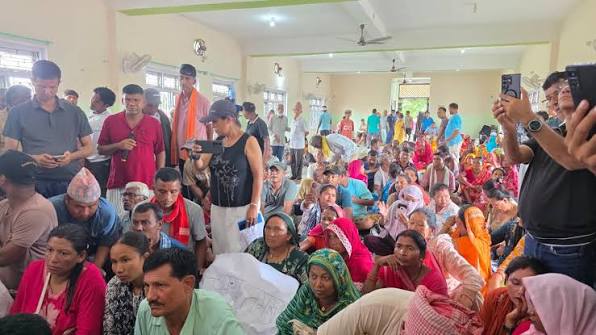
Suddenly one night, the summer flood entered the holding center in Kirtipur and left those landless settlers utterly destitute. Pictures of small babies, the elderly, and the infirm coming out soaked while carrying their meager belongings were seen all over online news portals and social media. Once again, the country was divided into two factions.
This time too, a certain section expressed sympathy towards those whom the authorities haphazardly declared ‘Hukumbasis’ (powerful people living illegally). They raised fingers at Prime Minister Balendra Shah, who led the displacement of landless settlers, arguing that he cleared the riverbank residents to save them from floods. “Floods entered the place you moved them to as well, why such irresponsibility?” questions were aimed at him. But his fan base stood firm in defense of their favorite Prime Minister. They said, “Those who ruled for 35 years should take responsibility for this.”
Those who rule for 35 years have already received punishment from public opinion through being rejected, and some leaders have personally suffered consequences through attacks on private property, arson, physical attacks, and even an exit from politics. The punishment for the mistakes, weaknesses, inaction, and lack of foresight of previous governments has already been meted out. Although history will judge this. However, conscious citizens questioning the authority should not be understood as merely opposing the government because they feel compassion for Ganesh Nepali. This is just an expectation that a democratic government should be on the side of the poor. It is also not opposition to the government to say that the management of landless settlers must be done humanely, that they should be removed only after giving options. It is only a wish that the government provides a strong canopy to the lowest class of people in the country.
However, it is a great insult to the people and voters that a government that came with strong public opinion promising to do things differently evades responsibility by giving the blame for everything to the old. Taking credit for the bricks added on the foundation of positive work laid by the old but pointing fingers at others instead of becoming humble and correcting one’s mistakes when weakness is pointed out, is unbecoming. It is a betrayal of oneself to partition off all bad things to those who designed the liberal system in which an ordinary rapper could become the Prime Minister of the country, and ordinary students doing journalism, social service, or debating contemporary issues could themselves become members of parliament and ministers.
Cursing the old for making footpaths disorganized but not giving them the credit for making those very footpaths? Not giving credit for producing electricity, providing internet facility, removing load shedding, building roads, bridges, and culverts, and creating a middle class that now has the capability to overthrow one’s own authority? Being intent on dismantling the institutions and structures that are considered components of the state instead of improving and refining the structures formed from a long struggle for social justice and state restructuring, only confirms one’s weak capacity. Today’s Prime Minister blaming the existing structure of the metropolitan police made when he was mayor, doesn’t that do injustice to himself?
Has the state, focused only on Kathmandu Metropolitan, which is about the size of a small bowl, understood where the country’s geography extends to, and what the scope of the aspirations of the people living in those geographies is? It is surprising to see the children of authority, who have not seen beyond Kathmandu, speaking against federalism which was fought for and brought by the marginalized for identity and rights. It is even sadder to see the current youth generation following behind, being lazy to use their consciousness in the easy comfort of that delusion.
Why is intolerance towards one’s own class awakening in today’s human? This is a matter of search. Suppose someone sits selling leafy vegetables at a crossroads in the evening. A bundle of fresh spinach just picked moments ago costs Rs 50. A slightly withered bundle picked in the morning costs Rs 40. Even the person who lifts the slightly cheaper bundle when buying a bundle of spinach is cursing the poor on Facebook today. He is amused that the Prime Minister advertised cheese. But he, who eats donut dipped in black tea for a snack, doesn’t yet know the taste of cheese. But still, he is happy at the displacement of another poor person. How is this paradox growing?
In an advanced democracy, conscious people sit above the government they chose and caution it. They don’t sit under its boot and show loyalty. But when he hears a minister saying that Nepalis became undisciplined, they must be made to carry a heavy burden of punishments and fines, he says it is correct. He has not thought about what he will do if that plague of fines catches up to him too.
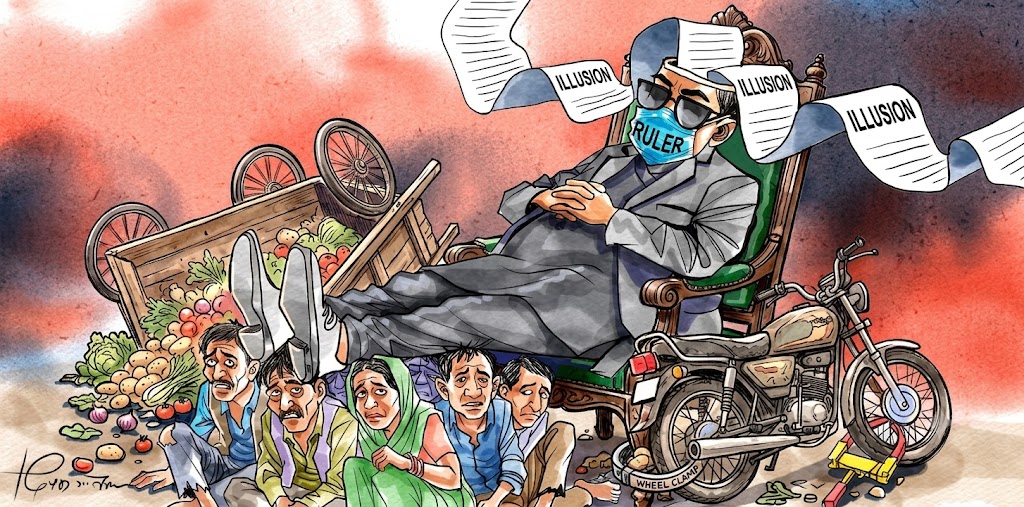
When told that the contractor who doesn’t work on time should be tied and beaten, he says it is correct. But he doesn’t know what kind of rope is needed to tie a minister who doesn’t work according to public expectations. A pushcart vendor on the roadside receives punishment; a minister selling books on the roadside receives praise. A squatter loses the thin tin shack he stayed in, sheltering both his dreams and future, at the whim of the state. But a minister desires to set up a bed inside a government office and gets that facility laughingly. He questions no one about this different standard.
He is utterly amused just seeing people dressed neatly, with meticulously arranged beards, wearing black sunglasses, sitting on the chairs of authority. He doesn’t ask how those who until yesterday walked around with YouTubers behind them in the name of social service, and were raining down abuse on social media, suddenly became rich. He doesn’t seek the source of their hundreds of tolas of gold and kilos of silver. He doesn’t look at millions of properties with questioning eyes.
Why is the stock market going downhill today? Why has confidence not awakened in investors? Why are employees in terror, he doesn’t understand. Bearing a brain full of hatred, he thinks that the country will be built only by locking, terrifying, beating, and hitting everyone. But he doesn’t know that the country built in that way is only North Korea.
Today’s bewildered youth was sick of always seeing that same old face in authority and government. Today he is overjoyed seeing youths glowing like freshly cut cucumber slices sitting in authority. He has met in real life the romance that cinema gives on the screen. Politics is so entertaining, he has just come to know. Algorithm had put earlier governments as Ravana in his mind. He is satisfied just thinking that his Ram has killed those ten-headed Ravana today. In his eyes, procedure is the villain, constitution and law are villains. Without striking them down with a sword, this country won’t be built. But he doesn’t know that a country with a civilized society and advanced system runs only by procedure. He doesn’t know at all that democracy stays alive only through questions.
The society that runs by rules, laws, procedure, and process is democratic. This path is somewhat slow. But it reduces the scope of injustice quite a bit. In this system that protects the minority while governing by majority, there is no thrill that increases adrenaline. There are no surprises of twist and turn. That some leader is just caught overnight. That the social media heats up with news of the Home Minister picking someone up from their home after writing good morning on social media, then real adventure comes! Who would like uninspiring debates in parliament.
That someone is allowed to say I didn’t find this right, it didn’t find it right because of this reason, this very thing is democracy. But here there are those who take away someone’s reputation saying our elder brother must have said it right, who are you to oppose. They think, let our country also become clean and neat like foreign countries where only stylish people are seen on the roadside. Isn’t it shameful when ragged poor people are seen driving pushcarts, roasting corn, and sitting at every roadside to sell ginger, turmeric, and Shilajit?
They need Hitler. Failing that, Jung Bahadur Rana or at least King Mahendra is needed. But he has not understood how much harrowing time the world and Nepal endured due to these anti-heroes. Jung Bahadur also imposed a heavier autocracy than that sought by a certain section now. That had given a stable authority of a temporary nature for that period. But did the country become heaven in that 103 years of rule? Grand palaces were built then too. But was it for the general public? A system built in the shadow of forcibly imposed discipline and fear is never sustainable. The longer it prolongs, the further backward the country goes.
Only a gradual movement of consciousness makes a person civilized and disciplined. Man has arrived at today’s stage only with slow branching out of sprouts of lakhs of years of consciousness. It has been only a few thousand years since man learned to wear clothes, wash hands, cook and eat. The system we embraced has also come only a few decades ago. Countries that have become adept in procedure, method, morality, development, and intellectuality some hundreds of years ago cannot be equivalent examples for us.
Tall buildings like foreign countries may be built gradually, initially our first job is to give basic facility, equal opportunity, and empathy to the weak like theirs. Smooth roads like theirs may also be built, our first responsibility is to make the calves of our people walking there strong. Any path is initially made by the steps of people walking. Only after that road is built there and vehicles run. Any city is initially made habitable by working laborers. Only after that capitalists are born on that foundation. Therefore, no tree can flourish by killing the roots. Choosing those who know is not for nothing, it is so that they move along with the laws of science.
Let us understand this much, we need policy, not control. We need voluntary discipline, not a rule imposed by force. We need freedom, not autocracy. Going slow will surely get us there, in a rush one cannot say, this is our own traffic police’s slogan. Let’s drive a break-less express vehicle after four-lane highway is built, for now Balen, let’s travel safely improving the two-lane highway that always closes in monsoon, okay! This is a country, right, it won’t be built by beating anyone, and it won’t be built by running in a rush either.