Kathmandu
Friday, July 24, 2026





The rapid decline of traditional Shamans is making it harder for Kirat communities to perform ancestral rituals, raising concerns that the erosion of a centuries-old spiritual tradition could also mean the loss of cultural identity and heritage.
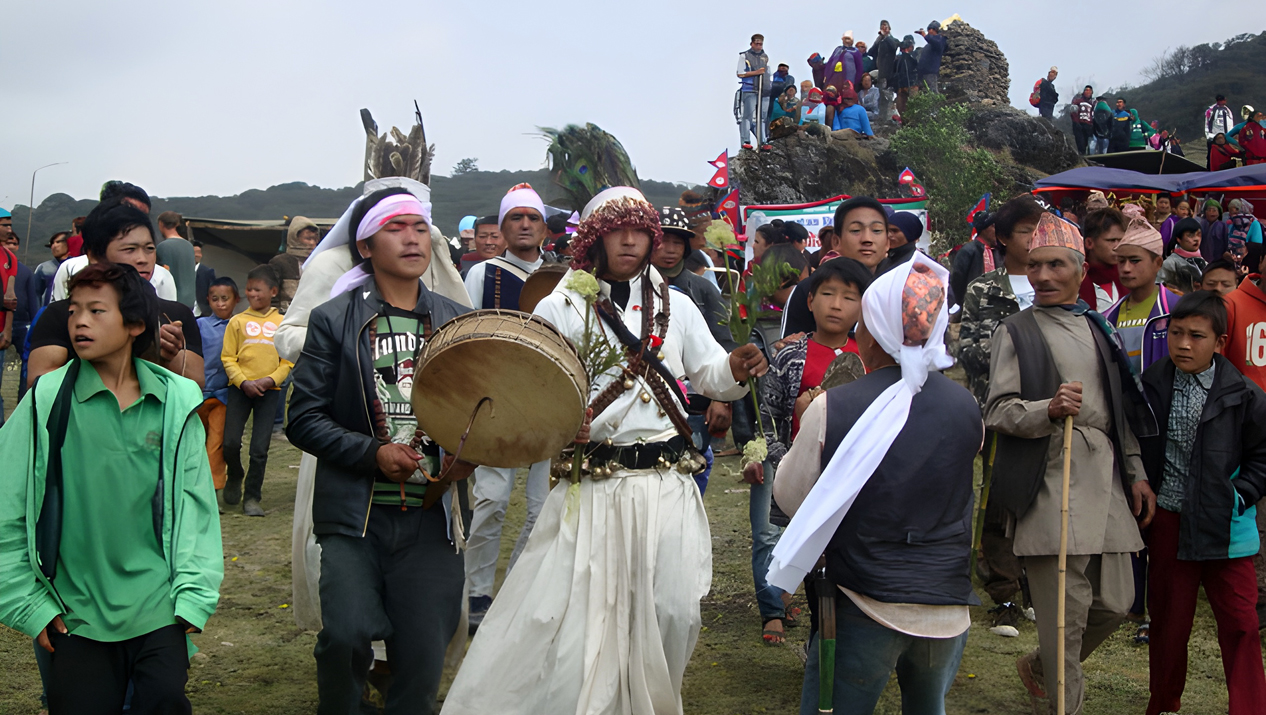
KATHMANDU: When we were children, the village was filled with Dhami (traditional shamans). Back then, in a single settlement of former Timma VDC-3 in Bhojpur (currently Temkemayung Rural Municipality-1)—a village of about a hundred households that was 100% Rai—there were around 12 to 14 Shamans who performed Chinta (shamanic rituals) by playing drums (dhyangro) and brass plates (thal). There were also Shamans who performed chinta without playing any musical instruments. As for Shamans who did not perform full chinta rituals but only engaged in faith healing (jharphuk) and worship, they were present in almost every household. In some families, every single member was a Shaman.
In the surrounding villages, there were equal numbers of Shamans from the Rai and other communities. Throughout the winter, the sound of drums played by Shamans on both sides of the valley would disturb the night’s silence. In the evenings, the dhyang-dhyang rhythmic beat could be heard sometimes from below and sometimes from above. It was a tradition to host and dance with a Shaman once a year in every home for household peace. The Shaman dance functioned much like a hub for social gatherings and interaction.
For adults, the Shaman represented faith and belief. For children, however, it was an ideal game combined with entertainment. Mimicking the Shamans at work, children walked around beating bamboo thambak (damphu drums), hollow tubes, fuel jugs, and pieces of wood. Adults, however, did not allow them to beat brass plates and would scold them if they tried.
While herding cattle or gathering grass and firewood, children would tie vines or scarves around their heads and stick leafy twigs in them, just as Shamans tucked feathers into their white turbans, and they would jump around beating whatever they found. They would act out violent shivering. In these playful reenactments, someone would play the patient, someone the Shaman, others the Shaman‘s assistants, the homeowner, or spectators.
In school too, whenever the teacher was absent from the classroom or during recess, one or two boys would instantly emerge as Shamans. Some would jump around shouting “Ha-ha, Hu-hu” while tapping their books with pencils or pens, while others hit desks and benches to assist the Shaman actor. The boys loved to imitate the more famous local Shamans.
The wheel of time kept spinning. The elderly Shamans of those days passed away. The young Shamans of that era grew old. The children who once enjoyed playing Shaman grew up; some became bound by household responsibilities, while others scattered to different places. The new generation stopped becoming Shamans altogether. Today, in that very village, there are only two Shamans left who beat the drum: Tankaraj and Meghraj, sons of the same shaman, Sirkumar. Another Shaman, Dilkumar, is bedridden due to old age. In the surrounding villages, Shamans are even scarcer. Most children today have never even seen a Shaman dance up close.
Cultural leaders
Kirat society considers the Shaman to be a leader. This is known as the Shaman system. Sociologists and anthropologists call it “shamanism.” The shamanic tradition exists all over the world. Almost all castes and communities in Nepal have a shamanic tradition. In most communities, the significance of the shaman is limited to a specific segment of the community. However, in Kirat society, the Shaman serves as the social and cultural leadership—it is both the heart and brain of the society.
The Shaman plays three roles in Kirat society. First executing social rituals from a person’s birth to death. Second communicating with ancestors, spirits, and nature to keep them pleased. Three healing the sick through jharphuk (faith healing rituals). The goal of all three roles of the Shaman is to make nature and ancestors happy, thereby ensuring peace, good health, and longevity for humanity.
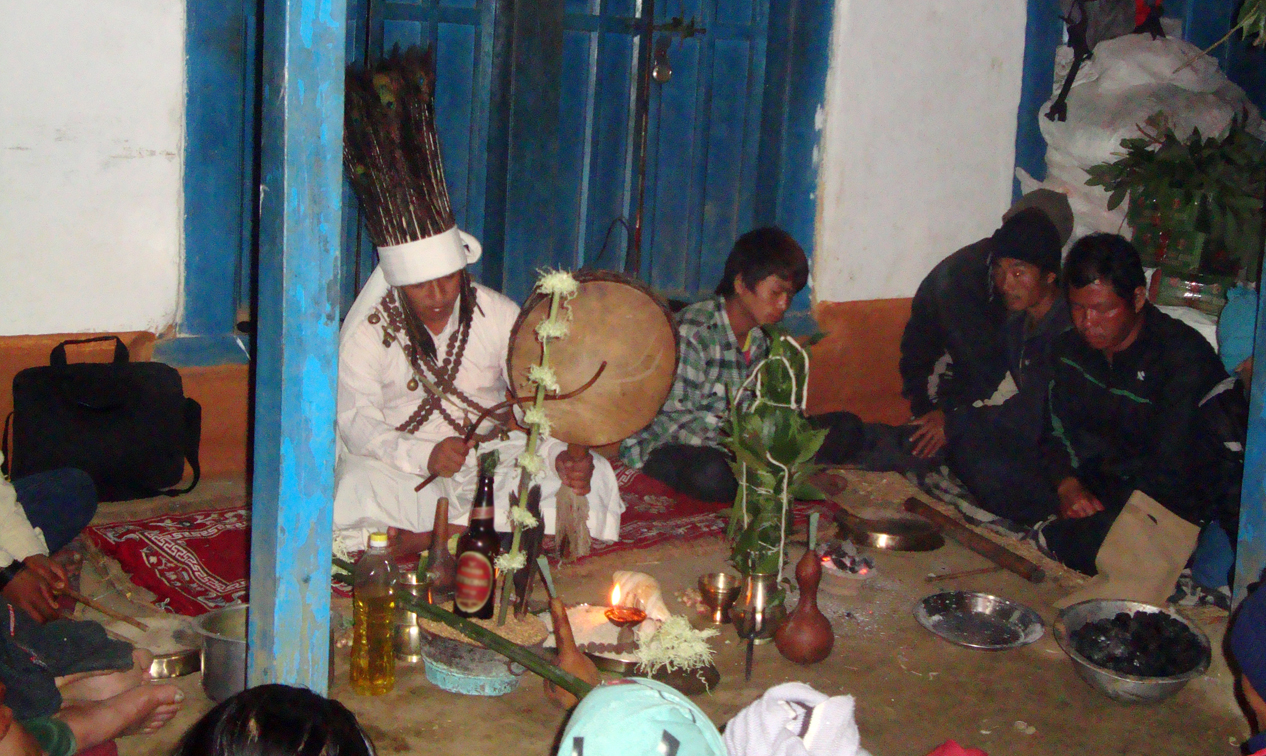
Young Shaman Mani Rai.
Sociologists view the Shaman as a communicator between the worldly/physical realm and the otherworldly/spiritual realm. The physical world can be seen and experienced by every individual, but the spiritual realm is not accessible to everyone. One can reach the spiritual world only after detaching from the physical world. Death is not the end of a human life; it is merely a transformation. Death is entering the spiritual realm from the physical world; it is the separation of the soul from the physical body. The soul does not die.
Deceased ancestors reside around us in the form of spirits. It is believed that seeing them requires special eyes, and such eyes and powers reside within the Shaman. Shamans play the role of communicating with spirits to guide physical humans toward peace, health, and prosperity. Since all rites of passage from life to death are dimensions of communication between the physical world and the spiritual world, it is traditional in Kirat society to perform all rituals under the leadership of a Shaman.
Obstacles in rituals as Shamans disappear
After birth, the naming ceremony (nwaran), solid food feeding (pasni), hair-cutting/first saree ceremony (chewar/gunyu-choli), marriage, and funeral rites are the main rituals in Kirat society. The primary and most complex ritual is the funeral rite.
Because Kirat society is multi-ethnic, multi-regional, multi-cultural, and multi-dimensional, rituals vary by location, yet fundamental beliefs, values, and themes remain similar. Rituals from birth to marriage generally proceed normally.
According to Kirat belief, a person’s death is the departure of the soul from the body. The age and cause of death determine where the soul resides. Those who die of natural causes in old age reside at the three-stone hearth. Those who suffer a premature death near old age reside at the eaves of the roof. Children reside in the flower garden. Shamans and hunters reside in remote, pure locations free from human encroachment. The souls of young people who die prematurely are unstable and restless. Premature deaths include accidents, suicides, homicides, and deaths due to childbirth.
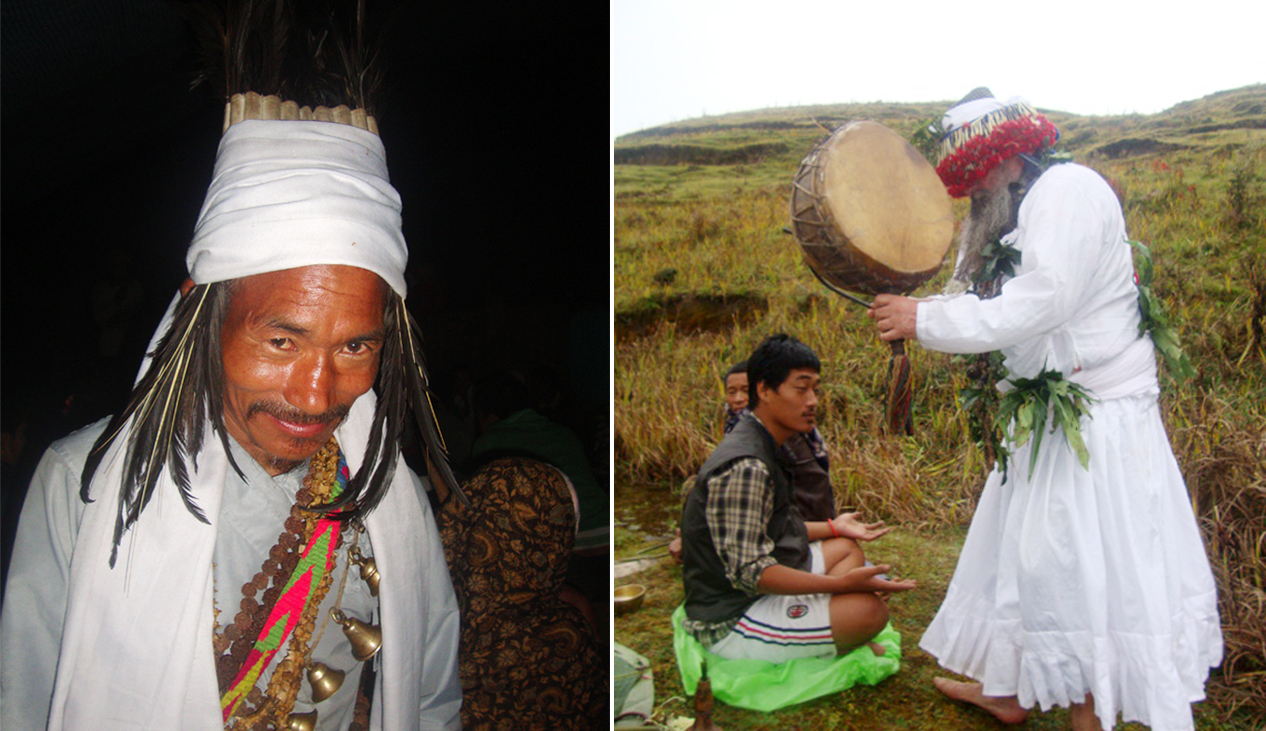
Shaman Meghraj Rai (left), Austrian (European) Shaman Rupert Huber.
It is the job of the Shaman to communicate with spirits, understand their wishes, and guide and settle them in their appropriate domain. Managing the restless souls of young people who suffered premature deaths in a proper way and place is the most challenging task for a Shaman. Cultural belief holds that if a restless spirit is not managed correctly, it becomes destructive and brings suffering to everyone. Therefore, not just any Shaman can perform this task simply by being a shaman. It requires a Shaman with extraordinary powers and capabilities, and such Shamans are few in number.
The disappearance of Shamans is impacting Kirati rituals. It is even more difficult in urban areas. Although shamans who set up shop to conduct commercial trading in the name of treatment are widespread in towns and cities, authentic ritual Shamans of the Kirat culture are fast disappearing.
The disappearance of Shamans might not make much of a difference to other societies, but it shakes the very roots of Kirat society. When the roots are shaken, the tree falls—meaning the essential “Kiratness” of Kirat society comes to an end. How? Without Shamans to perform traditional rituals, conversion finds an opportunity, and that trend accelerates.
It is observed that Kirat Rais who have separated from their ancestral homelands and live in small numbers have converted to other religions precisely due to difficulties in performing death rituals. Some are using Hindu Brahmin priests for every ritual, while others have undergone Christianization. Some are employing Buddhist lamas.
Many have to bring in Shamans all the way from far-off ancestral homelands by paying for two-way transportation or travel expenses, generous compensation, and other facilities to conduct rituals. Doing so is not only expensive but also unsustainable. Moreover, as Shamans become scarce in the ancestral homelands as well, even this option seems increasingly impossible.
If the current situation continues, Shamans will almost completely disappear within the next decade or two. The few remaining individuals will not be able to cover everywhere. They will become extremely expensive, beyond what ordinary people can afford. One way or another, rituals must be performed. For that, priests from other communities will have to be brought in—which is only possible through religious conversion. As a result, the society and community as a whole will lose its originality and identity.