Kathmandu
Sunday, July 12, 2026





One year after Nepal was placed on the Financial Action Task Force (FATF) grey list, negative impacts have begun to appear in foreign investment, banking transactions, remittances, and trade
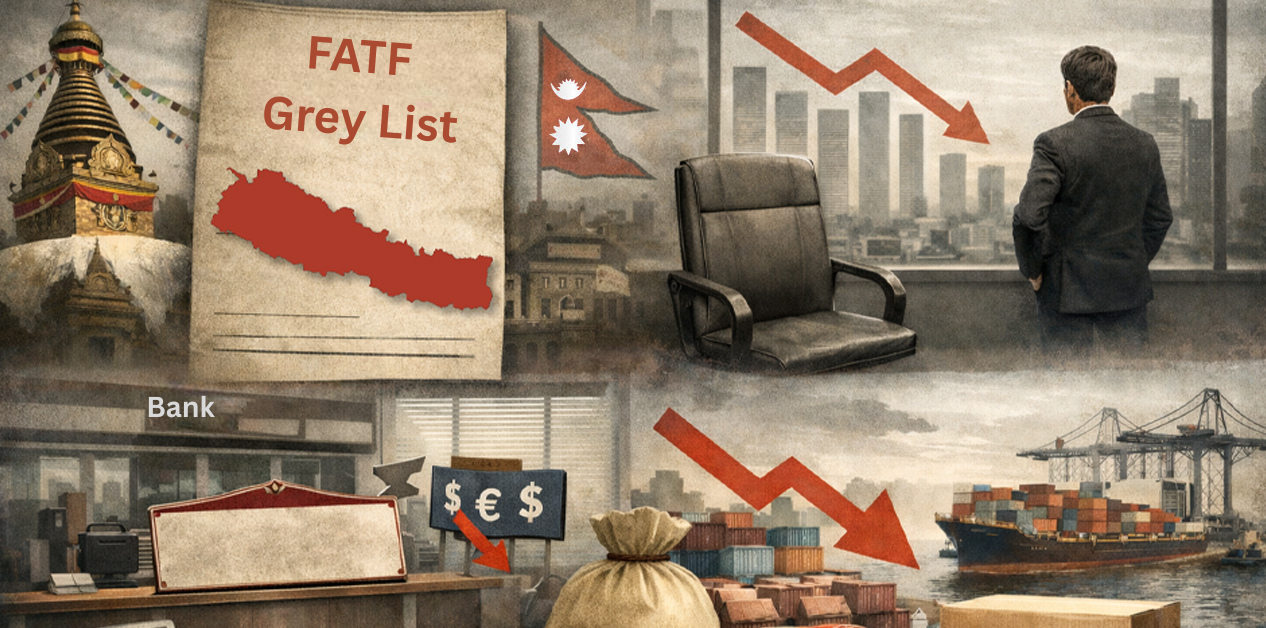
KATHMANDU: As one year has passed since the international watchdog on money laundering, the Financial Action Task Force (FATF), placed Nepal on its grey list, the effects are now becoming visible in the economy. Nepal was included on the grey list in February 2025.
While Nepal remains on the grey list, multidimensional impacts have started to emerge, including a decline in foreign direct investment, costlier and slower banking transactions, complications in sending and receiving remittances, questions over international credibility, and disruptions in trade activities.
A 2021 study by the International Monetary Fund (IMF) showed that grey listing negatively affects capital inflows to Nepal. The study estimated that capital inflows could decline by an average of 7.6 percent of gross domestic product (GDP), while foreign direct investment could drop by an average of 3 percent of GDP. Now, a year after Nepal was placed on the grey list for the second time, stricter measures have begun to affect cross-border payments, remittances, foreign investment, and even visa issuance for Nepali citizens.
International Monetary Fund (IMF)
To understand the extent of the impact, consider an example. In the last week of February 2026, Sabina Khadka (name changed) applied to participate in an international workshop held in Bangkok, Thailand. The organizers approved her participation, and she applied for a visa. She had booked a flight for midnight on February 27, but her visa was only issued at 8:30 pm that same night.
However, this was not achieved through her effort alone. Only after using connections with high-level officials did the Thai Embassy in Kathmandu complete her visa process, allowing her to fly to Bangkok. Recalling the incident, she says, “That workshop was extremely important for me and a big opportunity. I had already booked round-trip tickets and a hotel, spending both time and money. But I had to struggle a lot to get the visa. Getting it just three hours before the flight felt like a miracle.”
European countries have started demanding additional documents to verify applicants’ identities in detail. Some applicants are even asked to attend video calls to show their offices and provide clear proof of business transactions. Countries like Vietnam and Malaysia have also increased scrutiny while issuing visas.
Khadka is not alone in facing such difficulties. In recent times, even visa applications of government employees have been rejected. Officials say that even senior staff of Nepal Rastra Bank have been denied visas.
In recent times, Asian countries such as Thailand, Hong Kong, and the United Arab Emirates (UAE) have tightened visa issuance for Nepalis. Additionally, travel agency officials say that countries including those in the European Union (EU), as well as the United States and Canada, have also become stricter compared to before.
Madhav Kandel, managing director of Flights Gyani Pvt Ltd, a travel and tours company, says, “Many countries are imposing strict conditions on visas for Nepalis. A large number of applications for the US and European countries are being rejected. Even individuals with strong profiles are finding it difficult to obtain visas.”
The European Union has listed Nepal as a “high-risk third country.” This classification was made through Delegated Regulation 2025/1184, issued on June 10, 2025, amending Delegated Regulation 2016/1675. Clause 14 of the amended regulation states that Nepal remains under FATF monitoring and has not fully addressed the core reasons for its grey listing, thus warranting its classification as a high-risk third country.
The grey list has damaged the country’s image. Its direct impact is being seen on foreign investment, and it is also influencing how international institutions treat Nepal.
This classification affects how European countries treat Nepal. The recent tightening of visa issuance by European nations is largely due to Nepal being categorized as a high-risk country. Travel operators say that countries like Thailand, Hong Kong, and the UAE have also increased scrutiny when issuing visas due to Nepal’s grey list status.
Kandel adds, “European countries have started demanding additional documents to verify applicants’ identities in detail. Some applicants are even asked to attend video calls to show their offices and provide clear proof of business transactions. Countries like Vietnam and Malaysia have also increased scrutiny while issuing visas.”
According to Kandel, the UAE has even begun charging Rs 16,000 per applicant under the pretext of verifying police reports issued by Nepal Police for tourist visas. The UAE itself was placed on the FATF grey list in March 2022 but exited within two years after improving financial discipline.
Being on the grey list also tarnishes Nepal’s international image. It signals that the country is associated with financial crimes such as money laundering and terrorist financing.
The impact of grey listing does not immediately reach citizens’ kitchens, but it changes how the international community perceives and treats the country. Economist and former executive director of Nepal Rastra Bank, Nara Bahadur Thapa, says, “Bilateral and multilateral donors begin to view the country with suspicion. Overall national confidence declines.”
The grey list has also begun to directly affect the banking and financial sector. Bankers say international banks dealing with Nepal have increased risk assessments. Additional paperwork, verification, and monitoring are being imposed on processes for sending or receiving money from abroad.
Another consequence of FATF grey listing is the decline in international reputation and credibility. Institutions such as the IMF, World Bank, and other development partners have started placing greater emphasis on risk assessments when working with Nepal. This increases the complexity of securing new loans, grants, or technical assistance. Nepal is also facing higher interest rates when borrowing from international markets.
Rajan Sharma, general secretary of the Nepal–India Chamber of Commerce and Industry (NICCI), says, “The grey list has damaged the country’s image. Its direct impact is being seen on foreign investment, and it is also influencing how international institutions treat Nepal.”
The most immediate impact of being on the grey list is seen in foreign investment. Once a country is identified as high-risk in terms of financial transactions, foreign investors hesitate to enter Nepal. Even if they make investment plans, they often withdraw later. Data on foreign investment commitments received by Nepal in the current fiscal year reflects this impact.
By mid-April 2025 of the last fiscal year 2024/25, Nepal had received foreign investment commitments worth around Rs 60 billion. However, in the current fiscal year, such commitments have been limited to Rs 40 billion, according to the Department of Industry. Foreign aid received by the Government of Nepal has also declined significantly. According to the Office of the Financial Comptroller General, the government received Rs 13.24 billion in foreign aid by March 29, 2026, against a target of Rs 53.44 billion for the same period.
Economist Thapa says, “Representatives from various countries assess how effective financial systems, anti-terrorism measures, banking transparency, and regulatory frameworks are in countries like Nepal. If they do not see sufficient improvements according to their standards, it directly impacts foreign aid and international cooperation. Resources ranging from technical to financial assistance begin to decline, hindering long-term development efforts.”
In a remittance-dependent economy like Nepal’s, stricter monitoring and higher costs directly impact the economy. Already, additional checks are causing delays and increasing the cost of sending money from abroad.
The grey list has also begun to directly affect the banking and financial sector. Bankers say international banks dealing with Nepal have increased risk assessments. Additional paperwork, verification, and monitoring are being imposed on processes for sending or receiving money from abroad. Businesses are facing delays and extra costs while opening letters of credit (LCs) for importing goods and services.
Former president of the Federation of Nepalese Chambers of Commerce and Industry (FNCCI), Bhawani Rana, says the business community has started to experience increased complications in opening LCs for imports. “Due to the grey list, foreign investment in Nepal is declining. Additionally, we are hearing that opening LCs for imports has become slower and more complicated,” she says. “The grey list is continuously damaging Nepal’s image.”
To minimize the risk that money earned through corruption or money laundering could be used in international trade, foreign banks and financial institutions are spending more time verifying the identity of individuals or entities opening LCs. If they have doubts, they demand additional documents or require updated details. Payments are approved only after ensuring that transactions are not suspicious.
Ashoke Rana, CEO of Himalayan Bank, says the time required for LC approval has increased as foreign banks conduct additional scrutiny. “As screening of companies or individuals opening LCs has increased, the time taken for approval has also grown. Additional documents must be submitted, which takes more time,” he says.
Delays in payment processes create problems in supply chains for import-export companies. Nepali firms involved in international trade now have to provide more documentation and compliance proof to maintain trust with foreign partners. This has increased trade costs and raised the risk of reduced competitiveness. Ram Krishna Khatiwada, a businessman importing materials for infrastructure projects, says LC approvals now take three to four days. “Previously, LCs would be approved within a day or two. Now it takes three to four days. This may be due to increased scrutiny by foreign banks,” he says.
Thapa adds, “If someone takes a large loan and opens an LC for imports, delays in approval and delivery mean the investor must pay additional interest unnecessarily. This problem has already started.”
The European Union has listed Nepal as a high-risk country. If Nepal remains on the grey list for a long time, it will start attracting attention in foreign media, which could negatively impact the tourism sector.
Kamlesh Agrawal, president of the Nepal Chamber of Commerce, says fees for recognizing Nepal’s LCs in foreign transactions are increasing. “If Nepal remains on the grey list for a long time, there is a risk that LCs could even be rejected,” he says. He also notes that Nepal is being treated as a weaker or less reliable partner in international business relations. As a result, trade credit periods that were previously up to 60 days are now being reduced to 30 or even 20 days, according to Agrawal.
Another sector directly affected by the grey list is remittances. Financial institutions in various countries have increased scrutiny and fees for sending money to Nepal. In a remittance-dependent economy like Nepal’s, stricter monitoring and higher costs directly impact the economy. Already, additional checks are causing delays and increasing the cost of sending money from abroad. If this trend intensifies, there is a risk that funds may shift from formal banking channels to informal systems like hundi, weakening financial transparency. In fact, Nepal’s inability to control hundi transactions is one of the reasons it was placed on the grey list. As hundi transactions increase, not only is the formal financial system affected, but the country also loses revenue, and large sums of money remain outside the regulated system.
Speaking about the impact on remittances, former Nepal Rastra Bank executive director Thapa says, “When a country is on the grey list, additional checks, fees, and risk assessments are imposed on international transactions. As a result, the cost of sending money increases. Even a small percentage increase creates a burden worth billions of rupees due to the large volume of transactions. Ultimately, this affects the income of Nepali households.”

The Nepal Rastra Bank office at Thapathali. Photo: Bikram Rai/Nepal News
Businessman and Nepal Chamber of Commerce president Agrawal says, “We have met the new finance minister and urged him to intensify efforts to exit the grey list. The longer we remain on it, the deeper the impact will become.” Officials from the Chamber met Finance Minister Swarnim Wagle at Singha Durbar on March 31, 2026.
Deepak Raj Joshi, CEO of the Nepal Tourism Board, says that prolonged inclusion on the grey list could also affect tourism. “The European Union has listed Nepal as a high-risk country. If Nepal remains on the grey list for a long time, it will start attracting attention in foreign media, which could negatively impact the tourism sector,” he says.