Kathmandu
Thursday, July 16, 2026





Aiming to turn Nepal's capital market into a stronger engine of economic growth, SEBON's decade-long blueprint targets a market worth more than 150 percent of GDP by 2036 through sweeping reforms, despite a prolonged market slump.

KATHMANDU: Nepal’s securities regulator, the Securities Board of Nepal (SEBON), has unveiled the Capital Market Development Blueprint of Nepal, 2026, a decade-long roadmap prepared under newly appointed chairman Gopal Prasad Bhatta to modernize the country’s capital market.
The blueprint sets ambitious targets for market capitalization, listed companies and trading turnover through sweeping legal, institutional and technological reforms, even as NEPSE remains range-bound and capital gains tax collection has fallen sharply from last year’s record.
What exactly is the Capital Market Development Blueprint 2026 and who has released it?
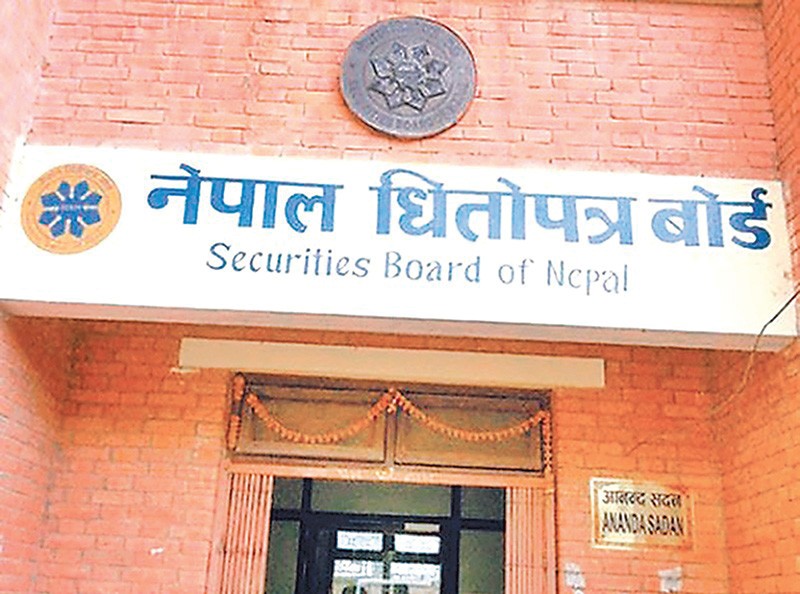
The Capital Market Development Blueprint 2026, officially titled the Capital Market Development Blueprint of Nepal, 2026, is a ten-year strategic document prepared and released by the Securities Board of Nepal (SEBON), the country’s capital market regulator. It was made public from SEBON’s office in Khumaltar, Lalitpur, under the leadership of newly appointed chairman Gopal Prasad Bhatta, and has also been submitted to the Ministry of Finance.
Rather than treating the stock market as a narrow venue for buying and selling shares, the document frames the capital market as what it calls the “second pillar” of national economic development, alongside the traditional banking system. It lays out a phased roadmap covering the first 100 days, two years, five years and ten years, with specific numerical targets for market capitalization, the number of listed companies, daily turnover and investor participation, alongside a long list of legal, institutional and technological reforms SEBON believes are needed to get there.
The blueprint is explicitly positioned as a long-term vision document rather than an immediate action plan, though it does specify near-term steps SEBON says it will begin acting on right away.
Why has SEBON brought this blueprint at this time?
SEBON’s own reasoning, as reflected in its public statements around the blueprint, is that Nepal’s existing legal and institutional framework for capital markets was built for a much simpler market and has not kept pace with how capital markets function internationally. The board has said that while the current Securities Act covers the basic operational aspects of running a market, it fails to address many features of a modern capital market, things like digital securities, alternative investment funds, derivatives or short selling, and therefore needs a comprehensive rewrite rather than piecemeal amendment.

This AI-generated image illustrates potential share market manipulation in Nepal.
Beyond the legal gap, SEBON’s leadership argues that Nepal is entering a new phase of economic development where rapid growth, industrialization, energy expansion, infrastructure build-out, the digital economy and job creation cannot be financed by a traditional bank-centred financial system alone.
In this framing, deepening the capital market is not an end in itself but a way to mobilize long-term capital for productive sectors that bank lending alone struggles to fund adequately, while also giving retail savers more sophisticated ways to participate in that growth.
Who is Gopal Prasad Bhatta and how does his appointment connect to the blueprint?
Gopal Prasad Bhatta was appointed chairman of SEBON by a Cabinet meeting held on June 19. Before this appointment, he served as an executive director at Nepal Rastra Bank, the central bank, and his academic and professional background is specifically in capital markets, which distinguishes his appointment from some previous SEBON leadership changes.
According to SEBON’s own account, after taking charge of the board Bhatta held consultations with Finance Minister Swarnim Wagle on capital market reform, and it was on the basis of those discussions that he prepared the ten-year roadmap covering 2026 to 2036. The blueprint is, in effect, the flagship initiative of his early tenure, released within weeks of his appointment, and it carries his personal framing of the capital market’s role in the economy, including his public explanation of tools like short selling.
His NRB background is notable because it links the blueprint’s implementation, at least informally, to an official who has already worked inside Nepal’s monetary and financial-stability apparatus.
What is the current size and state of Nepal’s capital market that the blueprint starts from?
According to figures cited in the blueprint, Nepal’s overall economy is currently valued at roughly Rs 6,600 billion. Against that base, the market capitalization of companies listed on the Nepal Stock Exchange (NEPSE) stood at about Rs 4,656 billion, equivalent to roughly 74 percent of GDP, with 297 companies listed on the exchange as of the most recent count. Daily average trading turnover was around Rs 8 billion.

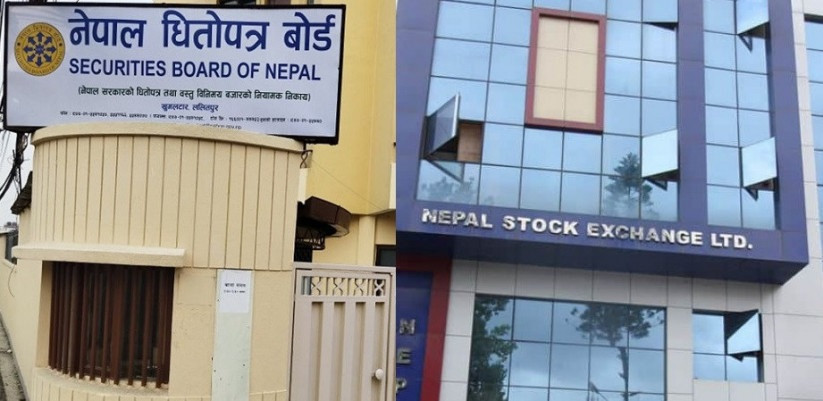
Nepal Stock Exchange Limited. File photo
Separately, market data reported around the same period showed the benchmark NEPSE index hovering near the 2,700-point mark for extended stretches during fiscal year 2025/26, well below the all-time high above 3,000 points reached in 2021, with neither a change in government nor the presentation of a new national budget managing to lift the index meaningfully.
This combination — a market capitalization-to-GDP ratio already in the 70s but a benchmark index that has been stuck or declining for months — is the starting point the blueprint is measured against, and it partly explains why SEBON frames its targets as requiring structural change rather than simply riding out a market cycle.
How has investor participation grown in recent years and what does this tell us?
One area where the blueprint points to genuine, measurable progress is retail investor access. Demat (beneficiary owner) accounts, needed to hold shares electronically, numbered only around 1.7 million as of fiscal year 2020/21; by the most recent count cited in the blueprint, that figure had grown to nearly 8 million, meaning more than a quarter of Nepal’s population now holds a demat account.
Mero Share accounts, the online platform investors use to apply for share allotments, show an even sharper jump, from about 700,000 in 2020/21 to more than 7 million now, covering close to a quarter of the population. TMS (trading management system) accounts, which investors need to actually trade on the secondary market, rose from roughly 35,000 in 2020/21 to about 3.47 million.
Geographically, account-opening is heavily concentrated in Bagmati Province, home to federal capital Kathmandu, which accounts for just over a third of all demat accounts, while Karnali Province, Nepal’s least urbanized region, accounts for under 3 percent. This tells a story of rapid, real gains in the technical infrastructure and reach of retail participation, even as actual trading activity and profitability have been much more volatile.
What has been happening to capital gains tax collection and why does the blueprint care about this?
Capital gains tax on share transactions, deducted at source by brokers only on realized profit, has fallen sharply this fiscal year, and this decline is part of the backdrop the blueprint is responding to. Over the first eleven months of fiscal year 2025/26, the government collected about Rs 9.54 billion in capital gains tax from share transactions, down roughly 37.5 percent from the Rs 15.27 billion collected in the same period the previous year, according to data from CDS and Clearing Limited.
So far, neither the tax simplification nor the new government has reversed the slide in either the index or collections, and this fragility of transaction-based tax revenue is precisely the kind of narrow, sentiment-driven dependency the blueprint’s diversification agenda is meant to reduce over time.
The previous fiscal year, 2024/25, had produced a record Rs 16.54 billion for the full twelve months on the back of a strong bull run, making this year’s decline look even sharper by comparison. Monthly collections have swung enormously, from a high of Rs 2.15 billion in the first month of the fiscal year to a low of Rs 243.6 million two months later.
The national budget presented on 29 May 2026 tried to address this by making capital gains tax a final withholding tax — removing the need for investors to separately account for share profits in their income tax returns — while simultaneously raising the long-term rate from 5 to 7.5 percent and the short-term rate from 7.5 to 10 percent.
So far, neither the tax simplification nor the new government has reversed the slide in either the index or collections, and this fragility of transaction-based tax revenue is precisely the kind of narrow, sentiment-driven dependency the blueprint’s diversification agenda is meant to reduce over time.
What is the headline, overarching goal SEBON has set for 2036?
The blueprint’s central, most-quoted target is to push Nepal’s stock market capitalization above 150 percent of GDP by 2036, roughly double the current ratio of about 74 percent. In absolute terms, based on the blueprint’s own reference point for the size of the economy, this would put market capitalization in the neighborhood of Rs 10,000 billion, more than double today’s approximately Rs 4,656 billion.
Alongside this, SEBON wants the number of listed companies to exceed 500, up from 297 currently — a rise of more than 70 percent. The broader ambition tied to these numbers is to establish Nepal as one of South Asia’s modern and competitive capital markets by the end of the plan period, rather than simply growing the existing market in its current form.
SEBON has been explicit that this is meant to be read as an ambitious, stretch target rather than a conservative baseline projection, and the blueprint itself acknowledges that meeting it will depend on much more than capital market policy alone, including the broader productive capacity of the economy.
What other quantitative targets does the blueprint set for 2036?
Beyond the headline market capitalization and listing goals, the blueprint sets out a fairly detailed scorecard for 2036. Daily average trading turnover is targeted to rise from roughly Rs 8 billion currently to Rs 30 billion, nearly a fourfold increase.
Demat accounts are targeted to exceed 12 million, up from around 8 million now. Institutional investors — thought of as pension funds, insurers and mutual funds rather than individual retail traders — are targeted to account for more than 40 percent of total trading turnover, a significant shift for a market that today is overwhelmingly dominated by retail participation.
The corporate bond market is targeted to make up 20 percent of the total capital market, more than 150 mutual funds are to be operating with combined assets equal to 10 percent of GDP, and more than 200 small and medium enterprises are to be brought onto the exchange through a dedicated SME platform.
Green bonds are targeted to make up 15 percent of total bond issuance, and foreign portfolio investment is to be opened up in stages rather than all at once. Taken together, these targets describe not just a bigger market but a structurally different one, with far more instrument diversity and institutional depth than exists today.
How is the blueprint’s implementation timeline structured?
SEBON has structured the roadmap along two overlapping timeframes. The first is a set of near-term milestones — the first 100 days, two years, five years and ten years — that sequence specific reforms in rough order of urgency and feasibility.
The second is a three-phase structure spanning the full decade: Phase One, from 2026 to 2027, focused on legal and institutional reform, board capacity-building, corporate governance, risk-based market regulation, and laying the groundwork for new financial instruments and the SME exchange.
Within two years, SEBON wants to launch a corporate bond market, establish a separate SME Exchange for smaller companies, and implement a Green Bond framework to support climate-related financing.
Phase Two, from 2028 to 2030, focused on market expansion and modernization, including the corporate bond market, exchange-traded funds, real estate investment trusts, other new instruments, and full digital systems; and Phase Three, from 2031 to 2036, focused on connecting Nepal’s capital market internationally, phasing in foreign portfolio investment, and establishing Nepal as a competitive capital market within South Asia.
This layered structure is meant to show that the more ambitious, internationally-oriented goals are back-loaded toward the end of the decade, after the foundational legal and institutional work is expected to be substantially complete.
What happens within the first 100 days?
The blueprint commits SEBON to five concrete actions within its first 100 days.
First, it will begin the process of amending the Securities Act, the foundational law governing capital markets in Nepal.
Second, it will pursue timely reform of the primary market issuance system — the process by which companies raise capital through initial public offerings — to make it more responsive to current market needs.
Third, it will establish a dedicated Capital Market Reform Implementation Unit to coordinate and drive the broader reform agenda.
Fourth, it will begin institutional restructuring at SEBON itself, along with NEPSE (the stock exchange) and CDS and Clearing Limited (the depository and settlement agency), acknowledging that all three institutions need internal changes to support the market SEBON envisions.
Fifth, it will form a “Vision 2036 Implementation Task Force” tasked with carrying the long-term reform agenda forward beyond SEBON’s own day-to-day operations, presumably to give the ten-year plan some institutional continuity that survives changes in SEBON’s leadership.
What legal and regulatory reforms does the blueprint propose?
At the core of the blueprint is a proposal for a comprehensive rewrite of Nepal’s Securities Act, rather than incremental amendment of the existing 2006 law. SEBON has said its review identified eight distinct areas requiring reform. Among the specific legislative products mentioned are a dedicated SEBON Act to govern the regulator itself, a Securities Market Management Act, a Securities Offence and Punishment Act to strengthen enforcement against market abuse, and a Financial Sector Trustee Act.
Alongside this institutional legislation, the blueprint calls for giving legal recognition to a range of instruments and practices that are not currently permitted or regulated in Nepal’s market at all, including digital securities, tokenized assets, alternative investment funds, securities lending and borrowing arrangements, intraday trading, and short selling.
The underlying logic is that many of the newer instruments and mechanisms the blueprint wants to introduce cannot legally exist in Nepal’s market until this legislative groundwork is in place, which is why legal reform is placed at the front of the implementation sequence rather than treated as a parallel track.
What new financial instruments and products will be introduced?
The blueprint lays out a fairly extensive menu of new instruments, phased over different time horizons. Within two years, SEBON wants to launch a corporate bond market, establish a separate SME Exchange for smaller companies, and implement a Green Bond framework to support climate-related financing.
Separately, and on a faster timeline, SEBON has said it is preparing to introduce short selling in the near term, tied to provisions already included in the current budget and in SEBON’s own policy.
Within five years, the plan is to introduce instruments that have never existed in Nepal’s market before: Real Estate Investment Trusts (REITs), Exchange-Traded Funds (ETFs), and Infrastructure Investment Trusts (InvITs), alongside a fully implemented legal framework for private equity and venture capital, entry for qualified foreign institutional investors, a digital capital market platform, and a dedicated Capital Market Research Institute.
Separately, and on a faster timeline, SEBON has said it is preparing to introduce short selling in the near term, tied to provisions already included in the current budget and in SEBON’s own policy. Short selling would sit alongside securities lending and borrowing and intraday trading as tools intended to give the market more depth and more varied trading strategies than the current buy-and-hold-dominated structure allows.
How would short selling work and why does SEBON want to introduce it?
According to chairman Bhatta’s own public explanation, short selling would allow an investor who expects a stock’s price to fall to borrow shares from another holder, sell them immediately at the current price, and later buy them back at a lower price to return to the lender — pocketing the difference as profit if the price does indeed fall.

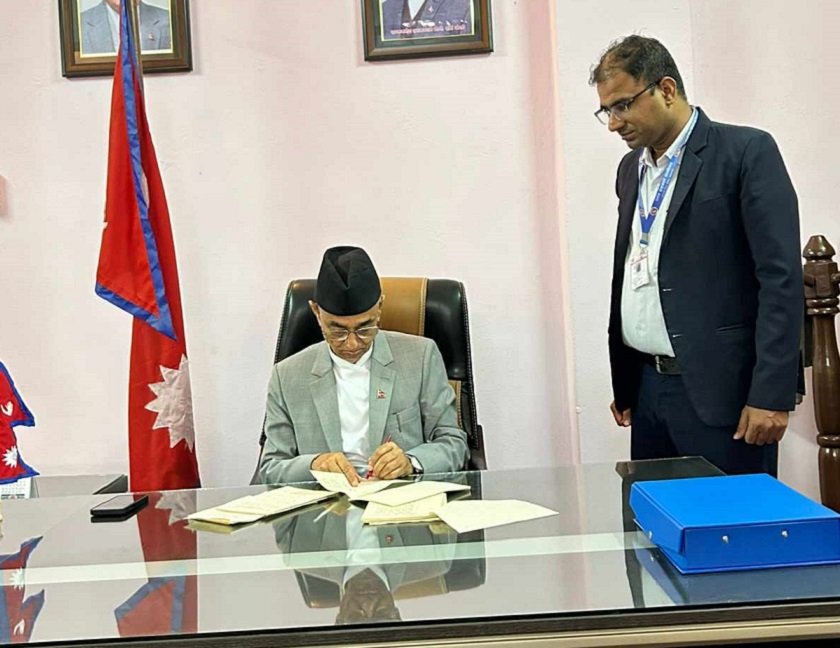
Finance Minister Swarnim Wagle administered the oath to newly appointed SEBON Chairman Gopal Prasad Bhatta. File photo
This mechanism does not currently exist in Nepal’s market, where investors can only profit from rising prices. SEBON’s stated rationale is that introducing short selling would bring participants with genuinely opposing views on where the market is heading into active trading, rather than a market where everyone is effectively betting the same direction.
Bhatta has argued this would ease the psychological and structural pressure for the index to move only upward, since bearish investors would have a legitimate way to express and profit from their view, potentially making price discovery more balanced and reducing some of the one-directional herding behavior that has characterized NEPSE’s booms and busts. It is described as being introduced alongside, and dependent on, related infrastructure like securities lending and borrowing.
What role do technology, AI and blockchain play in the blueprint?
Technology features prominently across the blueprint’s near- and medium-term plans. SEBON intends to build an AI-based market surveillance system specifically to detect abnormal trading patterns, insider trading and market manipulation — functions that are currently harder to police manually given the scale of retail participation. Blockchain technology is earmarked for use in trading and settlement processes, intended to improve transparency and reduce reconciliation friction between brokers, the depository and the exchange.

On the investor-facing side, the blueprint proposes building an integrated “Capital Market Mobile Super App” that would consolidate services currently spread across separate platforms (such as Mero Share and individual broker apps) into a single paperless interface. Longer term, the blueprint commits to phasing in international standards set by IOSCO (the International Organization of Securities Commissions) and the OECD, which is presented as a way of building credibility with foreign institutional investors who often benchmark a market’s regulatory maturity against these standards before committing capital.
None of this technology agenda is described as replacing the legal reforms discussed earlier; rather, it is framed as running in parallel, since much of the AI surveillance and blockchain settlement infrastructure would need updated legal backing to operate with full authority.
What are the seven strategic pillars underpinning the blueprint?
SEBON has organized its reform agenda around seven strategic pillars.
The first is building a strong legal and regulatory structure, essentially the legislative overhaul discussed earlier.
The second is diversifying financial instruments beyond shares to include bonds, mutual funds, exchange-traded funds and derivatives.
SEBON itself is expected to strengthen its own regulatory capacity and supervisory effectiveness, alongside the institutional restructuring it has committed to beginning within its first 100 days
The third is expanding the participation of large institutional investors such as the Employees Provident Fund, the Citizen Investment Trust and insurance companies, who currently play a much smaller role in Nepal’s turnover than retail investors do.
The fourth is building a fully digital market using artificial intelligence and blockchain technology.
The fifth is strengthening investor protection, financial literacy and the online complaint-handling system for aggrieved investors.
The sixth is bringing non-resident Nepalis and qualified foreign institutional investors into the market as participants.
The seventh is using a startup board and the planned SME exchange to bring innovation-driven and smaller companies into the capital market, widening the base of listed companies beyond the traditional bank, hydropower and insurance-heavy composition of today’s NEPSE.
What institutional and market-infrastructure changes are envisioned for SEBON, NEPSE and CDSC?
The blueprint assigns specific institutional roles to five different bodies, whose coordination it treats as essential to success. The Finance Ministry is expected to provide overall policy leadership for the reform agenda. SEBON itself is expected to strengthen its own regulatory capacity and supervisory effectiveness, alongside the institutional restructuring it has committed to beginning within its first 100 days.

NEPSE, the stock exchange, is expected to undergo technological modernization of its trading systems. CDS and Clearing Limited (CDSC), the depository and settlement body, is expected to move toward a “world-class” settlement system, a phrase used in the blueprint itself. Nepal Rastra Bank, the central bank, is expected to manage the financial-stability dimension of a deeper, more leveraged capital market, given its existing oversight of the banking system that currently dominates Nepali finance.
Finally, institutional investors more broadly are expected to actively participate rather than remain passive holders. SEBON’s own framing treats this five-way (plus institutional investors) coordination as a precondition for the blueprint succeeding, rather than something SEBON can deliver unilaterally through its own regulatory powers alone.
Why is implementation considered challenging, and what is ultimately at stake if the blueprint succeeds or fails?
SEBON’s own assessment, reflected in commentary around the blueprint’s release, is candid about the scale of the challenge. Raising market capitalization from roughly 74 percent to above 150 percent of GDP is not achievable through capital market policy alone; it requires the broader economy’s productive capacity to expand, the private sector to grow, large industries to actually list on the exchange, partial privatization of public enterprises, meaningful foreign investment inflows, and substantial growth in institutional investors — none of which SEBON directly controls.
Similarly, lifting daily turnover from around Rs 8 billion to Rs 30 billion requires not just more retail investors but new companies, new instruments and large institutional capital entering the market simultaneously. Meeting the 500-company listing target requires drawing large private-sector industrial, energy, infrastructure, IT and startup companies onto the exchange, many of which have historically preferred to stay private or finance themselves through bank debt.
If the reforms do land as planned, SEBON’s own framing is that the payoff extends well beyond market capitalization or turnover statistics: a genuine transformation of the capital market into a financing engine for national economic development, productive investment, innovation, infrastructure and long-term prosperity, with knock-on effects on employment, private-sector competitiveness, foreign investment, financial stability and social inclusion.
But, SEBON itself has acknowledged that effective implementation, not the ambition of the announcement, will be the real test facing its new leadership.