Kathmandu
Sunday, July 12, 2026





Nepal, which had a disappointing start in its first home series, has found its rhythm this time.

KATHMANDU: Nepal has taken revenge for its earlier loss by securing a grand victory against Oman in the ICC Cricket World Cup League 2 series held at the home ground in Kirtipur. After losing to Oman by 102 runs six days ago, Nepal secured an 81-run victory in Tuesday’s match.
Following the 102-run defeat against Oman in the ICC Cricket World Cup League 2, Nepali national team bowling all-rounder Sompal Kami reacted by saying, “Our plan was to save wickets for at least 20 overs. However, in the effort to save wickets, the run rate slowed down. If we could have played our natural game while rotating the strike, perhaps the result could have been in our favor.”
Sompal’s statement was relevant. Hosting Oman at home after nearly a year and a half, Nepal appeared desperate at that time. In that rain-affected match, chasing a target of 258 runs according to the Duckworth-Lewis-Stern (DLS) method, Nepal was bowled out for just 155 runs, forced to endure a wide 102-run defeat.
Exactly six days later, Nepal presented a natural style of play. Displaying excellent performance with aggressive yet controlled batting from the start, Nepal succeeded in securing an impressive 81-run victory against Oman. After the match, Gulsan Kumar Jha, who became the hero of the victory, also admitted the mistakes made in the first match. “We had planned to secure four wins out of four. In the first match against Oman, we overthought things. Although we lost one match, we did succeed in winning three,” he said.
This was the 10th meeting between Nepal and Oman in the One Day International (ODI) format. In the previous nine matches, Nepal had lost six, three of which occurred at the TU Cricket Ground in Kirtipur. In Tuesday’s match, Nepal overturned that history with a brilliant performance. Choosing to bat first after winning the toss, Nepal scored 256 runs, losing all wickets in 49.5 overs, bolstered by a grand innings of 94 runs from the returning Aasif Sheikh.
In response, Gulsan proved lethal against Oman. After he took five wickets conceding 38 runs in nine overs, Oman was bundled out for just 175 runs in 39.5 overs. With this, Nepal concluded the four-match series with three wins.
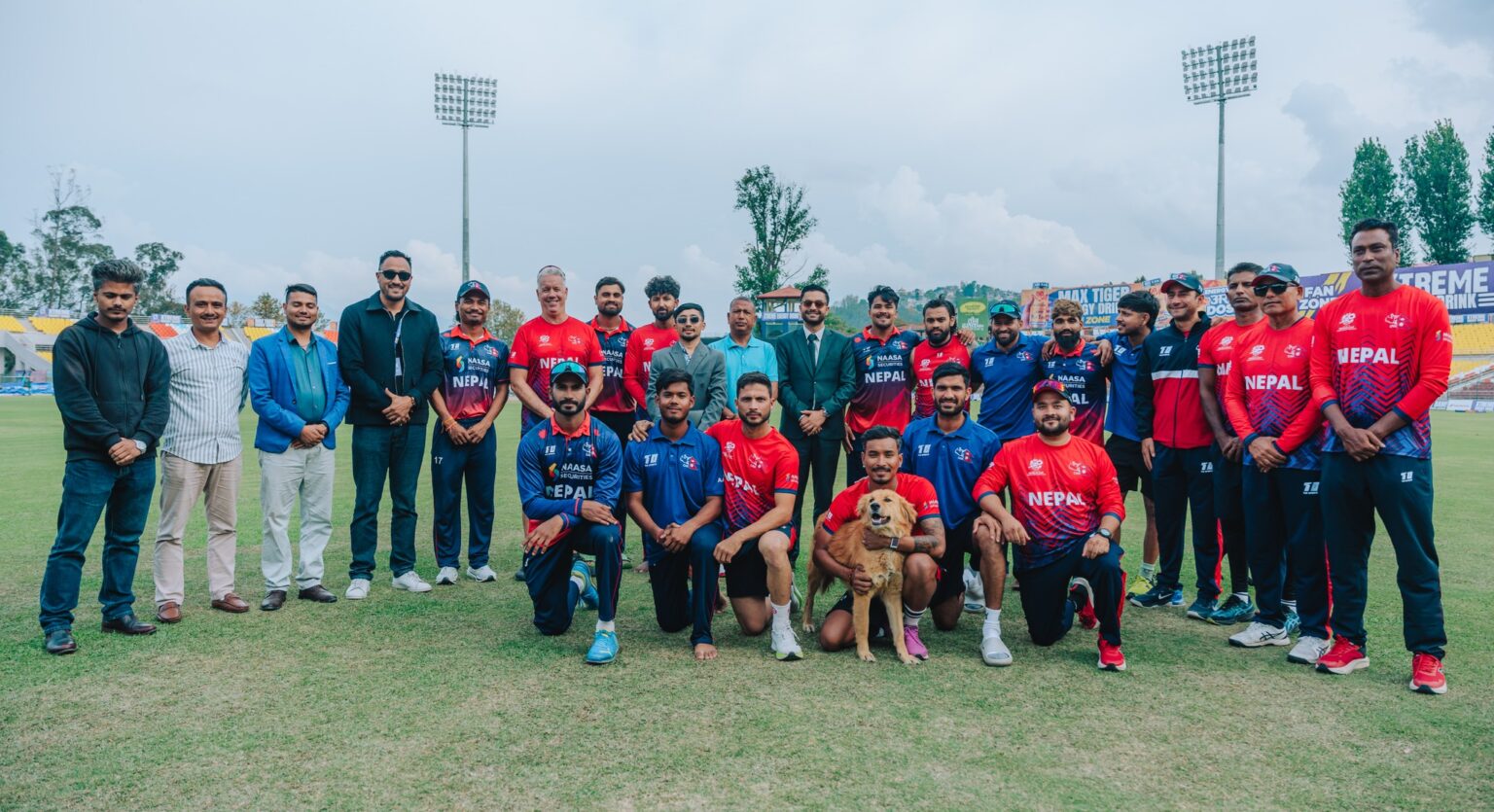
Players and CAN officials take a group photo with Minister Sasmit Pokharel after the win.
Previously, Nepal had defeated the visiting United Arab Emirates (UAE) by 37 runs and 6 runs (DLS method). However, those victories did not bring any change to Nepal’s position in the points table. Nepal sits in seventh place with 18 points from 24 matches, while Oman, having played four more matches, is in third place with 31 points. Gulsan states that the victory along with the players’ performance is more important than the ranking.
“Our goal was to win all matches. The first match with Oman didn’t go well. In this match, Binod Bhandari lost his wicket on the first ball. The new player in the team, Arjun (Kumul), played steadily. His innings of 48 runs was extremely important for the win,” Gulsan says.
Momentum returns to home ground
The TU Cricket Ground in Kirtipur is proving to be very lucky for the Nepali team in this 50-over cycle (2023–2027). In the 2019–2023 cycle, with 13 losses, one tie, and one no-result, Nepal was struggling just to save its ODI status for the first time. In the last eight matches of that same cycle, Nepal made a miraculous comeback.
In those matches, Nepal defeated not only the cycle winner Scotland, but also Namibia, and the weaker teams Papua New Guinea and UAE twice each. With the 16 points earned in those eight matches, Nepal not only saved its ODI status until 2027 but also secured a direct spot in the ODI World Cup Qualifiers held in Zimbabwe by finishing in the top three (40 points in 36 matches).
With the goal of continuing that momentum, the Nepali team entered the field to secure a spot in the World Cup Qualifiers to be hosted by South Africa, Zimbabwe, and Namibia next year, and to protect its ODI status for the next four years. However, the start of the new 2023–2027 cycle did not go as expected.
Starting the new campaign from a series featuring Namibia and the Netherlands at home, Nepal could only manage one victory in that phase.
Defeated by Namibia by four wickets on February 15, 2024, Nepal showed signs of a comeback by brushing aside the Netherlands by nine wickets two days later, but the overall performance was not satisfactory.
In the next two matches, they suffered a two-wicket loss to Namibia and an eight-wicket loss to the Netherlands. Following that, two years and two months later, Nepal returned to the home ground to complete that cycle, starting the second series of League 2 by playing against the UAE.
It wasn’t that difficult for Nepal to secure a win against a UAE team that is on the verge of transition. This team itself was out of rhythm.
Nepal made a positive start by defeating UAE, who is below them in the points table, by 37 runs. However, in the second match that followed, they suffered a defeat after a helpless performance against Oman. Opener Aasif Sheikh says the main reason was the batters’ inability to take their time.
“You have to take a bit of time on this wicket. It doesn’t get into a flow immediately upon arriving. You have to play limited shots. That makes it easier to convert later on,” he says.
Two wins provided by changes
The head coach of the Nepali team, Stuart Law, who says he hates losing, took a risk this time. After relying on the same ‘squad’ for a long time, he gave opportunities to Arjun Kumal and Binod Bhandari, who performed excellently in the Prime Minister Cup One Day Tournament.
In the Prime Minister Cup completed on April 17, 20-year-old Arjun became the highest run-scorer of the tournament, scoring 504 runs including two centuries and two half-centuries while playing for Gandaki Province. Although his team, Gandaki Province, was limited to seventh place with four wins, Arjun’s individual performance succeeded in opening the door to the national team.
Arjun made his debut in the second match against UAE, even taking the place of regular opener Kushal Bhurtel. He was out for 11 runs in that match. Similarly, experienced wicketkeeper-batter Binod, who scored 404 runs to lead Tribhuvan Army to the title in the Prime Minister Cup, made a comeback to the national team after nearly four years.
In his comeback match, he played a vital half-century innings of 56 runs off 79 balls including seven boundaries. In the match, Captain Rohit Kumar Paudel contributed 39 runs and Vice-captain Dipendra Singh Airee contributed a century (100 runs).
After Nepal presented a target of 290 runs, the match was affected by rain. According to the DLS method, UAE received a revised target of 255 runs in 38 overs. Nepal emerged victorious by 6 runs as UAE was limited to 248 runs for the loss of 6 wickets. Since then, Coach Stuart Law did not feel it necessary to keep changing the team’s top order.
In Tuesday’s match against Oman, he rested Bhim Sharki at number three and returned Aasif Sheikh to the opening spot with his partner.
He pushed Arjun to the third spot and paired Binod with a new partner for the opening. Binod was caught by Hammad Mirza off the ball of Jitenkumar Ramanandi for a duck. Even though he returned without scoring, Arjun became the ‘turning point’ for the Nepali team. Coming in at number three, he shared a massive 123-run partnership with Aasif. Although Arjun, who hit four boundaries in 87 balls, missed his half-century by two runs, Aasif played a grand innings of 94 runs.
Meanwhile, his brother Aarif Sheikh provided an aggressive finish with an innings of 43 runs off 24 balls, including one four and four sixes. With this, Oman received a target of 256 runs.

The crowd present at the ground to watch the match between Nepal and Oman .
After Gulsan Kumar Jha took five wickets conceding 38 runs in nine overs, Oman collapsed for 178 runs in 39.5 overs, and Nepal won by 81 runs. Oman’s head coach, Sulakshana Kulkarni, says this victory was possible because of the remarkable improvement Nepal has made in cricket recently.
“In the last two years, Nepal has established itself as one of the best Associate teams in the world. The style of cricket Nepal is playing right now is very good and exciting,” he says.
The challenge of maintaining rhythm
Nepal is scheduled to play another important series against Scotland and the USA at the TU Cricket Ground starting from May 12. This series appears to be even more challenging for Nepal. The USA is at the top of the points table with 36 points from 24 matches. Scotland, having played four more matches, is following with 34 points.Based on current performance, it is clearly indicated that both these teams will be tougher competitors for Nepal than Oman and the UAE. Past results also
confirm this fact. Nepal has competed with the USA 11 times in this format. While one match ended in a tie, Nepal has been defeated in six matches.
Furthermore, the USA is undefeated against Nepal in the last four meetings. Similarly, Nepal has played 10 matches against Scotland, losing six of them. These statistics show that the upcoming series will be a test for Nepal. Aasif, however, says he isn’t thinking too far ahead.
“Every match is important. We don’t think too much. We implement all our plans as much as possible in the first match and move forward,” he says. Nepal will play against Scotland on May 12 and 18. They will conclude the second home series by challenging the USA on May 16 and 22.