Kathmandu
Saturday, July 18, 2026





Stepping outside established writing norms, the new release marks a commendable milestone as a well-crafted novel that successfully employs surrealism and fantasy
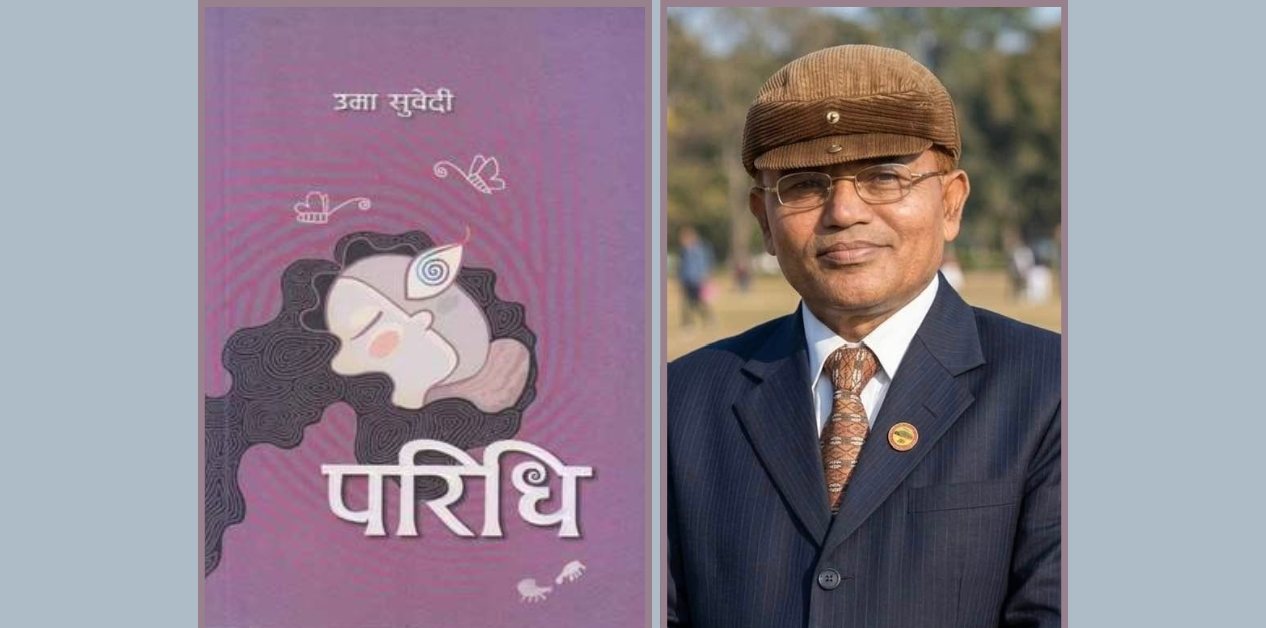
KATHMANDU: Right now, Uma Subedi’s written third novel, ‘Paridhi’ is in my hands. After reading this book, I felt like writing something. In the Nepali novel, there are few novels where the plot has moved forward by staying outside the social-realist perspective. In the majority of Nepali fiction, we are bringing forward subject matters centered on the pain and problems of daily public life. Things like poverty, exploitation, injustice-tyranny, violence against women, and the indifference brought into human life by financial difficulties tend to appear in our fiction.
Some novels carrying psychological problems are also in discussion. However, there are some such different novels, which are few in number. Bijaya Malla’s Anuradha is a different kind of novel. That was centered on the life of a woman having a certain kind of mental problem, and its discussion keeps happening.
Even so, it is not found that Nepali novelists have made much effort to enter toward the ‘surreal’ world by going outside specific viewpoints like social reality or progressivism. Here, I will talk about some of those few novels, which are written in a slightly different manner.
Among the novels that go into the imagination outside this worldliness, move toward surrealism, and build a plot on subjects that seem impossible, Sarubhakta’s Pagal Basti is one celebrated novel. It had also received the Madan Puraskar (Nepal’s most prestigious literary honor) around the year 1991/1992.
Similarly, there is the novel Sharanarthi, which carries a painful plot. The experimentation done inside there has been called ‘Leela Prayog‘. In there, ranging from genre-mixing and genre-breaking, a style where characters of various works gather at one place, those characters assume the form of a different personality, and a debate takes place between the author and the characters has been used.
The novel Alikhit by Dhruba Chandra Gautam, which was published even before that, had also received the Madan Puraskar. In Alikhit, characters reach a certain village in the course of excavation. While becoming centered on the problems of the village, in the end, that village itself disappears. The novel concludes in a mystery as to where and how it disappears. When the reader looks at it by standing on the ground of reality, they keep carrying the question in their mind as to how those unreal things happened.
Many domestic and foreign literatures were read, but the success of a book is for the impression to remain in the mind for many days even after reading it. Even after reading Paridhi, its characters and plot are creating an illusion in my mind.
Likewise, Tej Raj Khatiwada’s (Terakh) Sarbaja is also an experimental novel. In it, from the beginning to the end, a paragraph has not been separated anywhere. It is just like a swimmer swimming in the ocean not finding the shore. Reading this gives the reader a kind of panic, because there is no place to rest at all. There, the novel runs from the name of the character ‘Sarbaja’, and animals, birds, plants, all speak. Looking at it from the perspective of human society, that seems like an impossible plot.
Similarly, Sanjeev Uprety’s Ghanachakkar is a highly celebrated novel. Its character leaves from home and meets mysterious places and individuals of the city. To prove that he is not crazy, he makes a lot of effort. Like the title, while reading this, the reader’s mind also gets trapped in a dizzying spin, and the reader oneself gets lost there. While reading this, a confusion occurs as to whether it is real or imagination, and in the course of time, the reader oneself starts feeling in the role of the protagonist.
Sanjeev Uprety’s small novel named Aloo Nauni ra Coffee is also surreal or ‘surreal’ like this. Another novel by GS Poudel, Kriti Ek Sarko Maya, also keeps making one wonder what it is all about while reading it. The plot runs in such a way that after having read 300 to 400 pages, in the end, nothing has happened at all. Even if the title makes it seem like a love story, there is something else other than love there.
Similarly, in Lila Raj Khatiwada’s Ma Ko Hu, it is also not known at all where the protagonist has blown away, what he hears, and what he sees. There is a huge ‘ego’ in him, but in reality, nothing happens there either.
In Rabindra Samir’s novel Mrityuko Aayu, corpses are speaking; sometimes the characters of the Garuda Purana and sometimes heaven-hell are discussed. Sima Aabhas’s Mahayug is another such surreal one, where women create an entirely new world.
The reason why I discussed these seven to eight novels is that this novel Paridhi also has to be taken and made to stand in the line of these very books. This novel has felt magnificent to me. Many domestic and foreign literatures were read, but the success of a book is for the impression to remain in the mind for many days even after reading it.
Even after reading Paridhi, its characters and plot are creating an illusion in my mind. This cannot be discussed in any simple linear manner. It is so entangled within itself that it is difficult to figure out what is happening. However, even if it cannot be understood, once one starts reading this book, it cannot be left. Its messy subject matter keeps pulling the reader. The language style is extremely simple, because of which one does not have to get confused while reading. The subject matter, however, is just like woolen thread or a ball of hair getting knotted.
The characters and events within this feel as if they are and are not real. One character comes and, not because the author left them, gets lost inside the story itself. Many characters appear and disappear, making the boundary between reality and imagination almost impossible to trace.
The characters and events within this feel as if they are and are not real. One character comes and, not because the author left them, gets lost inside the story itself. Just like Narad Ji of the Purana comes saying ‘Narayan Narayan’ and vanishes somewhere, here too characters come, converse, but are not seen leaving the room. Someone disappears at the very place where they were sitting on the chair. Many characters appear and disappear. When an accident occurs, where blood should come out, the colors of the rainbow come out, and they fly away becoming butterflies. When a person is injured, for this to happen instead of blood coming is unnatural.
This can be called ‘magical realism’, where a simple dialogue takes place between the characters, but they do not match with worldliness. The characters, however, accept these things easily; they do not feel surprised. It used to be like this in our old magical tales as well. Miracles like a man entering a pond to swim coming out as a woman and later becoming a man again used to be abundant in the Puranas too.
In this novel as well, there are such miraculous characters and events. The characters are few, but their role changes moment by moment. A confusion occurs as to whether the previous role is correct or the current one. Here, the role of the protagonist has been played by women, but they themselves are in a situation of not being able to figure out where they are.
In fact, a play titled ‘Paridhi‘ is being performed inside this book. The characters of the play are sometimes inside the play and sometimes outside. The reader gets confused as to whether they spoke on the stage, behind the curtain, or by becoming the audience. As we keep reading the story, a dilemma occurs as to whether we ourselves are inside the story or outside. This felt quite wonderful.
How could the author have thought of such a knotted subject? What this proves is that the straight answer given by other works is not found here. Once upon a time, when asked ‘what education did you get’ after reading a story, we used to give one answer, but when coming out after reading this, we become empty. Everything keeps spinning in the mind. As if disorganized shadows and colors play in the mind of a person who has consumed an intoxicating substance, the reader reaches a similarly intoxicated state of mind after reading this book too.
In fact, a play titled Paridhi is being performed inside this book. The characters are sometimes inside the play and sometimes outside. The reader gets confused as to whether they spoke on the stage, behind the curtain, or as part of the audience.
I read this 257-page book by taking two days, because after reading one paragraph, one feels like returning again and looking at what was there. Its presentation and experimentation are matchless. The initial sentence is, “This is the time to realize this life, Aarya.” Aarya is the main protagonist of this novel, and she herself is also the author of this novel. The name of the play written by Aarya is Paridhi, and she is the director as well. But, then again, there is another author who is writing Aarya’s story. How many authors are here? One author Uma Subedi, the character Aarya created by her, who again is writing another play. There is a different joy in the confusion of who wrote this. This is not the author’s weakness; this is a conscious experiment.
The beginning and the end of the novel have happened from the same sentence. In this, there is a judge named Asmita, who has said she will commit suicide on September 14, 2025. Aarya has to write her biography, and to not let her die, Aarya starts her scooter and leaves. This entire novel is actually the story of a single day. After a phone call saying ‘today I will die’ comes to her on the way, the story moves forward by sitting right where she was, and in the end, she returns home. Interestingly, September 14, 2025 happens to be Aarya’s own birthday.
To understand this, it can be looked at from the angle of magical realism, Lila writing, or ‘hallucination’. In certain mental states like ‘schizophrenia’, a person considers oneself special, and there are things that only he/she sees or hears. Illusions which no one else sees but he/she sees, hears, and smells are generated. The author was found to have prepared the novel by using such experiments. When the sequence of billions of neurons and electrical impulses of our brain breaks, a person sees things they haven’t seen or hears voices they haven’t heard.
There is another experiment in this too characters of other works have come here. Suyogbir of Shirishko Phool appears here in Aarya’s room and he says, “I was in this very room for years.” There, a dialogue between Suyogbir and Aarya takes place. Suyogbir talks about Sakambari, and while Aarya is looking, Sakambari’s hair falls from the book, a Mimosa (Shirish) tree grows, and a bumblebee kisses the flower. In the end, Suyogbir transforms into a bumblebee and disappears somewhere through the window. Even if these experiments do not match reality, symbolically it has encompassed the violence happening to women, rape, the pain of men, and flawed decisions of the court.
How could the author have thought of such a knotted subject? When we finish reading, we do not come away with a simple answer. Instead, everything keeps spinning in the mind, leaving the reader questioning reality long after the final page.
Particularly, a significant aspect has been shown through the character of Asmita, the judge. When the father raised the daughter by saying ‘you are a son’, a male personality has been filled in her mind. At the time of writing the decision in the court, she has written it so as to give justice to the innocent, but at the time of reading, a male shadow stands behind her, and that reads out the reverse decision. In this way, a symbolic expression of how the shadow world and the hidden personality operate a person is here. Upon finishing this novel, a suspicion is generated in the reader too what I am doing, is that done by me, or is some shadow personality making me a puppet and causing it to be done?
Anyway, in the journey of the Nepali novel, this is a different, strange, and fun novel that has come lately. It does not give reading entertainment only; the malpractices growing inside the country, deceptive justice, insecurity of female selfhood, criminalization of law, etc., have been openly fictionalized.
Before this, five works of Subedi were published a ghazal collection, a song collection, two novels, and one story collection. Before Paridhi, the novels Toda and Iti were published.
The novel Toda was based on a story developed on the soil of Israel. Those Jewish elderly people, who had arrived in Israel by surviving Hitler’s oppression during the Second World War and were living a life of more than 90 years there, the war and crisis of existence faced by them was the feature of the novel Toda.
The novel Iti, on the other hand, was focused on the havoc wreaked by elephants coming to graze from Assam in the Bahundangi area of Jhapa, and the black businesses across the border. The adjustment of geography, environment, language, culture, etc., in the novel had also caught regionalism well.
Her third novel Paridhi is a distinct and experimental work written by encompassing fantasy, suspense, thriller, and the complexity of the human mind in the Nepali fiction field. Stepping outside the established line, it has sought to touch diverse dimensions of human consciousness and female existence through the imagination of a ‘shadow world’.
Paridhi is successful in serving a new taste in Nepali fiction. Due to its ultra-fictional texture, complex presentation, and extreme depression, this work has indeed not been able to become completely flawless. Nevertheless, this courage of hers to write differently from established subject matter, style of presentation, and linguistic heaviness is commendable in itself. Welcome to a good novel where a successful use of fantasy has taken place in Nepali literature.