Kathmandu
Sunday, July 12, 2026





As the government led by Prime Minister Balendra Shah sets a 90-day deadline under its reform agenda, long-delayed action on encroachments faces legal hurdles, compensation disputes, and local resistance, putting the fate of Pokhara’s iconic lake at a decisive moment.
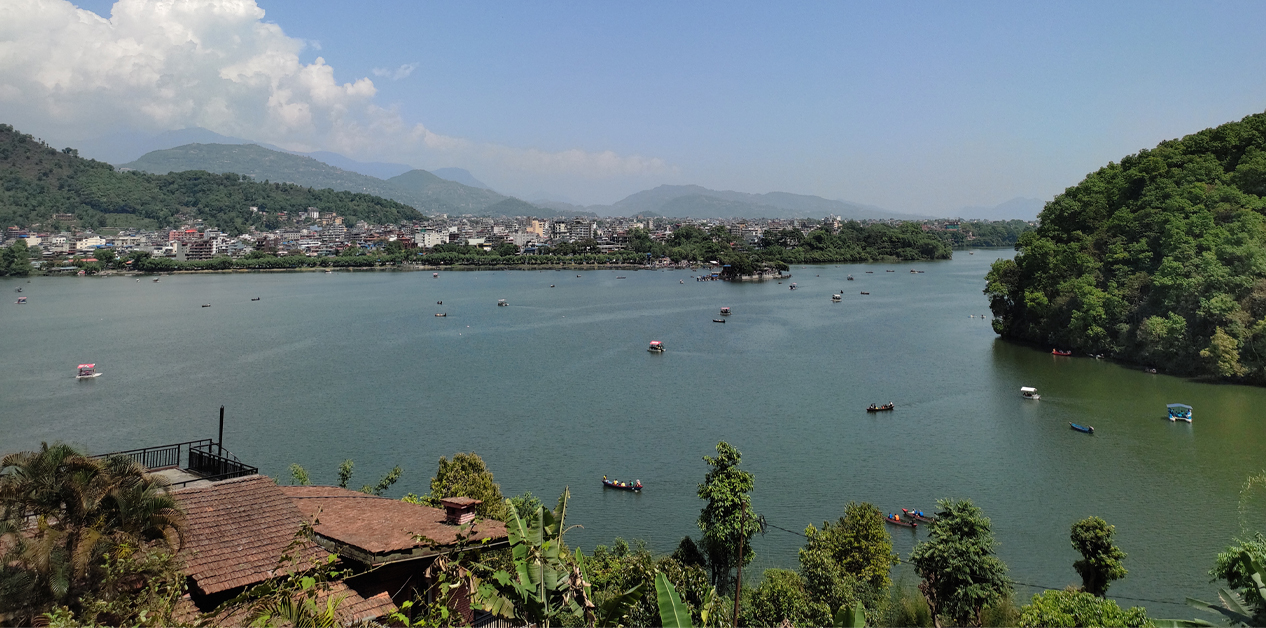
POKHARA: The governance reform agenda made public by the government on March 28 included Phewa Lake and watershed conservation. The government led by Prime Minister Balendra Shah has decided to begin the work of removing encroachments and restoring Phewa Lake within 90 days.
“The process of removing encroachments in the Phewa Protected Watershed Area in Pokhara, restoration, landslide management, spring conservation, and climate change adaptation works shall be advanced within three months with the participation of stakeholders for effective conservation of the watershed area,” states Point 76 of the 100-point governance reform agenda.
Meanwhile, Pokhara Metropolitan City Mayor Dhana Raj Acharya and Prime Minister Shah had a phone conversation on March 29. During the conversation, Shah expressed concern about Phewa Lake conservation and made inquiries. Acharya reported on the matter.
The issue of Phewa Lake conservation and removing structures falling within the standards is extremely complex. The Supreme Court had ordered the authorities on June 19, 2023 to enforce a standard of 65 meters from the highest point of the lake. According to the full text released on September 26, 2023, the order was to be implemented within six months. However, the order has yet to be implemented.
Nevertheless, Pokhara Metropolitan has been moving forward with work in coordination with the Gandaki Province government to implement the court’s order. On November 29, 2023, the Gandaki Province Security Committee meeting formed a committee to implement the Phewa Lake standards. Accordingly, an 11-member committee was formed under the coordination of Chief Minister Surendra Raj Pandey.
Pokhara Metropolitan Mayor Acharya is also a member of the committee. After the committee set the 65-meter standards from the highest point, the metropolitan has already completed the work of erecting pillars.
“The metropolitan is moving forward. We have completed the work of erecting 1,055 poles inside Phewa Lake by the end of mid-July 2025. Currently, from what we can see with our eyes, the lake has expanded by more than 1,500 ropanis,” says Mayor Acharya.
About two years after the order was issued, the metropolitan began the pillar-erecting work on May 31, 2025. Pokhara Mayor Acharya and Gandaki Chief Minister Pandey had inaugurated the demarcation work of Phewa by erecting a boundary pillar at Barahichowk. However, some businesspeople had protested. After locals protested against the pillar-erecting work in the Khapaudi area, the metropolis completed erecting 1,055 pillars with the help of Baidam police. Mayor Acharya informed Nepal News that the committee is currently studying more than 4,800 land parcels.
“As directed by the court, the technical committee is investigating 4,800 parcels to determine how many are fraudulently registered, how many are not, which parcels are registered and which are not. After the final report comes, it will be determined which ones require compensation and which do not. Then the process will move forward,” says Acharya.
The reason the committee is studying parcels is the court’s order, according to which structures must be removed and compensation must be paid to those entitled. As per the court’s order, compensation must be given for land outside the lake and the lake’s embankment that was established from 1961 to 1974. The committee is identifying land that requires compensation. Hundreds of structures fall within the 65-meter standards from the lake’s highest point. Ratna Temple, Himagriha, and the Pokhara Fisheries Center office also fall within the standards.
There are more than 40 indigenous households between Ratna Temple and the Himagriha. They have been affected by the 65-meter standards. After the Supreme Court’s verdict, locals in this area had filed a case in court. That case is pending in the Supreme Court. Local resident Hari Bhujel explains that the case filed in court is about a specific area, not about the entire 65-meter standards for all of Phewa Lake.
The phone conversation between the Prime Minister and the Metropolitan Mayor has created an atmosphere that the Phewa Lake conservation work will move forward. Bhujel is optimistic that the government will move forward only after understanding all the issues. His opinion is that the same standards should not apply to all locations of the lake. “I feel that the new government will move forward only after impartially understanding the problems faced by the people. The Tourism Minister is from our own area. The MP from Constituency No. 3 is from the Rastriya Swatantra Party. They know everything from the geographical structure to the reality,” he says.
Not everyone falling within the 65-meter standard of Phewa Lake will receive compensation. However, residents between the Himagriha and Ratna Temple will be covered by compensation as they have been living there from the beginning. Bhujel suggests that another on-site observation should be conducted before moving forward. He claims they are ready if the state provides compensation and lets them go.
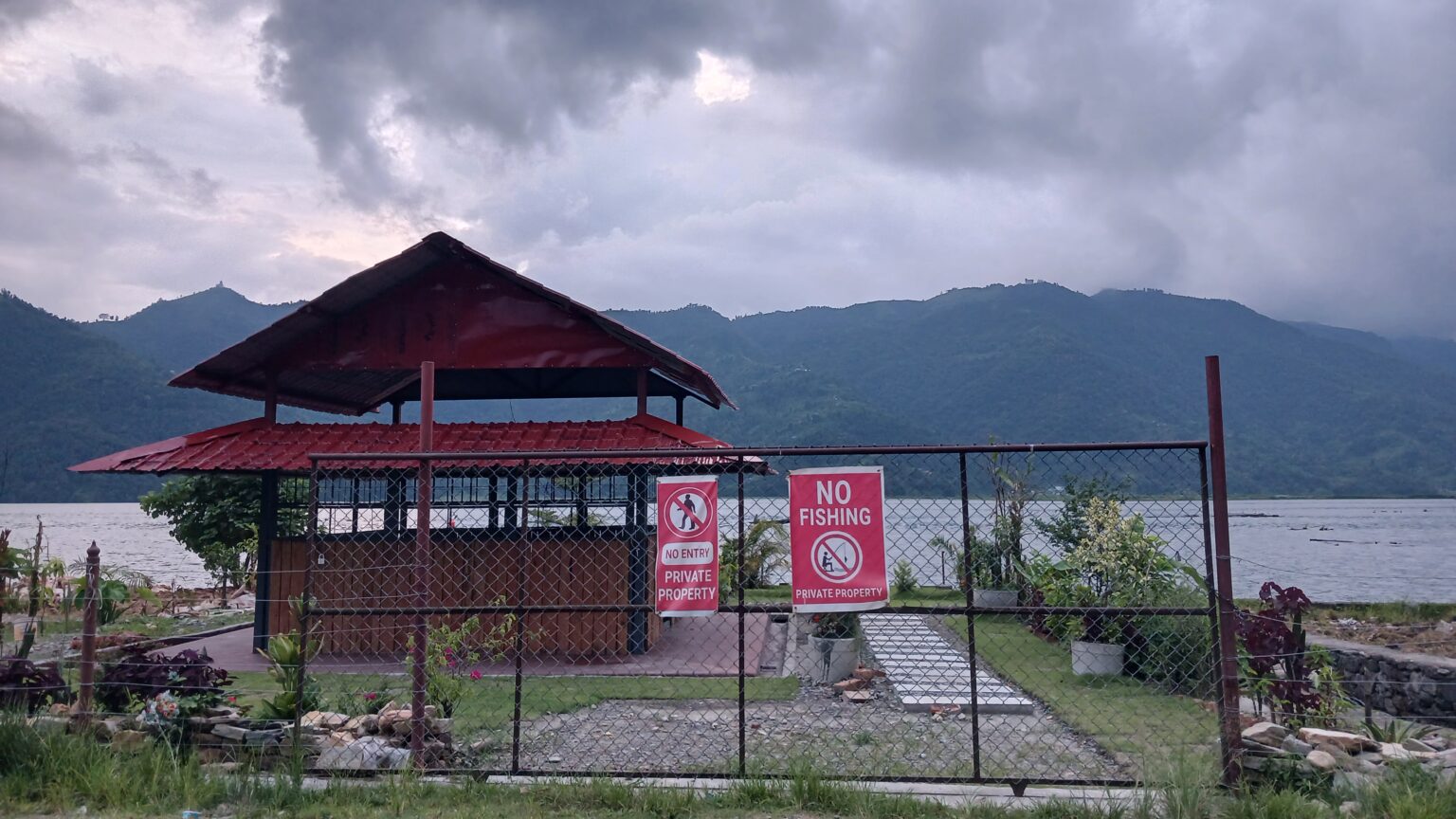
Photo: Rina Thapa
In 1961, the area of Phewa Lake was studied to be 10 square kilometers, which had decreased by the 2020 study. The Punya Paudel Commission’s report in 2020 showed the area of Phewa Lake to be 5.726 square kilometers. The Metropolitan Mayor says that the lake’s area has increased after the demarcation. According to the metropolitan, the lake’s area is currently about six square kilometers.
With increasing tourist activities, structures along the lake shore have been growing. Most restaurants on the bustling lakeside fall within the standards. From Disneyland to Pokhara’s famous restaurant Open House and Annapurna Garden fall within the standards.
The issue of Phewa Lake is not just a few years old. The issue of conservation arose after Phewa Lake came under the risk of human encroachment. On August 12, 2007, the lake standard of 65 meters was set. A study committee was formed under the leadership of Bishwa Prakash Lamichhane, the then chairman of the Pokhara Valley Town Development Committee, which studied the actual condition of the lake.
Even 18 years after the lake standard was set, it has not been implemented. Instead, structures have started appearing near the lake.
The Khapaudi area is where structures have been built the most. There, structures started being built rapidly after the COVID-19 pandemic. This is also the area where there are equally many structures violating the standards.
Along with the committee’s work, Mayor Acharya claims that the metropolis has not allowed new structures to be built in the past three years. “On the one hand, we have not allowed new structures to be built in these three years. On the other, we have also removed some structures that were built at some point. We have also given time to others to remove theirs,” he says.
The metropolitan city office has removed some such structures. However, in recent years too, structures have been built rapidly near the lake. In the Khapaudi area, land near the lake has been cemented and marked as ‘private property.’
About that, Mayor Acharya says, “That will be demolished; we have been directing its demolition. If they don’t remove it themselves, we will remove it.”
He says he is happy that the government has included this issue in its list of work to be done within a hundred days, as they have been working on lake conservation for the past three years. He says this is not just about the 65-meter issue but also about the watershed area and the source of Phewa Lake.
“This is not just about the 65-meter standards. The issue extends from the entire watershed to the source of Phewa Lake. We are working on a priority basis. The provincial government, the metropolitan, and the central government will all work together to move forward urgently with the remaining work,” says Acharya.
Although no directly visible work has been done in Phewa Lake conservation, the metropolis is on the path of implementing the court’s order. However, the capacity of Pokhara Metropolis or the Gandaki government alone is not enough to implement the order. There are hundreds of structures near the lake, some of which require compensation. The metropolitan city office needs the support of the federal government on this matter. Sunday’s phone conversation has given the metropolitan encouragement in the work of removing structures that violate the standards. But that alone is not enough. Mayor Acharya says the issue of compensation is a challenge.
“The challenge is to manage the budget by allocating the money needed for compensation in the red book (budget),” he says.
When asked whether this was discussed, the mayor says, “There was no detailed discussion on that matter, but I reported on the direction things are going and the current situation. We will sit down soon and discuss how to implement this.”
He is confident that the work started three years ago will move forward again with the Prime Minister’s support.