Kathmandu
Monday, July 13, 2026





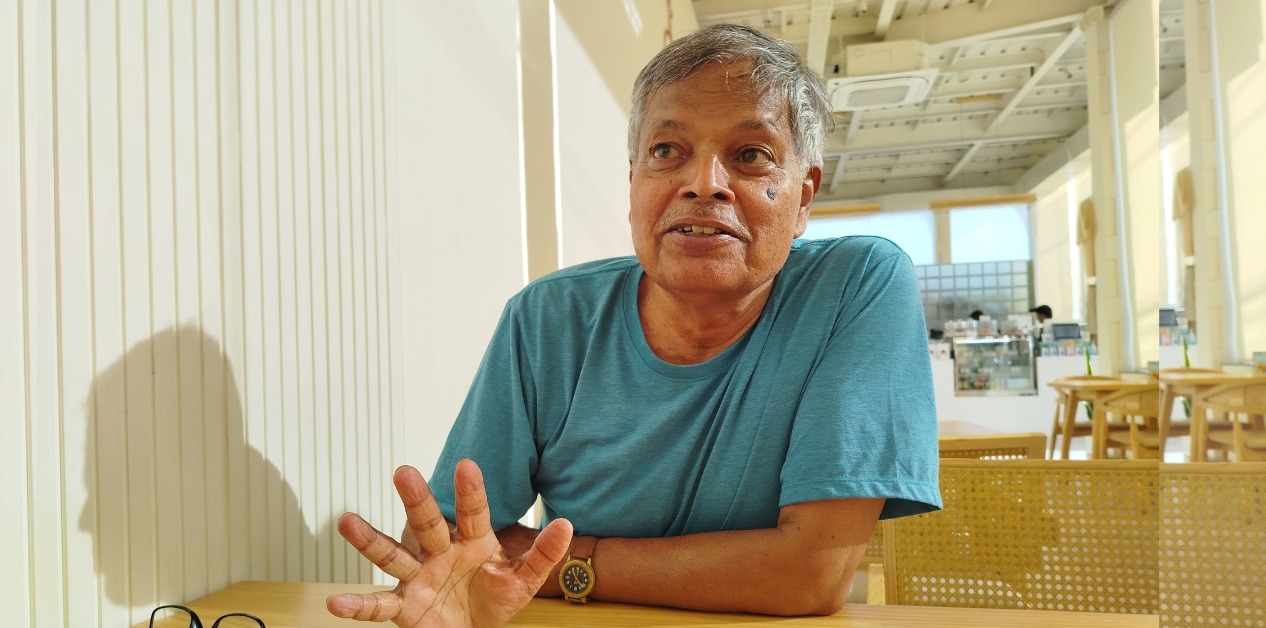
Federation of Nepalese Transport Entrepreneurs President Saroj Sitaula says Nepal's proposed traffic law should reflect the country's road conditions, geography and transport realities rather than replicate foreign penalty models.
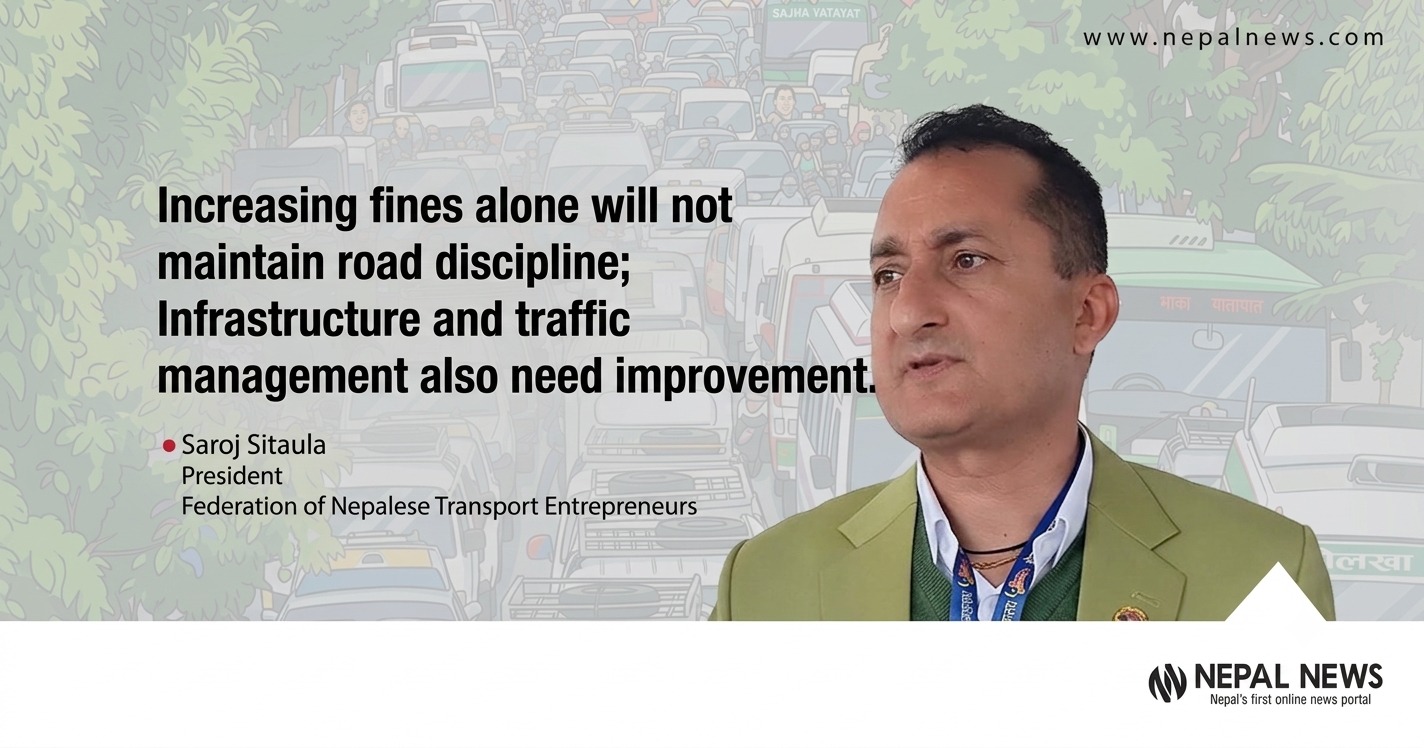
KATHMANDU: As the government prepares to amend vehicle and transportation laws, a proposal to significantly increase traffic fines has sparked intense discussion. Transport entrepreneurs have argued that simply tightening penalties without improving road infrastructure and traffic management will not solve the underlying problems.
Below is an edited excerpt of a conversation between Shambhu Raj Regmi of Nepal News and Saroj Sitaula (Punya Prasad), President of the Federation of Nepalese Transport Entrepreneurs, regarding the proposed provisions, driver discipline, road management, and measures to improve public transport:
There is a rumor that the government is going to heavily increase traffic fines in the new Act. How do transport entrepreneurs view this?
We heard about this through the media. The topic of increasing traffic fines is currently getting a lot of attention. However, the bill to amend traffic fines has not formally reached Parliament yet. It is only being discussed across media platforms.
By our estimate, there are around 500,000 black-plated (commercial) vehicles. When you include two-wheelers, private vehicles, and others, there are over 6.4 million vehicles in the country. Public transport currently operates under the 1992 Act. Preparations are underway to revise this Act in 2026. Therefore, the laws must be made in a visionary and intellectual manner; we must not rush.
The laws must suit Nepal’s geography, roads, political and governmental situation, as well as the passengers and consumers. We should look at foreign practices, but we cannot just copy and paste them directly into Nepal. Right now, political leaders, MPs, ministers, and the Prime Minister have traveled abroad and gained experience there. However, trying to implement those exact practices in Nepal creates a mismatch.
Isn’t it a good thing to learn from foreign countries?
I have repeatedly said in public that before talking about Europe, Singapore, or other countries, we must first understand our own country’s situation. What are the political parties running the country like? What is the state of the governments formed by those parties? What is the condition of our bureaucracy, geography, transport entrepreneurs, workers, and passengers? Policies and laws must be made by combining all these factors.
It is fine to look at foreign policies, but we must consider whether we have reached their level of development or not. Crafting laws and fines based on the practices of Europe, America, or Singapore should not be done in a way that panics people. This is our positive suggestion to the government.
Are you saying that no change is necessary at all?
Based on my long experience, I also believe that Nepal’s transport sector needs to change. We do not believe we should stay stuck in past methods and conditions. If the state listens to our suggestions and expertise, public transport can be made excellent, smooth, and hassle-free.
The state will benefit if it consults and advises with us to make public transport passenger-friendly and tech-friendly. Relying solely on bookish knowledge to claim that exorbitant fines will transform Nepal’s public service sector or reduce accidents is wrong.
Lately, news reports have been highlighting that Rs 2.5 million or 4 million were collected from traffic fines in a single day. This is not a good thing. All sides need to break out of old patterns. In the 21st century, boasting about high traffic fine collections sends an international message that our country’s transportation system is in chaos. On the contrary, if fines drop to zero, it signals that our traffic management is efficient and well-organized.
The news about fines has been communicated nationwide in a way that spreads panic, and this needs to be controlled. Public transport is a massive sector based entirely on self-employment. Most of the investment comes from self-employed individuals. It is different from other industries and factories.
Therefore, the government, parliament, Prime Minister, ministers, line ministries, and MPs must look at the public transport sector seriously and respectfully. This is a major industry that provides jobs to many people who return from abroad due to unemployment.
Isn’t the government trying to bring in strict provisions because drivers are undisciplined?
The government and the state are the guardians of the country. Since governments are formed by political parties, the parties and the government must first conduct themselves in a disciplined manner. As a guardian, the state must guide everyone.
Questions are being raised about drivers right now. But where has the state contributed to producing drivers? Many people born in remote villages and hills became orphans or were deprived of family love. Due to various circumstances, they started working as conductors. By working as helpers and learning the technical aspects of the vehicles, they eventually became drivers.
We must not always look only at the negative side. There are examples of drivers who have driven for 28 to 30 years without harming a single bird or fly. They might not have seen the face of a school, but they are excellent in technical knowledge.
In the future, educated people who understand the roads should also enter the driving profession. Just as highly intellectual individuals enter parliament and government, there should be a debate about bringing people with technical knowledge and geographical understanding into the transport sector.
However, trying to bring an absolute overhaul overnight will likely lead to failure. Making drivers disciplined is our objective too. The Federation is moving forward with an agenda to make drivers, entrepreneurs, and all stakeholders disciplined, dignified, and tech-friendly.
If drivers are disciplined, why should it matter how high the fine is?
That is not how it works. First, it must be clear how many vehicles should run on which road. Drivers must be disciplined, but the chaotic state of vehicles on the roads must also be removed.
Let’s look at the Kathmandu Valley. How long does it take to get from Jorpati to Ratnapark? Why do crowds gather at Sundhara and Ratnapark? Why do people pile up at Prithvi Chowk in Pokhara, Traffic Chowk in Butwal, and Mukti Chowk in Jhapa?
These issues are mentioned in various commission reports. First, we must determine how many vehicles are needed on a specific road, evaluate passenger pressure, and decide what kind of vehicle should run on that road. Vehicle management must match the local geography and conditions. ‘Route permits’ should not be handed out to just anyone.
When I came to Pokhara, I saw three-wheeled city rickshaws and tempos running on the highway. Passengers were taking risky journeys in them. How can travel be safe when three-wheeled tempos run on the highway? We must move forward scientifically. If we continuously guide drivers to be disciplined, the transport sector will become more dignified. Drivers must now have identity cards and uniforms; we can no longer operate using the old methods.
The government must create policies and laws through a single-window system, resolving conflicting rules between federal, provincial, and local governments. When the federal government increases inter-province fares, provincial fares do not get adjusted, and local governments are barred from adjusting fares. The government must clear such confusion and create a proper environment.
There is no space to stop public transport in Kathmandu. When thousands of vehicles pile up at Sundhara at the same time, chaos and congestion are inevitable.
The roads are also congested due to two-wheelers and private cars. You cannot blame public transport alone for this. To improve public transport, separate lanes must be managed. Micro-buses should also be allowed to run in a designated lane.
We conducted a single-lane trial on the Ratnapark–Suryabinayak stretch and concluded that a journey that usually takes three hours could be completed in just 45 minutes when the lane was separated. A vehicle that currently makes two trips could make seven trips if lanes are separated. Making seven trips benefits investors, workers, and passengers alike. Passengers wouldn’t have to wait for long periods, and it would save time.
The current government holds nearly a two-thirds majority and can pass citizen-centric laws. Why must all offices open at the exact same time? Why must every employee reach the office at 9:00 AM? Some offices could open at 8:00 AM and others at 11:00 AM. Changing the timings slightly would ease the burden on service seekers.
Such creative thinking must be implemented according to our geography. We need to find ways to reduce vehicle pressure in cities. On the Kathmandu Ring Road, if a driver gets an upset stomach, there isn’t even a toilet available for them to use. Such structures have not been built. Some are in the process of being built, and we remain hopeful.
We are positive toward the government. The private sector was positive in the past and remains so today. However, our suggestion is that the government should not adopt an aggressive approach to suppress and rule over transport entrepreneurs.
Public transport is not a minor sector. We support the regulations brought by the government to make it better and more organized. There is absolutely no compromise when it comes to driving under the influence of alcohol. However, the sheer volume of fines across all other offenses has terrified the transport business.
Pressure is mounting from both national and international sectors, with voices echoing that such arrangements are improper. Therefore, my request and suggestion is that this must be corrected.
What should the government do immediately?
The government must hold intensive discussions with the Federation and other stakeholders. A few days ago, we were called by the Infrastructure Development Committee, where we presented our views.
Currently, I am in Pokhara. Indian vehicles can enter Nepal carrying tourists from various parts of India. However, once they arrive at Pokhara or Kathmandu from the Nepal-India border, Nepali vehicles should get the work. Indian vehicles should not be given unrestricted access to all our tourist destinations.
Our vehicles and workers must get employment here. However, under the guise of the 72-hour permit provision, Indian passenger and cargo vehicles have been encroaching. This must be corrected immediately, and laws must be made strict for proper regulation.
To make drivers disciplined and dignified, the state must be vigilant about how to ensure their participation in social security and similar benefits. The public transport sector is different from other industries, as 65 percent of it is self-employed. Its technical aspects need to be sorted out.
Instead of just instigating people with popular talks about social security, we must find ways to sustain this sector and those dependent on it for the long term. For that, discussions must be held with investors, entrepreneurs, and workers. Whether it is passenger or cargo transport, we will move forward keeping the passengers and consumers at the center, making the sector more disciplined.
What is the Federation currently doing about this?
We have given many suggestions to the government, including reforms to the licensing and trial systems for private (red-plate) and commercial (black-plate) drivers. Sadly, these have not been implemented.
The government has formed various commissions and high-level panels through ministerial and cabinet decisions. We have presented several reform measures for Nepal’s transport sector to those commissions. The government must look into those suggestions. Everyone—drivers, entrepreneurs, passengers, and pedestrians—must follow discipline.
Improvements are also needed in zebra crossings, overhead bridges, and other infrastructure. In the Kathmandu Valley and Pokhara, two-wheelers can be seen haphazardly violating lanes and causing chaos on the streets. Recently, the number of workers making a living by riding two-wheelers has increased, which adds a challenge to traffic management. They are also stating that traffic fines have become too expensive.
The Federation has already held many informal talks with the government. However, formally, we have not had the opportunity to present our views directly to the ministers or the Prime Minister. This is unfortunate. The Prime Minister must understand that if Nepal’s public transport sector changes, the country will change.
The Prime Minister should call transport entrepreneurs for a discussion. Our voices must be heard, and our guardian must listen to us. We are waiting for that.
If fines are increased drastically, what will be the impact?
If raised drastically, it will become very difficult to operate vehicles. What happens to a driver earning a monthly salary of Rs 30,000 to 40,000 if they are fined Rs 50,000 all at once? The general public is asking this exact question.
Our point is not that fines shouldn’t be applied at all. However, necessary infrastructure must be built first. After that, fines should be determined in a way that matches the country’s condition, geography, public income, and daily life.
What should be everyone’s role in maintaining road discipline?
To maintain road discipline, all traffic structures must be efficiently established and managed. Once a proper environment for vehicle movement is created, lane discipline will naturally become effective.
Currently, all types of vehicles run on the same road, and this needs to change. Separate lanes must be designated for different vehicles. Our suggestion is that large vehicles should run on large roads and small vehicles on small roads.
If such a system is put in place, road discipline will follow gradually. Everyone using the road must follow discipline, including pedestrians and street vendors. Everyone must use overhead bridges and zebra crossings, traffic lights must be properly managed, and everyone must follow them. For this to happen, thought-out laws that can actually be implemented should be made. The laws passed by the government must be acceptable to its citizens.
Applying foreign practices based on suggestions from invisible experts who do not understand local realities—claiming that high fines will automatically bring drivers into line—will not work in Nepal. It is simply not possible right now. Therefore, I suggest revising the proposed provisions.
What is the main suggestion of transport entrepreneurs to the government?
Public transport serves the public, represents a massive investment, and provides employment to many. Our main suggestion is that the government must keep infrastructure construction as its topmost priority.
The Prime Minister, the Infrastructure Minister, relevant ministries, and other stakeholder bodies must call transport entrepreneurs and listen to our views. They must hold discussions with us, and our demands and suggestions should not be ignored.
Discussions should be conducted by bringing all stakeholders to one place without showing bias toward any side. The government should move forward based on the suggestions that emerge from those discussions. The issue of traffic fines raised right now should be reconsidered instead of creating panic, though traffic rules must be followed by everyone.