Kathmandu
Sunday, July 12, 2026





The deployment of the Nepali Army during Kathmandu Valley landless settlers’ evictions, alongside growing military involvement in business, political appointments, and administrative affairs under Prime Minister Balendra Shah, has intensified concerns over transparency, civilian supremacy, and the widening influence of the military in Nepal’s democratic system.

KATHMANDU: Two days before bulldozers were rolled into the landless people’s settlements along the riverbanks of Kathmandu Valley on April 25, mikes were used in those areas to broadcast orders to vacate illegal houses and huts. During the announcement, it wasn’t just the Nepal Police and Municipal Police present; there were also armed soldiers.
Following behind the Municipal Police, Nepal Police, and Armed Police Force, soldiers of the Nepali Army had reached the landless people’s settlements of Thapathali, Sinamangal, and Manohara. Army personnel were also deployed on April 25 when houses and shanties were demolished using bulldozers in the Thapathali settlement.
Prior to that, on April 24, Army Headquarters had issued an internal circular to battalions and companies across the country, directing them to send details of squatters within 48 hours. Following the headquarters’ direction, the battalions wrote letters to the Land Commission and respective municipalities.
These incidents faced intense criticism in the public sphere, labeled as an “Army parade in landless people’s settlements” and “unusual activism of the Army in landless settlers’ affairs.”
The responsibility for resolving landless settlers’ problems lies with the Ministry of Land Management, Cooperatives, Federal Affairs and General Administration. However, despite the presence of an elected government, ministries, and the Land Commission, the Army moved a step forward and entered into the matter.
While the security provided by the Nepal Police and Armed Police Force would have been sufficient to clear the settlements, the Army—which is typically deployed through special procedures under special circumstances—was mobilized.
When asked why and under which law the Army was deployed in the squatter settlements, the Chief District Officer of Kathmandu, Ishwar Raj Paudel, said, “I will not speak on this matter.”
Such a reaction from the Chief District Officer, who is entrusted with the responsibility of operating the entire peace and security mechanism of the district, signals that the thread of Army deployment in squatter settlements connects all the way to the upper echelons of the government.
Army soldiers, including officers, were also deployed during the demolition of houses and huts around the Manohara River in Bhaktapur.
However, the Army was not mobilized through a written decision of the District Security Committee. Umesh Dhakal, Chief District Officer of Bhaktapur, says, “Since an atmosphere of tension could arise regarding the removal of the settlement, even leading to a situation where a curfew might have to be imposed, Army officers accompanied the Police and Armed Police Force by virtue of being members of the District Security Committee; it should be understood as monitoring.”
Army in administrative issues
In a democratic governance system, the military is the last resort, not a routine administrative tool. Army deployment happens only in extraordinary situations or matters linked to national security. The use of the Army to remove settlements has raised constitutional questions. Since the security of the Nepal Police and Armed Police Force was sufficient in the squatter settlements, there is no basis to assume they were deployed as a ‘backup force.’
According to the Local Administration Act, 1971, if there is or is likely to be a serious disturbance in any area within their jurisdiction, and preventing it is not possible solely with the assistance of the police, the Chief District Officer may seek the assistance of the nearest Armed Police Force or, depending on the situation, the Nepali Army. The physical presence of armed military forces outside barracks is addressed by that Act. Broadly, however, the Army can only be mobilized by the President upon the recommendation of the National Security Council.
The context of the Army leaving the barracks even under a curfew imposed as per the said Act is distinct. Only when a procession, crowd, or organized group engages in violent or destructive activities like looting with weapons, setting shops on fire, or vandalizing public property, and it appears that prevention is impossible through ordinary police action, can the Chief District Officer declare that area as riot-affected. “After declaring a riot-affected area in this manner, the Chief District Officer shall take the assistance of the Army to maintain peace and order in that area,” the Act states.
When bulldozers were deployed in the settlements of Kathmandu and Bhaktapur, the situation specified by the Act had not arisen. Neither was there a situation likely to trigger large processions, clashes, or devastation.
In such circumstances, the Army does not leave the barracks merely upon a ‘request’ from the Chief District Officer. Security analyst Shovakar Budhathoki states that the overall circumstances show the Army was deployed from the higher authority, meaning the level of the Prime Minister itself. He says, “The Army does not move out without the government’s consent; the way it did is not a good sign.”
He argues that pushing a security apparatus like the Army forward where social-administrative mechanisms should solve problems creates suspicion of military dominance in a democratic system. “A democratic governance system rests on law, civil rights, transparency, and the leadership of elected bodies. Involving the military in administrative tasks can weaken the decision-making capacity of the civilian government,” Budhathoki says.
Deepak Prakash Bhatta, another expert on security affairs, also states that the Army appeared in the squatter incident in a manner that gives the benefit of the doubt. “It remains to be seen how the Army’s steps will move forward in the coming days; civil society and opposition parties must remain alert,” he says. “If a situation requiring military mobilization does exist, the process must be fulfilled, but the Army appears to have moved a step ahead without going through the process.”
The Military Headquarters, however, claims that the Army was not mobilized in the landless settlers’ matter. Military Spokesperson Assistant Brigadier General Raja Ram Basnet states that the Battalion Commander and his driver were spotted in the Manohara area. “When the District Security Committee meeting was held at the battalion in Suryabinayak, a decision was made to go for a field observation, so the Army representative went as an ex-officio member,” he says. “The Army has not gone to other places, and the Army did not do the miking.”
He mentions that the Army was working at that time on mapping and data collection during disaster preparedness targeting the approaching monsoon.
However, the statement from military headquarters does not seem consistent. There was no disaster situation in the landless settlements. Furthermore, disasters do not occur exclusively in squatter settlements. There was no special circumstance for broad military mobilization. Even if the Army came for a disaster, it is not procedurally sound. Security expert Indra Adhikari says, “In a disaster, the Army does not come to the frontline among the four security agencies, the way it was seen in the squatter incident.”
During the Gen Z protestst on September 9, 2025, the Army faced criticism for remaining a mute spectator while national property burned in arson carried out by protestors, including the Office of the President — the Supreme Commander of the Army itself. The Army stated that constitutionally it could not enter into defensive action without completing the required legal procedures. However, it argued that even without that process, it had done what it could to provide protection.
“The destruction of national infrastructure is unfortunate, but in the tense situation at the time, the Army exercised restraint instead of using lethal force. After the crowd entered Singha Durbar, priority was given to protecting critical infrastructure such as the data center, which prevented the government system from collapsing,” the Army had said.
There is a legal provision that even the Prime Minister alone cannot deploy the Army at will. If the Army has indeed been mobilized with the government’s consent or through personal directives, she argues, that would be harmful for the nation.
Former Defense Secretary Devendra Sitaula says that since the national army is an extremely sensitive institution and the highest body within the security apparatus, it must operate strictly within the authority granted by the Constitution, laws, and the Army Act. “I do not clearly understand whether the Army was deployed in the squatter settlements for personal or organizational purposes, or under which law or regulation,” he says.
“If assistance was sought under the Local Administration Act for maintaining peace and security, then the Army should operate according to the legal procedures.”
Security analyst Shovakar Budhathoki says that if military involvement in social and administrative issues gradually becomes normalized, state power could become concentrated within the security apparatus, weakening elected governments, shrinking civil liberties, and slowly hollowing out the structure of democracy.
The Prime Minister’s pat on the back
The Nepali Army, which has shown a specific interest and involvement in trade and contracts rather than its military role over the past decade, has come out even more openly at a time when Balendra Shah has become Prime Minister, transitioning from a rapper to the Mayor of Kathmandu Metropolitan City. And this security force seems to be receiving further encouragement from Prime Minister Shah’s behavior.
As an illustration of this, Prime Minister Balendra Shah, who appears to believe in informal styles rather than democratic elements and processes, has various backgrounds regarding his interest in the Army.
After becoming the Mayor of Kathmandu Metropolitan City in 2022, Shah met the Chief of Army Staff first. Immediately after taking the oath of office and assuming charge on May 30, 2022, he reached the military headquarters and met with the then Chief of Army Staff, Prabhuram Sharma. The Mayor meeting the Chief of Army Staff without meeting the Prime Minister or other officials was viewed meaningfully in political circles.
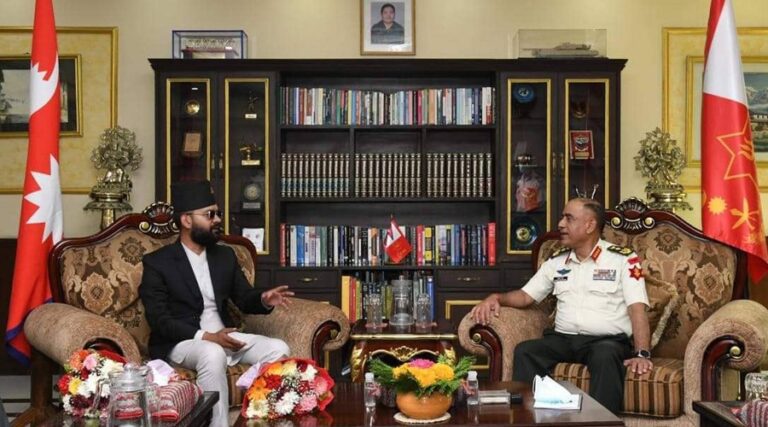
Balendra Shah meeting then Chief of Army Staff Prabhuram Sharma immediately after being elected KMC mayor in 2022. Photo: Social media.
On May 11, while President Ramchandra Paudel was presenting the government’s policies and programs at a joint meeting of the federal parliament, Prime Minister Shah walked out midway. In this incident, political and public circles criticized the Prime Minister for not maintaining basic decorum and courtesy, and for failing to uphold parliamentary dignity. Since then, while opposition parties have been searching for the Prime Minister in the house, Shah has not appeared. This is despite the Parliament Building being at a distance of about 200 meters from the Office of the Prime Minister and Council of Ministers inside Singha Durbar.
He has evaded the parliamentary tradition of participating in discussions on the policies and programs brought forward by his own leadership, answering questions raised, and participating in Q&A sessions under parliamentary regulations. Having never participated in public deliberations to date, he has not spoken in parliament since being elected Prime Minister on March 27, 2026.
However, Prime Minister Shah, who also holds the defense portfolio, did not just participate in military events during this interval but also addressed them. On May 9, Shah participated as the chief guest at the commissioning parade ceremony organized at the Nepali Military Academy in Kharipati, Bhaktapur. Shah, who did not spend a single word thanking the members of the House of Representatives who elected him Prime Minister, congratulated and extended best wishes to the newly commissioned army officers at that event, urging them to dedicate themselves to national service with dutifulness, discipline, and responsibility. This is the first address Shah has made as the executive head of the country since being appointed Prime Minister.
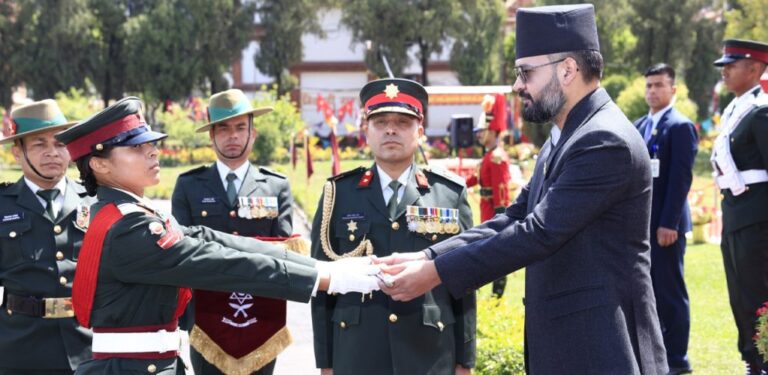
Prime Minister Balendra Shah at the officer cadet commissioning ceremony held at the Nepali Army barracks in Bhaktapur. Photo: RSS
Last year, during the political vacuum after KP Sharma Oli was ousted by the Gen Z protests, Shah, who was then the Mayor of Kathmandu Metropolitan City, pampered the military power by seeking the role of Military Headquarters instead of political institutions. At 3:15 PM on September 9, 2025, he had called upon the Gen Z protestors via social media ‘to remain ready to negotiate with the Army Chief as well.’ This was while the President, the supreme institution to protect the country’s unity, integrity, and the constitution, and the shared guardian of citizens, was still there.
Around 9:00 PM on the same day Shah made the call via social media, Chief of Army Staff Ashok Raj Sigdel issued a video message calling upon the protesting groups to come for talks. Exactly as Shah had stated and desired, after 10:00 PM on the night of September 9, the Army took the situation under its control and initiated the process of negotiating with Gen Z. Such sequences of events have revealed Shah’s interest in the Army. The military pageantry during the displacement of squatters signaled that this would provide the Army with even more room to open up and play after he became Prime Minister.
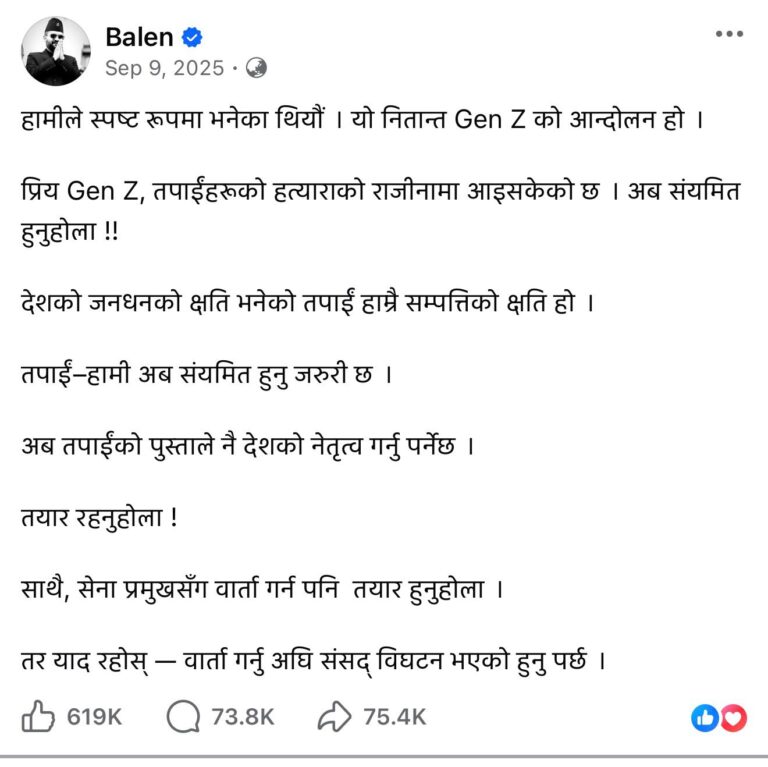
After the Gen Z protests, a Facebook post by Balendra Shah drew significant public attention.
The Nepali Army is already controversial. Free from conflict and facing no external military threats, the Army is active in non-military sectors. Generally, the core responsibility of the Army is national security, border defense, and defense preparedness. However, the Army operates in businesses including hospitals, schools, medical colleges, and petrol pumps. Though stated to be for welfare purposes, the institutions run by the Army are gradually transforming into a commercial empire.
Since 2017, when the Army entered contract projects like the Kathmandu-Terai Fast Track, its role in non-military activities has been expanding. The Fast Track project started on May 4, 2017. The project aimed to be completed by August 2021. The government extended the deadline by three years to November 2024. As it wasn’t completed in that duration either, the government extended the time again to April 2027. Even after nine years, the work on the project has not progressed satisfactorily. With approximately 84% of the project’s duration elapsed, physical progress is limited to 42.13% and financial progress to 44%. In the construction of the 72.977 km road, which has an estimated cost of Rs 211 billion 93 million, Rs 84 billion 23 million 90 thousand have been spent so far.
The Army operates a vast business through the Army Welfare Fund. Through the fund, the Army engages in medical colleges, schools, hospitals, and land plotting. The total capital and liabilities in these businesses stand at Rs 89 billion 10 million 73 thousand to date.
Apart from this, the Army runs Birendra Hospital. The hospital receives a government grant of Rs one billion 24 million 41 thousand. Besides this, combining the investment of the Army Welfare Fund and others, the total income of the hospital stands at Rs 1.55 billion.
The current government seems ‘favorable’ to the Nepali Army in every aspect. Since Shah became Prime Minister, former military officers are being chosen one after another for political appointments.
Similarly, the Army operates fair-price shops. The total assets there amount to Rs 433.7 million. The Army runs multi-business industries. The total capital and liabilities there are Rs 487.3 million.
The Army’s inclination toward business extends elsewhere too. In 2016, the Army showed interest in constructing the 65 MW Dudh Khola Hydropower Project. Army Headquarters, writing a letter to the Department of Electricity Development through the Ministry of Defense, requested to be given the responsibility of constructing a project with a capacity of 25 to 50 megawatts. It is also lobbying through the Nepal Rastra Bank to establish its own bank. However, the Army’s hydro and banking dreams remain unfulfilled so far.
Non-military activities similar to those of the Nepali Army are practiced in South Asia by Pakistan and Myanmar. In Pakistan, the military is active in business, real estate, education, industry, and strategic policy-making. In Myanmar, the military has a history of direct rule. Military influence is strong there in commercial groups, mining, telecommunications, and administration. Security analyst Budhathoki says, “Controversy is inevitable when the ultimate and sensitive institution of the nation gets involved in business; it is not theoretical for the military to do business, and other agencies are not even allowed to investigate the financial transparency of the military.”
The Army Welfare Fund of the Nepali Army is becoming an alternative power within the military’s economy. This structure strengthens the military financially even while sitting outside government resources. However, it lacks civic oversight and transparency.
On May 13, the government appointed former Army Colonel Ananda Singh Bhat as the Executive Chairman of the High-Powered Committee for Integrated Development of the Bagmati Civilization under the Ministry of Infrastructure Development. When a public notice was issued, 24 applications were received. Among them, five were shortlisted and recommended, and Bhat, who was second in the merit order, was made the chairman. Bikas Adhikari of Kaski was first in the recommendation list.
Similarly, on May 14, the government appointed a former military official as a member of the Board of Directors of Nepal Airlines Corporation. The person appointed as a member is former Major General Deepak Prasad Bastola. Twenty-seven people had applied to become a member of the corporation’s board of directors. When the government shortlisted five names from among them, Bastola was number one.
It’s not that individuals with military backgrounds did not receive appointments in previous governments. After the Gen Z protests, former Lieutenant General Balananda Sharma became Foreign Minister in the interim government led by Sushila Karki. At that time, the incident of appointing a person with a military background was not criticized. However, when the Shah government sequentially gave appointments to two former military personnel, it was opposed politically.
On May 21, UML General Secretary Shankar Pokharel reached Dang and protested against the appointments. “On one hand, it is said that a cooling period is required for the civil administration, and on the other hand, retired ex-army personnel are being rushed into political appointments through a fast track—what does this indicate?” he said. “This government seems to be moving along a plan to convert civilian power into the power of retired ex-generals of the Nepali Army.”
Financial opaqueness
The Nepali Army faces criticism from time to time for conducting activities by establishing separate funds. The Army Welfare Fund of the Nepali Army is becoming an alternative power within the military’s economy. This structure strengthens the military financially even while sitting outside government resources. However, it lacks civic oversight and transparency.
According to the Army Act, the Chief of Army Staff is the Chairman of the Army Welfare Fund Management and Operation Committee. The Prime Minister is the patron of the fund, and the Defense Minister is the co-patron. The Office of the Auditor General has raised questions regarding the transparency of the Army Welfare Fund’s expenses in recent years. According to the Auditor General’s 2022 report, the fund had a balance of Rs 60 billion 71 million 28 thousand.
The income was Rs 24 billion 37 million 66 thousand. The Army showed a lump sum expenditure of Rs 15 billion 53 million 72 thousand under the headings of peacekeeping operations, income-generating activities, and capital and infrastructure.
The growing inclination of the Prime Minister toward an institution that cannot be absolved of financial opaqueness even from a basic standpoint of integrity and ethics, along with his direct management, has raised questions regarding the institutional credibility of the Nepali Army.
The income received from peacekeeping was shown as Rs 17 billion 17 million 16 thousand, and peacekeeping expenditure was shown as Rs 9 billion 98 million 84 thousand. However, it did not separately show the reimbursement expenses for personnel salaries and allowances, equipment, and other costs. It did not present the financial statements of petrol pumps at all.
According to the 61st Annual Report of the Auditor General, 2024, the balance in the welfare fund was Rs 69 billion 55 million 22 thousand. The income was Rs 27 billion 75 million 55 thousand, and the expenditure was Rs 19 billion 25 million 7 thousand. Under the expenditure heading, Rs 11 billion 70 million appears to have been spent on operating peacekeeping forces. The accounting for the other Rs 8 billion is not visible at all.
The Auditor General raises questions on the military’s financial transparency every year. According to the Auditor General’s Report 2025, the property records and accounts for Rs 14 billion 28 million rupees in advances and Rs 594.2 million rupees in deposits across 6 entities under the fund have not been found.
In the Auditor General’s Report 2026, the un-accounted amount has increased further. The Army has not included the accounting of houses, land, furniture, vehicles, and machinery tools present in the Army Welfare Fund and its 36 subordinate offices into its assets. The Army has failed to include Rs 19 billion 84 million 17 thousand in advances and Rs 626.3 million in deposits held by 6 entities under the fund into its financial statements.
In 1975, the Nepali Army established the welfare fund with Rs 12.4 million received from participating in a United Nations mission in the Middle East. Reaching the year 2025, the fund has grown to Rs 89 billion 10 million 73 thousand. Through this, the Army has invested in schools, hospitals, higher education, petrol pumps, and commercial complexes. The fund invests in the health, education, skills, self-employment, facilities, subsidies, financial relief, and insurance of army personnel.
In the year 2025, the Army’s bank balance stands at Rs 87 billion 60 million 74 thousand 56 hundred. In the year 2024, the Army’s bank balance was Rs 84 billion 53 million 97 thousand 93 hundred. Deposited into the fund are a 22% portion of the allowance received by soldiers deployed in peace missions at the call of the United Nations, interest received from deposits in banks and financial institutions, and income from institutions run by the army, such as schools and petrol pumps.
According to security expert Adhikari, the number and capacity of the Nepali Army were increased during the conflict period. In the name of maintaining that capacity, the Army is being let into tasks that should be performed by agencies of the civilian government.
The growing inclination of the Prime Minister toward an institution that cannot be absolved of financial opaqueness even from a basic standpoint of integrity and ethics, along with his direct management, has raised questions regarding the institutional credibility of the Nepali Army.