Kathmandu
Thursday, June 11, 2026





There is a direct impact of the war in the Middle East on workers’ safety, remittances, and fuel

KATHMANDU: Om Thapa from Sindhupalchowk works as a security guard at Mina Zayed Port in Abu Dhabi, the capital of the UAE. He has been assigned there by a company called Securiguard Middle East.
About four kilometers from the port where Thapa works is a French Navy base, which Iran attacked with drones on Saturday. Since then, the navy base camp has been intercepting and neutralizing drones launched by Iran. The sound of explosions can be clearly heard even at Thapa’s workplace. “We occasionally hear the sound of explosions. But we are continuing our duties. The markets are open. The local administration has told us to stay safe, but work has not stopped,” he said. It has been only about two weeks since he returned to work after spending 45 days of leave in Nepal.
Iran also carried out an attack on Dubai Airport in the UAE. After the United States and Israel attacked Iran on February 28, a series of attacks and counterattacks has severely affected Gulf countries, including the UAE. After the war began, the UAE shut down all air services and partially reopened them on March 3.
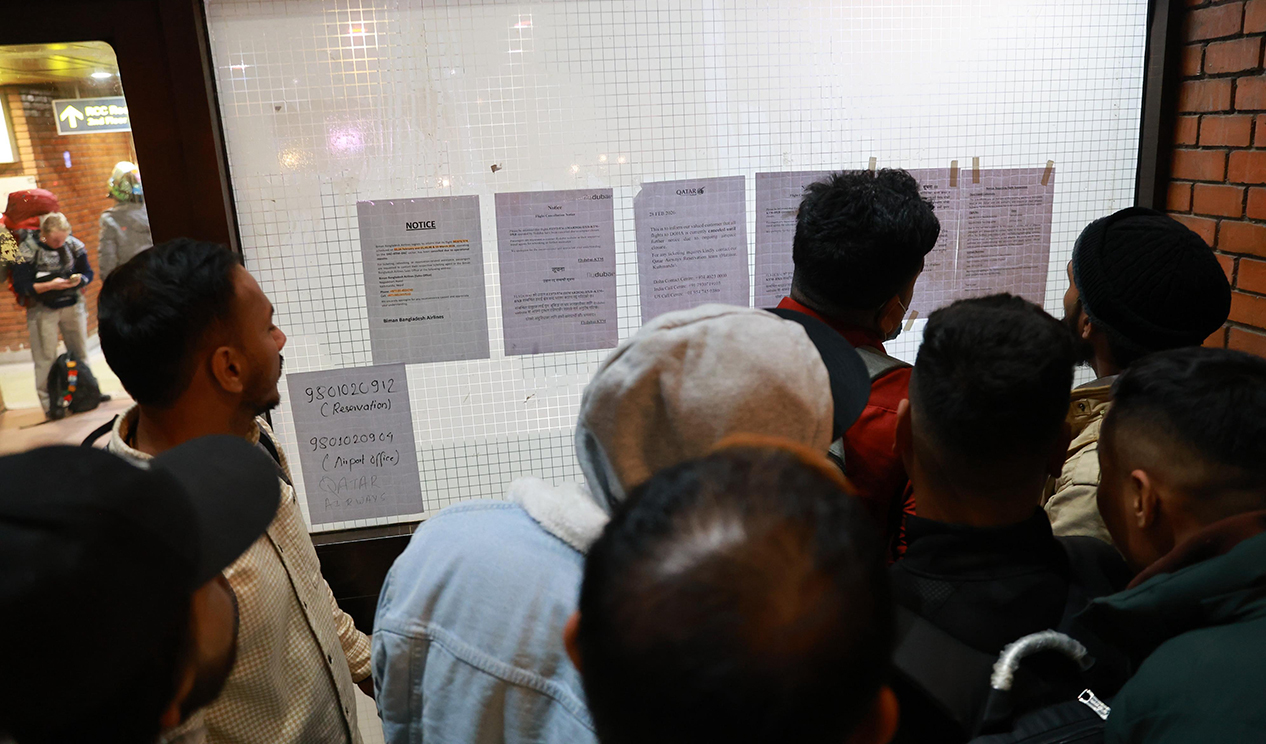
Passengers checking flight information at Tribhuvan International Airport after flights to Middle Eastern countries were canceled following the attack on Iran by United States and Israel. Photo: Nepal Photo Library
According to the Ministry of Foreign Affairs, around 700,000 Nepalis are currently in the UAE for employment. The ministry states that a total of 1,729,288 Nepalis are in 12 Gulf countries—including the UAE, Saudi Arabia, Qatar, and Kuwait—for foreign employment, study, and other purposes.
Ishwar Shrestha, vice president of the Non-Resident Nepali Association (NRNA), UAE, says that although markets are open and regular work has not stopped, Nepalis there are feeling anxious. He said, “Markets are open and regular work has not stopped. The local administration has told us to work safely. We have heard the sound of bombs exploding. It is natural to feel afraid in such a situation.”
According to the Ministry of Foreign Affairs, around 700,000 Nepalis are currently in the UAE for employment.
The local administration has urged people not to spread misinformation and to rely only on official information. Taking photos or videos and posting them on social media has been banned. Violators face fines ranging from 50,000 to 200,000 dirhams and possible deportation.
After Israel and the United States attacked Iran, Iran retaliated by targeting military camps of the US and other countries in Gulf nations. In the US attack on February 28, Iran’s Supreme Leader Ayatollah Ali Khamenei was killed. Iran’s counterattack strategy could further escalate tensions in the Gulf, potentially affecting Nepali workers there. Due to Iran’s retaliatory attacks, millions of migrant workers working in critical areas of Gulf countries are at risk. One Nepali has died in Abu Dhabi as a result of an Iranian attack. The deceased was Diwas Shrestha from Gorkha.
Concern over worker safety
Countries in South and Southeast Asia have been supplying large numbers of workers to the Middle East (Gulf region). According to the International Labor Organization (ILO), more than 24 million workers are employed in Gulf countries, including significant numbers of doctors, construction laborers, and domestic workers.
The ILO states that migrant workers make up more than 40 percent of the total labor force in Gulf countries—the highest proportion in the world. Most of them are engaged in low-income jobs and often work in unsafe and risky conditions. In recent days, the war has pushed workers overall into insecurity.
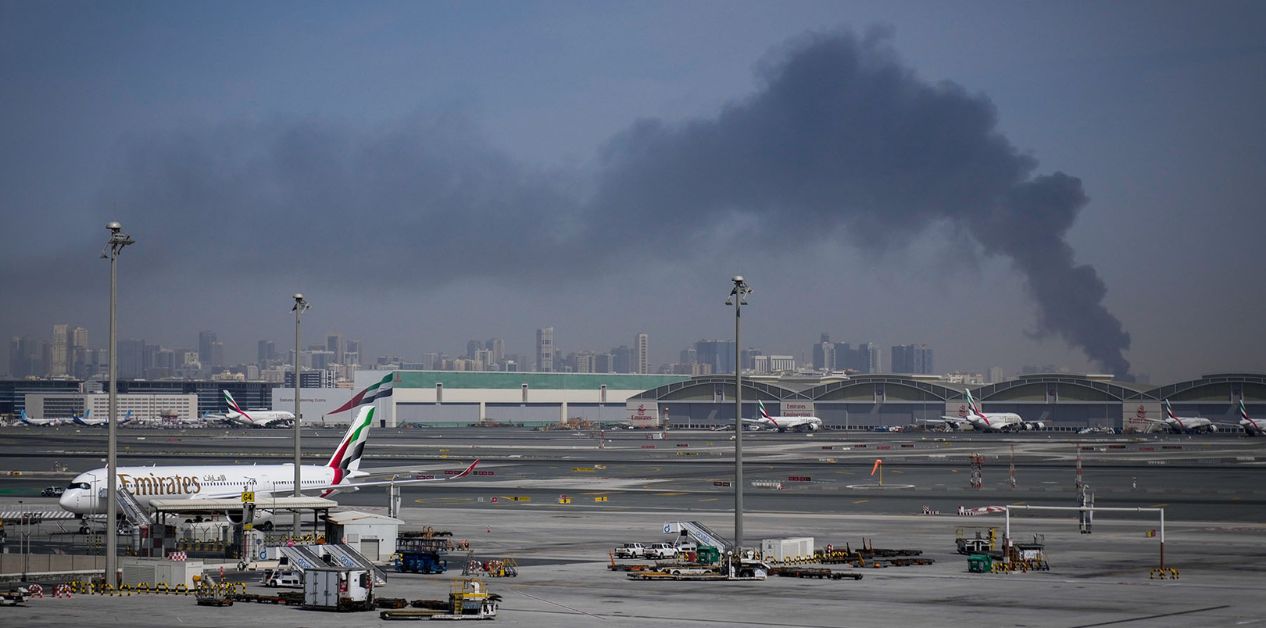
Aircraft parked after Dubai International Airport was closed on 1 March. Smoke rises in the background following an Iranian attack. Photo: Associated Press / Altaf Qadri
According to international financial news agency Bloomberg, on Monday (March 2), Philippines Labor Secretary Hans Leo Cacdac said that if the situation in the Gulf worsens, the government is prepared to repatriate around 2.4 million Filipino workers. He noted that relocating such a large number of workers would significantly affect both the Philippines and the destination countries.
Nepal is in a situation similar to the Philippines. If conditions in the Gulf deteriorate further, Nepal may need to bring its citizens home or relocate them to safer places—posing a major challenge for the country.
What Is Nepal’s preparation?
To provide emergency assistance to Nepalis affected by the war in the Gulf region, the government has formed an “Emergency Response Team” under the coordination of Foreign Secretary Amrit Bahadur Rai. According to Foreign Ministry Spokesperson Lok Bahadur Poudel Chhetri, the team will plan and act if Nepalis face problems or need rescue.
The Ministry of Foreign Affairs has created a portal to collect information and details of Nepalis in Gulf countries. Durpada Sapkota, Director General of the Consular Services Department, said, “This portal has been created to gather information about where Nepalis are, their condition, and what kind of assistance they need, so that immediate support can be provided.” All 10 Nepali diplomatic missions in the Gulf have been instructed to inform Nepalis about the portal.
The Nepali Embassy in Abu Dhabi issued a notice on March 3 informing people about the portal. The notice states: “In the first phase, Nepali citizens who are stranded at UAE airports while returning to Nepal from various countries, or whose UAE visas have expired or been canceled by their companies and who have already purchased tickets to return to Nepal but are facing difficulties due to the current situation, are requested to update their details through the portal as soon as possible.”
Ram Kaji Khadka, chief of the Middle Asia, West Asia, and Africa Division at the foreign ministry, said, “The safety of Nepalis in the Gulf region, Israel, and Iran is a matter of high priority. Accordingly, Nepali diplomatic missions there are working actively.”

Former vice chairman of the National Planning Commission and former governor of Nepal Rastra Bank, Dipendra Bahadur Kshetri warned that if Nepalis working in Gulf countries are forced to return home, it could create a severe crisis. “If Nepalis who went abroad for employment are forced to return, the country does not have the capacity to provide them jobs. Even though land lies barren, we do not have the systems in place to generate income through advanced agricultural technology,” he said. “Without employment and income opportunities, people could become frustrated and even rebellious.”
According to NRNA UAE Vice President Shrestha, those who had traveled for visits and had booked return tickets since Saturday are being provided free food and accommodation in hotels by the UAE government until airports fully reopen. However, Nepalis who traveled on visit visas for employment purposes may face difficulties. He said: “There was data showing around 500,000 Nepalis in the UAE. In the past six months, about 200,000 Nepalis arrived in the UAE on visit visas. There is no accurate data on how many have secured jobs. Those who have found employment will be taken care of by their respective companies, but those who remain unemployed may struggle even for food and shelter.”
Shrestha says that if Nepalis face any problems, they have been asked to contact the office of the NRNA there, and preparations have been made to provide them with necessary assistance.
Impact on remittances
Nepal’s economy depends heavily on remittances. Remittances account for about 25 percent of the country’s Gross Domestic Product (GDP). According to data published by Nepal Rastra Bank, in the first six months of the current fiscal year (mid-July 2025 to mid-January 2026), Nepal received remittances totaling Rs 1.062 trillion. According to Nepal Rastra Bank Spokesperson Guru Prasad Paudel, 42 percent of the remittances coming into Nepal originate from 17 Gulf countries. He said, “An analysis of remittance data over the past three to four years shows that 40 to 42 percent of remittances have come from 17 countries in the Gulf region. Among them, the largest amounts come from Saudi Arabia, Qatar, the UAE, and Kuwait.”
According to central bank data, in the month of Poush (mid-December 2025 to mid-January 2026) alone, Nepal received Rs 192.62 billion in remittances. Of that, 42 percent amounts to approximately Rs 80.90 billion. In other words, more than Rs 80 billion per month is flowing into Nepal from Gulf countries.
Of the remittances coming from those countries, Saudi Arabia and Qatar each contribute 12 percent, the UAE contributes eight percent, and Kuwait contributes five percent. Apart from these four, around five percent of remittances come from other Gulf countries. There are 1,617,778 Nepali workers in Saudi Arabia, Qatar, the UAE, and Kuwait alone.
If the United States and Israel escalate military actions against Iran, the direct impact could extend to Gulf countries as well. If Iran retaliates in a way that affects the Gulf region, it would impact the Gulf economies. Economist and executive director of South Asia Watch on Trade, Economics and Environment (SAWTEE), Paras Kharel, says this would directly affect the employment of Nepalis there and ultimately shrink the remittances Nepal receives. “When the economies of Gulf countries contract, the first impact is usually job cuts. That could affect Nepalis who are employed there,” he said.
According to central bank data, in the month of Poush (mid-December 2025 to mid-January 2026) alone, Nepal received Rs 192.62 billion in remittances.
Since Nepal is primarily dependent on Gulf countries for foreign employment, Kharel estimates that a prolonged war in the region would deeply affect Nepal’s economy. “A large share of remittances—the backbone of Nepal’s economy—comes from employment in Gulf countries. If the war intensifies and employment is affected, remittance inflows will shrink and Nepal’s economy will suffer a serious blow,” he said.
Due to rising tensions in the Gulf, Nepali workers there are living in fear. Their families in Nepal are also under stress. Migration expert Keshav Basyal says, “At a time when workers and their families are anxious, the Nepal government must prepare emergency plans. It is important to send the message that the government stands with them.”
Economist Hom Nath Gaire says that if tensions in the Gulf escalate further, Nepal will face a double impact. “If conflict increases in the Gulf, Nepali workers may be forced to return home. That will directly affect employment and remittances. A decline in remittance inflows will impact Nepal’s foreign exchange reserves. The country may have to pay higher prices for fuel, and there could be shortages of foreign currency needed for payments,” he said.
Nepal requires foreign currency to pay for all imported goods and services. Remittances are the country’s primary source of foreign exchange earnings. Since countries like India import fuel via the Gulf region, if fuel prices rise, the prices of most imported goods in Nepal will also increase, affecting the entire economy, Gaire said. “When fuel prices rise, production and transportation costs also increase. The country has to spend more money. Consumers may have to pay higher prices for imported goods, which Nepal heavily depends on,” he said.
Problems in fuel supply
Iran supplies about 10 percent of the world’s fuel consumption. According to Al Jazeera, Iran has closed the Strait of Hormuz, located along the border between Iran and Oman. Around 20 to 30 percent of the world’s fuel supply passes through this waterway.
Citing Iran’s Islamic Revolutionary Guard Corps (IRGC), Al Jazeera reported that Iran closed the strait on Monday (March 2) and warned that ships attempting to pass through would be set on fire. Earlier, Iran had attacked five oil tankers in the strait, resulting in two deaths. With the strait closed, around 150 ships have been stranded.
If fuel transportation through the Strait of Hormuz remains blocked, global fuel prices are expected to rise. On March 2, crude oil prices climbed above USD 79.40 per barrel. Just the previous Friday (February 27), prices had dropped to USD 73 per barrel. International media reports indicate that freight rates along Middle Eastern shipping routes have surged sharply. If the situation persists, projections suggest that fuel prices could rise to as much as USD 200 per barrel.
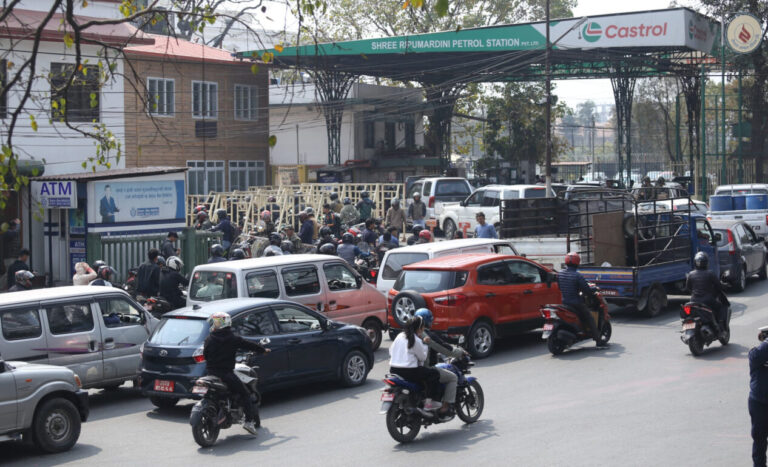
Vehicles lined up on 1 March at the Ripumardini petrol pump of the Nepal Army in Bhadra Kali, Kathmandu. Photo: Nepal Photo Library
This will also affect fuel prices set by India, which in turn will directly impact Nepal. In such a scenario, Nepal would have to spend a large sum on fuel imports, economist Kharel said.
According to the Department of Customs, from Shrawan to Poush (mid-July 2025 to mid-January 2026), Nepal spent Rs 142.75 billion on importing diesel, petrol, and cooking gas (LPG). If tensions between the United States and Iran continue, Nepal’s fuel import expenses could increase significantly, Kharel warned. “If electric stoves had been widely adopted instead of cooking gas, the impact of such problems would have been less. Despite facing repeated blockades, Nepal has not increased its fuel storage capacity. During the 1989 blockade (2045 BS), Nepal had a certain level of fuel storage capacity, and even today there has not been significant expansion,” he said.
When fuel prices rise, there is a chain effect. As fuel prices increase, transportation costs rise, which automatically drives inflation in the market. The direct impact is felt in consumers’ pockets.
Experts say the Nepal government must immediately begin preparations to face potential risks and crises arising from tensions in the Middle East. Economist Kharel said, “If workers in the Gulf are forced to return home, the government must start intensive preparations now to mitigate and manage the resulting impact.”