Kathmandu
Tuesday, July 14, 2026





Nepal’s new government faces a delicate Himalayan chessboard. Its strategy to balance the country amid rising regional and global power competition remains uncertain, and it will take time to see how these ambitions translate into practical outcomes.

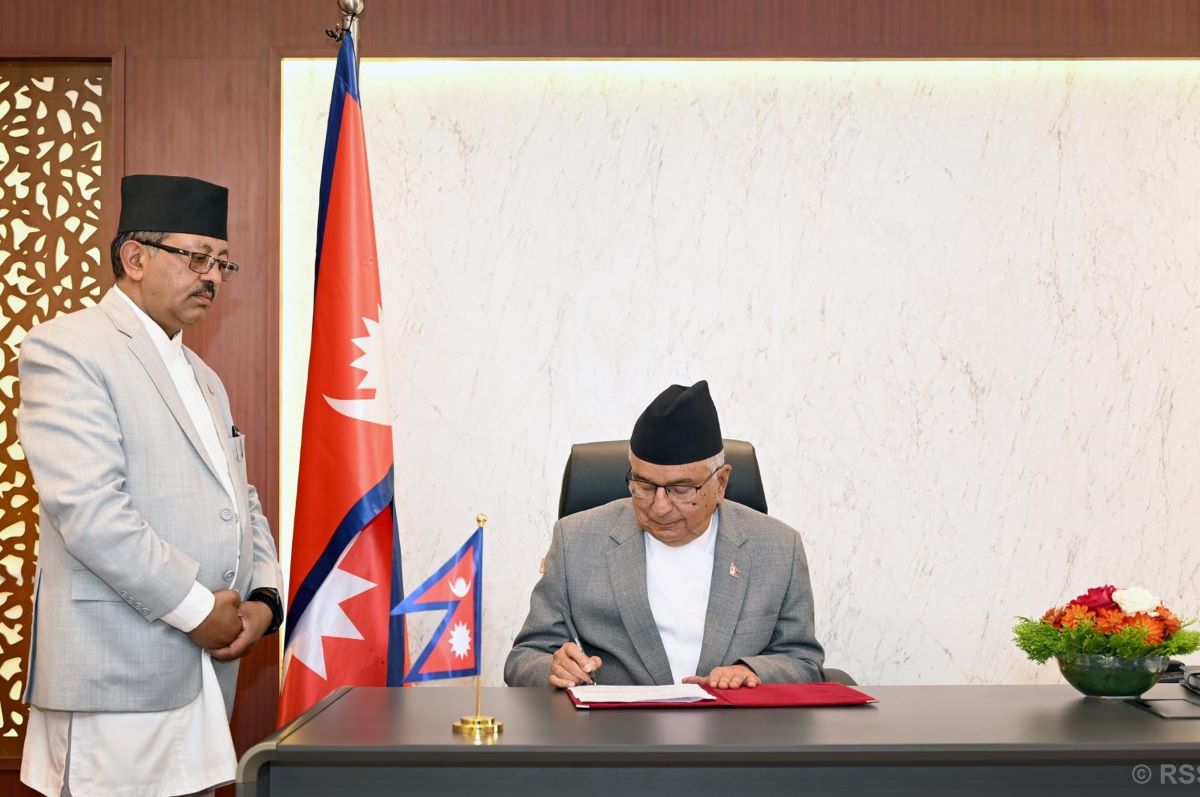
KATHMANDU: As Prime Minister Balendra Shah convenes foreign ambassadors for a collective meeting today, Kathmandu’s diplomatic corps will be watching more than mere protocol. The gathering marks the first formal multilateral engagement between the Balen-led government and the foreign missions since the formation of its commanding near two-thirds majority government-a fresh mandate that has raised expectations at home and scrutiny abroad.
Yet beneath the symbolism lies a deeper question: how will a relatively new political force, still untested in the intricacies of statecraft, navigate Nepal’s increasingly fraught geopolitical environment? In a country where foreign policy is shaped as much by geography as by diplomacy, the challenge before Shah’s government is not simply managing bilateral relations, but balancing intensifying rivalries among competing powers in one of Asia’s most strategically sensitive arenas.
Nepal has long been described as a yam between two boulders. The metaphor remains useful, but no longer sufficient. The country is still wedged between India and China, still constrained by geography, and still vulnerable to the strategic anxieties of larger neighbours. Yet the old binary framing obscures a more consequential reality: Nepal is no longer merely balancing between two giants.
It is navigating a more crowded and more complicated geopolitical order in which India, China and the United States-along with wider global rivalries-now intersect on Nepali soil, in Nepali politics and through Nepali institutions.
For Kathmandu, the challenge is not simply to preserve neutrality. It is to prevent strategic competition from overwhelming state capacity while turning foreign interest into national advantage. Nepal is no longer a passive buffer in regional geopolitics. It has become a contested strategic hinge in the Himalayan corridor-important not because of its military strength, but because of where it sits, what it borders and which rivalries now pass through it.
Geography has made Nepal relevant; geopolitics has made it vulnerable
Nepal’s geopolitical significance begins with geography but does not end there. Its Himalayan territory separates the Tibetan plateau from the Indo-Gangetic plain, placing it between one of China’s most politically sensitive frontier regions and one of India’s most strategically vital heartlands. For Beijing, Nepal is inseparable from Tibet’s security. For New Delhi, Nepal is inseparable from northern India’s strategic depth. Neither power can regard Nepal with indifference.
That structural reality has shaped Nepal’s foreign policy since the modern state emerged. But what has changed in recent years is the intensity of strategic competition and the number of actors involved. China’s rise, India’s recalibrated regional strategy and America’s more assertive Indo-Pacific posture have transformed Nepal from a bilateral balancing problem into a multipolar geopolitical arena. Kathmandu is no longer managing one rivalry. It is managing overlapping rivalries.
China sees Nepal as frontier security, not merely a neighbour
Chinese engagement with Nepal is often discussed through the language of infrastructure and development. That is only partly correct. Beijing’s Nepal policy is driven first by security logic and only second by economics.
China’s core concern is Tibet. A stable, cooperative Nepal helps Beijing secure its southern frontier, prevent anti-China political activism linked to Tibet, and reduce the possibility of external powers exploiting the Himalayan corridor. Nepal’s role in Chinese strategic thinking is therefore less about Nepal itself than about what instability in Nepal might mean for western China.
This explains why Chinese investment and diplomacy in Nepal have expanded sharply since the 2010s. The Belt and Road Initiative, cross-border connectivity plans, road and rail proposals, dry-port access and growing political engagement are not standalone development gestures. They are instruments of strategic shaping. Beijing wants a Nepal that is economically tied northward enough to remain politically sensitive to Chinese interests.
The broader objective is not domination but insulation: ensuring that Nepal does not become a platform for anti-China security pressure, ideological hostility or strategic encirclement.
India remains Nepal’s indispensable partner-but no longer its uncontested one
Despite China’s rise, India remains Nepal’s most consequential external actor by a wide margin. No other country matches India’s embedded influence in Nepal’s economy, labour market, energy grid, transport systems, security linkages and societal fabric.
Trade overwhelmingly flows south. Transit routes overwhelmingly run through India. Millions of Nepalis work in or move through India with ease. Electricity trade is increasingly integrating the two economies. Social, linguistic, religious and familial ties across the open border remain unmatched by any external power.
Yet structural centrality has not guaranteed political goodwill. India’s longstanding tendency to approach Nepal through a security-first lens has repeatedly generated resentment in Kathmandu. Whether through perceived interference in constitution-making, overt involvement in coalition politics, or the enduring shadow of blockade politics, New Delhi has often undermined its own influence by appearing less like a partner than a supervisor.
This is the paradox of India’s Nepal policy: no state has deeper influence in Nepal, yet few external actors generate stronger periodic nationalist backlash.
India increasingly recognises this. Its strategy has shifted from overt dominance to managed pragmatism—accepting that Nepal will engage multiple powers while seeking to remain Kathmandu’s most indispensable partner. The emphasis on hydropower trade, cross-border transmission lines, railway expansion and infrastructure integration reflects this adaptation. New Delhi understands that in an era of alternatives, relevance matters more than hierarchy.
America’s role is limited-but strategically amplifying
The United States does not view Nepal with the same strategic urgency as India or China. Nepal is not a core American theatre. Yet Washington’s involvement has outsized geopolitical consequences because even limited US engagement alters the regional balance.
American assistance through governance programmes, democracy support, military cooperation and infrastructure initiatives such as the MCC has introduced a strategic dimension to Nepal’s relationship with Washington that exceeds the material scale of the programmes themselves. For Beijing, such engagement is interpreted through the lens of strategic competition. For some in Nepal, it represents diversification. For others, it risks entanglement.
America’s significance in Nepal lies less in what it does than in what its presence symbolises: the widening of Nepal’s geopolitical field beyond its immediate neighbourhood. That makes Nepal not merely part of South Asian regional balancing, but a secondary theatre in the broader contest over Asian order.
Nepal’s problem is not pressure from abroad- it is incoherence at home
Nepal’s strategic predicament is often framed as the inevitable burden of geography. That explanation is too convenient. Geography creates constraints, but domestic weakness magnifies them.
Nepal’s greatest geopolitical vulnerability is not that major powers compete for influence. It is that Nepal often lacks the institutional coherence to manage that competition strategically.
Foreign policy in Kathmandu remains overly personalised, fragmented and reactive. Strategic decisions are too often shaped by coalition arithmetic, ideological symbolism or short-term domestic political gain rather than durable national doctrine. Successive governments have welcomed major external initiatives-from BRI to MCC-without first building internal consensus on strategic objectives, implementation frameworks or red lines.
As a result, foreign partnerships that should have been developmental become politically polarising. Infrastructure proposals become ideological battlegrounds. Diplomatic engagements become proxies for domestic factional conflict.
No foreign power has created this dysfunction. Nepal has. A small state can survive intense geopolitical competition if its institutions are disciplined, strategic and coherent. A weak state cannot remain autonomous merely by declaring neutrality.
Non-alignment is no longer enough
Nepal’s traditional answer to geopolitical competition has been non-alignment. The doctrine remains rhetorically powerful, rooted in Panchsheel principles, the Non-Aligned Movement and Nepal’s self-image as a peace-oriented sovereign state. But in today’s strategic environment, non-alignment alone is inadequate.
Cold War neutrality assumed relatively clear blocs and distance from direct strategic integration. Modern geopolitics is more complex. Competition now occurs through infrastructure, standards, digital systems, energy grids, financing, development institutions and political influence-not merely military alliances.
Nepal cannot remain “non-aligned” simply by avoiding formal security pacts while permitting unstructured strategic dependencies to deepen through economic and political channels.
What Nepal needs is not passive neutrality but disciplined multi-alignment: engagement with all major powers, dependence on none, and strategic clarity about where developmental cooperation ends and strategic vulnerability begins.
That requires red lines. Not every investment is benign. Not every grant is neutral. Not every connectivity project is purely economic. Nepal must evaluate foreign engagement not through ideological narratives but through strategic cost-benefit analysis grounded in national interest.
The bridge-state ambition remains largely rhetorical
Nepali foreign policy experts increasingly describe the country as a future “bridge” between India and China. It is an attractive vision: Nepal as a transit hub, logistics corridor and commercial connector linking the world’s two most populous states.
But the bridge-state narrative remains more aspiration than reality. Cross-Himalayan connectivity remains underdeveloped. Most Chinese transit promises remain infrastructural concepts rather than functioning trade alternatives. Geographic realities, cost structures and engineering challenges limit the near-term viability of large-scale northbound trade substitution. India will remain Nepal’s dominant economic artery for the foreseeable future.
That does not make northern connectivity irrelevant. It makes realism necessary. Chinese routes can diversify dependence, improve bargaining leverage and expand long-term options. But they will supplement, not replace, Nepal’s southern economic orientation. Nepal’s danger lies in mistaking diversification for strategic transformation.
The real contest is over Nepal’s strategic agency
The central question in Nepal’s geopolitics is not whether India, China or the United States gains more influence in absolute terms. Some level of influence from all three is inevitable. The real question is whether Nepal retains agency over how that influence operates.
Agency requires the capacity to set terms rather than merely react to them. It means deciding which projects align with national priorities, which external partnerships enhance resilience, and which dependencies create long-term strategic risk.
At present, Nepal’s leverage is often overstated. Geography creates opportunity, but only capable states can convert strategic location into strategic power. Without stronger institutions, better diplomatic planning and greater domestic consensus, Nepal risks confusing visibility with leverage. Being courted by major powers is not the same as being powerful.
Nepal’s next decade will determine whether it becomes a player or a platform
Nepal now stands at a strategic inflection point. If it manages external competition intelligently, it can extract infrastructure, market access, diplomatic relevance and strategic flexibility from competing powers. Few small states are so geographically positioned to leverage rival interests for national gain.
But if mismanaged, the same competition could deepen dependency, intensify domestic polarisation and reduce Nepal to an arena in which stronger powers contest influence through local proxies and institutional capture.
That is the essential geopolitical test of the coming decade. Nepal’s geography guarantees strategic attention. It does not guarantee strategic success.
For too long, Nepal has viewed geopolitics as something that happens to it. That mindset is no longer sufficient. In a multipolar Asia, survival will depend not merely on balancing external powers, but on building the internal strategic competence to shape the terms of engagement.
Nepal cannot change its geography. But it can decide whether geography remains its constraint-or becomes its leverage. In the new Asian order, that choice may determine whether Nepal emerges as a sovereign strategic actor, or remains simply the terrain upon which others compete.