Kathmandu
Thursday, June 18, 2026





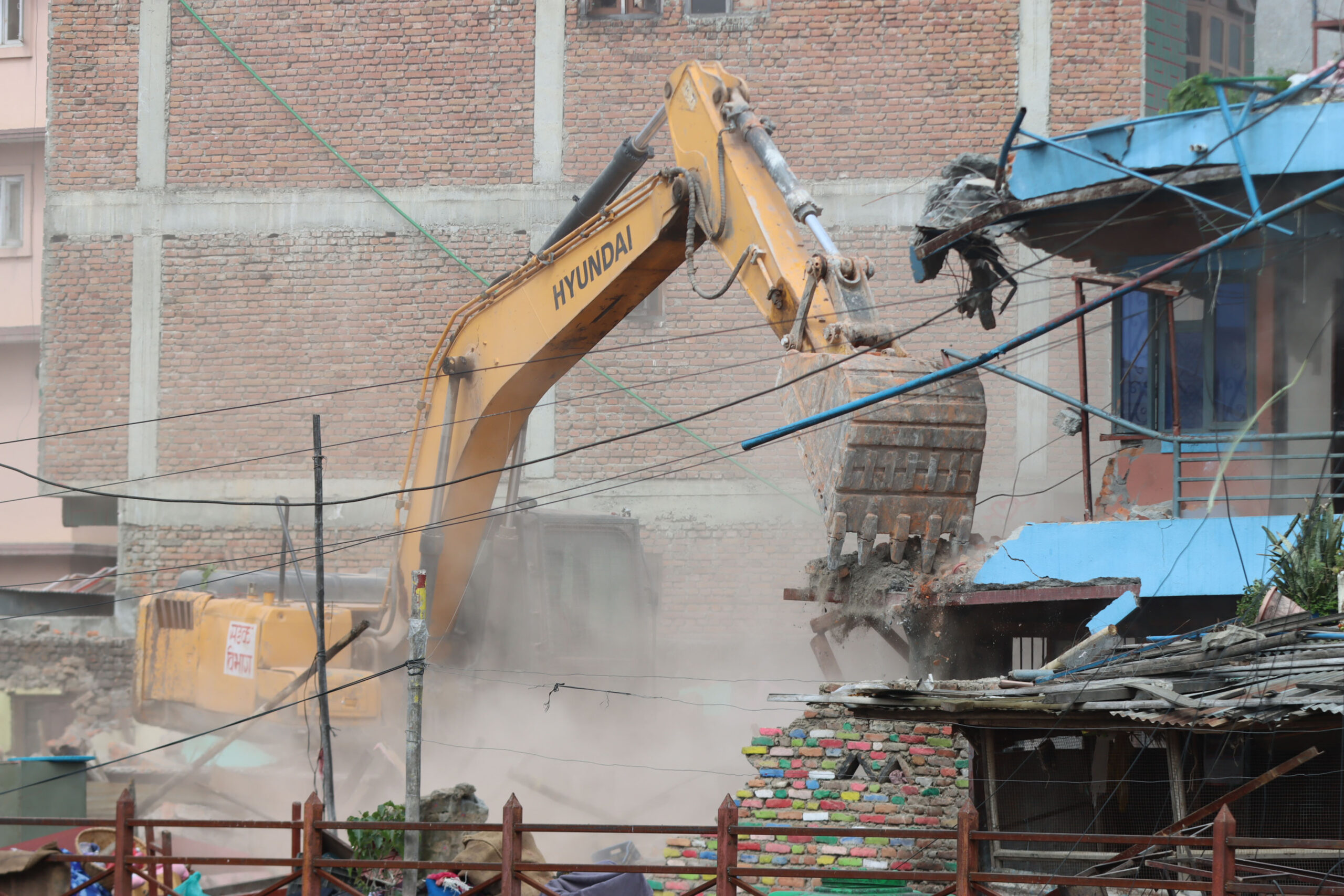
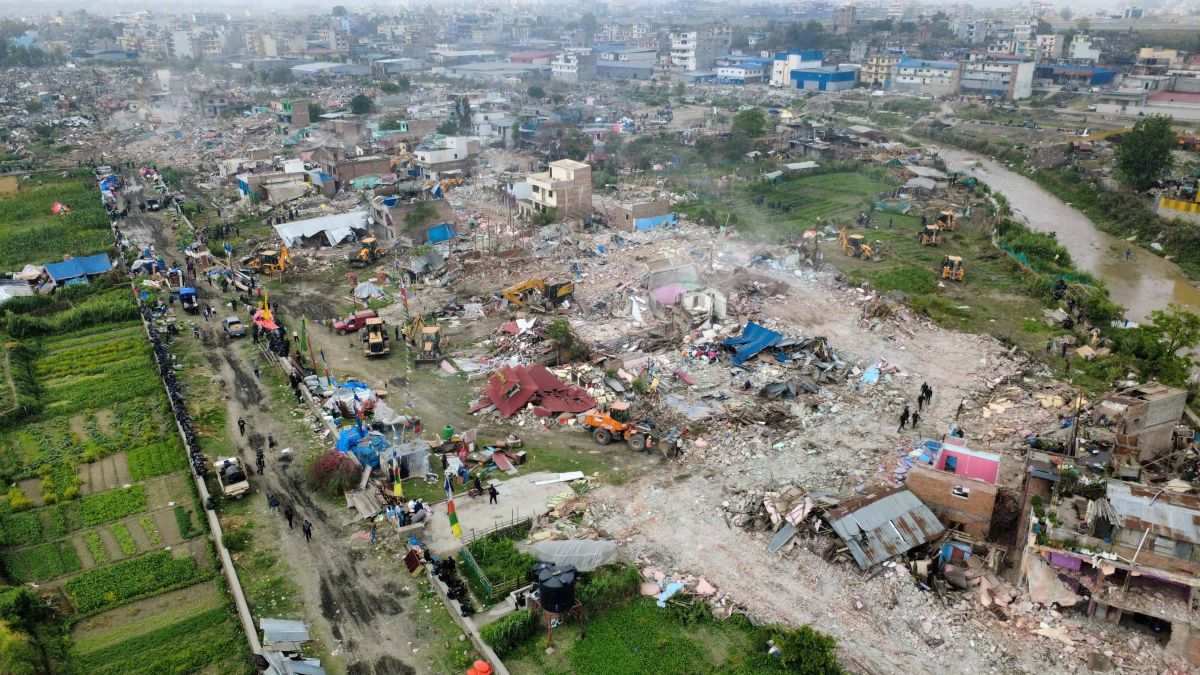
KATHMANDU: In the days leading up to April 25, 2026, something revealing happened in the narrow lanes of Thapathali’s riverside settlement. Before the bulldozers arrived, before the security forces gathered in numbers that swelled as the neighbourhood emptied, loudspeakers mounted on police vehicles moved through the colony on April 23 announcing that by six in the morning on April 25, the settlement had to be vacated. Families who had built lives on that ground, in some cases across two generations, spent those nights in the particular agony of not knowing where morning would take them.
This is how the state announced itself: not with a policy, not with a resettlement plan, not with the name of a building where a family with a sick elderly member or a newborn child could report and expect care. It announced itself with noise, with a deadline, and then with machines.
Two people died in the days that followed. One man, who had worked at a vegetable market near Balkhu for nearly seventeen years, was found dead in the Bagmati River as the settlement where he had lived with his wife and son was being cleared. He had lived there long enough to see the city change around him. The city did not see him clearly enough to offer him an alternative before it erased his home.
These deaths did not silence the debate. For a significant portion of Nepal’s urban middle class, the evictions were long overdue. Social media filled with approval. The word “finally” appeared with exhausting regularity. What this analysis is interested in is what that word reveals: about the limits of our empathy, the selectivity of our historical memory, and the political promises we are willing to forget.
The State That Moved Without Preparing
There is a particular kind of governance failure that is more insidious than simple incompetence, and that is the failure of sequence. When a state has all the legal obligations, all the court directives, all the constitutional provisions it needs to act humanely, and then acts, but in the wrong order, the result is not decisive leadership. It is organized harm presented as public administration.
Nepal’s legal framework on the question of landless communities is not vague. The Constitution, in its fundamental rights chapter, guarantees every citizen the right to adequate housing. It explicitly prohibits eviction from a dwelling without due legal process. The Supreme Court, in a significant order in 2024, did not simply direct authorities to clear riverbank settlements. It conditioned that direction on a prior obligation: genuine landless families had to be provided with verified, adequate housing before any eviction could proceed. The court named specific agencies responsible for fulfilling that obligation. Two years passed. The obligation was not fulfilled. The agencies proceeded anyway.
The Land Related Problems Resolution Commission had already placed itself on record by early 2025, warning that evictions carried out without prior resettlement plans would constitute violations not only of domestic constitutional rights but of the country’s obligations under international law. This warning was not buried in obscure legal literature. It was institutional, formal, and specific.

What the government did instead was begin clearance operations while simultaneously denying that a formal cabinet decision authorizing them had been taken. The government spokesperson stated that no such decision existed. The bulldozers arrived at six in the morning. This contradiction, administrative machinery in motion while official authorization remained officially unconfirmed, is not a bureaucratic anomaly. It is a pattern. It reflects a government more comfortable with facts on the ground than with accountability on paper.
The verification of who among the displaced actually qualified as a genuine _sukumbasi_ , defined under Nepal’s own laws as someone who has no land anywhere in the country and cannot acquire any through their income, was announced for the day after the first demolitions began. This is the sequencing problem at its starkest: destroy first, identify later. The families who did not qualify would face eviction regardless. The families who did qualify would face eviction before the state had determined they qualified. Everyone would be displaced. The sorting would happen afterward, in stadiums and temporary shelters, among the rubble of their previous lives.
Local governments; municipalities and rural municipalities, the constitutional frontline institutions for exactly this kind of community-level identification work, had not been properly consulted. The representative bodies of local governments across the country issued a formal joint statement expressing not mild concern but serious objection, pointing out that the responsibility for identifying and managing landless communities belonged primarily to local governments, and that federal security agencies had been deployed in ways that overrode and bypassed that responsibility. They noted that data collection and verification were still ongoing. They asked that the evictions stop.
The Supreme Court issued a show-cause order to the government, asking it to explain itself. International human rights organizations described the approach as authoritarian. Prominent political figures across party lines visited the cleared sites and expressed public dismay. Former prime ministers, an opposition party president, civil society activists, legal experts, and the consensus among those who examined the situation carefully was consistent: the goal may have been legitimate; the method was not.
None of this reached the social media feeds of those who had already celebrated. Or it reached them, and it did not change what they felt, because what they felt was not primarily about process. It was about the satisfaction of seeing disorder removed from sight.
The Myth of the “Fake Squatters”
A justification circulated widely in the weeks surrounding the evictions, and it deserves serious examination rather than dismissal, because it contains a partial truth that has been stretched into a comprehensive moral alibi.
The argument goes like this: the majority of people living in these riverbank settlements are not genuine landless. Many of them own land in their home districts. Some of them are there not out of destitution but out of proximity to the city’s economic opportunities, or because the land they occupy is valuable and its occupation has become a form of informal security. The state has indulged this situation for decades because politicians used these communities as captive vote banks, distributing small benefits in exchange for electoral loyalty while never resolving the underlying situation. The time for firm action has arrived.
There is truth in parts of this. It is accurate that not everyone living in an informal riverside settlement meets the strict legal definition of a landless. Commission data has consistently shown a gap between the total population living in such settlements and the number who qualify as genuinely landless under the 1964 Land Act’s narrow criteria. It is also accurate that the political instrumentalization of these communities, using them as vote banks without providing real solutions, has been a disgraceful feature of Nepali politics across multiple parties and multiple decades.
But notice what the argument does with this truth: it uses the existence of some non-genuine claimants as justification for mass eviction without individual verification. It substitutes the guilt of a portion for the punishment of the whole. If the concern is genuinely about distinguishing real landless from those who do not qualify, then the appropriate response is rigorous, humane, individual-level verification — exactly what the Supreme Court ordered, exactly what the land commissions were supposed to do, exactly what the local governments were in the process of attempting. The existence of non-genuine claimants is not an argument against verification. It is the strongest possible argument for it.

Tents set up for displaced landless settlers within the ashram premises with no privacy
When that argument is used instead to justify skipping verification entirely: when “many of them are fake” becomes the reason to move the bulldozers in without identifying who is and who is not, it has stopped being an argument about truth and become an argument about convenience. It says: the administrative work of telling these people apart is difficult and slow, and so we will not do it, and we will use the moral weight of the fraud concern to prevent anyone from criticizing us for not doing it.
This logic has real victims. Among the people displaced from Thapathali, Manohara, Gairigaun, and the other cleared settlements were pregnant women. Women who had recently given birth. Newborns. Old people in fragile health. Students sitting examinations. People managing chronic illnesses without access to regular healthcare. These are not abstractions. The government’s own pre-eviction announcements acknowledged their existence that residents were instructed to move these vulnerable individuals to safer locations before the machinery arrived. The announcement did not specify what those safer locations were. The state offered a warning and withdrew the offer of a plan.
To look at a pregnant woman carrying her belongings out of the only shelter she has known and to say “well, many of her neighbours were probably not genuine landless anyway” is not sophisticated policy analysis. It is the avoidance of moral discomfort wearing the costume of analytical thinking.
Two Centuries of Dispossession
The most consequential thing missing from the middle-class celebration of these evictions is historical understanding. Not historical sentiment — not nostalgia or guilt — but the basic factual understanding of how land came to be distributed the way it is in Nepal, and why that history makes the present situation morally different from what the word “encroachment” implies.
Nepal’s land inequality was not created by the choices of poor people. It was created by the choices of powerful ones, across centuries.
Under the old monarchical and Rana regimes, land was the primary instrument of political control and reward. Fertile agricultural land across the hills and the Terai plains was granted to court insiders, military commanders, religious institutions, and high-caste elites through the birta and jagir systems — grants of land that came with the people already working it included as effective bonded labourers. The recipients of these grants were not farmers. They were patrons. The farmers were tied to the land but owned none of it. This was not an informal arrangement. It was the formal legal structure of the Nepali state for generations.
When that structure was eventually reformed, the birta system was abolished in the 1960s, the reform did not include redistribution. The concentrated ownership patterns created by two centuries of elite land grants remained in place, transformed into market relationships that preserved the fundamental inequality while removing its most explicitly feudal legal forms. The people who had worked that land for generations were not compensated for the centuries in which their labour had enriched the state and its favoured classes. They were simply left where they were, without land titles, without formal recognition, without a pathway into the document-based ownership system that the modern state was constructing around them.
The Tharu people of the western Terai represent one of the clearest examples of this dispossession. For generations, Tharu communities cultivated land across the Terai plains using communal agricultural systems that did not require or rely on formal state documentation, because formal state documentation had not existed for most of their history and because their systems of collective land use were internally coherent and functional. When malaria eradication in the 1950s and 1960s opened the Terai to widespread migration from the hills, the document-based land registration system the state used gave migrants a mechanism to formally claim land that Tharu communities had farmed for centuries. The methods of appropriation were sometimes openly predatory: thumbprints of illiterate farmers on documents they could not read, presented to land offices as evidence of voluntary sale. This was land theft facilitated by administrative systems that the state had built without any protection for communities who organized themselves differently.
The Dalit dimension of this history is perhaps the most severe. Dalits, communities placed at the base of Nepal’s hierarchical caste structure, were not merely disadvantaged in competition for land ownership. They were categorically excluded from it. For centuries, Dalits had no legal right to own land. Their relationship to the land they worked was defined entirely by their relationship to high-caste patrons who could withdraw even subsistence-level access as a form of social punishment. The abolition of caste-based discrimination in law did not undo the material consequences of those centuries. Research consistently shows that the overwhelming majority of Dalit families in Nepal today remain functionally landless, not because of choices they made, but because of a system designed to exclude them that has never been adequately reformed.
The civil conflict between 1996 and 2006 added another layer. The Maoist insurgency drew much of its energy from rural landlessness and the perception — accurate in structural terms — that the post-1990 democratic system had failed to redistribute either land or economic opportunity. When the conflict ended, tens of thousands of people had been displaced. Freed bonded labourers — people who had worked off hereditary debts through lifetimes of unpaid agricultural service — were promised land as part of the peace settlement. Many are still waiting.
When someone stands in Kathmandu in 2026 and calls a family living on a riverbank an “encroacher,” they are using a word that describes a legal status while ignoring the history that produced it. They are treating the end of a very long story as if it were the beginning, and judging the last chapter without having read any of the others.
RSP, Balen Shah and the Specific Weight of Specific Words
Political promises are easy to criticize in general — every party makes them, every party breaks some of them, and the public has become understandably cynical about manifesto commitments. But there is a difference between the vague aspirational language of a party platform and specific, embodied, first-person commitments made in front of cameras to specific constituencies on specific issues.
RSP chairman Rabi Lamichhane made such a commitment. In the lead-up to the 2026 elections, with the question of landless settlements politically charged, he stated explicitly and emotionally that if bulldozers were deployed against landless communities after his party came to power, he would place himself physically between the machine and the people. This was not platform language. This was a personal pledge. It was recorded. It circulated widely. It was part of what shaped the political identity of the RSP as a party that would treat the powerless differently from how the establishment parties had.

He also told voters, as recently as the election campaign period of March 5 elections, that the landless settlers’ issue would be resolved through a dedicated commission after the RSP formed government — that verification and long-term solutions would come before displacement. No such commission had been formed when the bulldozers were prepared and deployed.
When young people who had voted for the RSP based partly on these commitments went to social media to ask Lamichhane whether he intended to honour his words, they were not being naive. They were doing exactly what an accountable democracy requires: holding elected officials to specific commitments made to specific people. They received in response an argument about the distinction between taking shelter and occupying land — a distinction that is conceptually valid and operationally meaningless without the verification process that the government had not conducted.
Balen Shah’s history with this issue is, in some ways, even more instructive. During his tenure as Kathmandu’s Mayor from 2022, he attempted repeatedly to clear riverside settlements through force. The most prominent of these attempts, in late 2022, ended in clashes that injured more than two dozen people and generated significant criticism both domestically and internationally. Human rights organizations documented what they described as the use of disproportionate force against both squatters and street vendors. The metropolitan government under Shah was criticized consistently for bypassing consultation and due process in its enforcement actions.
This record did not disqualify Shah in the eyes of many voters. In a political environment where decades of elite consensus had produced spectacular inaction on virtually every structural problem the country faced, decisiveness — even imperfect, even contested — had a genuine appeal. Shah’s electoral mandate in 2026 was strong. The RSP’s victory was real. The public appetite for a different kind of governance was legitimate.
But the lesson that could have been drawn from Shah’s mayoral tenure, that force without preparation produces short-term spectacle and long-term failure does not appear to have been the lesson, that shaped the government’s approach to the latest evictions. The same sequencing error, the same insufficient preparation, the same gap between announced intention and operational reality appeared again, now with federal rather than municipal authority behind it.
The government’s roadmap for addressing the landless settlers’ issue included commitments to form a commission and implement long-term solutions within a stated timeframe. The commission had not been formed. The evictions had begun. The Gen Z activists who had been central to the political movement that brought the RSP to power — the same movement whose energy Balen Shah had channelled and whose aspirations his government claimed to represent — found themselves publicly calling out a betrayal of the specific terms on which their support had been extended.
This is not a story about idealism versus realism. It is a story about the gap between what was promised and what was done, and about who pays the price for that gap.
What Comprehensive Policy Requires
The argument for decisive action rests on a real frustration: Nepal has formed commission after commission to address the landless settlers problem, each one dissolving without completing its work, each one replaced by another, the whole process consuming decades while the genuinely landless remained landless and the political class retained its ability to promise solutions without delivering them. By some counts, Nepal has established over twenty successive commissions for land-related problems without resolving the fundamental situation. The 22nd commission registered more than a million applications, signed agreements with the overwhelming majority of local governments, and developed databases of landless Dalits, landless squatters, and informal settler families — and then its mandate expired before distribution was completed. A technical database built by one commission to cross-reference applications against national land records was simply discontinued when the commission changed. Institutional memory, verification progress, and public trust were all lost simultaneously with each reset.
Against this backdrop, the impulse toward action is understandable. The problem is that moving bulldozers is not a substitute for the institutional work. It is a way of performing urgency without incurring the actual costs — administrative, political, financial — of solving the problem. Evicting families from riverbanks and moving them to temporary shelters does not make them less landless. It makes them more displaced. If the verification that should have preceded the eviction is then conducted after the fact, in hotels and stadiums, with families separated from their communities and their contexts, the results will be less accurate, not more, and the process of rehabilitation will be harder, not easier.
What genuine resolution would require is at minimum the following: a nationally consistent and politically insulated database of landless individuals, built through actual door-to-door verification and cross-referenced with land records, that survives changes in government rather than resetting with each new commission. Differentiated approaches by region and community type, because a freed bonded labourer in the Terai whose family farmed the same land for generations needs something fundamentally different from an urban migrant family whose members work daily wage labour near a city market. Constitutional compliance as a non-negotiable procedural baseline, meaning that housing arrangements must genuinely precede, not follow, displacement. Statutory timelines with independent monitoring, rather than commission terms that expire with political appointments. And, most fundamentally, some honest engagement with the concentration of land ownership that is the structural engine of ongoing landlessness — five percent of the population controlling approximately 37 percent of all arable land is not background context for the landless problem. It is the squatter problem’s ongoing generator.
Every government that has addressed the downstream consequences of this concentration — the evictions, the settlements, the commissions — without seriously addressing the upstream cause has bought temporary political credit while leaving the structural problem intact. The RSP government, with its strong mandate and its stated commitment to structural reform, has the institutional and political capacity to do something different. What the latest eviction drive demonstrated is that the government has not yet decided to use that capacity in a way that is equal to the complexity of the problem.
The Question of Sympathy
There is a word that has been largely absent from the middle-class discourse around these evictions, and that word is sympathy. Not pity — pity looks down; sympathy looks across. Not guilt — guilt is about the observer. Sympathy is about recognizing another person’s specific, concrete, human experience and allowing that recognition to inform your response to what is happening to them.
The cases that were documented during the evictions are not difficult to sympathize with if one allows oneself to be present to them. An elderly woman who watched her home of many years become rubble expressed something that she had every human right to feel. A man who had built his livelihood near his community for nearly two decades walked into a river and did not come back. A woman carrying a pregnancy faced the night without confirmed shelter. A student preparing for examinations came home to find the home no longer existed.
None of these individual realities should be difficult for a person of ordinary human feeling to recognize as worthy of serious concern. Yet the dominant tone on social media — from urban, educated, relatively comfortable people — was closer to satisfaction than sorrow. The phrase “the rule of law” was invoked repeatedly, as if the rule of law means only enforcement, never procedure, never due process, never the constitutional guarantee that precedes any lawful eviction.
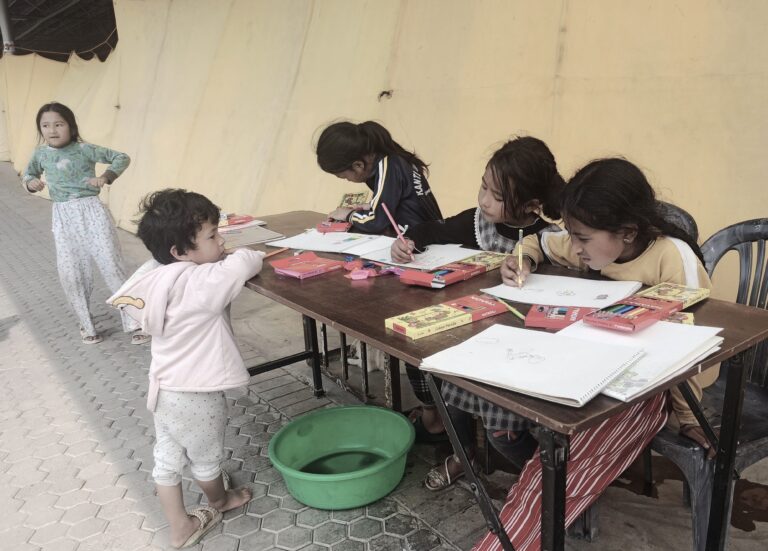
Children continuing their studies at the ashram following their eviction from school
This selective application of legal reasoning deserves notice. The same people who invoked the rule of law to justify the evictions were largely silent about the Supreme Court’s conditional directives, the constitutional housing guarantee, the Land Commission’s unmet verification obligations, and the documented failure to provide prior resettlement. The rule of law, in this framing, applied to the obligation of the poor to vacate. It did not apply to the obligation of the state to prepare.
This is not coincidental. It reflects a class-based moral geography in which the violations committed against the poor are categorized differently from the violations committed by the state. The poor who occupy public land without a title are encroachers. The state that evicts without verification and without prior housing is implementing policy.
The history of how those families came to be on that land — through caste exclusion, feudal dispossession, indigenous land theft, conflict displacement, and the systematic failure of every formal mechanism that was supposed to address these things — is treated as irrelevant context. But it is not irrelevant. It is the entire explanation.
What Remains After the Bulldozers Leave
The Bagmati River does not remember the argument. It will flood this monsoon as it floods every monsoon, carrying the city’s waste and the city’s complicated conscience through its polluted channels. The settlements that existed on its banks have been cleared. The people who lived in them have been moved — to stadiums, to hotels, to relatives’ spare rooms, to other informal arrangements elsewhere in the city that will eventually face the same political pressure.
The problem has not been solved. It has been relocated.
Nepal’s landless crisis is older than its democratic institutions and more durable than any of the governments that have tried to manage it. It was created by the choices of the powerful across two centuries. It was maintained by the failure of the political system to address structural land inequality even after formal democracy arrived. It was exacerbated by a civil conflict that displaced hundreds of thousands and produced peace agreements whose land provisions were never implemented. It was complicated by urbanization that proceeded without adequate housing policy, by land commissions that were reset every time they neared completion of their work, and by a political culture that found it easier to promise solutions to the landless than to build them.
The RSP government under Prime Minister Balen Shah came to power with a genuine mandate for change. The voters who gave them that mandate — including the young voters whose political energy was the movement’s backbone — did so partly because the old parties had failed so comprehensively on issues like this one. The expectation was not just better governance in a procedural sense. It was a different relationship between the state and its most vulnerable citizens.
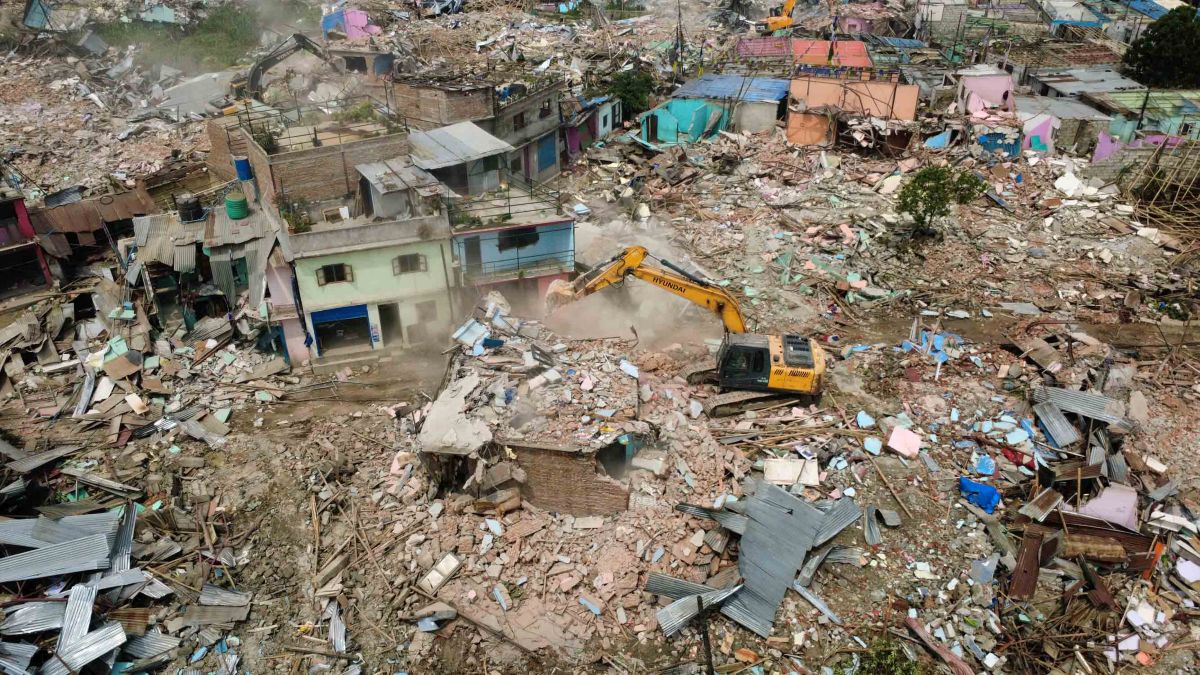
What the evictions showed is that the government has, so far, inherited the old instinct: to demonstrate action through force, to treat the complexity of a structural problem as an excuse for operational shortcuts, to move the bulldozers before the housing is ready and the verification is done and the commission is formed and the promises are kept.
Two people died. Pregnant women were displaced without guaranteed shelter. The sick were moved without confirmed medical arrangements. Students lost their homes during examinations. The middle class cheered.
This is a moment that calls not for satisfaction but for reckoning. Not with the question of whether riverbanks should be cleared — they should, eventually, lawfully, humanely, with proper alternatives in place. But with the question of what kind of state Nepal intends to be: one that enforces the law selectively, against those who cannot resist it, without meeting its own prior obligations — or one that recognises that the rule of law binds the government as completely as it binds the governed.
The landless families of Nepal did not create the conditions that made them landless. The state has not yet created the conditions that would make them something else. Until it does, the bulldozer is not a solution. It is the postponement of one, at the expense of those who can least afford to wait.

![Ruins of Deuba residence stand with CIAA notice [Photo feature]](https://english.nepalnews.com/wp-content/uploads/2026/06/Akhtiyar-letter-deuwa-niwas_NPL-3.jpeg)