Kathmandu
Monday, June 15, 2026





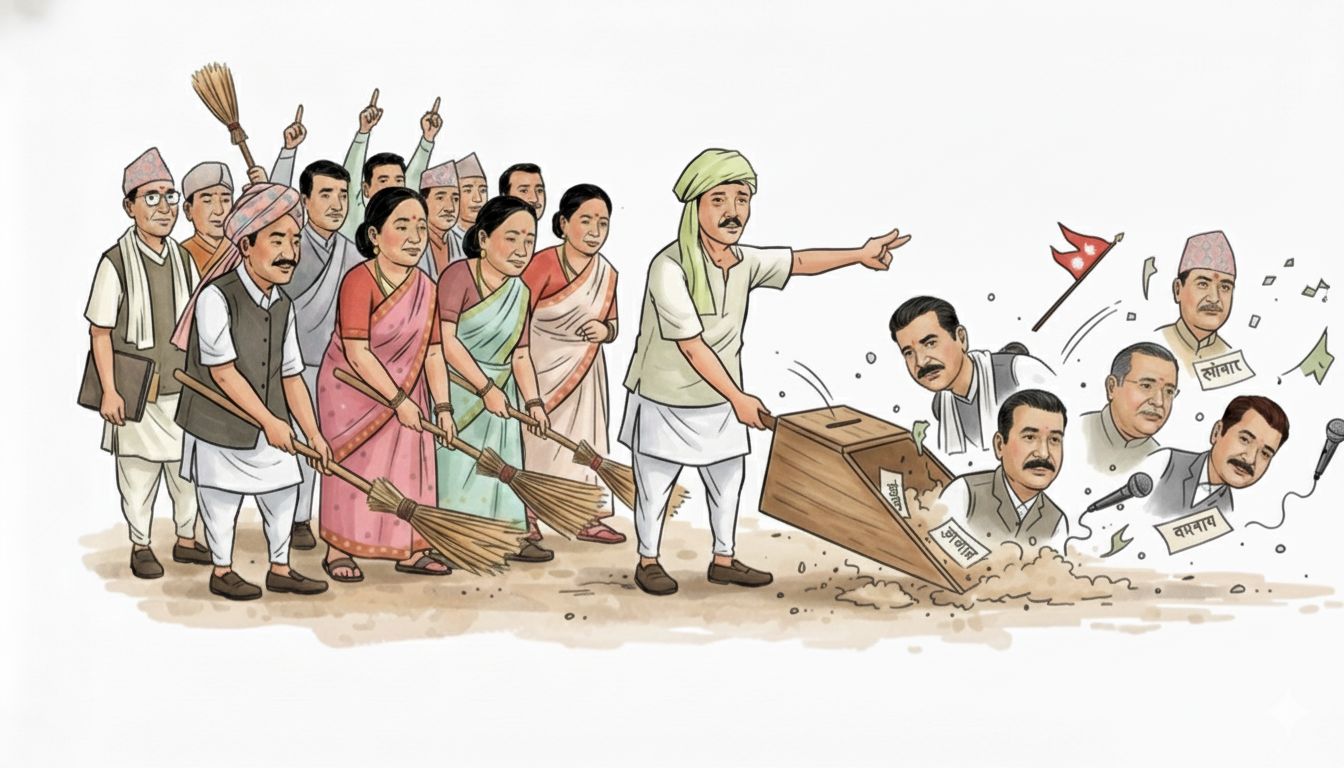
KATHMANDU: In the March 5 House of Representatives election, the results sent shockwaves through Nepal’s political establishment. Madhesh-based parties-long seen as the region’s standard-bearers-suffered humiliating defeats, losing the trust of the very voters they once mobilised. A movement that had reshaped Nepal’s politics has now lost its grip entirely, leaving these parties with zero representation in parliament.
The irony is striking: Madhesh-the region that once propelled identity politics into the national mainstream-has now delivered the clearest verdict on its limits. Voters in the plains have turned toward new parties promising change, efficiency and development rather than identity-driven mobilisation.
In Madhesh Province-a region whose politics for two decades revolved around identity, representation and autonomy-voters have abruptly turned away from the very parties that once championed those causes. In constituency after constituency, candidates of Madhesh-centric parties fell, while the insurgent Rastriya Swatantra Party (RSP) surged forward.
The result is stark. Out of 165 directly elected seats nationwide, not a single candidate from the region’s traditional Madhesh-based parties has secured victory. Even in the proportional representation vote, where smaller parties often find lifelines, none appears to have crossed the three-percent threshold required to enter the national parliament. For the first time since the restoration of multiparty democracy in 1991, the parliamentary presence of the parties born from the Madhesh movement has effectively vanished.
The defeat has halted the parliamentary careers of many of the movement’s most prominent figures. Leaders such as Upendra Yadav, Rajendra Mahato, CK Raut, Sharat Singh Bhandari and Rajkishore Yadav-once central to the region’s political imagination-have all suffered humalating electoral defeat. Several national heavyweights have fallen alongside them, including Congress President Gagan Kumar Thapa, UMl leader Raghubir Mahaseth, Congress leader Bimalendra Nidhi and Nepali Communsit party leader Mahendra Yadav.
At first glance, the outcome may appear to be simply another electoral swing. In fact, it marks something deeper: a generational and psychological shift within Madhesi society itself.
From marginalisation to movement
For decades, Madhesis-people living in Nepal’s southern plains-complained of exclusion from the state. Representation in government, security forces and bureaucracy remained disproportionately low. Though early attempts to articulate these grievances emerged after 1991 through parties like the Sadbhawana movement, it was the upheaval of 2007 that fundamentally reshaped the political landscape.
The Madhesh Movement transformed regional grievances into a national political question. Protesters demanded proportional representation, federal restructuring and recognition of Madhesi identity within the Nepali state. The agitation shook Kathmandu’s political establishment and forced constitutional negotiations to address long-ignored issues.
The movement quickly translated into electoral success. In the 2008 Constituent Assembly election, Madhesh-based parties captured a significant bloc of seats. Organisations such as the Madhesi Jana Adhikar Forum and the Tarai Madhesh Loktantrik Party emerged as powerful forces capable of shaping coalition governments. Identity politics-once marginal-had entered the centre of Nepali power.
Fragmentation and fatigue
Yet movements that rise quickly often struggle to sustain momentum. Over the years, Madhesh-centric parties became entangled in endless cycles of mergers and splits, producing new entities such as the Janata Samajbadi Party (JSP), the Loktantrik Samajbadi Party (LSP) and others.
Their ideological foundation remained clear: federalism, inclusion and equal opportunity. But the political energy that once animated the movement gradually faded. Internal leadership rivalries became routine, alliances shifted frequently, and accusations of opportunism grew louder.
The deeper problem, analysts argue, was not the disappearance of the Madhesh agenda. Rather, it was the erosion of public trust in the leaders who claimed to represent it. The promise of structural transformation—so central to the 2007 movement—seemed increasingly distant.
The 2022 election offered an early warning. While some traditional parties held ground, a new entrant disrupted the landscape: CK Raut, who had once advocated secession before joining mainstream politics, formed the Janamat Party and attracted protest votes. Yet even that experiment proved unstable. Voters appeared less interested in new versions of old politics than in entirely different leadership.
The governance gap
Performance in government further eroded confidence. Madhesh-based parties repeatedly led the provincial administration after the creation of federal provinces, but their tenure produced few transformative results. Economic transparency remained weak. Development projects were frequently mired in controversy, and allegations of political bargaining over budgets and contracts became common.
For many voters, the parties that had once mobilised the language of dignity and identity appeared increasingly preoccupied with power struggles and patronage networks.The result was a widening gap between the movement’s ideals and the lived reality of governance.
Enter a new kind of politics
Into this vacuum stepped an unexpected figure: Balendra Shah-better known as Balen-the former mayor of Kathmandu and a prime minister candidate of the Rastriya Swatantra Party.
Unlike traditional Madhesh leaders, Balen did not emerge from the region’s established political networks. Yet his appeal grew rapidly. During a major rally in Janakpurdham, he addressed the crowd in Maithili and described himself as a “son of Madhesh”, forging an emotional connection with voters.
The message was carefully crafted. Rather than rejecting identity politics outright, Balen reframed it. He spoke of dignity, opportunity and inclusion but linked these ideas to governance and economic development. In doing so, he blended identity with a promise of technocratic competence-a formula that resonated with younger voters.
The symbolism mattered. For some supporters, Balen represents the possibility of the first prime minister from the Madhesh community. Whether realistic or not, that perception reflects a powerful psychological shift in the region’s politics.
A generational revolt
Another crucial factor lies in demographics. The protests of September 8–9, often described as a “Gen-Z movement”, revealed the frustrations of younger voters who had grown up after the 2007 upheaval. For them, the achievements of the Madhesh movement are historical facts rather than lived experiences.
This generation is less attached to the parties that led the struggle and more focused on governance, employment and opportunity. In effect, the movement succeeded in securing representation—but the political organisations built around it failed to evolve beyond the moment of protest.
The election results suggest that many voters have not abandoned the issues of federalism or social justice. Instead, they have changed the leaders they trust to pursue them.
The uncertain future of Madhesh politics
The collapse of Madhesh-centric parties therefore marks both an end and a beginning. An era defined by identity-based mobilisation appears to be fading. Yet the structural questions that produced the movement-representation, dignity and equitable development-remain unresolved.
Whether the rise of the RSP signals a durable transformation or merely another phase in Nepal’s volatile politics remains uncertain. Voters in Madhesh have demonstrated their willingness to abandon established leaders. The next challenge will be determining whether the new leadership can deliver the change they promised.
For now, one conclusion is unavoidable: the parties born from the Madhesh movement once reshaped Nepal’s political map. But in a single election cycle, the electorate that empowered them has also shown it can just as quickly move on.
Two decades after the Madhesh uprising
Twenty years ago, Nepal’s political centre was shaken not by palace intrigue or insurgent warfare, but by a revolt from its plains. The Madhesh uprising of 2007 transformed the structure of the Nepali state, forcing Kathmandu to recognise identities it had long ignored and to embrace federalism. Yet two decades later, while the movement altered the political map, many of its deeper social ambitions remain unfinished.
The origins of the upheaval lie in the fragile transition that followed the end of Nepal’s decade-long Maoist insurgency. In November 2006 the government and the Communist Party of Nepal (Maoist) signed the Comprehensive Peace Agreement, formally ending the civil war. A coalition known as the Seven Party Alliance—dominated by the Nepali Congress and the CPN (UML), alongside the Maoists—took charge of steering the country toward a new constitutional order.
But the transition exposed old tensions. On January 15, 2007, the interim government promulgated an interim constitution. Notably absent from the document was any reference to federalism, a demand that had increasingly resonated among marginalised communities.
The omission triggered an immediate backlash in the southern plains. The following day, January 16, 2007, activists from the Madheshi Janadhikar Forum, Nepal (MJF-Nepal), led by Upendra Yadav, burned a copy of the interim constitution at Kathmandu’s Maitighar Mandala. Police swiftly arrested the protesters and charged them with Rajya Droh, or treason. In response, the MJF-Nepal declared an indefinite strike across the Tarai.
Tensions escalated quickly. In Lahan, Siraha, clashes broke out when Maoist leader Ram Karki and his supporters attempted to break a transportation blockade organised by Madheshi activists. Amid the confrontation, Ramesh Mahato, a young student activist, was shot dead. His death ignited the plains.
What began as a protest became a mass movement. For more than three weeks, demonstrations paralysed the region. Roads were blocked, government offices shut down and public anger mounted. Eventually Prime Minister Girija Prasad Koirala intervened, promising that federalism would be incorporated into Nepal’s future political structure. The assurance helped calm the uprising—but the political consequences were only beginning.
A year later, in February 2008, a second wave of agitation erupted. Known as the Second Madhesh Movement, it was led by Mahanth Thakur, who had recently broken with the Nepali Congress to enter Madhesh politics. This phase of the movement secured concrete institutional reforms.
The electoral system was revised. Constituencies in the Tarai were expanded to better reflect population distribution, while the proportional representation component of elections was increased from 40 percent to 60 percent. Madheshis were recognised as a distinct cluster in the proportional system. Agreements were also reached to open the Nepal Army to group recruitment from Madheshi youth and to introduce quotas in the civil service following the Constituent Assembly elections.
To understand the significance of these demands, one must look further back. For decades, Madheshi identity had been marginalised within Nepal’s state structure. During the Panchayat era under King Mahendra, the official national narrative revolved around a singular identity summarised in the slogan: “One king, one nation, one language, one uniform.” The political system concentrated power among hill elites-particularly Thakuris, Chhetris and Bahuns-who dominated parliament, the bureaucracy and security institutions.
Madheshis and many indigenous Janajati groups found themselves largely excluded from political decision-making.
Even after the restoration of multiparty democracy in 1990, the basic power structure changed little. Madheshis often supported the Nepali Congress, while Janajatis leaned toward communist parties. But representation remained skewed. Between 1991 and 2006, Nepal held three parliamentary elections and two District Development Committee elections, yet the presence of Madheshis and Janajatis in national politics improved only marginally.
Meanwhile, the Maoist insurgency reshaped political discourse. During its “People’s War”, the Maoist movement began advocating state restructuring and federalism with autonomous provinces. It created various ethnic and caste-based fronts, including the Madheshi Rastriya Mukti Morcha. By 2005–06 Maoist leaders were describing the marginalisation of Madheshis as a form of “internal colonisation”.
That language proved politically powerful. It gave the Madhesh movement a vocabulary to articulate grievances and mobilise mass support against Kathmandu’s traditional power structures.
The uprisings ultimately produced far-reaching institutional changes. One of the most symbolic shifts came in January 2007 when Prime Minister Koirala publicly used the terms “Madhesh” and “Madheshi” for the first time in a formal state address-recognising identities that had long been politically sidelined. The interim constitution was subsequently amended to include federalism.
Electoral reforms followed. The proportional representation system ensured that 60 percent of seats would reflect Nepal’s social diversity. The number of constituencies in the Tarai increased significantly-from 86 out of 205 seats to 116 out of 240-better aligning representation with population realities.
The impact was visible. Before 2007, Madheshis and Janajatis together held only about 15 to 17 percent of parliamentary seats. After the reforms their representation rose to roughly 31 to 32 percent. Nepal’s first president and vice president were elected from the Madheshi community, while Madhesh-based political parties emerged as influential actors in Kathmandu’s coalition politics.
The bureaucracy also began to change. In 2008 the government introduced reservation policies in civil service recruitment, allowing Madheshis and other marginalised groups greater access to administrative positions.
Perhaps the most profound outcome was the reconfiguration of Nepal’s political geography. Federalism, formally enshrined in the 2015 constitution, divided the country into seven provinces. Madhesh Province became a central arena of regional political power.
For many in the plains, the transformation was historic. Madheshis, once treated primarily as vote banks, had become indispensable political actors.
Yet success has brought new complications. The pan-Madheshi identity forged during the uprising has begun to fracture along caste and regional lines. Election results in Madhesh Province reveal changing internal hierarchies. While traditional elites-high-caste Madheshis and hill-origin communities-have gradually lost dominance, groups such as Yadavs and Baishyas have gained disproportionate political influence.
Other communities remain marginalised. Muslims, Janajatis and Dalits-along with groups such as the Dhanuk, Kebat, Kurmi and Amat, collectively known as DKKA-continue to be underrepresented in politics. Dalits are particularly absent from positions of power. Women’s political participation has also remained largely symbolic. In effect, a new hierarchy has emerged within the once-marginalised.
Development disparities across the region further complicate the picture. Areas along the East–West Highway in the northern belt have seen faster economic growth than communities along the southern border and the central plains. Meanwhile, the reservation policies introduced after the Madhesh movement—once celebrated as instruments of inclusion—are increasingly debated, with some groups advocating their revision or removal.
Citizenship remains another unresolved issue. Although many complications were addressed through legislation in 2008, new problems later emerged, particularly concerning the children of individuals who obtained citizenship by birth. Recent laws have resolved part of the problem, but the question of Baibahik Angikrit—naturalised citizenship through marriage—remains politically sensitive. Madheshi leaders themselves have often avoided taking a clear position.
Two decades on, the Madhesh uprising stands as one of the most consequential political movements in Nepal’s modern history. It compelled Kathmandu to confront questions of identity, representation and federalism that had long been ignored.
Yet while the movement succeeded in transforming institutions, the deeper challenge of social transformation persists. Many marginalised groups-Dalits, Muslims, Janajatis and smaller caste communities-still lag behind on education, income and social mobility.
The uprising changed the architecture of the state. But the struggle for genuine inclusion, in the plains and beyond, remains unfinished.
Madhesh turns the page
Madhesh politics is entering a post-identity phase. The province, long treated as “other,” may yet define a new standard for inclusive politics in Nepal—but only if leaders listen, adapt, and act. Covering 9,661 km², Madhesh is the country’s most densely populated region and a mosaic of communities: Yadavs form 15.2% of the population, Muslims 13%, Teli 5.31%, Tharu 4.92%, Kushwaha 4.51%, Chamar 4.41%, Dhanuk 3.55%, Kurmi 2.95%, Musahar 2.93%, Paswan 2.88%, Mallaah 2.32%, Kanu 2.27%, other Madheshi non-Dalit 20.1%, other Madheshi Dalit 5.51%, Hill Janajati 4.61%, Khas 3.39%, and others 2.22%. Dalits account for 15%, Muslims 12%, while indigenous and hill communities add further layers of complexity.
For decades, Madhesh’s politics revolved around identity. The movements of 2007, 2008, and 2015 forced Kathmandu to acknowledge Madheshi identity, representation, and federalism. Yet recognition rarely translated into meaningful autonomy, social justice, or economic inclusion. The state’s securitised approach to dissent left frustration to fester.
Madheshi parties, fragmented and absorbed into mainstream politics, increasingly traded grassroots credibility for parliamentary visibility. The rhetoric of identity has faded. Slogans have lost force. Leadership, preoccupied with “messiah” posturing, has struggled to deliver.
As Madhesh enters this post-identity era, the province’s future now hinges on pragmatic governance, social inclusion, and economic opportunity. Voters are signaling that rhetoric alone no longer suffices; they expect action. The challenge for the next generation of leaders is clear: adapt to a new political reality or risk irrelevance.
Why did the Madhesh rise up?
Nepal is a country of striking diversity. Its geography stretches from the Himalayas through the hills to the southern plains of the Terai, known politically as Madhesh. Socially, the population broadly comprises three groups: Khas-Arya, indigenous nationalities (Janajatis) and Madheshis. Yet the commanding heights of the state-the “gun” of the security forces, the “pen” of the bureaucracy and the “money” of public resources-have historically been dominated by Khas-Arya elites. Madheshis and many Janajatis have long felt marginalised.
The Madhesh movement arose as a response to this imbalance. Its central demand has been straightforward: political representation, social inclusion and constitutional recognition of Madheshi identity. For decades Nepal’s state institutions and national narratives reflected the culture and language of the hill elite while overlooking the social realities of the plains. Many Madheshis felt invisible within their own country.
The grievance is not only institutional but social. Madheshis often report discrimination in everyday interactions, particularly in Kathmandu’s political and administrative circles. Even senior Madheshi politicians describe encountering condescension from hill-based elites. Such experiences have reinforced a shared perception of exclusion, transforming the movement into a broader struggle for dignity.
Despite loose organisational structures, the movement has proved resilient. Activists rely on informal networks of intellectuals, politicians and civil-society groups to articulate Madheshi concerns in public debate. At the grassroots level, mobilisation is sustained through community radio, local newspapers and village-level organisation.
Protests have also been unusually inventive—human chains across the plains, satirical rallies featuring animals dressed as political leaders and symbolic demonstrations representing fallen activists. Such theatrics keep the media engaged and maintain pressure on the state.
The Madhesh movement is less a single organisation than a persistent demand: that Nepal’s diverse society be more fairly reflected in its state.