Kathmandu
Thursday, June 4, 2026





Stakeholders warn that the desertification of Madhesh cannot be stopped unless deforestation and uncontrolled exploitation in the Chure region are halted.
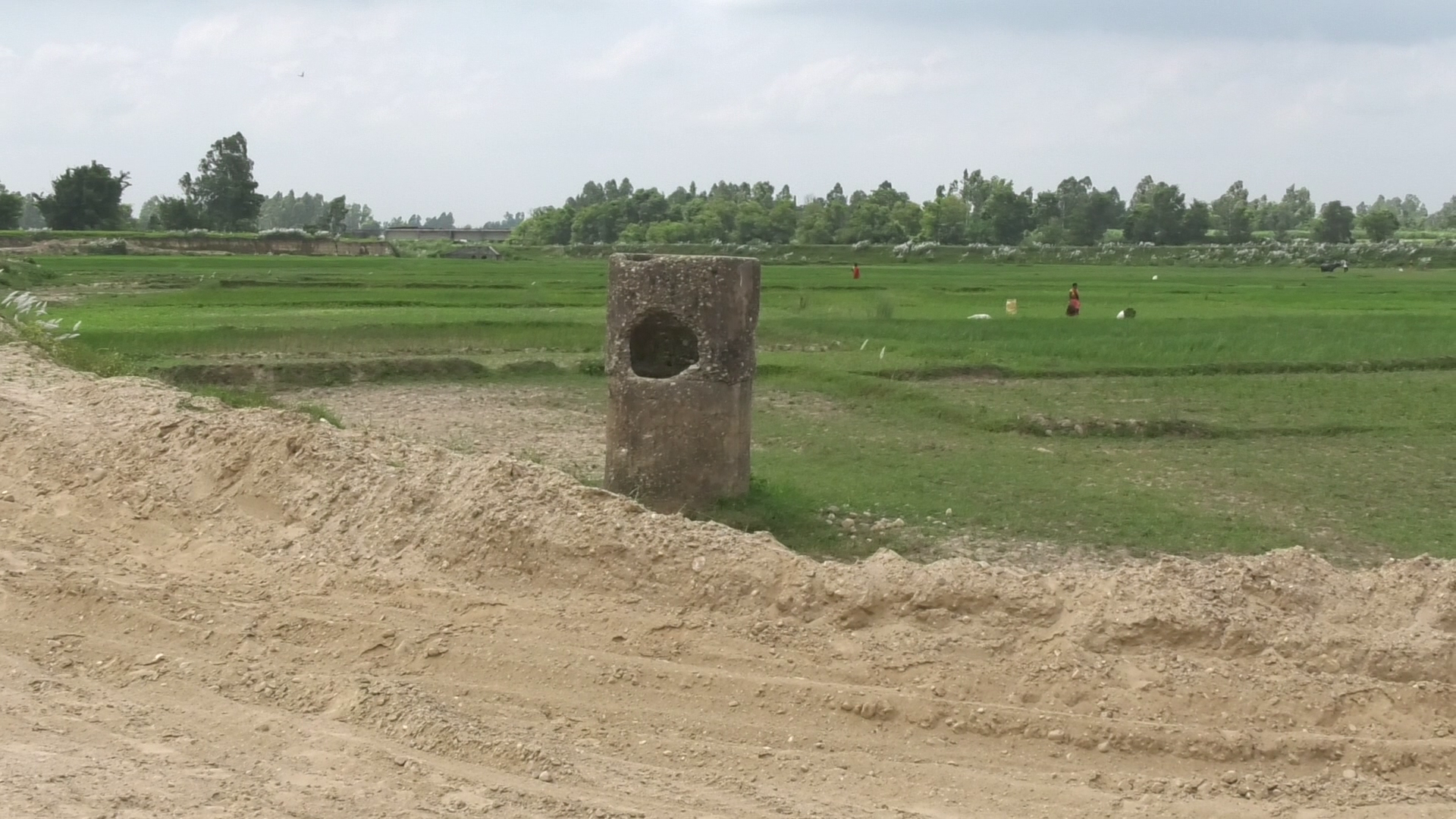
KATHMANDU: There used to be a beautiful village named Chhedipokhari in the then-Digambarpur VDC-4, which is currently incorporated into Khireshwaranath Municipality of Dhanusha. More than 65 farmer families used to reside there. However, there is no village by this name in Khireshwaranath now. The place where the village once stood looks like a desolate desert.
In the month of July 1987, a flood in the Jaladh River cut down nearly eight feet of land and washed away the entire Chhedipokhari. As a reminder that a village once existed, only the remains of two deeply dug and concrete-lined wells from before the flood are left.
Recalling that terrifying day, local resident Kula Devi says, “Suddenly, a flood came rushing down from the hills. People started running helter-skelter in the village. As we watched, it swept away all the houses; not a single grain of food could be saved. We barely escaped with our lives and reached the upper region. Today, it is impossible to even recognize where the houses used to be. It looks like a barren riverbed everywhere.”
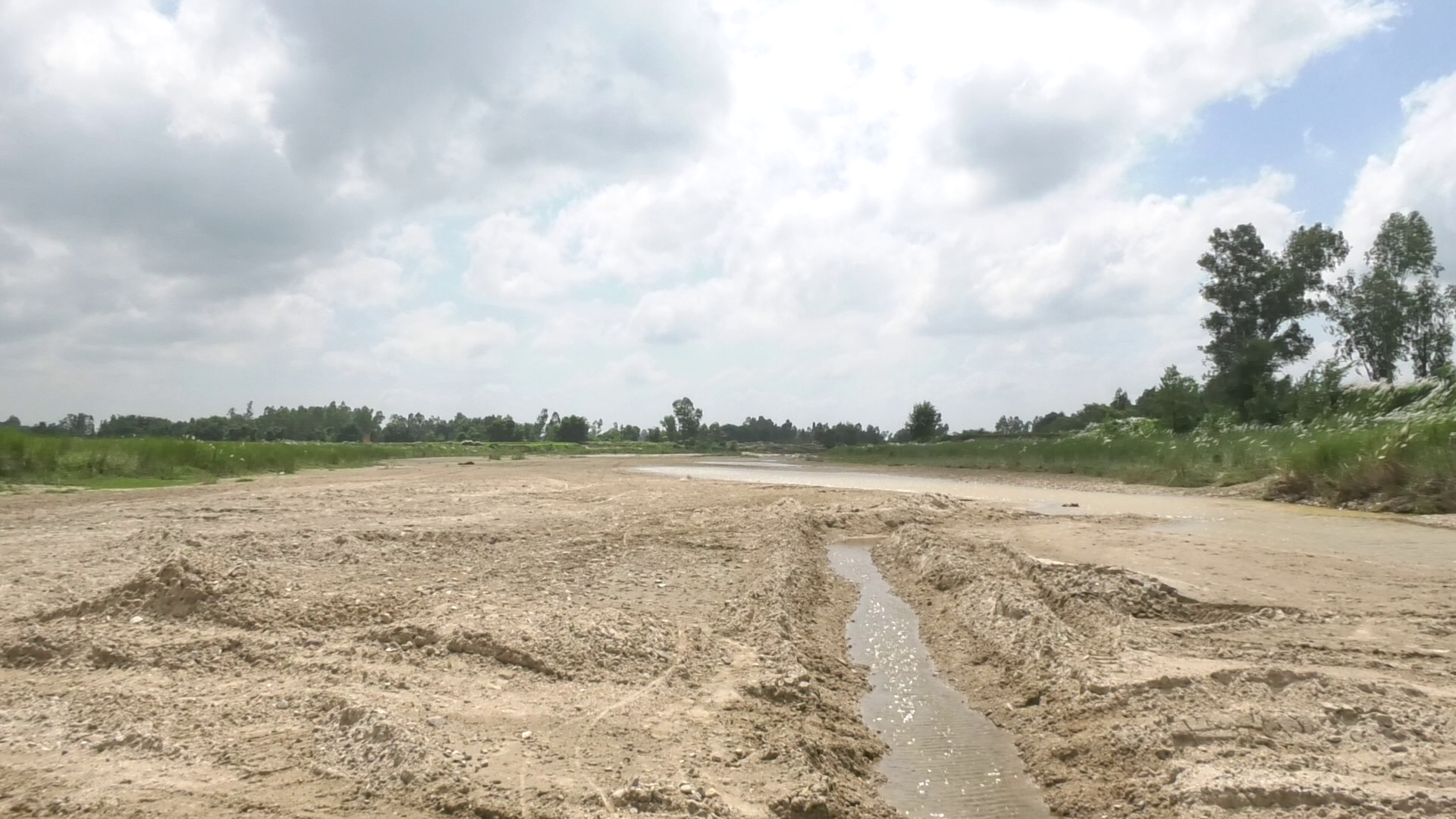
The area turned desolate near the Chure range in Sukhawa Mahendranagar, Dhanusha
After the flood destroyed the village, the displaced villagers have been residing in Sakhuwabazar, located in Khireshwaranath Municipality-6. Dependent on farming, they were forced to look for other alternatives to earn a living after their houses and farmlands were swept away.
Lalit Budhathoki, who is now making a living by running a tea shop in the new settlement, takes a deep breath while looking toward his old village, which has turned into a barren riverbed at the foothills of the Chure. He says, “At one time, there was a beautiful forest right next to the village, which was a great support for us. Fodder leaves for livestock and firewood came from there. Then the forest was destroyed. Consequently, the flood finished off our village. Now, I have to sustain my life relying on this tea shop.”
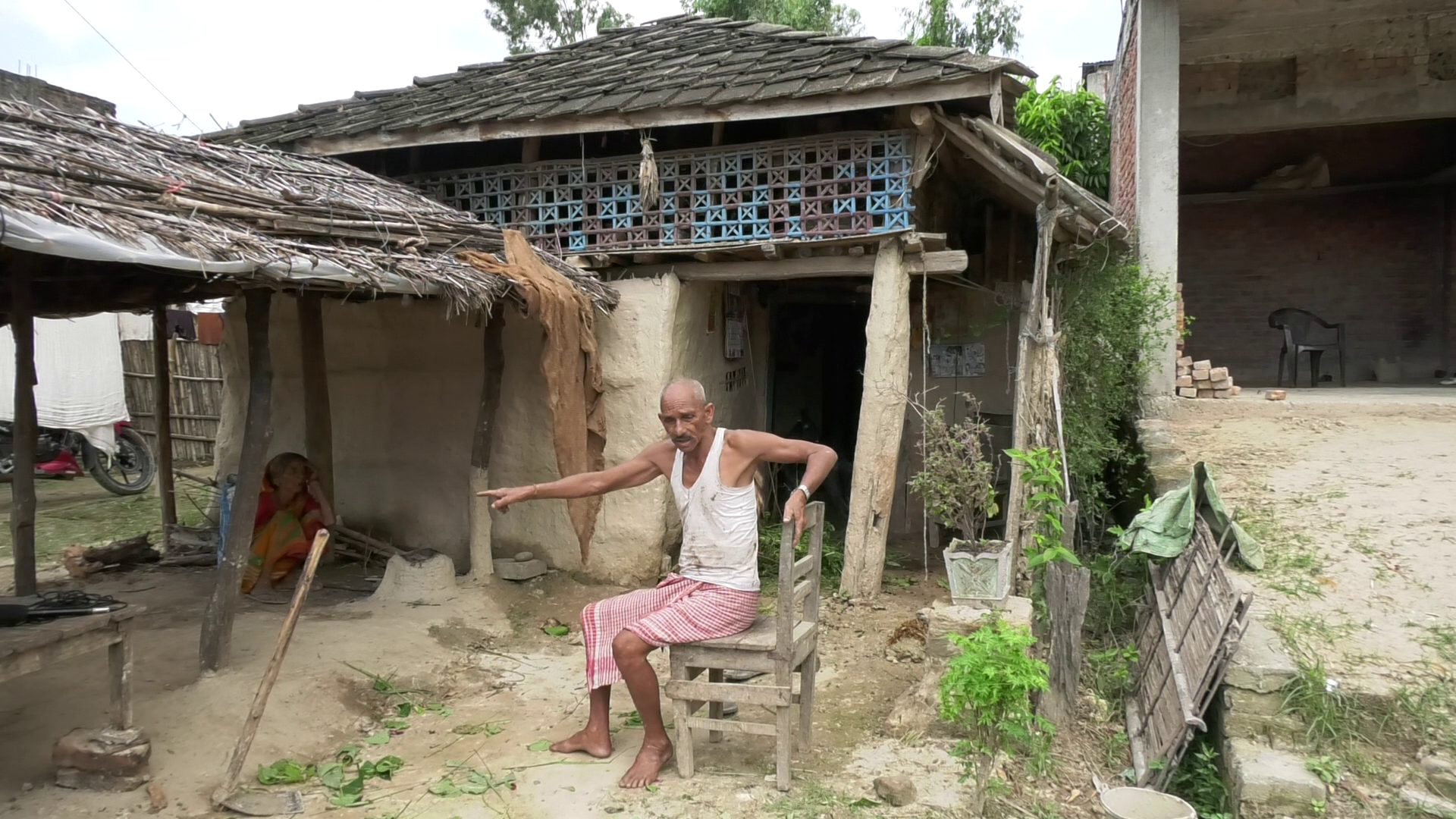
Lalit Budhathoki in the new settlement after the village was ruined.
Chhedipokhari is just a representative example. Numerous subsequent incidents indicate that the day-by-day destruction of the Chure region, which stretches from the east to the west of Nepal, poses a threat of turning the entire Terai-Madhesh into a desert. The Chure range, which touches 36 districts across all seven provinces, is an area formed of weak and stratified rocks. Spanning an area of 18.96 billion square meters, this region is considered highly sensitive eco-geographically.
Rich in biodiversity, this region is currently at high risk due to unmanaged settlements, encroachment, deforestation, unscientific land use, and uncontrolled livestock grazing. On one hand, illegal and inhumane exploitation has not stopped, while on the other, billions of rupees in government investment made in the name of its conservation are going down the drain, akin to pouring water onto sand. The direct impact of Chure destruction is beginning to show in the daily lives of the Terai people. Settlements at the foothills of Chure are in crisis due to disasters like floods and landslides.
Water sources vanished, Bhawar stripped bare
Due to uncontrolled excavation and the exploitation of Chure, even the spring water has dried up today in rivers that used to flow twelve months a year until a few years ago. Natural water sources are vanishing one after another. With the drying up of ponds, wells, and deep borings—the sources of drinking water—this region is becoming desolate for human habitation and agriculture.
According to geologists, the Chure range is the youngest and greenest hill formation, created about 40 million years ago during the origin of the Himalayas through the accumulation of riverine materials like stones, pebbles, and sand. However, due to continuous deforestation, the Chure and the Bhabar region below it have been stripped bare. Because of deforestation, the soil in the Bhabar zone has stopped conserving rainwater, which has triggered a water crisis across the whole of Madhesh.
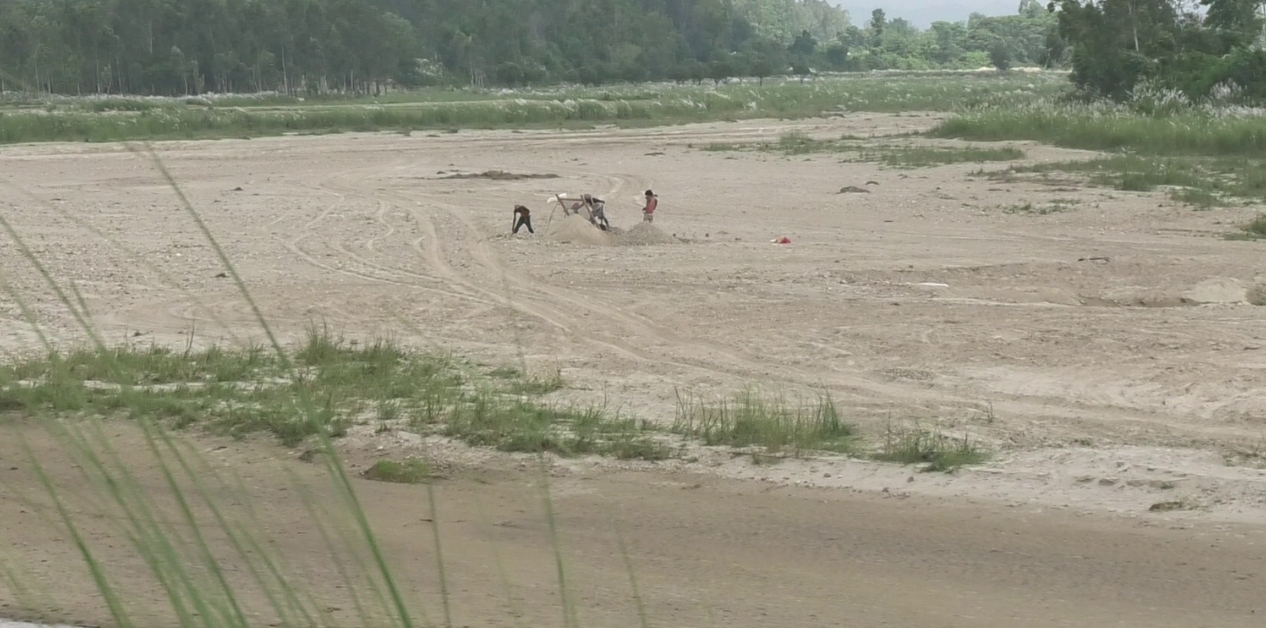
Locals collecting sand
Forest expert Manzur Ahmed states that more than 50 percent of the population of Madhesh is at direct risk of floods and soil erosion due to the illegal excavation of stones, pebbles, and sand in the Chure and Bhabar regions. According to him, the fact that sand and pebble excavation is unscientific is the main reason behind Chure’s destruction. He says, “The haphazard and random way excavation is currently taking place in the Chure region has increased environmental risks. Its direct impact is falling upon the daily lives of the locals.”
Policies limited only to paper
For the conservation of the Chure region, the Government of Nepal implemented the ‘President Chure Conservation Program’ starting from the fiscal year 2009/10. For its sustainable management, the ‘President Chure-Terai Madhesh Conservation Development Committee’ was also formed. However, due to the rapid exploitation of riverine materials, the government’s efforts have become like ‘water on sand.’
In its policy and program for the fiscal year 2025/26, the Madhesh Province Government brought forward the concept of ‘Green Resilient Inclusive Development’ and announced the campaign ‘Save Chure, Save Madhesh, Save Our Chure Ourselves.’ Keeping in mind the interrelationship between the lower and upper riparian areas, a policy was formulated for integrated watershed management and identification of drought-prone areas. Although a commitment was expressed to build the necessary legal structure for the management of riverine materials, in practice, the work is almost zero.
Mainly, due to the failure to stop illegal crusher businesses, both forests and rivers are being ruined. Subim Bhattarai, a local from Simara, Bara, says that the sight of mountains of sand and pebbles piled up right by the roadside mocks the government. He questions, “If the illegal exploitation of riverine materials cannot be stopped, what is the point of just talking about Chure conservation? Until this illegal trade is stopped, Chure cannot be saved.”
Although the Ministry of Forest and Environment of Madhesh Province appears to have worked on Chure and watershed conservation, it seems to have failed to stop forest encroachment. According to the ministry’s records, there is a total of 3132.33 square kilometer of forest area across the eight districts of Madhesh Province. According to data received by the ministry from eight divisional forest offices, out of 76,020,000 square meters of encroached forest area, only 2,920,000 square meters have been freed from encroachment. Out of 1,132 cases registered until last year regarding forest encroachment and illegal exploitation, only 8 cases have been settled.
The ’83rd Annual Report of the Auditor General, 2026’ has also pointed out that the ministry’s policies and programs have remained limited to paper. It mentions that attractive programs like the ‘Save Chure Save Madhesh Campaign, Chure Conservation Dialogue, Urban Watershed Management, Chief Minister Green Province Campaign, Where There is Soil There is a Tree—That Brings Ultimate Happiness, One Citizen One Sapling, and Green City Clean City’ could not be implemented. The Auditor General has issued strict directives to the government to implement such policies and programs with seriousness.
Environmentalist Hari Narayan Mandal says, “The soil of Chure is extremely weak and soft. If the exploitation continues like this, the granary of Terai-Madhesh will turn into a desert within the next few decades, and there will be an outcry for drinking water.”
Madhesh Province Assembly member and former minister Ram Saroj Yadav also agrees with this. Yadav warns, “Agriculture is the main basis of Madhesh’s prosperity, but due to Chure destruction, arable land is shrinking. We Madheshis, who exported food products yesterday, have become importers today. If this situation continues, no one can stop Madhesh from becoming a desert.”