Kathmandu
Sunday, July 26, 2026





Village schools are emptying out in Karnali due to migration, the search for opportunities, and an attraction to English-medium instruction.
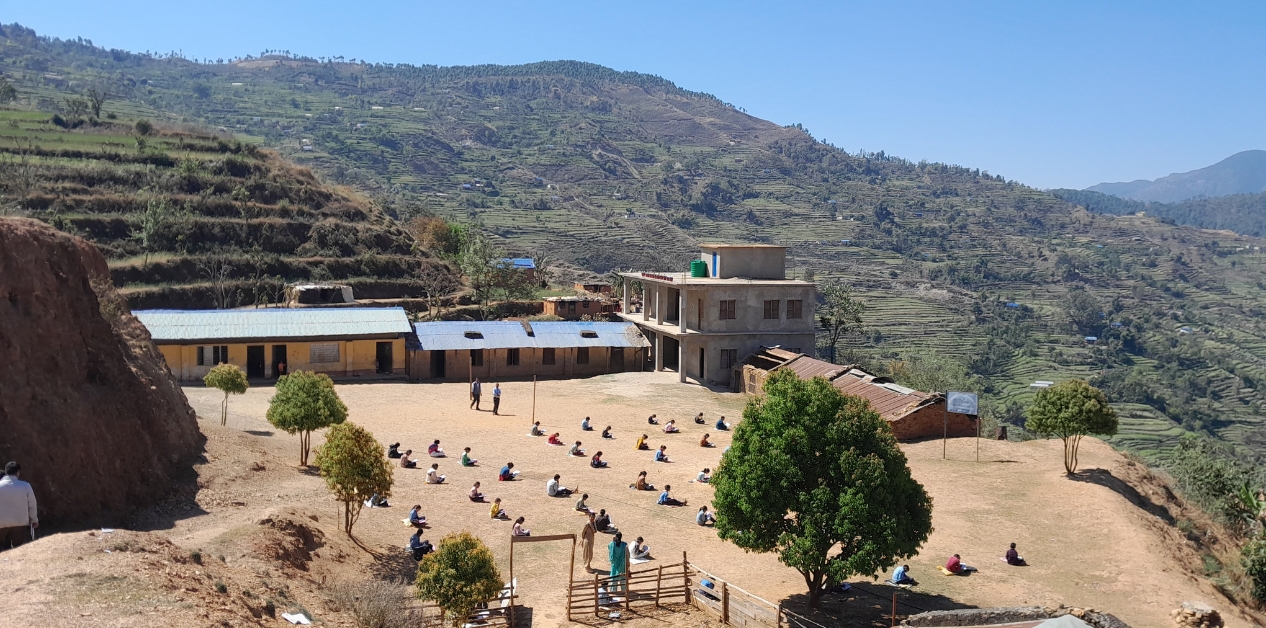
SURKHET: There are 42 households within the catchment area of Bhairab Primary School, located in Lower Naule of Naule Rural Municipality-6, Dailekh. Operating classes from Early Childhood Development (ECD) through grade 5, this school has a grand total of only 26 students. Among them, 10 are in the ECD center, leaving a mere 16 students enrolled across grades 1 to 5.
The school has an allocated government quota of two teachers. According to the student-teacher ratio maintained for hilly districts, there should be 35 students per teacher. However, the total number of students at Bhairab Primary School does not even meet the standard ratio required for a single teacher.
According to Headmaster Resham Bahadur Rana, the primary reasons behind the low student turnout are a falling birthrate and outward migration. “First of all, the birthrate itself has dropped; the practice of having many children is no longer common,” Rana says. “Secondly, villagers are constantly moving toward cities or places with better facilities. Once the family relocates, the children naturally leave the school as well.”
Similarly, Jairam Jaishi Basic School, located in Khandachakra Municipality-10 of Kalikot, runs only an ECD center and grade 1. The school has a total of just 15 students. Out of these, 10 are in the ECD center, and only five are in grade 1.
The school’s catchment area is small to begin with. However, according to Headmistress Hukuma Malla, even that limited service area is now emptying out.
“Half of the households within our catchment area have already migrated to Kailali,” Malla says. “The children present here are the only ones left.”
The school employs one ECD teacher and one primary-level teacher. Malla states that based on the established student-teacher ratio, the school should have had at least 50 students.
According to Anisha Tharu, Senior Education Officer and Head of the Education Branch at Naule Rural Municipality, no schools within the rural municipality have been merged yet. However, she noted that discussions regarding school mergers are underway after observing a continuous downward trend in student numbers over recent academic sessions.
Bhairab Primary School and Jairam Jaishi Basic School represent the plight of numerous rural schools across Karnali Province. In some places, schools exist but students do not. In others, teachers are available but there are not enough children to satisfy the standard ratio.
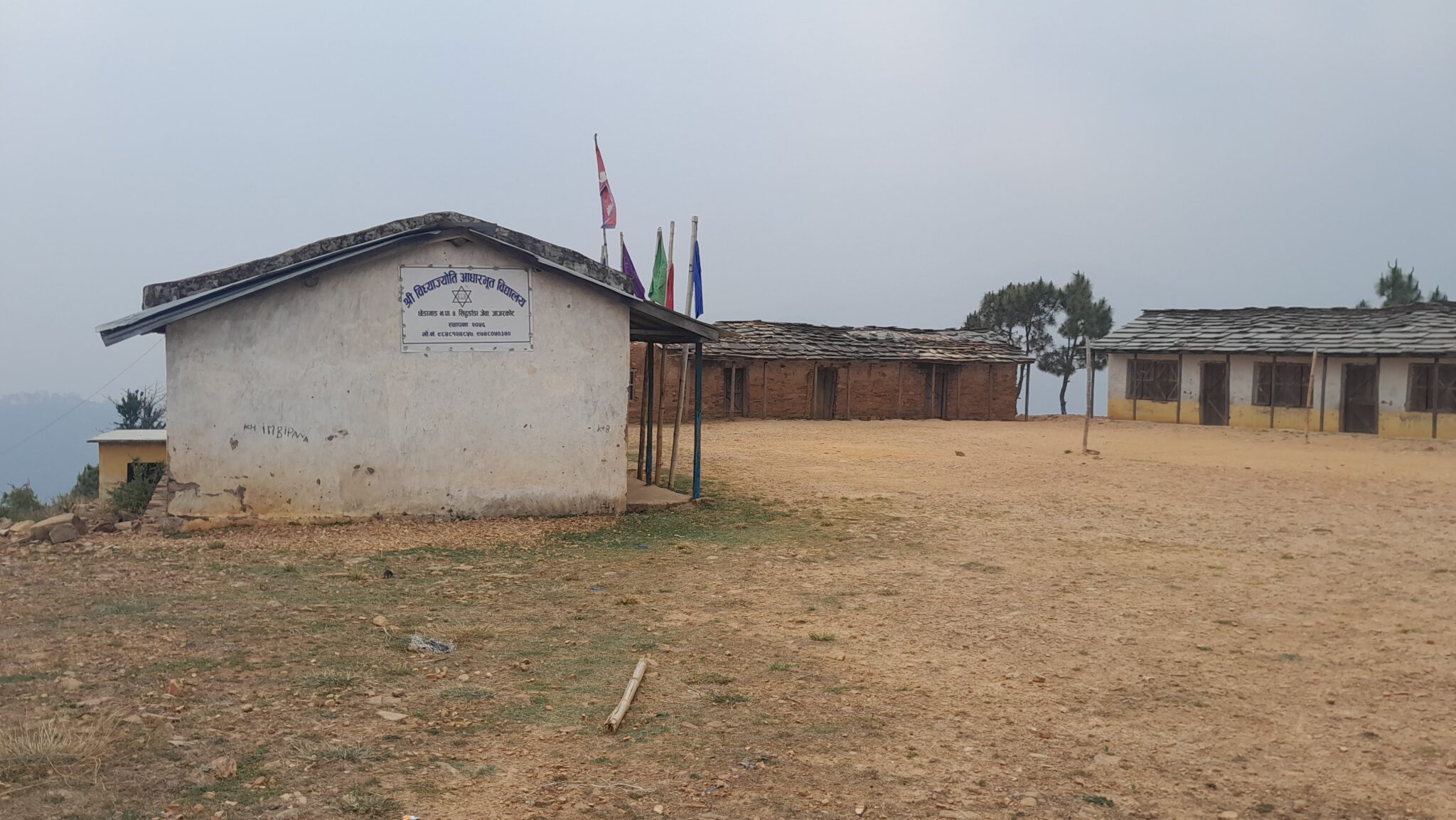
Vidya Jyoti Basic School is located in Chhedagar Municipality-4, Jajarkot.
According to records held by the Ministry of Social Development of Karnali Province, there are 3,435 community schools across the province. The Ministry maintains these statistics on schools and students based on the Education Management Information System (EMIS).
Ministry data reveals that 1,188 schools out of the province’s total have fewer than 50 students. Most of these are basic and primary schools, alongside a few ECD centers that fall into this category.
There are various reasons why schools established to serve local communities lack the student numbers required to satisfy standard student-teacher ratios. However, the most visible reason is migration. As families begin migrating toward urban areas in pursuit of better opportunities, employment, healthcare, education, and transport facilities, student numbers in village schools continue to plummet.
Because of this decline in student numbers, the issue of school consolidation or mergers has also begun entering discussions at the local government level.
Infrastructure built, but no new students added
Durga Primary School, located in Pajaru village of Chhedagad Municipality in Jajarkot, runs classes from ECD to grade 3. The school hosts 47 students. Three teachers—one ECD, one relief quota (Rahat), and one municipal grant teacher—work here.
A few years ago, due to the lack of permanent teacher quotas, the school, which previously ran up to grade 5, was downgraded to grade 3.
According to Principal Raju Kumari Shahi, enrollment at the school has been weak from the very beginning. She shares that student numbers are consistently low because only children from families who cannot afford city schooling attend here.
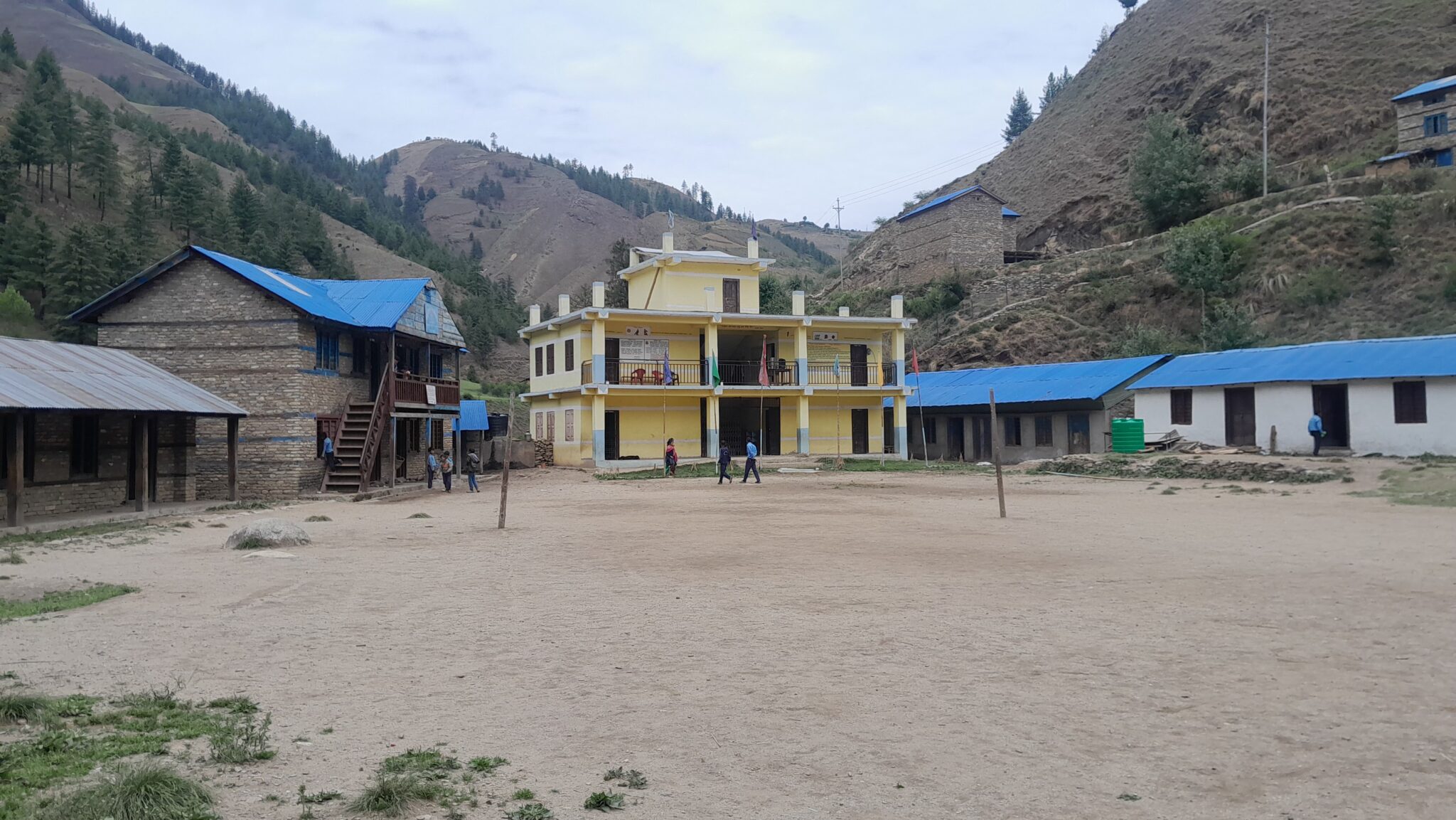
Durga Secondary School is located in Tatopani Rural Municipality-7, Jumla.
Out of the total student body, 17 are in the ECD tier, while 30 students occupy grades 1 to 3.
“With the support of development partner organizations, the school’s infrastructure has become excellent, but due to the lack of teacher quotas, a school that once ran up to grade five was reduced to grade three,” Shahi said. “Even though the infrastructure and teachers are sufficient up to grade three, the student count doesn’t increase; instead, it declines. This is likely because most people now want to educate their children in market areas, preventing village schools from gaining new students.”
The problem of declining student numbers is not limited to small primary or basic schools. The impact of migration is also becoming visible in larger schools that offer technical streams.
At Jwala Secondary School, located in Bestada Bazaar—the administrative center of Bhagawatimai Rural Municipality in Dailekh—the student population has dropped by approximately 40 percent over the past three years. Until the academic year 2022/23, more than 900 students were studying at this school. Currently, only around 500 students are enrolled, despite the school offering technical agricultural courses.
According to Devendra Adhikari, a teacher at Jwala Secondary School, seeing the lifestyle of those who moved to cities has fueled a growing trend of people shifting down to urban areas with their entire families.
“Once parents move to the city, there is no question of children staying back to study in village schools,” Adhikari says. “Furthermore, after the SEE (Secondary Education Examination), urban schools are the primary choice for students looking to pursue higher secondary education. That is why student numbers in large rural schools keep dwindling.”
Registered on paper, absent in classrooms
Records show that Janapriya Secondary School in Jajarkot has over a thousand students on paper. However, teachers state that less than half of those students actually attend classes regularly. The reason behind this is that not all registered students reside within the actual catchment area of the school.
Students from families that migrated from the village to the city end up enrolling in grade 10 at Janapriya Secondary School specifically to sit for their SEE exams.
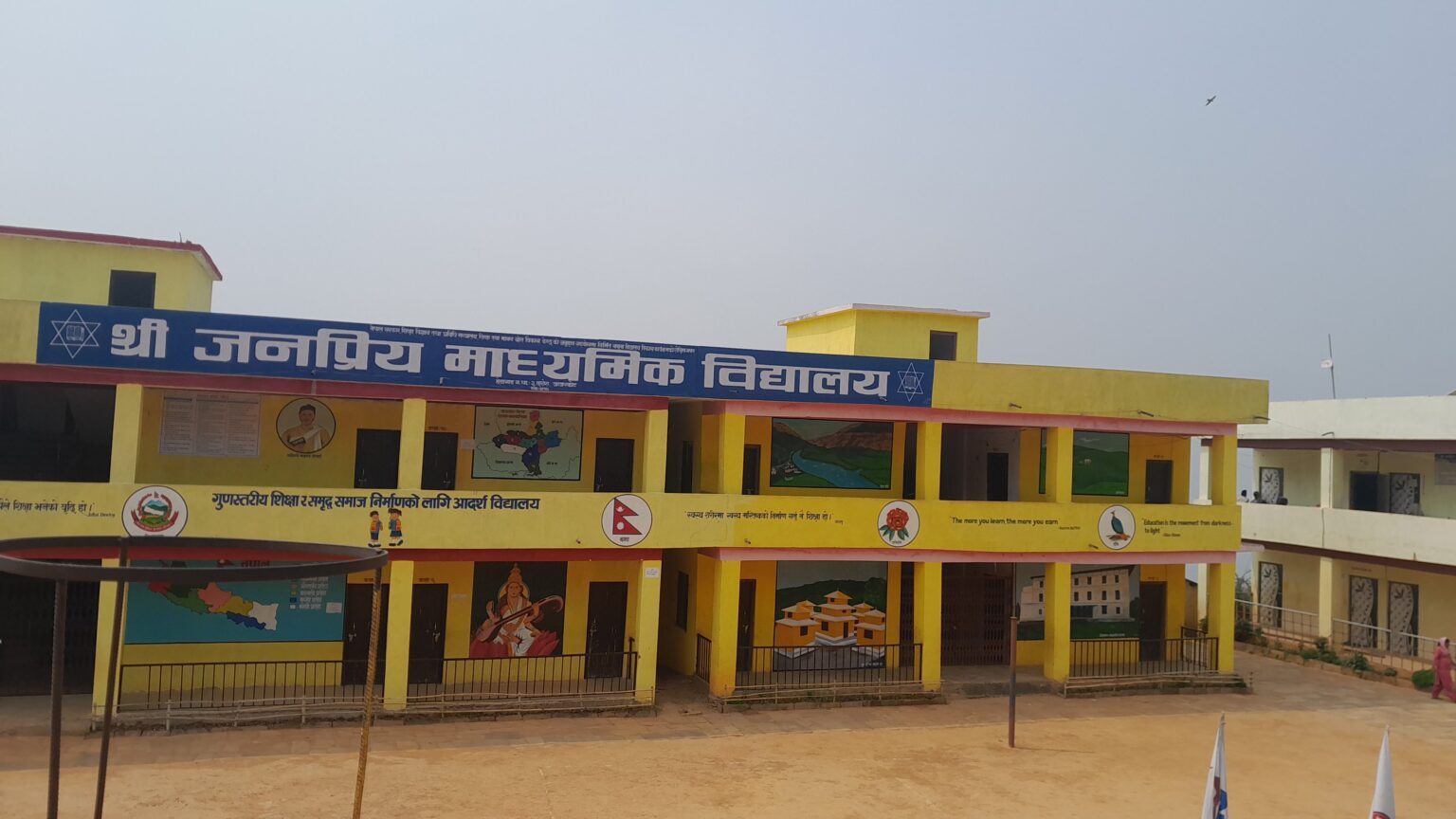
Janapriya Secondary School is located in Chhedagar Municipality 3, Jajarkot.
“Due to the misconception that passing exams might be easier from here, students who studied up to grade 9 in the city end up registering here for grade 10,” explains Rajn Bahadur Budha, a teacher at Janapriya Secondary School. “Most of the students who enroll here just to take the SEE are those whose families had already migrated from the village to the city.”
This highlights another deep-rooted issue: students exist in the school records, but they are absent from the actual classrooms.
Urban capital community schools overflowing
While village classrooms fall far short of the student-teacher ratio, community schools in the provincial capital of Birendranagar are bursting at the seams.
Jana namuna Secondary School, located in Birendranagar-6, ranks among the finest community schools in Surkhet. Driven by a massive surge in interest from parents and students, the school faces an overwhelming volume of applications. During the current academic session, more than 3,000 students have enrolled from ECD to grade 12. This excludes a separate cohort of students enrolled in CTEVT’s three-year diploma programs. The school employs 118 teachers and staff members alone.
Headmaster Yam Bahadur Shrestha confirmed that because admission requests far exceed the school’s physical capacity, the administration has been forced to enforce strict admission quotas.
“On one hand, our infrastructure and human resources are barely enough to accommodate students from within our immediate service area,” Shrestha says. “On the other hand, people moving here from other districts are deeply attracted to this school, meaning we receive far more applicants than the quotas we open.”
Lately, the school has restricted fresh admissions primarily to three entry points: ECD, grade 6, and grade 9. Shrestha notes that vacancies in other classes are only filled if a specific need arises.
Among the 118 teachers and staff members working at Jana Namuna Secondary School, only 32 occupy approved government quotas. The institution employs five full-time and 58 part-time teachers funded through private resources. If one looks strictly at the approved government teacher quotas, the student population at the school is double the standard student-teacher ratio.
According to Govinda Koirala, Chairman of the School Management Committee, a vast majority of the students coming from outside Birendranagar hail from Dailekh and Kalikot. They are followed by students from other districts of Karnali, alongside Banke and Bardiya from Lumbini Province, and Achham from Sudurpashchim Province.
“Most parents here are either employed or running businesses locally,” Koirala said. “However, our school also hosts students whose parents sent them to Birendranagar purely for their education.”
Another community school in Birendranagar experiencing a similar surge in student numbers is Amarjyoti Model Secondary School. Located in Birendranagar-12, this institution is one of the oldest in Surkhet.
More than 3,000 students study here, with the vast majority coming from outside the school’s immediate neighborhood.
“The bulk of our students are from outside Birendranagar,” says Chandra Lamichhane, a school management committee member. “Those from within our immediate catchment area probably make up only about 15 percent.”
Headmaster Khagendra Thapa echoes this observation, explaining that since the preferred destination for local parents within the immediate service area is either Kathmandu or private schools, the student body is dominated by youths from the upper districts of Karnali and Sudurpashchim.
Thapa mentions that Amarjyoti Secondary School has had to operate by enrolling more than twice its actual capacity.
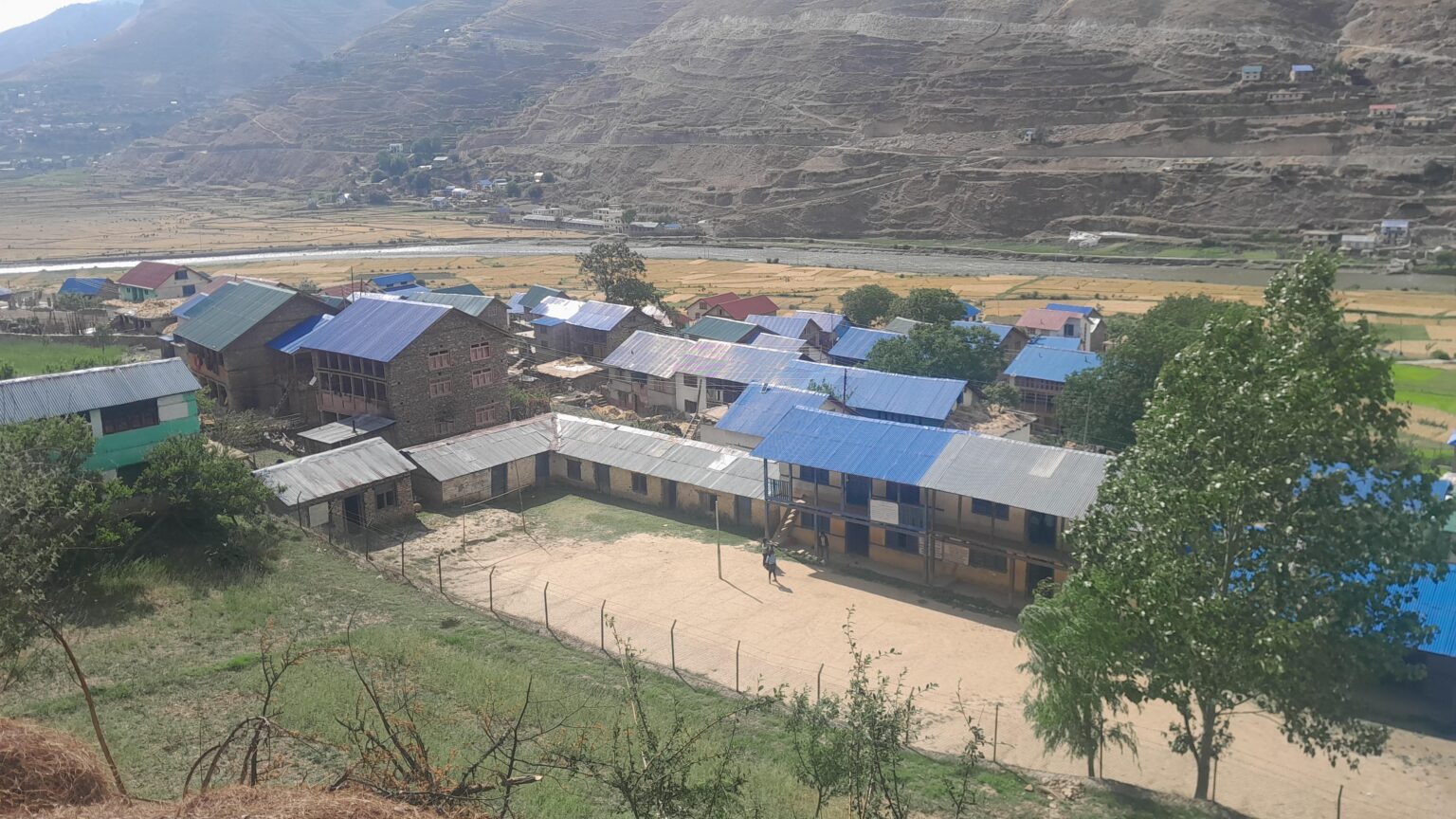
Himshikhar Secondary School is located in Tatopani Rural Municipality-2, Jumla.
“In terms of government quotas, funding, and infrastructure, we cannot properly sustain more than 1,200 students,” Thapa says. “However, believing that those who come to learn should not be turned away, we are teaching double our intended capacity.”
This student shift from villages to urban centers can be put into perspective by comparing the statistical metrics of two different local bodies. Chhedagad Municipality in Jajarkot houses 109 educational institutions, combining 87 community schools and community-centered ECD centers. The collective student enrollment across all these institutions is just around 12,000.
In contrast, the Birendranagar Valley alone (covering only wards 1 to 12), which functions as the provincial capital, contains 137 schools of various types. The student population in these valley schools alone exceeds 68,000.
Comparing the student population of the entire remote municipality of Chhedagad against just the Birendranagar Valley reveals that the valley hosts over five times more students.
The English illusion, urban allure
Educationist Jeet Bahadur Shah attributes the emptying of village classrooms to migration driven by the hunt for better education, healthcare, employment, and opportunities.
Shah, who has spent decades working in the education sector, notes that a growing trend among parents to send their children to market areas as soon as they reach school age is leaving village schools deserted. He advocates for policies that require children to be educated in their place of birth at least until grade 5.
“A child must have the opportunity to study in their birth village at least until the fifth grade. That is how they understand their society, relatives, and environment. Later on, even if they eventually study in the city, they will long to return to their roots,” Shah explains. “Nowadays, people bring three- or four-year-old toddlers to the city for schooling. Once that individual grows up, they have no desire to return home.”
According to Shah, the widespread perception that “English-medium instruction equals quality education” also prompts parents to send their children to cities.
“Recently, government schools have also started teaching in the English medium. A misconception has spread among many parents and stakeholders that English itself constitutes quality education,” he remarked. “English is simply a language. If one requires it for practical purposes, it can be mastered through short-term training. It should not be promoted as a false metric for educational quality.”
Devendra Adhikari, President of the Nepal Teachers’ Federation for Karnali Province, points out that when influential village figures relocate under the pretext of educating their children, it creates a ripple effect across the entire community. According to him, once teachers, government employees, politicians, and well-off families begin educating their children in cities, lower-income families also fall under the same influence.
“In the villages, teachers, government employees, and politicians send their children to cities, paying exorbitant fees,” Adhikari says. “This heavily influences families with lower income levels as well.”
His understanding is that once the prominent and affluent migrate to cities under the guise of schooling their children, it transforms into a cultural norm where less privileged villagers feel compelled to move to the city too, declaring, “We will get by on manual labor just to educate our kids there.”
Adhikari stresses that the state needs to formulate policies capable of making rural community schools trustworthy. He believes an environment must be built where rural schools can inspire and retain even prominent, well-to-do families.