Kathmandu
Friday, July 24, 2026





Despite a promising showing during home fixtures, Nepal’s batters continue to repeat disastrous displays on foreign soil, raising urgent concerns over top-order consistency and bench strength mid-tournament

KATHMANDU: Rohit Kumar Paudel, captain of the men’s national cricket team, appeared confident two weeks ago before departing for the Netherlands tour. Expressing satisfaction with the team’s preparation and recent performances, he said, “We have created a good template as a batting unit. We believe we can defeat both the Netherlands and Namibia.”
There was some basis for Rohit’s statement. Under his captaincy, Nepal delivered an excellent performance last April-May at the TU Cricket Ground in Kirtipur under the ICC Cricket World Cup League 2, winning six out of eight matches played against Oman, the United Arab Emirates (UAE), Scotland, and the United States. Additionally, before departing for the Netherlands, Nepal had indicated momentum by completing a clean sweep in a two-match One Day International (ODI) series against Jersey.
However, in the ongoing ICC Cricket World Cup League 2 in the Netherlands, the Nepali team is delivering a disappointing performance contrary to expectations. Having suffered defeats in crucial matches against both the home team Netherlands and Namibia, both of Nepal’s opportunities to qualify directly for the World Cup qualifiers and to secure its ODI status are under pressure.
Captain Rohit also admits that batting is the main reason for the ongoing poor performance. “We batted poorly in both matches. As a batting unit, we failed completely,” he says.
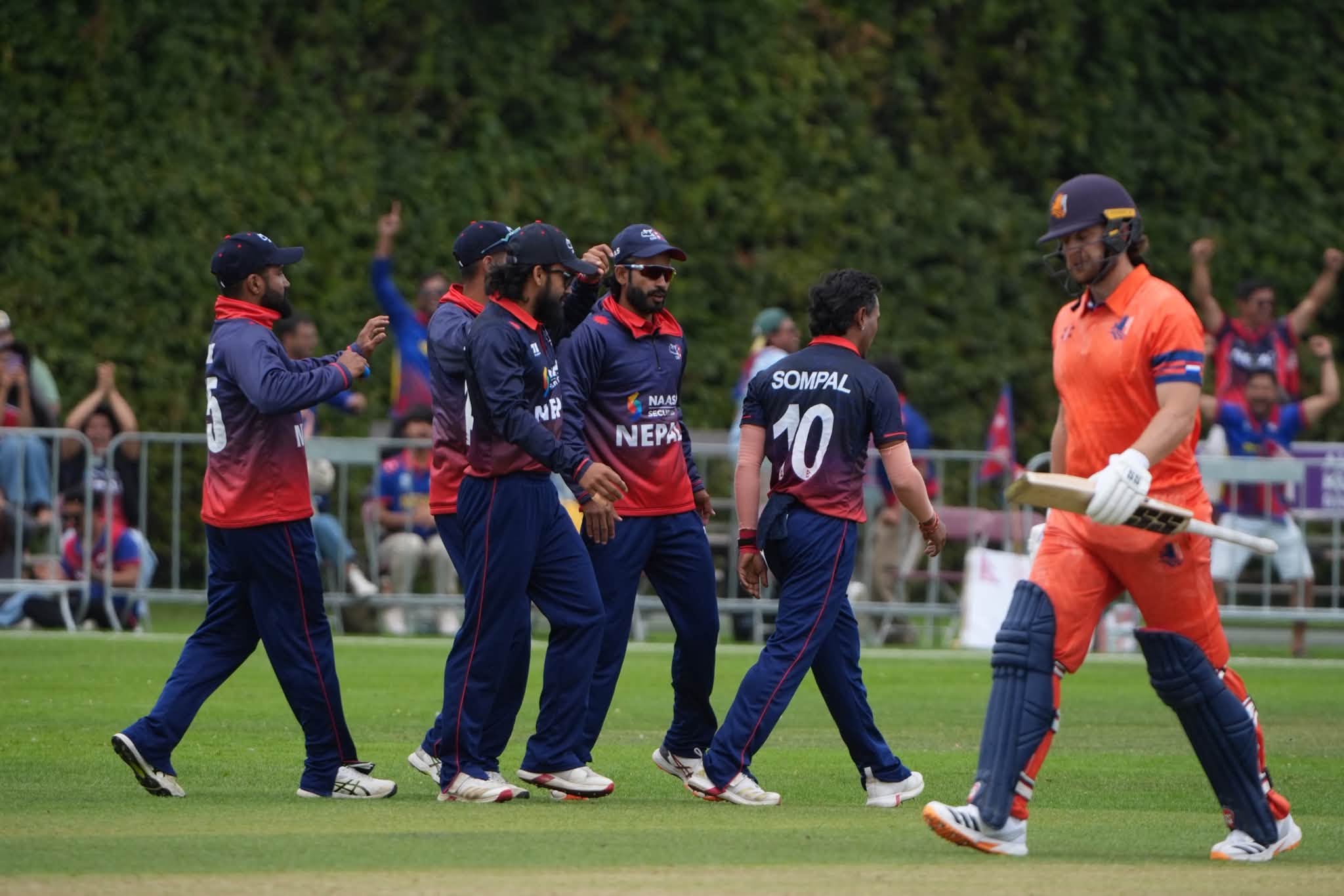
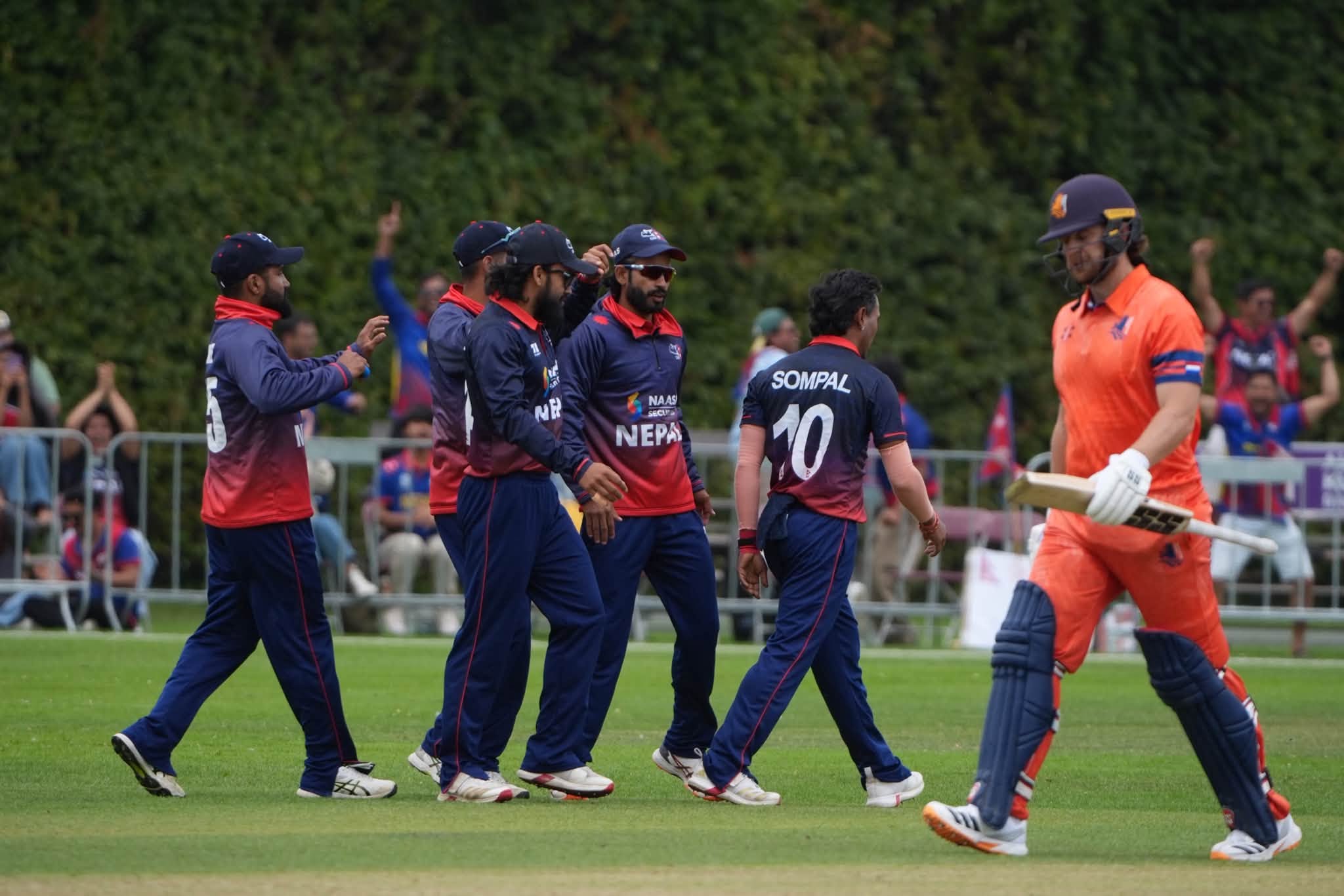
Nepali team after taking wickets against Netherlands
Lost momentum
Following the Nepali team’s consistently impressive performance on home soil, it was expected that they would maintain that momentum on the Netherlands tour. Therefore, head coach Stuart Law did not wish to make major changes. However, on foreign soil, that decision failed to yield expected results.
Key batters who formed the foundation of success in the home series have failed in the Netherlands. Not only vice-captain Dipendra Singh Airee, who served as the team’s backbone by hitting four half-centuries and one century in four of the previous eight matches, but both openers, Kushal Bhurtel and Aasif Sheikh, also appeared helpless in scoring runs. With Ishan Pandey, who received the opportunity to bat at number ‘3’ starting from the home series, alongside captain Rohit’s bat remaining quiet, the overall batting order has fallen into crisis.
Consequently, the confidence, consistency, and momentum seen on home soil were lost upon reaching the Netherlands. As Nepal failed to post competitive scores due to collective batting failure, it had a direct impact on the team’s results. For that reason, Nepal was defeated by eight wickets against Namibia in the first match and by six wickets against the Netherlands in the second match. “Even when there was no big score on the board, the bowlers fought. However, in both matches, our top four batters failed,” says captain Rohit.
At present, Nepal’s top-order batting has made everyone concerned. Opener Kushal has scored a total of just 11 runs across two matches. Although another opener, Aasif, scored 30 runs in two innings, he could not give the team a solid start.
Ishan, who received an opportunity at number three, has also been unable to perform according to trust. Returning to the pavilion, he scored eight runs against Namibia and just four runs against the Netherlands. Although captain Rohit played a fighting innings of 31 runs against Namibia, he lost his wicket for just three runs under similar circumstances against the Netherlands.

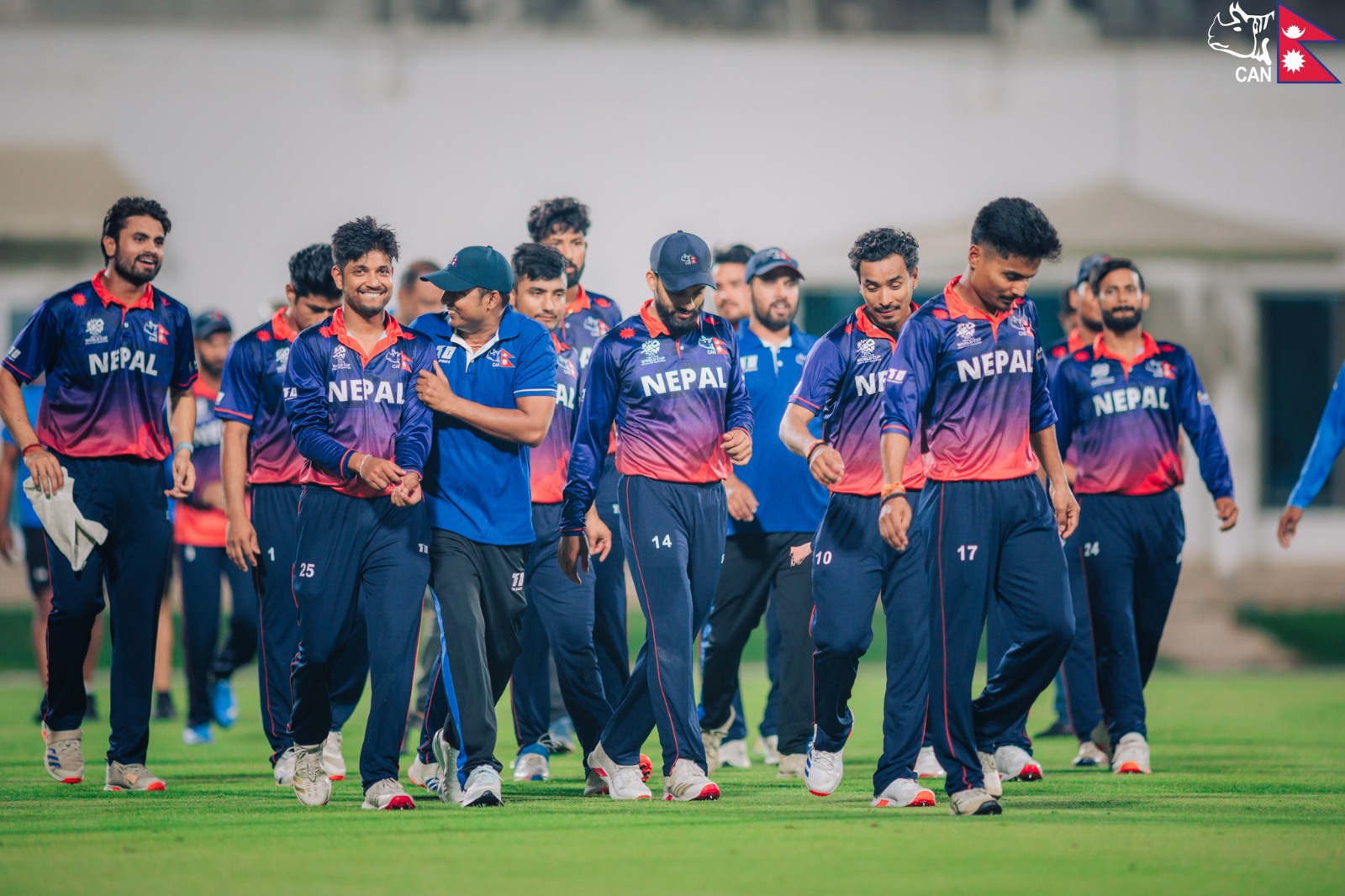
vice-captain Dipendra Singh Airee
Vice-captain Dipendra contributed to some extent by scoring 51 runs across two innings. Aarif Sheikh, who was out for zero against Namibia, proved his importance in the middle order once again by scoring 41 runs off 90 balls against the Netherlands. It was based on Aarif’s patient innings that Nepal managed to set a target of 158 runs before the host team.
Weak performances
The top four teams of the ICC Cricket World Cup League 2 will directly secure spots in the qualifying tournament for the World Cup to be jointly hosted next year by South Africa, Zimbabwe, and Namibia. Having played in the World Cup qualifiers four times in 2001, 2014, 2018, and 2023 without making the World Cup journey, Nepal’s goal this time was different: to reach direct qualification by remaining in the top four of League 2.
However, recent unexpected performances have made Nepal’s goal difficult. With six matches remaining to be played in League 2, Nepal has a total of just 24 points in its account. Ahead of Nepal in the points table are the United States, Scotland, the Netherlands, and Oman. Their points stand at 43, 38, 34, and 31, respectively. Adding to the challenge, the Netherlands has played one match fewer, and Oman has played two matches fewer than Nepal.
On the other hand, Namibia, which is trailing Nepal, has already gathered 24 points from 29 matches. Canada, which has played 28 matches, also has an equal 24 points. The UAE, having played six matches fewer than Nepal, has 14 points in its account.

Nepali fans rallying behind the team in the match against the Netherlands
Now, Nepal must secure a place in the top four by leaving behind Oman, Namibia, and Canada, for which even winning the remaining matches continuously appears to depend on the results of other teams.
Strong opponents
The main goal of all eight participating teams in League 2 is to make the World Cup journey. Therefore, these teams are not limited to League 2 matches alone; they are continuously improving their level and preparation by playing against other strong nations. Furthermore, the fact that Nepal recently posed a strong challenge to two-time champions England in the T20 World Cup remains fresh. For this reason as well, the remaining seven Associate nations in League 2 take the field against Nepal with special preparation.
Opposing teams have become aware of the strengths and weaknesses of every Nepali batter. Therefore, playing against Nepal is not difficult for opponents, says former national team member and head coach of the Nepal Police Club cricket team, Manjeet Shrestha. “We have been playing almost the same team for a long time. This has made it easy for opponents to understand our playing style and weaknesses,” says Shrestha.
An example of this is shown by the matches against Namibia in the previous League 2 cycle.

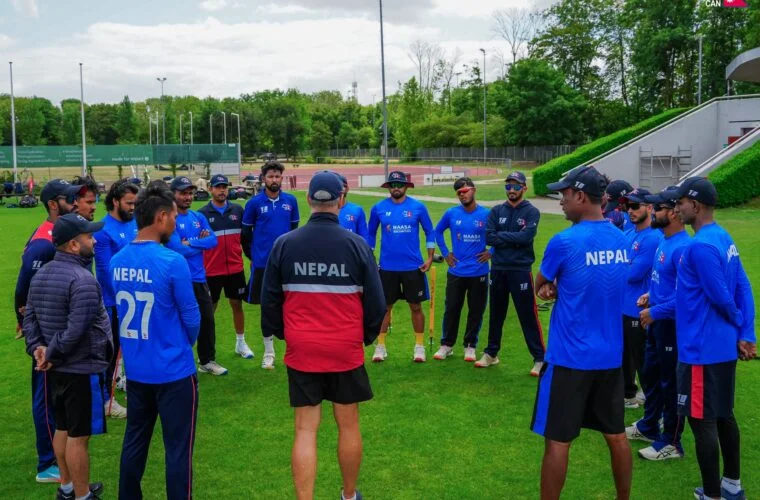
Opener Aarif Sheikh during a net practice session
In the 2019-2023 League 2 cycle, Nepal played six matches against Namibia. In the initial three matches, Nepal suffered defeats by 40, 90, and 68 runs, while one match ended in a tie. However, in a crucial situation where saving ODI recognition was mandatory, Nepal made some changes to the team and gave opportunities to players, including Sundeep Jora and Kushal Malla. Following that, Nepal secured a thrilling two-wicket victory against Namibia and achieved a three-wicket success in another match.
However, in the current 2024-2027 cycle, Nepal has been easily defeated in all three encounters with Namibia. Now, Nepal will play its fourth match against this same team on Monday, and after playing against the Netherlands on Wednesday, it will conclude the tour. However, previous results indicate that these matches will not be easy.
Shrestha suggests that the team should utilize its bench strength in these situations. “Every player on the national team is talented. If someone struggles to deliver for two or three consecutive matches, it makes sense to give another player a chance,” he says, adding, “Adapting the lineup as needed brings long-term benefits.”