Kathmandu
Sunday, July 26, 2026





University reform must go beyond appointing Vice-Chancellors to address chronic weaknesses in financial governance, transparency, internal audits, and accountability that continue to undermine Nepal's higher education system.
KATHMANDU: Whenever governments change, pledges to transform higher education are repeatedly made, yet they rarely materialize. The current administration has reportedly prioritized university reform as well. However, looking at the reform agendas put forward publicly, a pressing question arises: Do we have sufficient knowledge about the actual problems facing our universities? Are new studies and analyses being conducted, or are policies being formulated merely on guesswork?
The Ministry of Education appears to prioritize the appointment of Vice-Chancellors, the protection of university land, and taking action against professors who abuse leave. Undeniably, all of these are necessary matters. However, treating these alone as the main foundation of university reform is insufficient. University reform is not merely a matter of administrative management; it is intimately tied to academic quality, scholarly advancement, and students’ dreams of employment.
The selection process for Vice-Chancellors failed to generate the anticipated policy discourse regarding higher education. Debates focused heavily on candidates’ past experiences rather than strategies for enhancing academic quality, plans for scholarly advancement, financial governance, and job-oriented education. Questions regarding how to ensure a merit system, academic autonomy, and institutional accountability within universities also remained sidelined.

Tribhuvan University
Appointments made without open competition—ranging from the Tribhuvan University Service Commission to the Nepal Academy of Science and Technology (NAST)—have raised further questions. University leadership should not be determined by an individual’s personal connections or networks, but rather by their academic competence and leadership skills. Yet, there is an even more serious question—one regarding which neither the government appears serious nor public debate is focused. That issue is financial governance.
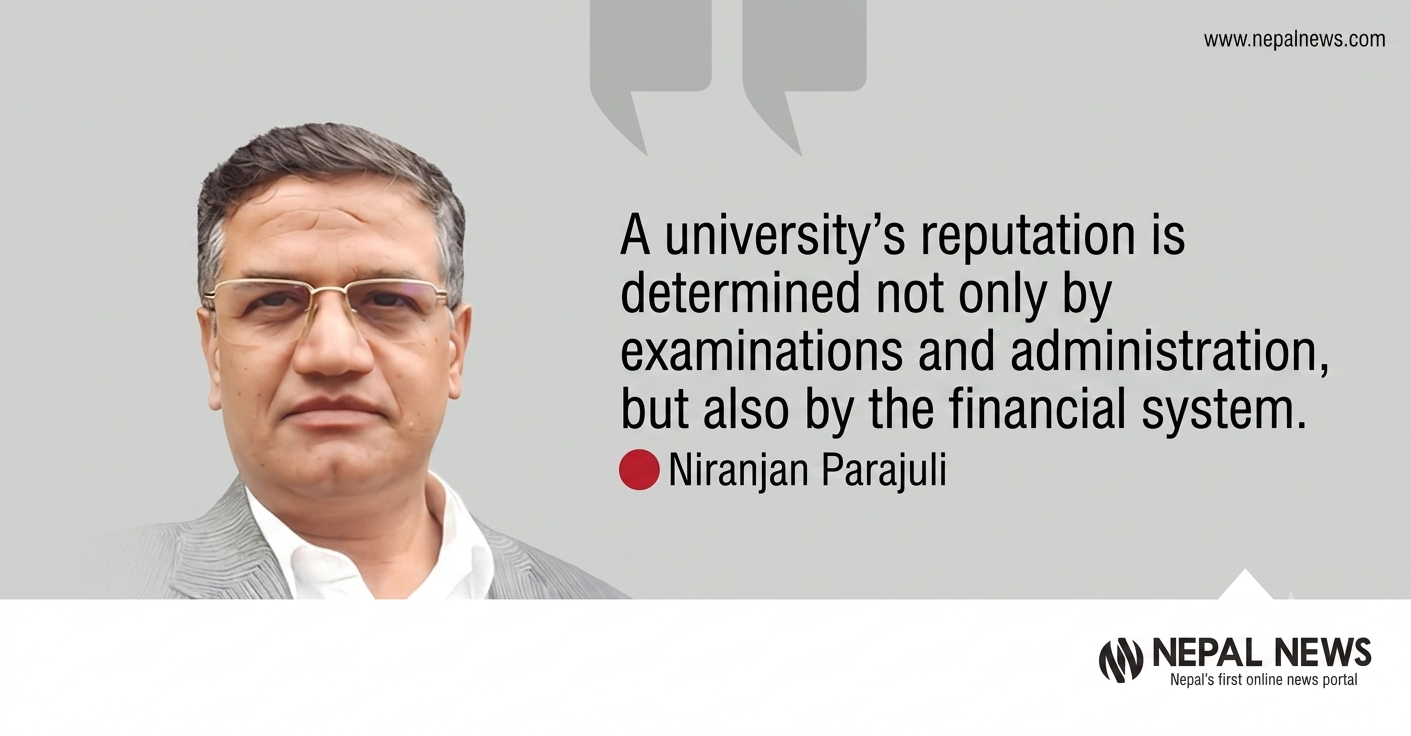
The reputation of a university is not determined solely by the regularity of conducting examinations and administrative management; its financial system matters just as much. Universities and colleges spend hundreds of millions of rupees every year from government grants, student fees, and income generated from internal sources. Therefore, treating financial management merely as a matter of routine accounting administration would be a grave mistake. Decisions regarding which sectors to invest in, which programs to prioritize, which infrastructure to construct, and how to manage teachers and staff funded by internal sources are all ultimately connected to the financial system.
The problems plaguing universities and colleges stem from managerial weaknesses alongside budget shortages. In recent years, internal revenues of universities have increased significantly due to academic programs operated through internal sources, research projects, consultancy services, and affiliation fees. However, the transparent management of that income is even more crucial.
The University Grants Commission provides tens of millions of rupees in grants to community campuses. Yet, public audits of these grants are not conducted. There are also examples where community campuses have been merged into universities—whether needed or not—solely with the objective of securing government-salaried positions. Therefore, transparency and auditing must be mandatory wherever government budgets are spent. The Ministry of Education must formulate a clear stance on such policy questions and plug existing loopholes.
The 63rd Annual Report of the Auditor General has further clarified many such realities. According to the report, certain campuses and central departments of Tribhuvan University recorded income generated from internal sources not as regular revenue, but spent it through deposit or liability accounts. Many bodies failed to reconcile their bank accounts. Furthermore, the university has been unable to prepare consolidated financial statements for all of its subordinate bodies.

Of the 163 bodies under Tribhuvan University, internal audits for 35 bodies had not been completed. Likewise, 135 bodies failed to submit financial statements for up to five fiscal years. These are not ordinary accounting errors; they are severe institutional weaknesses of the universities. Yet, such facts have failed to receive adequate space in the media and public discourse.
These facts raise another critical question: If the university leadership lacks a clear picture of its own institution’s actual financial standing, how can long-term planning be formulated? When financial information is incomplete, policy-making relies on estimation, thereby increasing risk. That is precisely what continues to happen.
The lack of regular internal audits is another grave problem. The purpose of internal audits is not merely to discover errors after expenses have been incurred, but to identify potential risks in a timely manner. However, this system is not found to be operating effectively across many universities. As a result, irregularities and weaknesses of the exact same nature have been recurring for years.
The problem is not limited to Tribhuvan University alone. The Auditor General has pointed out financial weaknesses of a similar nature in Mid-West University, Nepal Sanskrit University, and other universities as well. If the exact same weaknesses recur every single year, the problem is not confined simply to the failure of a single Vice-Chancellor, Registrar, or accounting officer. It demonstrates that structural reforms are required within the financial system of the universities itself. The Ministry of Education must treat this issue with utmost seriousness.
Some examples pointed out by the Auditor General further clarify this financial malpractice. The purchase of an IVF equipment by the Tribhuvan University Teaching Hospital at a cost of tens of millions of rupees remaining unused for a long period, and the expenditure of large sums on consultancy services without fulfilling required procedures at Madan Bhandari University of Science and Technology, are not merely examples of procedural flaws. They expose a severe lack of planning, monitoring, and accountability in the utilization of government budgets.
Amidst this, some important reform efforts appear to have been initiated under the pressure and support of the donor agency, the World Bank. The World Bank, which has been investing in Nepal’s higher education, has evaluated the financial management of universities as merely “moderately satisfactory.” It attributes this rating to delays in submitting financial reports, weak internal audit systems, and the failure to effectively implement Tribhuvan University’s Financial Management Improvement Plan.

Another important aspect pointed out by the World Bank is the integrated financial information system. Once such a system is implemented, all income and expenditures, procurement, asset management, and financial reporting of universities can be operated through a single digital platform. This not only expedites work but also provides reliable data necessary for decision-making.
However, technology alone is not a solution. Merely transferring a weak system onto computers does not bring good governance. Alongside a digital system, clear working procedures, effective internal controls, and leadership commitment are essential. Otherwise, paperwork errors will simply transform into digital errors.
To achieve this, universities must prioritize several fundamental reforms likewise first digital audit trail of every financial transaction must be made mandatory. This automatically preserves details regarding who performed a transaction, when, and why. Secondly, traditional internal audits must be transformed into a risk-based system so that problems can be identified in a timely manner rather than after damages have accumulated. Third, clear criteria must be established for procurement, payments, research grants, scholarships, and service delivery. When procedures remain ambiguous, delays, unnecessary discretionary power, and the risk of corruption escalate. Once timeframes and responsibilities for every service are clearly defined, accountability increases.
Fourth modern payment systems, such as payment cards, can be utilized for small and routine administrative expenses. This reduces cash transactions, organizes expense records, and facilitates monitoring. Many universities in developed nations successfully utilize such systems. Fifth, universities must make their annual budgets, expenditures, procurements, research grants, and key financial indicators public through regularly updated digital dashboards. Institutions operated using public resources should not be granted exemption from public accountability. Transparency builds trust, and trust strengthens institutional autonomy.
Alongside financial reforms, the resource allocation framework must also transform. The practice of distributing grants to all universities under a uniform criterion does not incentivize excellence. It is essential to expand the scope of performance-based government grants grounded in indicators such as research, academic quality, student pass rates, innovation, financial discipline, and social contribution. The World Bank’s ongoing program is initiating preliminary exercises in this direction.
The experiences of the world’s finest universities impart this very lesson. Leading institutions such as Oxford, Cambridge, Harvard, Stanford, or the top universities in Singapore have not succeeded merely because of exceptional teachers and students. For decades, those institutions have systematically developed transparent financial systems, strict internal controls, independent audits, and public accountability.
Consequently, the debate on university reform must now become policy-oriented. The question of who becomes Vice-Chancellor is important. However, an even more critical question is how honestly, effectively, and accountably universities utilize public resources. Unless a satisfactory answer to this question is provided, problems will keep recurring regardless of leadership changes.
The invisible crisis in universities is not merely a shortage of financial resources; it is also the absence of financial governance. Only by placing this crisis at the center of reform can universities embark on a new journey of quality and skill-oriented education, research, and international competition.
The World Bank’s ongoing program concludes this coming December. If existing weaknesses are not rectified before then, how can the government put forward a credible proposal for a new project? Therefore, reform efforts must begin right now.
(Parajuli, who holds a PhD in Bioorganic Chemistry, is a professor and researcher at Tribhuvan University.)