Kathmandu
Tuesday, July 21, 2026





By prioritizing short-term economic gains over biodiversity, current community forestry practices are wiping out vital vegetation and displacing forest animals, raising urgent questions about the true purpose of conservation
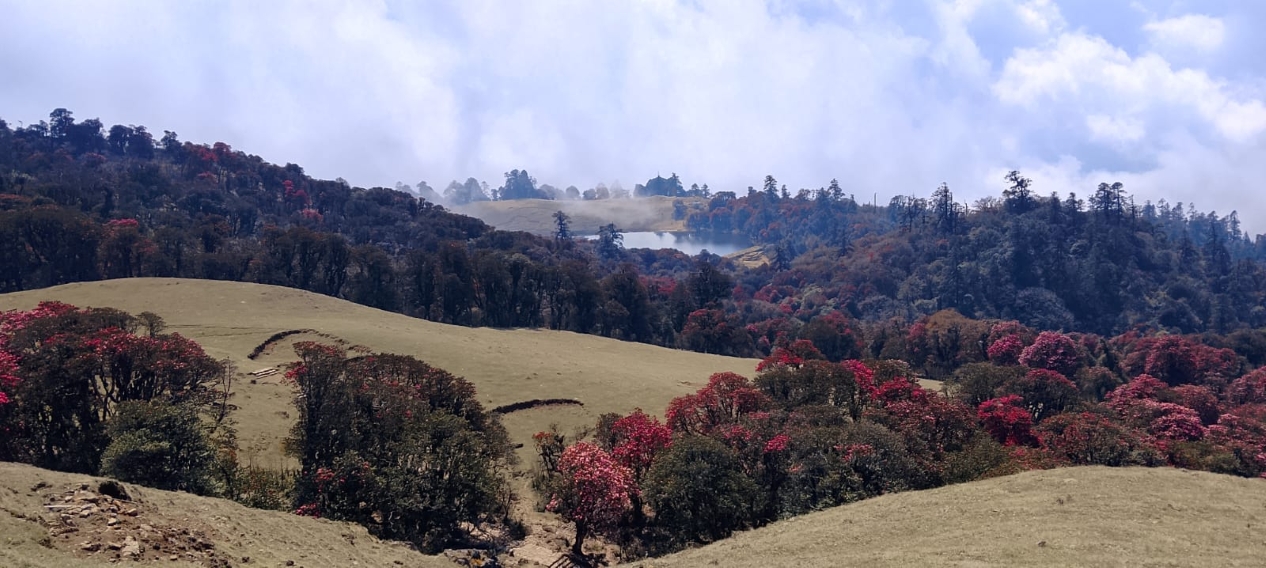
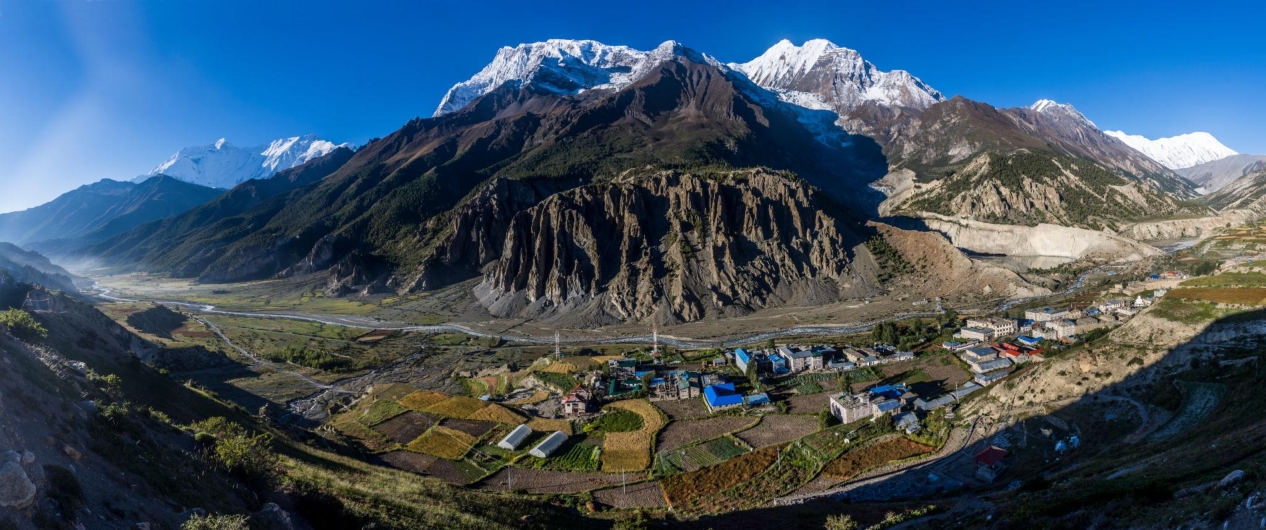
Hans Pokhari, a name that literally translates to ‘duck pond,’ has become a popular destination along the Mundhum trail in the Maiyung area, yet it currently features neither ducks nor a pond. Instead, only a swamp remains as evidence of the massive body of water that once existed there. According to local elders, until 40 to 50 years ago, this swamp was actually quite dangerous, trapping and killing one or two animals every year. Over time, however, the wetland continued to dry up, leaving nothing but a small puddle tucked away in a corner.
The pond kept drying up due to two reasons. First, because the soil and stone flowing together from the stream that brings water to the pond piled up. Second, because the soil toward the outlet of the pond was washed away due to natural causes. As the animals grazing there damaged it and toad hunters dug into it, the natural dam became weak and kept collapsing. Because that happened every year, water could not collect.
Hans Pokhari falls in a pasture and meadow area located at an altitude of 2,900 meters above sea level. There used to be dozens of sheds around it; now there are only a few sheds, but there are many in the Nagi area. After the swamp kept drying up, cowherds built a volleyball court there. The swamp dried up even more. Since the geography is shaped like a plate, a football ground was made because no matter how hard it was hit, the ball would not go outside. During festivals and leisure time, youths from surrounding villages used to climb up to Hans Pokhari to play football by placing bets.
Community forestry entered the surrounding villages. Hans Pokhari fell under the Nayak Kharka Community Forest. The consumers were from the then former Timma VDC Ward Nos. 3 Sawa and 2 Phongla of Bhojpur District. After the restoration of democracy, a flood of tourism promotion came across the entire country. The forest user group determined that the Maiyung area itself is naturally beautiful, and on top of that, if Hans Pokhari is made into a real pond, it will become a tourist choice and also generate income for the consumers.
With the voluntary labor of consumers and the help of various government and non-governmental donors, the pond area was demarcated, a dam was built at the outlet to hold water, a small canal was cut so that floods would not enter the pond directly, and a wire fence was installed around an area of around 20 hectares. It became necessary to buy a ticket to enter it. Boats were also brought to make it tourist-friendly. Currently, except during the rainy and cloudy weather and the monsoon, there is a continuous flow of tourists throughout the year. During the season when Chimal blooms, which is around the New Year, there is a very heavy bustle.
Protection of exclusion
Around the month of May 2017, the ‘Maiyung-Hans Pokhari Festival’ was organized with the aim of publicizing the tourism promotion of the Maiyung area. The cowherds of the Maiyung area submitted a memorandum to Chief District Officer Goma Chemjong and Local Development Officer Sita Nepali of Bhojpur, who had reached the festival. The memorandum stated, “Since Hans Pokhari has been closed, yaks, cows, and buffaloes have not been able to drink water. Initiatives should be taken to open it. Instead, we will pay taxes.” At that time, local governments had not been formed. The demand of the cowherds was not heard. After that, even though local governments, provincial governments, and federal governments have come twice, no one has heard the demand of the cowherds.
Since a long time ago, Hans Pokhari has been a major reason why livestock rearers liked the Maiyung area. Whether it is in the upper Nagi area or the lower forest area of that region, natural water sources are abundant. However, such sources are on cliffs, streams, and bushes; they are in narrow and difficult places; they are also small. Even though it was a pond on the verge of drying up, because the flow of water was large and wide, Hans Pokhari was the largest, open, and easiest place for yaks, cows, buffaloes, sheep, goats, and horses from surrounding villages to drink water. Since it falls almost in the middle of the Maiyung area, it was also appropriate. Domesticated livestock from Maiyung’s Nagi and the lower forest meadows would reach Hans Pokhari at least once a day. When livestock from all directions gathered at the same time, Hans Pokhari would be jam-packed during midday, just like a city’s traffic jam. It was no less exciting to see six species of livestock in the hundreds in one place.

Old cowherds experience that as long as Hans Pokhari was open, the terror of leopards was also less. The reason was that all animals would graze and play together in a single herd around Hans Pokhari. A situation where they had to separate from the herd and walk alone did not arise. But after Hans Pokhari was closed, there was no such place for animals to gather in a single herd. Because animals go to graze scattered, the instance of wild animals causing damage has increased significantly. When rushing and fighting to drink a small trickle of water located in a narrow and steep place, the risk of animals falling, getting injured, and dying has increased.
Previously, if someone’s livestock did not come to the shed on time or was lost, one could go straight to Hans Pokhari to search for it. If it were alive, it would definitely be found around there. Now, there is no clue to search if an animal is lost. Because animals are prohibited in that area. Neither the conservationists nor those providing financial, moral, and physical support to conserve thought about an alternative. Humans can enter inside by buying a ticket. If an animal enters, the animal owner is financially fined at the rate of Rs 500 per head.
The destruction of Chimal
The species of rhododendron that flourishes in high geography is called “Chimal.” Chimals are generally less red than commonly known rhododendrons. While wood trees like Kharsu, Phalat, and various species of pine are found in the lower region of that area, dozens of kinds of rhododendrons and chimals of various colors, shapes, and sizes are found densely in the upper region.
Around the year 2010, a Nepali paper industry opened down in Phalante village as a collective small-scale industry. Since Sikre, a bush plant used to make Nepali paper, is found naturally in abundance in the Maiyung area, such domestic paper industries used to open here and there from old times. Once it opened in the village itself, and that too collectively, initiatives to commercialize Sikre in community forests began. Cutting in the right manner and time, conserving plants, weeding, opening for cutting on specific winter days, and not allowing non-consumers to cut started to be practiced. In the name of weeding Sikre, how many chimals were cut down every year? There was no account.
The pillars holding the wire fence around Hans Pokhari are made of Chimal. How many pillars have been driven to fence 20 hectares of land and how many chimals were felled for those pillars? No conservationist paid attention. Those pillars have started to rot. The pillars to be replaced now will certainly be of Chimal as well. Even for constructing the stage, the stage perimeter, the secretariat, shops, and stalls in the Maiyung-Hans Pokhari Festival, the organizers did not find any wood other than Chimal. Moreover, Chimal itself is used in that region for building sheds and as firewood to burn in sheds.
In the Tinjure area, even someone picking a single bloom of rhododendron and chimbal is fined. The tourism business is running by showing that very rhododendron. In the Maiyung area, however, the pond is conserved by cutting rhododendrons and chimals. Tourism festivals are held by making a litter of rhododendrons and chimals. Tourism houses are built by cutting down rhododendrons and chimals themselves. Chimal for construction, Chimal for conservation. Whatever is done, it is the destruction of Chimal. Chimal has not been made a subject of conservation at all.
A flood of forming community forests came to the country in the early 1990s. But community forestry reached the villages touched by Maiyung only much later. There are three reasons for this. First, most of the residents of that region have their own private forest. Second, the government forest area is excessive. Third, because it falls in an extremely remote area, there was no government presence in the government forest, and there was no obstacle for villagers to utilize the products.
In the Tinjure area, even someone picking a single bloom of rhododendron and chimbal is fined. The tourism business is running by showing that very rhododendron. In the Maiyung area, however, the pond is conserved by cutting rhododendrons and chimals.
After becoming a community forest, the consumers did become the collective owners of the forest, but when going to guard the forest (to check if anyone would destroy it), the officials of the group themselves randomly hunting animals and birds; carelessly sweeping up herbs; completely wiping out toads; not tolerating the sight of cliff bees; and cutting and carrying away more trees and plants than they needed under the guise of poles and stakes became common. The conservation of a forest means the conservation of all kinds of plants, animals, and birds present there. But the attention of community forest user groups across the country is on conserving specific species of plants that provide immediate, direct financial benefit to humans and on destroying others. In the name of forest cleaning and weeding, other kinds of plants are destroyed. In the name of community forests, the forest area is increasing, but facts that many species of forest animals, birds, and plants are being wiped out are often made public. After Hans Pokhari received a rebirth, flocks of wild ducks had started coming. It is said that consumer hunters of that group and neighboring groups killed them off, and the remaining one or two also disappeared after boats started operating in the pond.
This kind of conservation has disrupted biodiversity, the ecosystem, and the environmental cycle. A loud voice is being raised in parliament regarding monkey terror and human-wildlife conflict; community forestry is also one of the major reasons for inviting such terror and conflict. Because only plants that provide immediate and direct financial benefits are saved in community forests, the wild animals and birds have become aggressive toward humans because the plants necessary for them have been destroyed. The currently conserved forests have started to become less of a green forest and more of a desert. A change in the present concept of conservation itself is necessary.
Finally, lines from the poem ‘Parkhal’ by Basu Shashi:
“Parkhal lagayepachhi dherai thok bahira parchha …
ra parkhal, tyo bhatkina pani sakchha.”
Translation:
“When a wall is put up, many things fall outside …
and the wall, it can also break down.”