Kathmandu
Tuesday, July 28, 2026





Cash seizures, silent-period campaigning, use of teachers and children, and blaring DJ rallies expose widespread violations ahead of the March 5 House of Representatives elections
BIRATNAGAR: As the date of the House of Representatives election draws closer, widespread violations of the election code of conduct have been reported across districts in Koshi Province. With candidates from political parties racing to woo voters, the code of conduct issued by the Election Commission has been reduced to a mere formality on paper. On the one hand, parties sign written commitments to abide by the code of conduct at the office of the election officer, and on the other, they flagrantly violate it the moment they step onto the streets.
On February 28, a scene was witnessed in Morang Constituency No. 2 that raised serious questions about the integrity of the election. A vehicle bearing registration number Ko. 1 Cha 7338, which was part of an election campaign convoy, was found carrying Rs 449,000 in cash. The vehicle also contained pamphlets, banners, and sample ballot papers of the Nepali Congress. In Ratuwamai, cadres of the Rastriya Swatantra Party (RSP) grew suspicious and stopped the vehicle before alerting the police. According to Morang District Police Chief, Superintendent of Police (SP) Kavit Katwal, three individuals were apprehended along with the cash and the vehicle. The driver claimed to be a businessman.
SP Katwal says that after interrogation, the police handed over all three individuals, including the driver, to the Election Office of Morang-2 for further investigation. “We have handed over those apprehended to the election office. They have initiated the investigation process on the matter,” he says.
In Morang-2, Minendra Rijal is the candidate from the Nepali Congress. Other candidates in the constituency include Dilip Kumar Agrawal from CPN (UML), Chandrabir Rai from the Nepali Communist Party (NCP), and Krishna Kumar Karki from the RSP.
T-shirt politics under the guise of Holi
The silent period has been in effect since Monday night, ahead of the election scheduled for March 5. The Election Commission has stated that during the silent period — which begins 48 hours before polling and remains in force until voting is completed — no campaign activities, vote solicitation, speeches, rallies, discussions, reviews, or any activity that could influence the election are permitted.
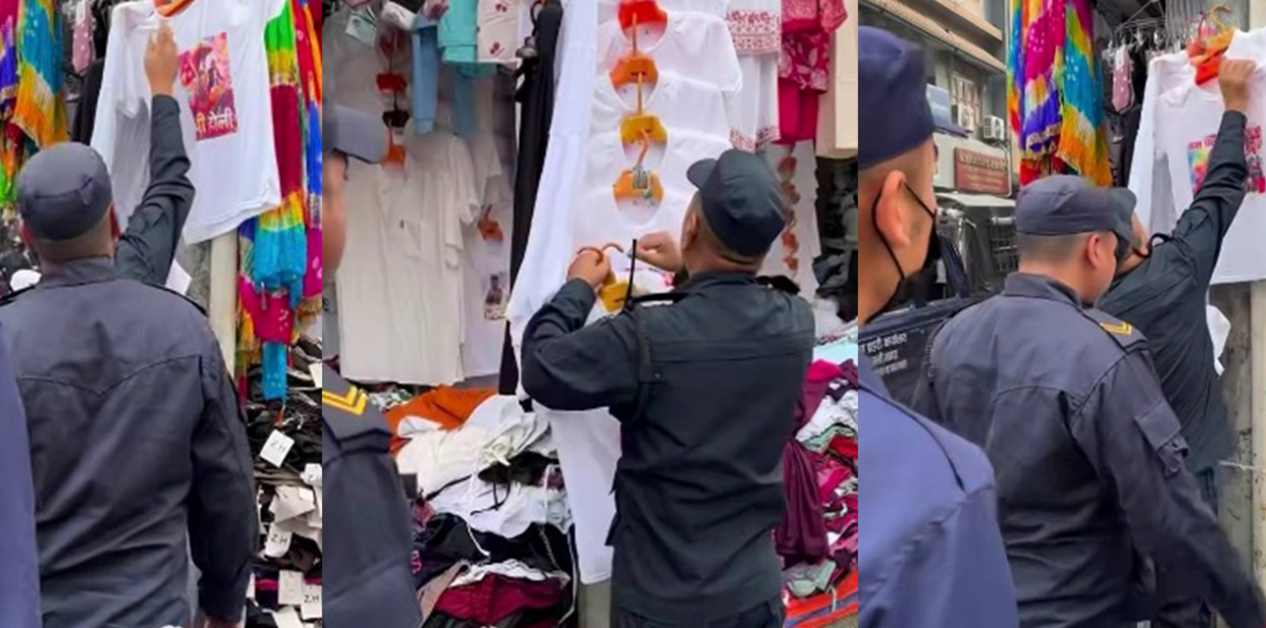
However, political parties and their supporters were seen devising ways to continue campaigning even during the silent period. On February 27, police seized more than 3,000 T-shirts and vests bearing the images of RSP Chairman Rabi Lamichhane and senior leader Balendra Shah from various markets in Morang and Jhapa. A total of 262 pieces were confiscated from shops in Birtamod, Mechinagar, Damak, and Buddhashanti areas of Jhapa, while 3,000 pieces were seized from Morang.
The police have concluded that the T-shirts — inscribed with slogans and candidates’ names — were intended for distribution to voters during the silent period to influence their decisions. According to Koshi Province Police spokesperson, Senior Superintendent of Police (SSP) Yogendra Singh Thapa, the items were seized as a precautionary measure, given the risk that such materials could undermine the impartiality of the election during the silent period.
Campaigning under the cover of teachers
The code of conduct strictly prohibits government teachers and civil servants from participating in any party’s campaign activities. However, in Jhapa-5, the code was openly defied. On February 15, the Nepal National Teachers’ Organization held a political program in Damak in the very presence of UML Chairman and candidate KP Sharma Oli.
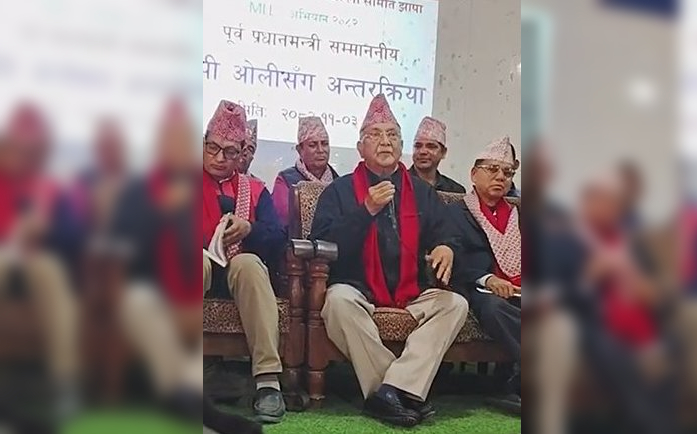
CPN (UML) Chairman KP Sharma Oli attending a program organized by the Nepal National Teachers’ Organization. Photo: Anil Shrestha
While building an election-friendly atmosphere by assembling teachers in his own constituency, Oli delivered speeches about the rule of law and stability in the country, but remained silent on the violation of the code of conduct through the political use of government teachers. The event was attended by former minister Devendra Dahal, who also serves as the campaign commander for UML in Jhapa-5, as well as leaders and members of the teachers’ organization from across Jhapa district.
During his address, Oli targeted the destruction caused during the September 2025 protests, stating that “criminal activities carried out in the name of public dissent have pushed the country into a difficult situation.” Voters in Jhapa-5 have questioned the contradiction of expressing concern over attempts to destabilize the country on the one hand, while personally violating the code of conduct meant to ensure election integrity on the other. “It is ironic that the very person who preaches the rule of law turns government employees into electoral weapons in violation of the code of conduct,” says Krishna Shrestha of Damak-3.
Use of children and the din of DJs
During the campaign period, the election code of conduct had prohibited the use of sound systems and flashy campaigning in public spaces. However, parties and candidates blatantly disregarded the rule. Candidates’ vehicles were seen cruising through the intersections of Biratnagar blaring loud DJ music.
That was not all — the use of children in election rallies and dance programs was equally prevalent. Child rights activist Basu Adhikari says, “Children from impoverished families were lured with financial incentives and used in campaign activities — this is a serious crime.” The parties, however, have been evading accountability by claiming that the children came of their own volition.
Despite numerous representative incidents of code of conduct violations coming to light, the monitoring body has been dismissing them as “sporadic” incidents. According to Morang’s election code of conduct monitoring officer Somnath Upreti, no serious incidents have occurred so far. “We have had banners and festoons bearing party symbols removed. Some complaints have come in, but they are not of a serious nature,” he says.
Maniram Pokharel, the information officer at the District Election Office in Morang, says that no formal complaints have been filed to date.
The walls and poles of Biratnagar have been painted over with banners, flex boards, flags, and caps. The extravagant campaigning has stretched the election spending limits beyond measure. The Election Commission had divided constituencies across the country into five categories and set candidates’ spending limits between Rs 2.5 million and Rs 3.3 million. Advocate Paris Subedi says the absence of formal complaints and lax monitoring have only emboldened the candidates.
Koshi Province has 28 constituencies across 14 districts. A total of 505 candidates are contesting the election in these 28 constituencies.
Morang’s Assistant Chief District Officer Saroj Raj Koirala said that security personnel have been directed to prevent any campaign activities that violate the standards set by the Election Commission. “We have been immediately addressing and issuing warnings regarding the minor code of conduct violations that come to our attention on a daily basis. However, in the case of incidents of a serious nature and larger scale, the Election Commission itself will take forward the investigation and enforcement process,” he says.