Kathmandu
Tuesday, July 21, 2026





NHRC’s investigation into the Gen Z protests triggers sharp backlash from ruling party MPs, casting doubt on the implementation of recommendations
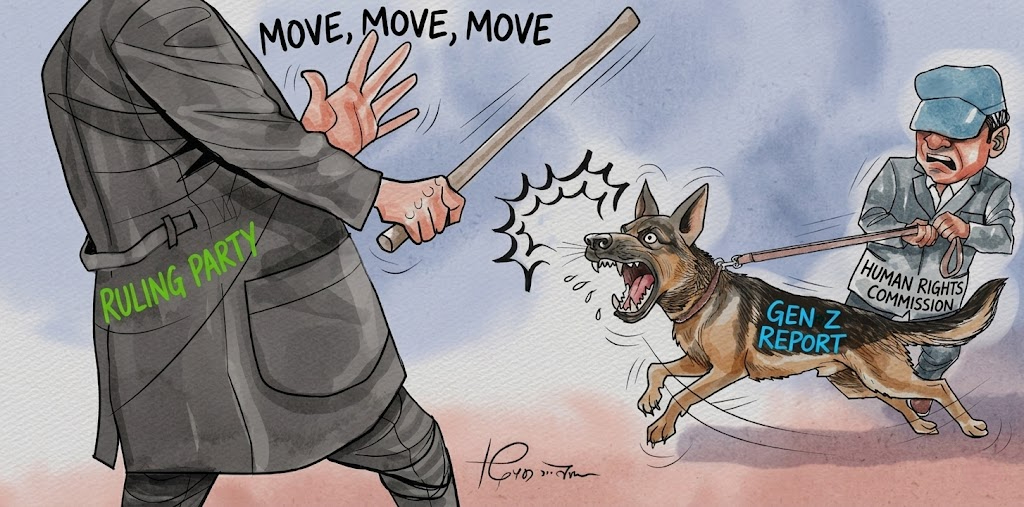
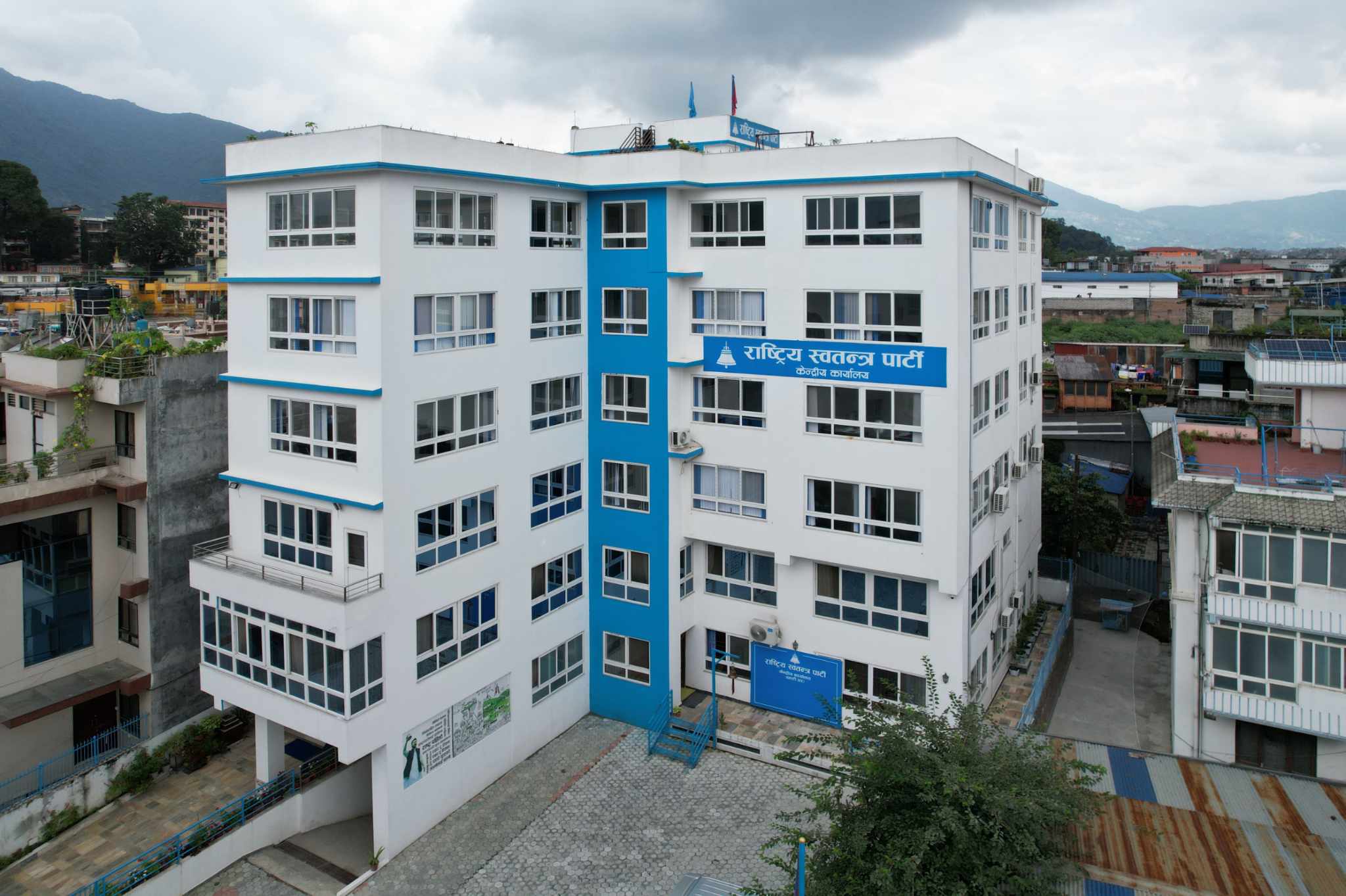
KATHMANDU: Following the release of the “Investigation Report on the Gen Z Protests” on the occasion of the 26th anniversary of the National Human Rights Commission (NHRC), leaders and Members of Parliament from the Rastriya Swatantra Party (RSP) have begun openly challenging the constitutional body.
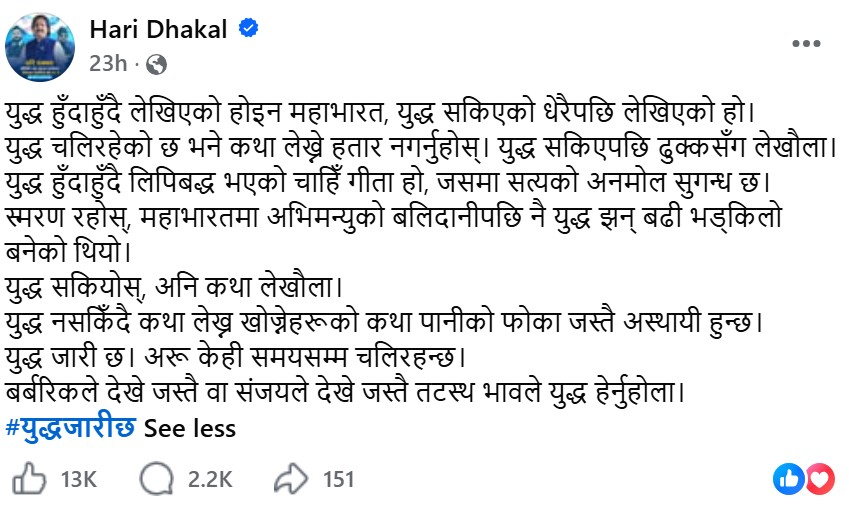
For instance, RSP MP Hari Dhakal took a satirical jab at the Commission after the report was made public, suggesting that a “war is still ongoing” in the country. “The Mahabharata was not written while the war was active; it was written long after the war ended. If the war is still ongoing, do not rush to write the story. Let’s write it comfortably once the war is over. Let the war end, then we shall write the story. The war continues. It will go on for some more time,” Dhakal wrote on Facebook.
The report recommends that the government conduct a microscopic investigation into 49 individuals, including activists, mobilizers, and participants of the Gen Z protests, and prosecute them if found guilty. Among those recommended for investigation are 15 MPs from the RSP, including Dhakal.
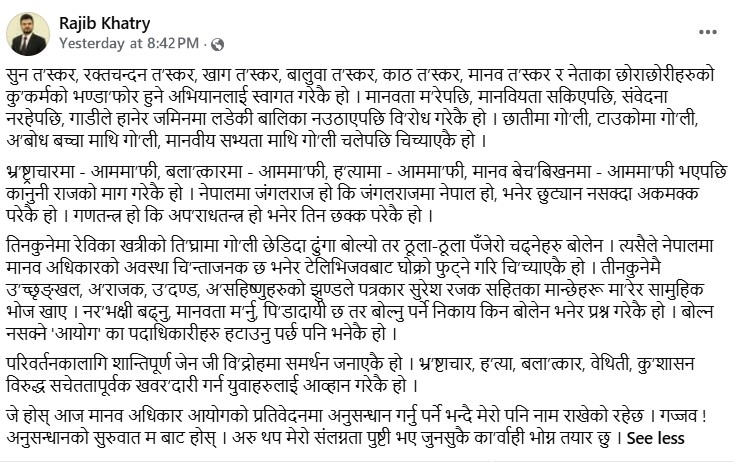
RSP MP Rajib Khatry also acknowledged that he had called upon the youth to join the movement, challenging authorities to initiate an investigation against him. “I certainly welcomed the campaign that aimed to expose gold smugglers, red sandalwood smugglers, rhino horn smugglers, sand smugglers, timber smugglers, human traffickers, and the misdeeds of political leaders’ children,” he wrote on Facebook. “I was indeed bewildered when unable to distinguish whether there was a jungle raj (bandit rule) in Nepal, or Nepal was in a jungle raj. I was completely stunned wondering whether this is a republic or a system of crime (apradhatantra).”
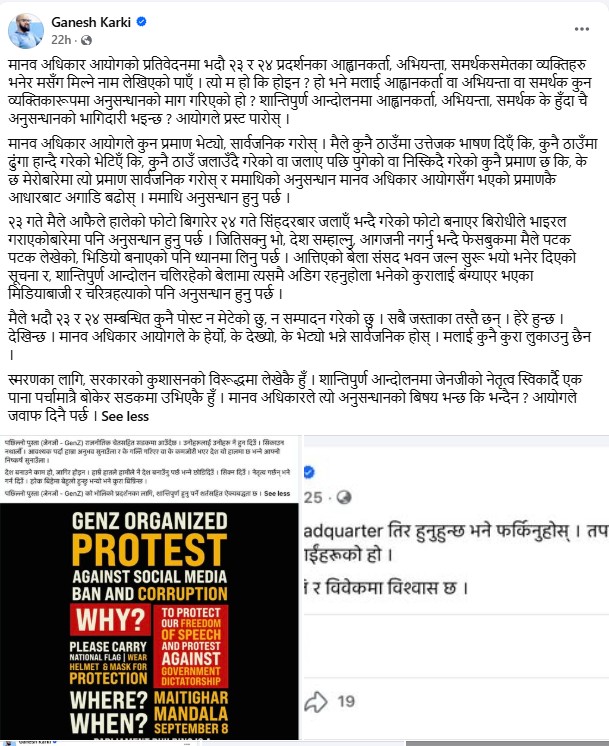
Similarly, RSP MP Ganesh Karki expressed anger over the Commission’s report for making him a subject of the investigation. “I have neither deleted nor edited any of my posts related to September 8 and 9, 2025. Everything remains exactly as it was. Anyone can look and see. Let the Human Rights Commission make it public what it looked at, what it saw, and what it found. I have nothing to hide,” he wrote.
The Commission’s report has also recommended that the government investigate Sushila Karki, the head of the government formed after the Gen Z protests, then-Home Minister Om Prakash Aryal, and Gauri Bahadur Karki, the chairman of the commission formed to investigate the Gen Z protests itself. Citing their roles in making the demonstrations violent, the Commission has placed Purushottam Yadav, Sabal Gautam, Ankit Malla, Khemraj Saud, and Sudhan Gurung, the president of Hami Nepal, on the list of individuals requiring further investigation. The Commission has also recommended investigating those who made statements that provoked and angered the demonstrators.
It is the government’s responsibility to take the recommendation report of a constitutional commission seriously and move toward implementation. However, the statements made by leaders and MPs of the ruling party immediately after the release of the Human Rights Commission’s report have cast doubt on its execution.
Doubts and hopes surrounding implementation
Two separate reports regarding the Gen Z protests have been released formally and informally. The commission chaired by former judge Gauri Bahadur Karki had submitted its report to the Sushila Karki-led government on March 8. However, the government has not yet officially made that report public.
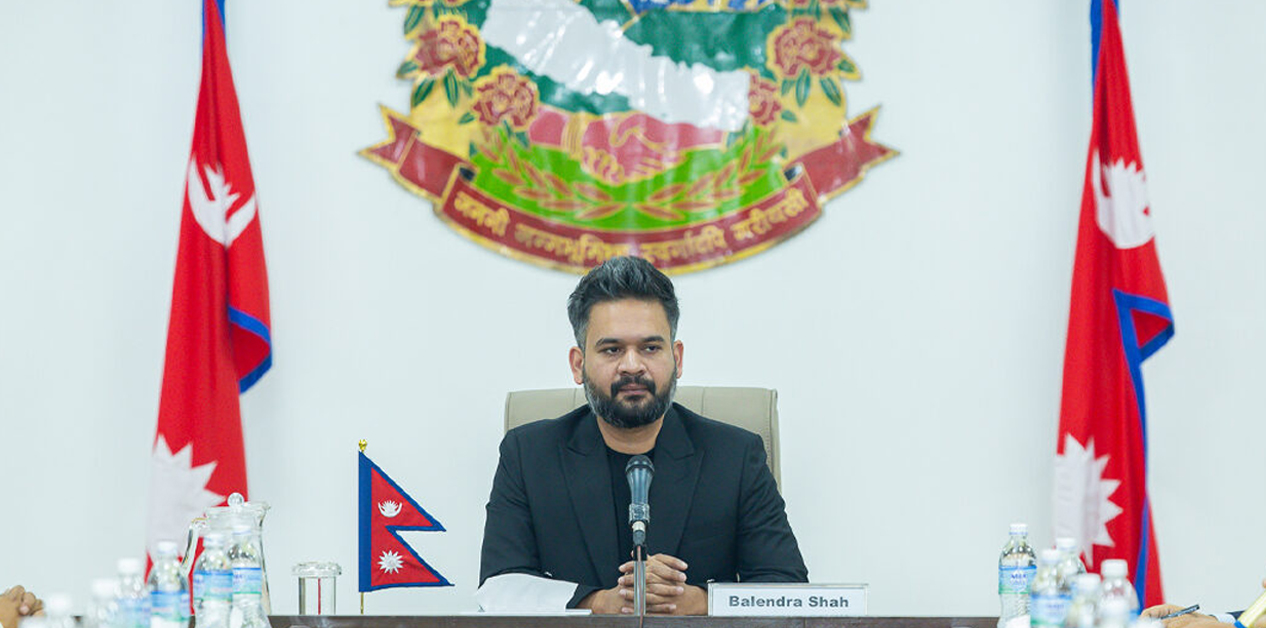
The government led by Balendra Shah has already decided to implement the investigation report submitted by the Karki-led commission. Accordingly, on March 28, the day after the government was formed, former Prime Minister Oli and former Home Minister Lekhak were arrested. After extending their remand for investigation and keeping them in custody, the Supreme Court ordered their release 12 days later.
On the other hand, past governments seem to have ignored the recommendations made by the Human Rights Commission. In a speech delivered at the 26th anniversary event, Commission Chairman Tapa Bahadur Magar noted that only 13 percent of the Commission’s reports have been fully implemented. Because the report recommends investigating 15 MPs of the ruling party, doubts have arisen over whether the Balendra Shah-led government, which includes the RSP, will implement it.
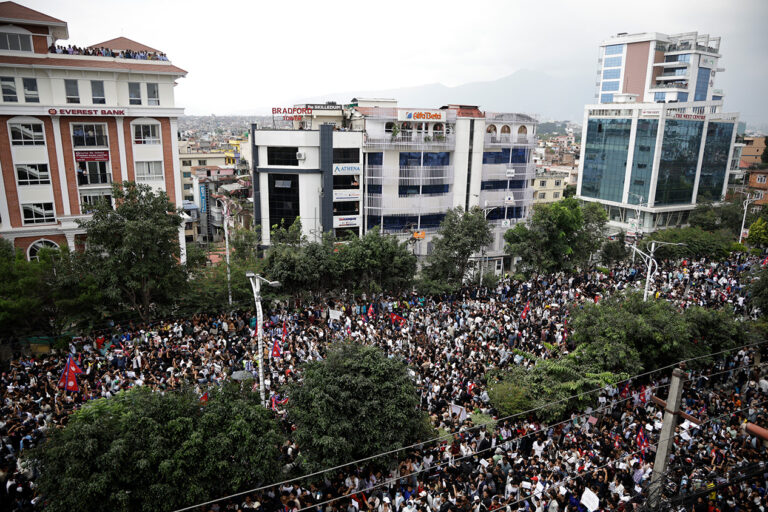
The Gen Z protest on September 8, 2025. Photo: Bikram Rai
The Human Rights Commission has recommended investigating Gauri Bahadur Karki, the chairman of the government-appointed inquiry commission itself. This has raised questions about the relevance and legitimacy of the report submitted by the commission under Karki’s chairmanship.
Despite this, representatives of the Human Rights Commission remain optimistic that the current government will implement the report. Manoj Duwadi, a member of the Commission, states that although previous coalition governments showed no interest in implementing recommendations, they hold hope for the new government.
“The Human Rights Commission is not a punishing institution. Presenting the facts we have understood and observed, we have recommended that the government investigate whether the individuals concerned are guilty,” Duwadi says. “During this process, it was also found that responsible individuals drawing salaries from the government provided false information, and an attempt has been made to alert them as well.”
Human rights activist Charan Prasai argues that the Human Rights Commission’s report presents a major opportunity for the government. Reminding that the Gen Z revolted precisely because of the quagmire of impunity in the country, he argues that the government now has an opportunity to end impunity and ensure human rights by implementing the recommendation report.
International significance of the report
Even if governments show reluctance to implement them, the reports of a country’s national human rights commission are considered official international documents. Since the commission is a constitutional body, its recommendations carry constitutional weight.
Noting that international organizations, including the United Nations, take note of recommendations made by constitutional bodies, activist Prasai says, “Whosever names are mentioned in the report, those individuals become listed internationally. Therefore, it provides extra strength to the government to conduct detailed investigations and take action according to the recommendations.”
He emphasizes that the government must show readiness to implement the Commission’s report. “If its recommendations are not implemented, the Human Rights Commission can also place those who fail to implement them on the list of the accused,” Prasai adds.
Commission member Duwadi also believes that Nepal has an opportunity to set a precedent in human rights jurisprudence that could serve as an example for other nations. He says, “This report reaches the Office of the United Nations High Commissioner for Human Rights (OHCHR) in Geneva. Reporting on this takes place at the Global Alliance of National Human Rights Institutions, the umbrella organization of national human rights commissions, where Nepal is listed in the ‘A’ grade. Therefore, if the government can implement the report, its international credibility will also rise.”
Article 132 of the Constitution outlines the functions, duties, and powers of the Human Rights Commission. It states, “It shall be the duty of the National Human Rights Commission to ensure the respect, protection, and promotion of human rights and their effective implementation.” Clause (c) of the same article grants the Commission the power “to recommend the filing of a case in court in accordance with the law, if it is necessary to file a case against a person who has violated human rights.” Similarly, clause (j) mentions the power “to publicly release the names of officials, persons, or bodies failing to follow or implement the recommendations or directions made by the National Human Rights Commission regarding human rights violations, and to record them as human rights violators in accordance with the law.”
The National Human Rights Commission Act, 2011 provides that the Commission shall send its recommendations in writing to the concerned official, person, or body. The official, person, or body must implement the recommendation and inform the Commission within three months. If there are difficulties in implementation, they must notify the Commission within two months of receiving the recommendation, stating the reasons.
Who is on the list of violators?
The Commission has named KP Sharma Oli, who was Prime Minister at the time of the Gen Z protests, then-Home Minister Ramesh Lekhak, and then-Information and Communication Minister Prithvi Subba Gurung as human rights violators. The Commission has recommended making arrangements so that cases against such individuals, for whom action has been recommended, are heard by the Special Court.
Since there is a lack of prevailing laws to punish human rights violations, the Commission has also recommended enacting retrospective laws (laws affecting past events) to penalize them. The report suggests provisions to sentence them to a maximum of six months in prison, a fine of up to Rs 300,000, or both.
Furthermore, the Commission’s recommendation includes a provision to bar them from receiving political appointments or standing as candidates for elected office for at least five years. The recommendations also include barring them from administrative responsibilities for three years, imposing international travel bans, and introducing provisions for public apologies with court permission, providing compensation, or granting amnesty from punishment for human rights violators.
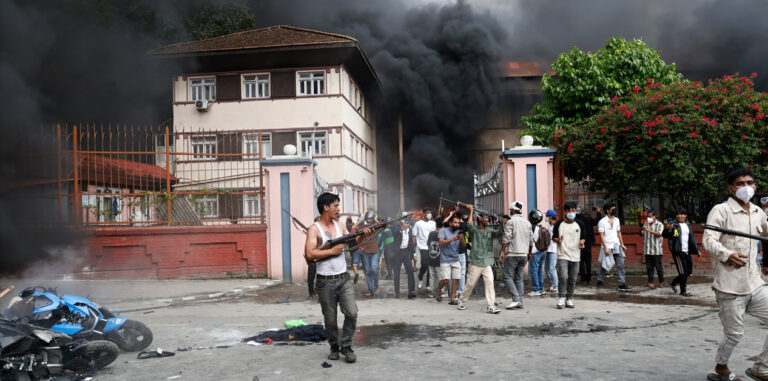
Arson at the Supreme Court on the second day of the Gen Z protest, September 9, 2025. Photo: Bikram Rai
For departmental action, the Commission has recommended the names of the Inspector General of Police Dan Bahadur Karki (then Additional Inspector General of Police), Deputy Inspector General of Police Om Rana, Deputy Inspector General Bishwo Adhikari (then Senior Superitendent of Police), the Inspector General of Armed Police Force Narayan Prasad Paudel (then Additional Inspector General), Superintendent of Armed Police Force Jiban KC, then Director of the National Investigation Department Krishna Khanal, and the then Chief District Officer of Kathmandu Chhabilal Rijal.
Departmental action has been recommended for everyone deployed on the field in the Baneshwor and Parliament House areas on September 8. It is suggested that individuals labeled as human rights violators be suspended for at least six months, regardless of the public office they hold.
For retired Inspector General of Police Chandra Kuber Khapung, Inspector General of the Armed Police Force Raju Aryal, and Chief of the National Investigation Department Huta Raj Thapa, who were found responsible for human rights violations, the Commission has recommended keeping a record ensuring they are not given any government service responsibilities in the future.
The Commission, however, has spared the Nepali Army. Although weaknesses of the Nepali Army were pointed out regarding the arson, human casualties, and physical damage at Singha Durbar, the Supreme Court, and the President’s Office, the recommendation mentions directing the Chief of Army Staff to prioritize the obligation to protect the human rights of ordinary citizens. It has merely called for cautioning the then army commanders of Singha Durbar and Sheetal Niwas. The recommendation also suggests “making legal and policy arrangements without delay regarding whether or not to deploy the army in internal riots and violent movements.”
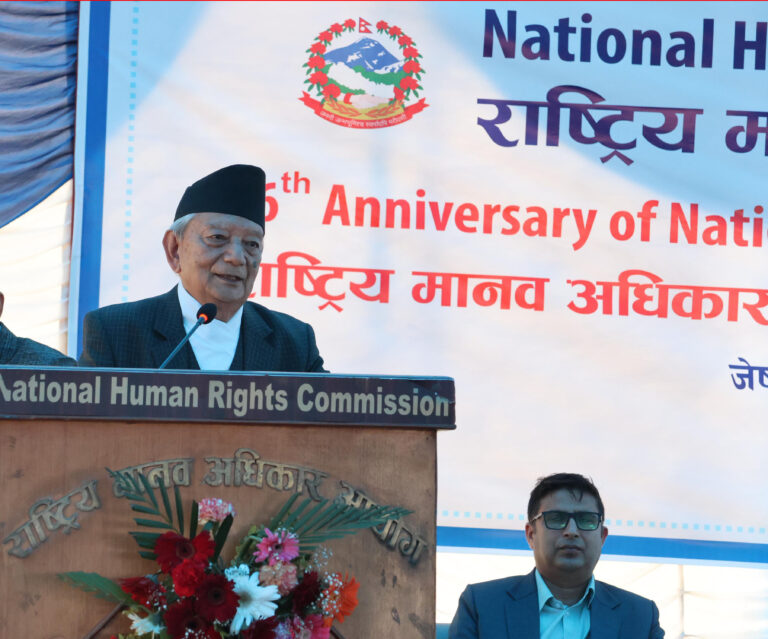
NHRC Chairman Tapa Bahadur Magar delivering a speech at the 26th anniversary of the National Human Rights Commission. Photo: Madhav Prasad Ghimire/RSS
To prevent such nature of incidents from recurring in the future, the Commission has recommended policy and institutional reforms to address the weaknesses found in coordination and information sharing among security agencies.
How did Rabi Lamichhane get out of jail?
The Human Rights Commission has taken the exit of RSP Chairman Rabi Lamichhane from Nakkhu Jail very seriously. The Commission has recommended identifying and taking action against everyone involved in his exit. The Commission’s report states that Nakkhu Jail’s jailer Satyaraj Joshi, as well as RSP MPs Manish Jha and Hari Dhakal who went to free Lamichhane, should be kept under the circle of suspicion, microscopically investigated, and penalized if found guilty.
Lamichhane had given a statement to the Commission claiming that he stepped outside for the security of the prison, as there was a possibility that angry protestors might cause damage while he was inside. Conversely, the prison administration stated in its deposition that they had to release him under pressure. The Commission’s report notes that the two statements contradict each other.
The Commission has shown the involvement of Lamichhane and prison administrator Joshi in violating human rights by assisting in sending inmates outside juvenile correction homes and prisons.
The report notes that precisely because Rabi Lamichhane stepped out of prison, inmates and detainees walked out of prisons and juvenile correction homes across the country, during which three police personnel and 250 individuals were severely injured. It mentions that 10 inmates and detainees lost their lives while attempting to escape from the Naubasta juvenile correction home in Banke, as well as from the Ramechhap, Sindhuli, and Dhading prisons.
Who else is on the investigation recommendation list?
Labeling them as activists, mobilizers, and supporters, the Commission has recommended investigating Ganesh Karki, Sulav Kharel, Bablu Gupta, Rakshya Bam, Krishna Karki, Dr. Toshima Karki, Rajiv Khatri, Som Sharma, KP Khanal, Deepak Bohara, Manish Jha, Jwala Sangroula, Hemraj Thapa, Bimal Panta, Khemraj Saud, and Purushottam Yadav.
Similarly, Sudhan Gurung (President of the Hami Nepal organization), Aman Pratap Adhikari, Bibek Thapalia, Sisan Baniya, Ashika Tamang, Asman Basnet, Bhagya Neupane, Tanka Dahal, Victor Paudel, Ankit Malla, Umesh Bohara, Shiba Yadav, Binod Deuba, Saru Sunuwar, Bhim Upadhyaya, and Rabi Kiran Hamal have also been placed on the list of those recommended for investigation.
The Commission has recommended investigating Hari Dhakal, Nischal Basnet, Sushila Karki, Om Prakash Aryal, Gauri Bahadur Karki, Pashupati Khadka, Durga Prasai, Urja Baral, Jerri Tamrakar, Hemsagar Bidrohi, Buddha Chhering, Santosh Rajawadi, Amit Khanal, Deepak Devkota, Gaurav Baral, Himani Rajya Laxmi Singh, and Nishan Mainali, among others, ensuring their right to a fair hearing, and taking action if they are found guilty.
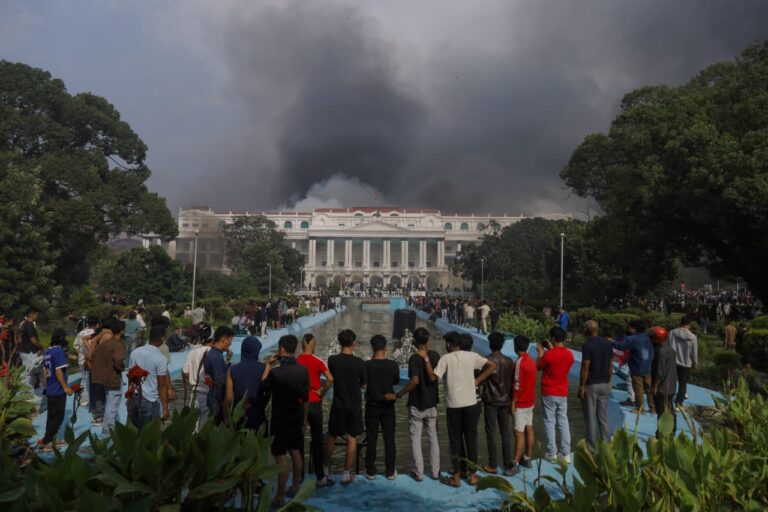
Singha Durbar set on fire during the Gen Z protest. Photo: Bikram Rai
The Commission has handed the responsibility to the government to investigate whether the expressions these individuals made on social media caused protestors to become angry and agitated, whether it had any effect or impact, and whether they were involved in the human casualties and physical damage that occurred during the events.
During the Gen Z demonstrations on September 8, 19 people lost their lives to police gunfire in the Baneshwor area.
With 23 more dying during treatment, the death toll reached 42. Two people lost their lives in Itahari and three in Jhapa, making a total of five, while 19 people died on September 9, among whom 12 have not yet been identified, according to the Commission’s report. Vandalism and arson took place in 36 prisons, and inmates escaped from 28 of them.
On the second day, vandalism, arson, and looting took place at the residences of the former Prime Minister and political leaders and workers, party offices, police posts, commercial buildings, as well as private properties.
A six-member committee formed under the coordinator of Commission member Lily Thapa prepared the 10,000-page report on the entire series of events. However, Commission member Duwadi states that the full text of the report will not be made public. He says, “Depositions have been taken from many individuals. Respecting the right to privacy, we will not be making the full report public.”