Kathmandu
Sunday, July 12, 2026





Even after systemic reforms, an unchanged civil service continues to challenge every new government
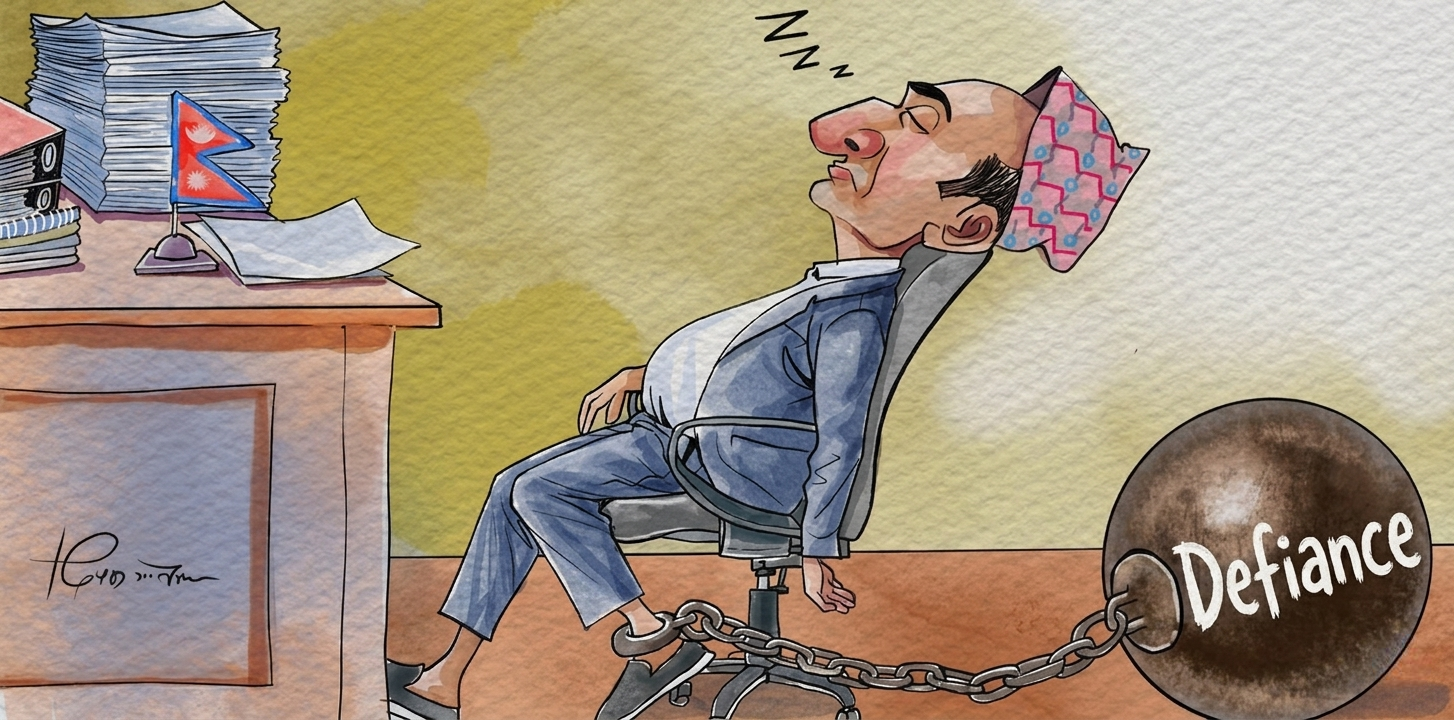
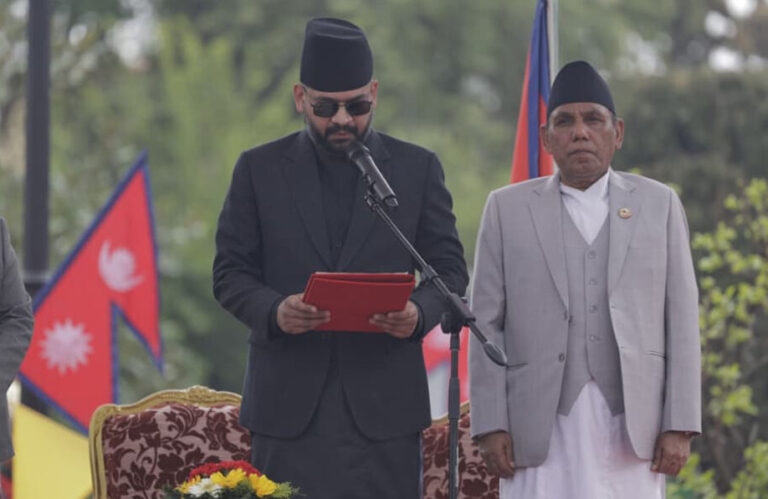
KATHMANDU: Prime Minister Balendra Shah (Balen), known for his awareness of bureaucratic arbitrariness, summoned secretaries to Singha Durbar immediately after his swearing-in and instructed them not to evade ministerial directives by citing procedural or legal technicalities or to “lecture ministers on rules and laws,” he said. He directed them to align their work with the government’s intent, pace, and policy direction. Despite this, civil servants have already begun reverting to entrenched practices, at times disregarding ministerial instructions.
On March 30, the Ministry of Federal Affairs and General Administration deployed 63 undersecretaries, or officials of equivalent rank, to local units lacking chief administrative officers. Several officials resisted their postings, while others lobbied the ministry to have their transfers revised.
The absence of chief administrative officers across many local bodies has disrupted development activities and, in some cases, halted the delivery of essential public services. Pratibha Rawal has warned that disciplinary action will be taken against officials who refuse to report to their assigned stations.
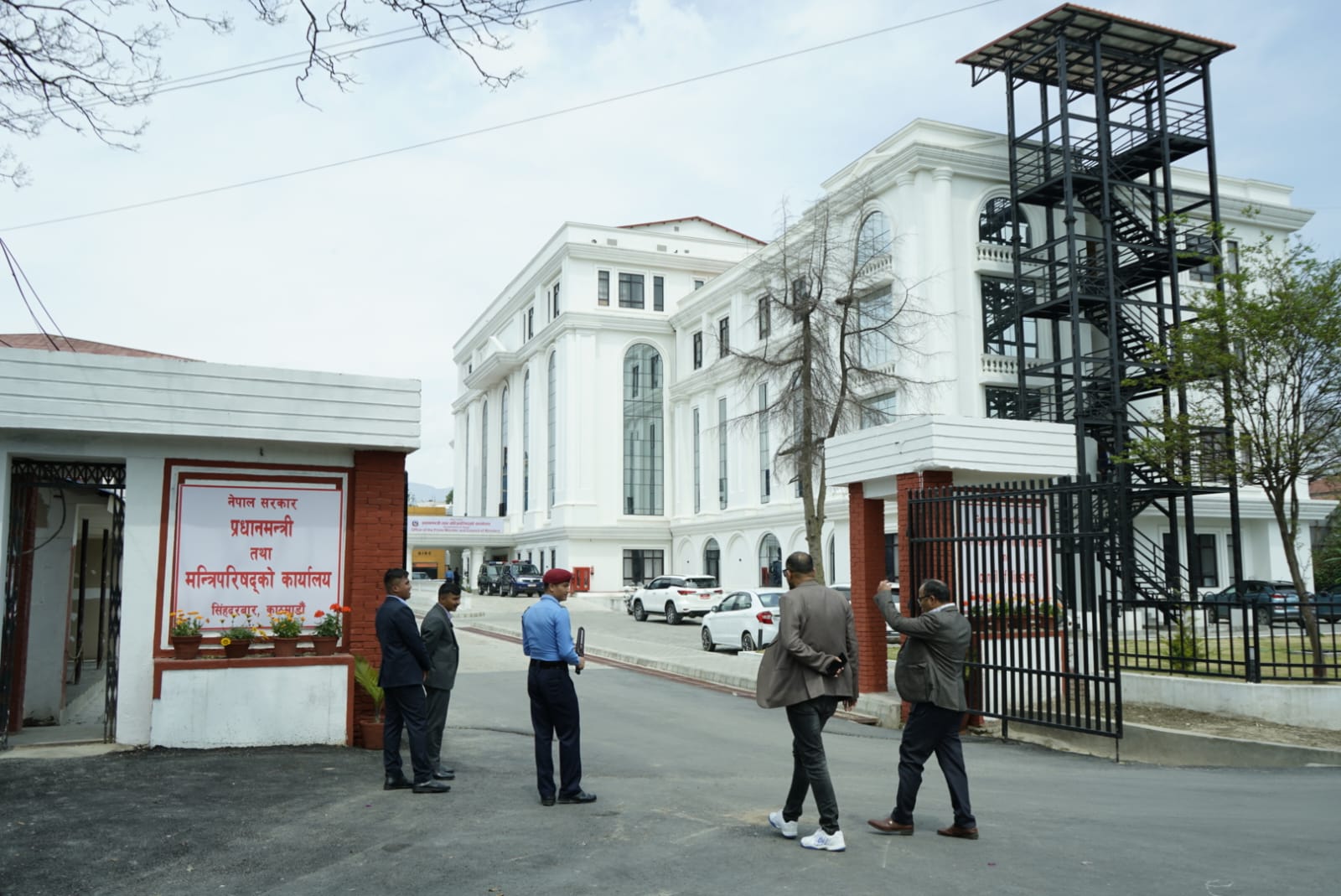
Office of the Prime Minister and Council of Ministers. Photo: Bikram Rai/Nepal News
A longstanding pattern persists within the bureaucracy: drawing salaries and benefits from the state while engaging in factional alignments, forming party-affiliated associations, and, at times, mobilizing against the very government they serve. Backed by political patronage, sections of the bureaucracy have grown sufficiently powerful to obstruct even ministerial and prime ministerial initiatives by invoking legal complications. As a result, citizens frequently endure undue delays and procedural burdens in accessing routine public services.
Bitter lessons learned by ministers of the interim election government
To grasp the depth of bureaucratic arbitrariness, one must consider the experiences of ministers and the prime minister of the interim government formed after the Gen Z protests. The frustration was not limited to ministers; even Sushila Karki, who led the interim government, publicly expressed her disillusionment. On March 15, she stated that politicization has come to dominate the bureaucracy, with officials often acting in pursuit of personal interests.
In an interview with the National News Agency (RSS), she said, “Secretaries keep spinning every task,” she said. “They present multiple options when it concerns their own interests, but when it is about the country, they simply say it cannot be done,” she added.
Karki’s assessment carries weight, given her leadership of both the judiciary and the executive, and underscores the systemic dysfunction within the administrative apparatus. The Gen Z protests held on September 8 and 9, 2025, were driven by demands for good governance, leading to the fall of the government and the collapse of established political forces. Yet, the very interim administration formed on the promise of reform found itself ensnared in the same bureaucratic inertia and resistance it sought to dismantle.
While stepping down as Minister for Land Management, Cooperatives, and Poverty Alleviation on March 19, Kumar Ingnam delivered a pointed remark to civil servants. “I have lost and you have won,” he said. “Celebrate if you must, but one day this wrongdoing may become the most painful moment of your life,” he added.
Public dissatisfaction with services at land revenue offices has long been widespread. Appointed on December 1, 2025, Ingnam initiated surprise inspections early in his tenure. These inspections revealed deliberate delays intended to harass service seekers, as well as instances where outcomes were manipulated through financial inducements, making legitimate processes obstructive and illegitimate ones possible.
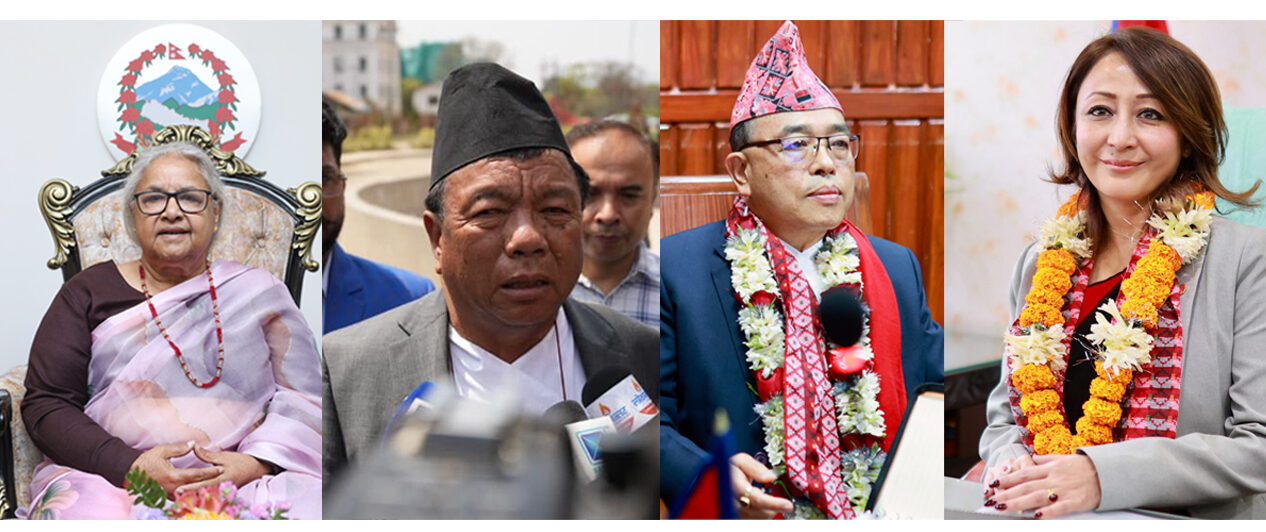
Former Prime Minister Sushila Karki and former ministers Mahabir Pun, Kumar Ingnam, and Shraddha Shrestha, respectively. Photo courtesy: Nepal Photo Library
Reflecting on his tenure, Ingnam cited persistent non-cooperation from officials in his attempts to enforce good governance. In an interview with Nepal News, he said, “There is a strong network among employees from top to bottom,” he said. “Regardless of political affiliation, they are united when it comes to personal gain, and when that is challenged, they retaliate with allegations of financial misconduct,” he added.
Similarly, Mahabir Pun, who resigned as Minister for Education, Science, and Technology on January 20 before contesting as an independent candidate, voiced concerns over bureaucratic resistance. He stated that officials failed to cooperate when he attempted to simplify legal frameworks. Even after being elected to the House of Representatives from Myagdi, he has continued to critique the system. “In the current situation, employees do not listen to visionary leaders or experts,” he said. “As a result, laws fail to become practical and forward-looking,” he added.
“Even after introducing an online system to streamline file comments, it could not function effectively because there were no staff available to operate it,” she added,” said Former Minister Shraddha Shrestha.
Another interim minister, Anil Kumar Sinha, also reported obstruction from within the bureaucracy. A former Supreme Court justice entrusted with five ministries, including Culture, Tourism, and Civil Aviation, Sinha said officials hindered his efforts to appoint a director general at the Civil Aviation Authority of Nepal, according to an interview with Kantipur Daily.
Dissatisfaction was echoed by Shraddha Shrestha, Minister for Women, Children, and Senior Citizens. Appointed on December 12, 2025, she recounted that ministries appeared to be populated more by party affiliates than by neutral civil servants. She said officials often dismissed short-term ministers, delayed processes, and failed to take directives seriously. Speaking on Kantipur Television’s ‘Fireside’ program, she said, “Even after introducing an online system to streamline file comments, it could not function effectively because there were no staff available to operate it,” she added.
Mahabir Pun attributes the deterioration of the bureaucracy primarily to political leadership. He argues that leaders have historically exerted undue pressure on officials to serve partisan or personal interests, fostering long-term institutional decay. “If leaders had enforced discipline from the beginning, this situation would not have arisen,” he said. “It is the leaders themselves who have weakened the system,” he added.
Tracing the political infiltration of the civil service
The new government’s 100-point administrative reform agenda explicitly commits to curbing political influence within the civil service. Its 12th provision calls for abolishing party-affiliated trade unions in public administration, ending undue interference and informal pressure, and strengthening both decision-making processes and service delivery.
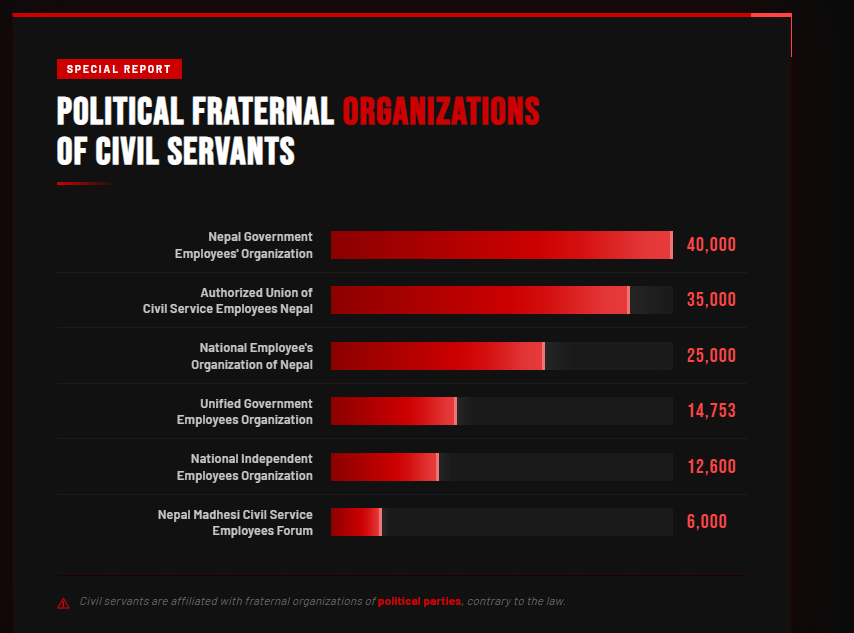
The roots of politicization date back to the restoration of multiparty democracy in 1990. On April 20 that year, a day after the first post-restoration government was formed, civil servants established the Nepal Government Employees’ Organization. According to its founding chairperson, Gauri Bahadur Karki, the body was not originally conceived as party-aligned. However, internal competition soon emerged, leading employees affiliated with the Nepali Congress to split and form the Authorized Union of Civil Service Employees Nepal after rivals linked to the Communist Party of Nepal (Unified Marxist–Leninist) gained influence.
The dispute escalated to the Supreme Court of Nepal, which ruled on March 14, 1995, that the union had not been formed through due process. Later that year, on November 5, the cabinet led by Sher Bahadur Deuba approved its registration. The case returned to court, but a full bench ruling on August 16, 2001, temporarily settled the matter in favor of the original organization.
Political entanglement deepened during the 2006 People’s Movement, when political parties actively mobilized civil servants. On April 12, 2006, seven parties jointly urged employees, teachers, and professionals to fully participate in the protests. In return, participants demanded formal recognition of trade union rights. Following the reinstatement of the House of Representatives, Parliament on May 11, 2006, directed the government to enact legal provisions ensuring such rights.
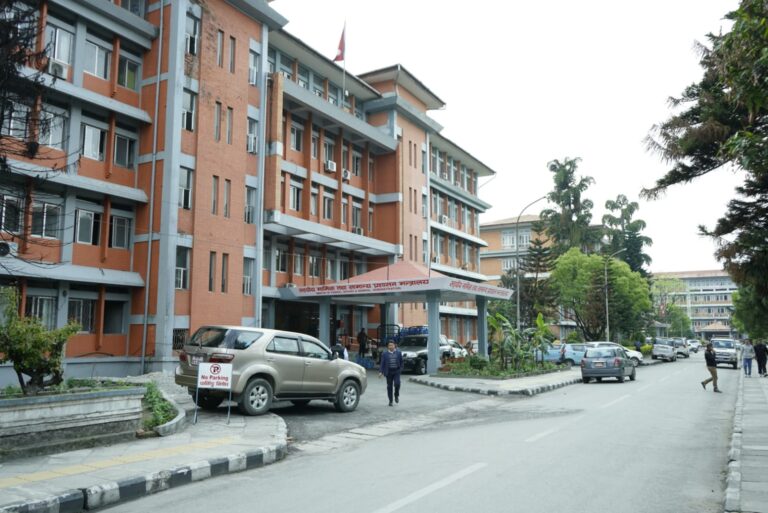
Ministry of Federal Affairs and General Administration. Photo: Bikram Rai
Subsequently, civil servants across ranks, from office assistants to section officers, organized along party lines and, at times, protested against the government itself. Successive administrations have repeatedly been compelled to negotiate with their own employees. Although lower-tier officials dominate party-linked organizations, their influence over transfers and promotions has been substantial, with union leaders lobbying political parties on appointments ranging from chief district officers to secretaries and even the chief secretary.
Article 34(3) of the Constitution guarantees workers the right to form trade unions, while the Civil Service Act and Rules permit unionization. However, these provisions do not explicitly authorize party-based unions. Civil servants nevertheless argue that their organizations are grounded in these legal frameworks, leading to the proliferation of unions aligned with nearly every major political party.
At the same time, Section 44 of the Civil Service Act, 1993, clearly prohibits civil servants from engaging in political activities. Similarly, Rule 12 of the Civil Service Employee Conduct Rules, 2009, bars them from expressing support for or opposition to political parties or their affiliates, or from attempting to influence others.
According to the Department of National Personnel Records (Civil), Nepal currently has around 86,000 civil servants. Including approximately 60,000 contract staff, the total rises to nearly 150,000. Of these, an estimated 135,000 are affiliated with one political party or another, according to organizational data.
Although the government has provisions for an official trade union with a four-year term, party-affiliated employees have shown little interest in strengthening it, opting instead to sustain parallel partisan structures. The last election for the official union was held on June 1, 2016, and despite the passage of nine years, no subsequent election has been conducted.
In that election, 49,095 out of 55,329 registered voters cast ballots. Organizations aligned with the CPN (UML) secured 21,127 votes, those linked to the Nepali Congress won 16,259, and groups associated with the CPN (Maoist Centre) received 5,029 votes. The Nepal Madhesi Civil Service Employees Forum garnered 3,561 votes, falling short of the required threshold.
Sharan Kumar Gurung, former chairperson of the National Employee’s Organization of Nepal, noted that the dominance of party-based unions has weakened the official structure. “The official trade union has weakened as party unions dominate,” he said. “As a result, employee adjustment has become chaotic,” he added.
In recent years, however, the influence of partisan unions appears to be declining among younger civil servants. Calls to abolish such structures have also gained traction in Parliament. During deliberations on the Federal Civil Service Bill, 2024, registered in the House of Representatives on April 3, 2024, most lawmakers advocated scrapping party-based unions. The bureaucracy, however, pushed back strongly.
During the discussion on the bill on December 26, 2024, Chief Whip of the Nepali Congress Shyam Kumar Ghimire, Chief Whip of the CPN (UML) Mahesh Bartaula, CPN (UML) Whip Sunita Baral, Rastriya Swatantra Party (RSP) Whip Nisha Dangi, Rashtriya Prajatantra Party (RPP) Whip Bina Lama, and others expressed the view that legal arrangements should be made to prevent having political party employee trade unions. The day after the MPs expressed such views, leaders of five civil service organizations issued a joint statement warning the MPs not to show arrogance. Finally, on May 16, 2025, the State Affairs and Good Governance Committee of the House of Representatives passed the Federal Civil Service Bill while retaining trade union rights.
The relationship between political parties and civil servants has evolved into one of mutual convenience, allowing both sides to advance their interests. This dynamic has contributed to a situation where sections of the bureaucracy operate with considerable autonomy, at times disregarding government authority.
In his autobiography ‘Singha Darbar Badalne Sangharsha,’ Lal Babu Pandit recounts how union leaders pressured him to carry out transfers based solely on their recommendations. “Civil service unions behaved as though they intended to split the ministry,” he said. “Security arrangements had to be put in place within the ministry,” he added.
Successive governments have struggled to discipline a bureaucracy capable of challenging authority and steering decisions in its favor. Analysts suggest that reform must be gradual but firm, emphasizing accountability. Swift action against corrupt officials, they argue, could yield visible improvements.
Echoing this view, former minister Kumar Ingnam has called for legislative amendments to dismantle party-affiliated unions altogether. “Employees are defiant and unwilling to work,” he said. “Capable officials must be retained, wrongdoing must be punished, and party organizations should be removed,” he added.
Public land occupied by party-backed employee unions
Employee organizations backed by political parties have historically advanced a wide range of demands, many of which successive governments have accommodated. Over time, several party-affiliated unions have secured prime public land and constructed office buildings in and around Singha Durbar, consolidating both their presence and influence.
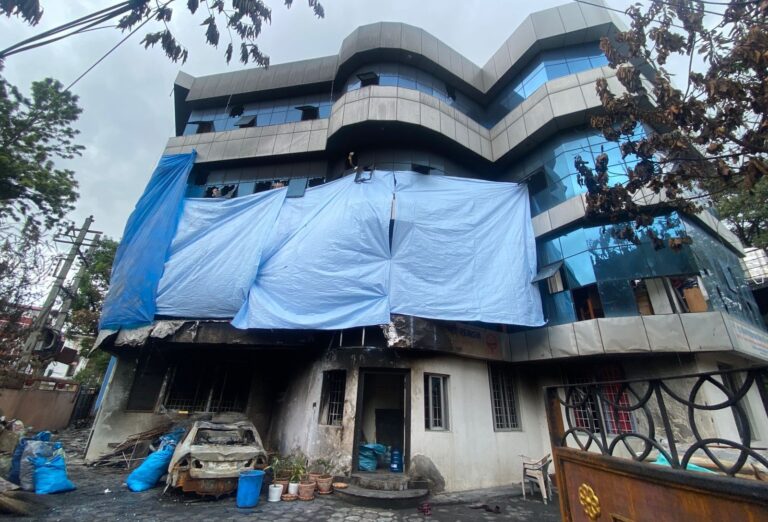
The office of the Nepal Government Employees’ Organization close to the CPN (UML) in Babarmahal, which was vandalized and set on fire during the Gen Z protest. Photo: Gopal Dahal
During the tenure of Jhalanath Khanal, a cabinet decision on June 15, 2011, authorized the allocation of government land for use by national-level trade unions. Under this provision, the Nepal Government Employees’ Organization, aligned with the CPN (UML), received approximately 3,645 square feet of land directly in front of the Singha Durbar south gate, where it has since constructed and operates a substantial office building.
Similarly, about 5,476 square feet of land each was allocated in Babarmahal to the Authorized Union of Civil Service Employees Nepal, affiliated with the Nepali Congress, and to the Nepal Madhesi Civil Service Employees Forum.
Under the premiership of Baburam Bhattarai, around 2,395 square feet of land was granted to the National Employees Organization, linked to the CPN (Maoist Centre), also near the Singha Durbar south gate. Subsequently, the Unified Government Employees Organization, associated with the CPN (Unified Socialist), was provided with a building owned by the Department of Buildings.
In some cases, these properties have been commercially exploited. Certain employee organizations have leased out their buildings, while premises allocated to the Nepal Madhesi Civil Service Employees Forum currently house the office of the Loktantrik Samajwadi Party, led by Mahantha Thakur.
In addition to land and infrastructure support, the government has provided financial and administrative perks to such organizations. Party-affiliated employee unions have received Rs 500,000 for convention expenses and have been permitted to assign five civil servants to remain on the payroll of the Ministry of General Administration while working directly for the unions.