Kathmandu
Monday, June 15, 2026





How a single-family shell game and an engineered 96% valuation crash became the ultimate legal armor to block a $1 billion corporate empire from reverting to the Nepali state.
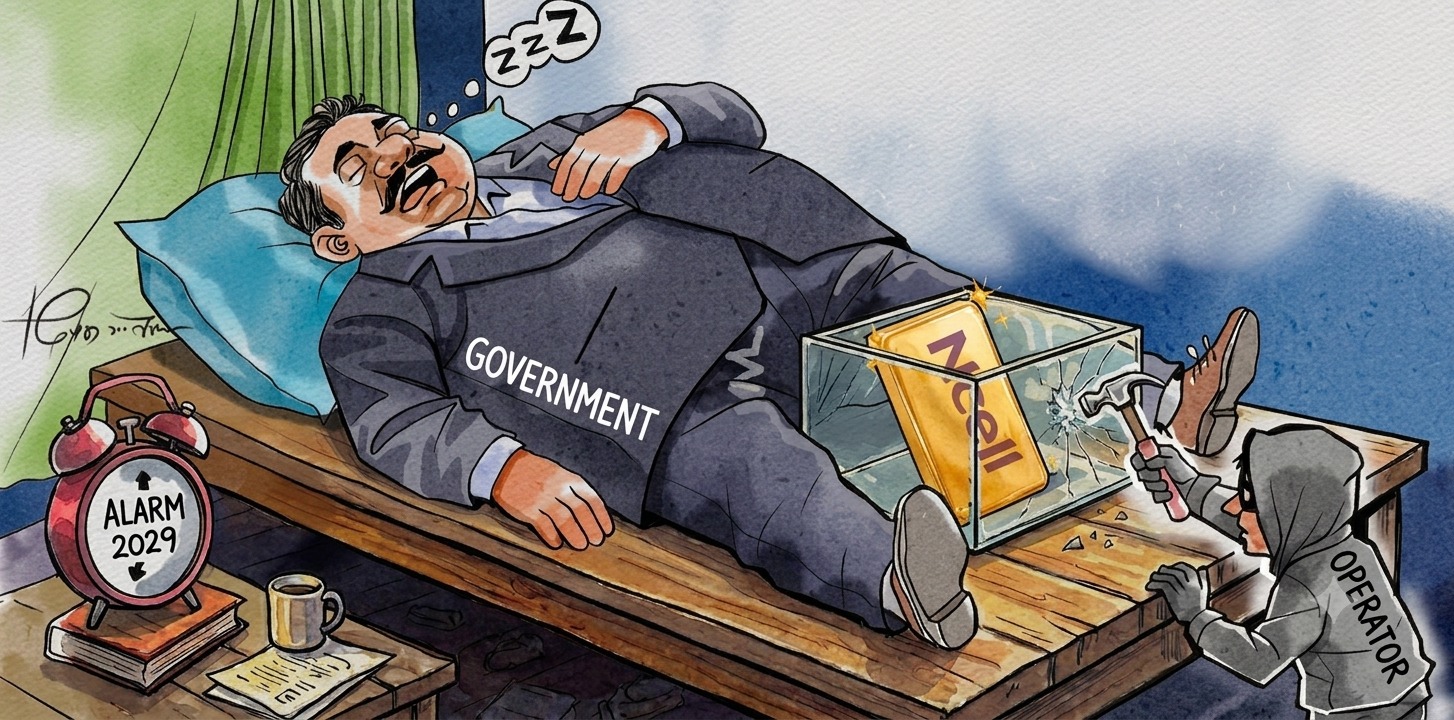
KATHMANDU: Legal provisions dictate that Ncell, a private-sector telecommunications service provider, will come under the ownership of the Government of Nepal in exactly three years and three months—specifically on August 31, 2029. However, the government itself is in a state of confusion regarding the nationalization of Ncell. While the company’s board members are actively pulling strings behind the scenes to block the transfer, the state has failed to make adequate preparations to assume ownership.
To prevent the company from transitioning into state hands, Ncell’s operators have long been heavily involved in political lobbying. They are attempting to tip the scales in their favor by setting up strategic arrangements with political party leaders, government ministers, and the bureaucracy. Meanwhile, the government has not even drafted a procedural guideline on how to operate Ncell once its ownership is transferred to the state. When asked about the ongoing preparations to bring Ncell’s ownership under the government, Min Prasad Aryal, Director of the Nepal Telecommunications Authority (NTA)—the regulatory body for telecom service providers—stated, “We are currently doing our homework on this matter.”
While the government and regulatory bodies remain indecisive, it is already public knowledge to what lengths Ncell’s operators will go to evade taxes. Capitalizing on the country’s fluid political situation, the operators have lobbied to influence political leaders and the bureaucracy, deploying various tactics to bypass legal hurdles. In a dramatic maneuver executed three years ago to evade taxes and prevent the company from transitioning to government ownership, they orchestrated a highly suspicious share buyout. This transaction concentrated Ncell’s entire shareholding into the hands of a single family.
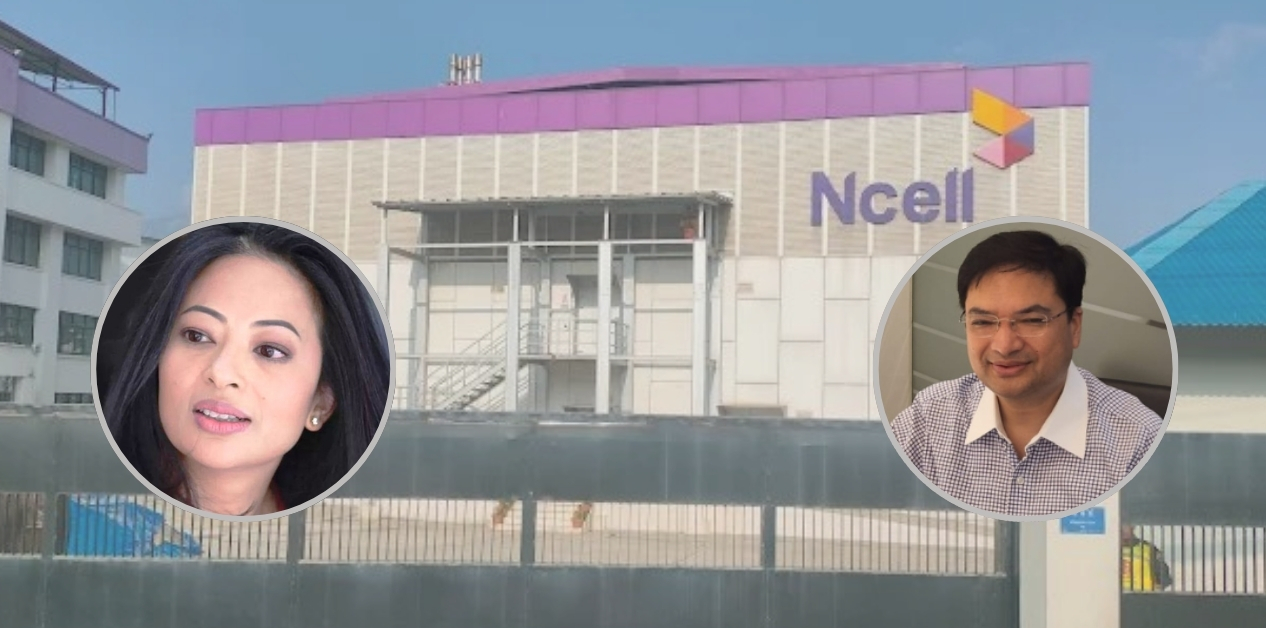
Satish Lal Acharya, Bhawana Singh Shrestha, and the Ncell office in the background.
Section 25 of the Telecommunications Act, 1997 stipulates that a license to operate telecommunications services can be granted for a maximum period of 25 years. The NTA issued a GSM cellular mobile license to Ncell on September 1, 2004. The term of Ncell’s license will expire on August 31, 2029, after which the company is legally bound to transition to government ownership.
Furthermore, Section 33 of the Telecommunications Act, 1997 specifies that any telecommunications service provider with more than 50 percent of its total capital invested by foreign individuals or corporate entities must transfer ownership of its land, buildings, machinery, equipment, and structures to the Government of Nepal upon the expiration of the license period. Currently, 80 percent of Ncell’s shares are held by Spectrlite UK, a company registered in the United Kingdom and owned by Satish Lal Acharya, a Singaporean citizen of Nepali origin. Under these conditions, it is certain that Ncell’s physical assets should legally revert to the state. A series of calculated maneuvers are underway precisely to prevent this outcome.
To manage the assets of telecommunications companies whose licenses expire and revert to state ownership, the government introduced the ‘Asset Management Regulation for Non-Licensed Telecommunications Service Providers, 2022’. Section 7 of this regulation mandates that an asset transfer plan must be prepared and submitted to the NTA two years prior to the expiration of the license. However, the law lacks clear mechanisms detailing exactly when and how the government should initiate its preparations. This regulatory vacuum is the primary reason why the government and the regulatory body appear trapped in confusion.
Advocate Semanta Dahal, an expert on the Ncell controversy, notes that because Ncell will be the very first telecom giant whose license expires under these conditions, the government lacks any prior experience or legal precedent to handle it.
A preceding case highlights these shortcomings. When the license of Smart Telecom—another service provider—was revoked on April 16, 2023, the management and transfer of its infrastructure and assets became heavily mired in controversy. Operating under a 10-year license granted in 2013, the company faced automatic revocation after failing to renew its license upon expiry. Following the revocation, its infrastructure, equipment, and other assets should have seamlessly reverted to state ownership. Instead, they were illegally auctioned off without NTA’s approval—an incident that remains under active police investigation. Consequently, because the state lacks successful experience in transferring telecom assets and ownership, it possesses no clear roadmap for Ncell. Advocate Dahal warns, “If Ncell is to come under government ownership, we have absolutely zero preparation. We need to draft procedures and make extensive logistical arrangements.”
Subhash Chandra Shiwakoti, Joint Secretary at the Administration and Planning Division of the Ministry of Communication and Information Technology, argues that the NTA must analyze the situation and formulate a concrete plan on how to proceed when the telecom provider’s ownership reverts to the state. “The laws and regulations do provide frameworks for managing assets that come under state ownership. If those are insufficient, the NTA must step up its preparation; our role at the Ministry is simply to facilitate,” Shiwakoti said.
A decade of calculated maneuvers
While disputes regarding Ncell’s share buyouts have surfaced before, the company became embroiled in a massive capital gains tax evasion scandal over the past decade. To fully understand these tax evasion maneuvers, one must look back ten years.
On April 11, 2016, the Swedish company TeliaSonera sold its 80 percent stake in Ncell—held through its offshore subsidiary Reynolds Holdings—to the Malaysian telecom giant Axiata Group Berhad for Rs 143 billion (USD 1.36 billion). This transaction triggered a massive corporate conspiracy to evade substantial tax liabilities owed to the government.
By routing the transaction through offshore shell companies in foreign jurisdictions, the corporations attempted to keep the deal outside the tax purview of the Nepali state. Since the trading entities were registered abroad, a protracted dispute ensued over who was liable to pay the tax. Ultimately, the government ruled that because the underlying assets being bought and sold belonged to Ncell located within Nepal, Axiata was liable to clear the tax dues.
On April 16, 2019, the Large Taxpayers Office (LTO) assessed Ncell’s total tax liability—including capital gains tax, fines, and interest—at Rs 62.63 billion. Since the company had already deposited over Rs 23.57 billion under various tax heads, the LTO issued a formal demand letter for the remaining Rs 39.06 billion. Ncell challenged this assessment in the Supreme Court. On August 26, 2019, a Grand Full Bench comprising Supreme Court Justices Tej Bahadur KC, Purushottam Bhandari, Dambar Bahadur Shahi, Sushmalata Mathema, and Manoj Kumar Sharma delivered a verdict ordering Ncell to pay Rs 21.10 billion in capital gains tax. This judicial intervention effectively slashed the LTO’s original tax assessment by Rs 17.95 billion
Following the LTO’s subsequent tax assessments, Axiata escalated the dispute to the International Centre for Settlement of Investment Disputes (ICSID) arbitration tribunal, claiming the tax levy violated a bilateral investment treaty between Nepal and the United Kingdom. However, the ICSID ruled in favor of the Government of Nepal, affirming its sovereign right to levy the tax. Ncell subsequently cleared that specific tax amount.
Later, on January 13, 2021, the LTO slapped Ncell with another tax assessment of Rs 57.90 billion under Section 57 of the Income Tax Act, 2001. Section 57 is triggered when a company undergoes a change of 50 percent or more in its share ownership. In Ncell’s case, 80 percent of its shares had changed hands. Claiming this amounted to double taxation, Axiata moved the court yet again. That case remains pending before the Supreme Court.
According to NTA statistics, Ncell alone commands over 14 million mobile subscribers. Generating Rs billions in annual turnover from Nepal, Axiata unexpectedly sold its entire 80 percent stake to Spectrlite UK on December 1, 2023, for a meager Rs 6.66 billion. Axiata announced its exit from Nepal, citing an unfavorable domestic business environment.
It is deeply astonishing that shares purchased eight years prior for Rs 143 billion were sold at a valuation crash of over 96 percent. Intriguingly, just two years before this fire sale, during the fiscal year 2020/21, Axiata had converted Ncell into a public limited company. To add the mandatory six shareholders required for a public entity, it sold 11 shares at a premium rate of Rs 124,100 per share. Yet, two years later, it sold the massive chunk of shares to Spectrlite UK at an engineered valuation of just Rs 8,332 per share. There is no record of the company suffering catastrophic financial losses or encountering business-ending shocks during those two years to justify such an unnatural collapse in share value.
An analysis of this highly implausible share transfer reveals an outright defiance of prevailing laws. While the law mandates that companies must obtain prior approval from the regulatory body (NTA) before buying or selling shares, this protocol was initially bypassed. It was only on March 13, 2024—after repeated warnings from the NTA and a flurry of public interest lawsuits filed in court—that Ncell Axiata finally submitted a formal application to the regulator seeking retrospective approval.
Furthermore, Spectrlite UK was incorporated in Britain with a nominal capital of just one dollar on September 26, 2023—a mere two months before it acquired Ncell’s shares. This offshore company was explicitly set up as a shell entity for the sole purpose of purchasing Ncell’s shares.
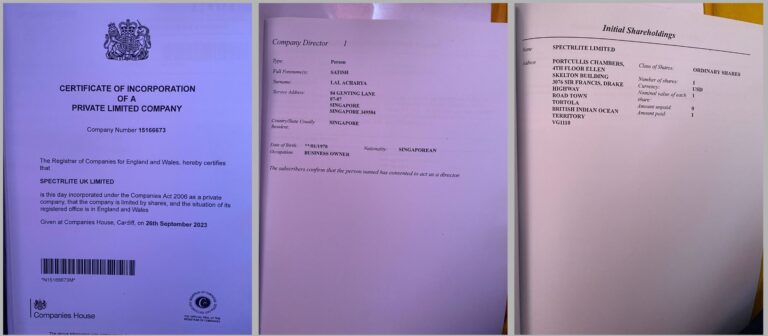
Documents of Spectrlite UK, the company registered by Satish Lal Acharya with a nominal capital of just one dollar.
The acquisition of an 80 percent stake in Ncell by Spectrlite UK—knowing the company was legally bound to revert to the Nepali state in six years—raised immediate red flags. Moreover, the hidden terms of the deal between the two parties are deeply suspect. The buyout agreement stipulates that the seller, Axiata, retains the right to siphoning off dividends until 2029 (when Ncell’s license expires), despite allegedly divesting its entire 80 percent ownership to Spectrlite. Furthermore, the agreement shields the buyer from existing debt liabilities and dictates that any future tax claims made by the state must be absorbed by the buyer—provisions that run completely contrary to prevailing tax laws.
It remains entirely unclear what financial arrangements or sources of funding Spectrlite has secured to cover the Rs 6.66 billion purchase price, the guaranteed dividend payouts to Axiata until nationalization, over NPR 85 billion in outstanding state tax liabilities, and more than Rs 30 billion in outstanding bank loans.
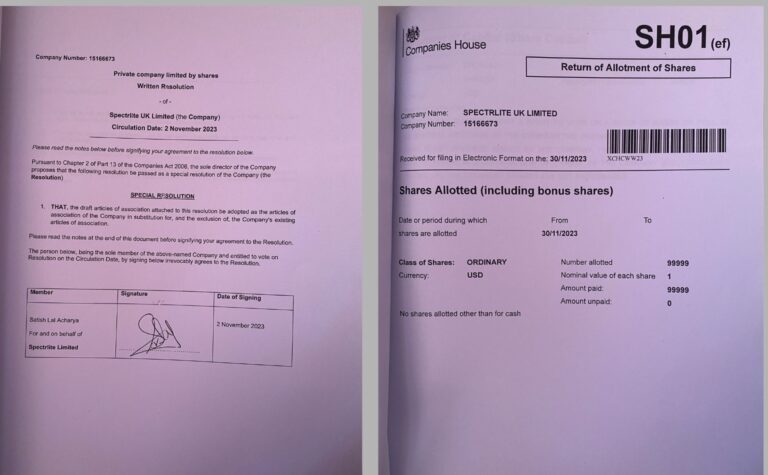
Document certifying the allotment of additional shares.
Compounding this mess is the unresolved lawsuit regarding the Rs 57.90 billion ownership tax levied by the LTO during Axiata’s original purchase from TeliaSonera. If the Supreme Court eventually rules in favor of the government, a massive legal battle will erupt over who is liable to pay—the buyer or the seller.
Meanwhile, the remaining 20 percent of Ncell’s shares have long been held by Sunivera Capital Ventures, a company owned by Satish Lal Acharya’s wife, Bhawana Singh Shrestha. Bhawana holds her shares under her status as a Nepali citizen, while her husband, Satish Lal, operates as a foreign investor. Consequently, the local and foreign shareholding split is split between a husband and wife from the exact same household. Following Satish Lal’s buyout of Axiata’s stake, Ncell has effectively fallen entirely into the pocket of a single family.
Preventing the state takeover
Evidence suggests that the fire sale of Ncell’s shares at rock-bottom prices is part of an elaborate scheme to ensure the company never falls under state ownership.
The government has long maintained a policy of pushing telecom companies into public ownership and forcing them to launch public share offerings. In the current budget, Finance Minister Dr. Swarnim Wagle announced plans to sell shares of Nepal Telecom to the general public.
Since his wife already owns 20 percent, Satish Lal’s long-term strategy appears to involve buying the remaining 80 percent, launching a public initial public offering (IPO), and diluting his foreign shareholding to below 50 percent—effectively bypassing the legal clause that triggers automatic government nationalization. Advocate Semanta Dahal, who represented the Government of Nepal when the capital gains tax dispute escalated to the ICSID arbitration committee, explains: “The government’s stated policy is to push companies toward IPOs. In Ncell’s latest transaction, the strategy seems driven by the calculus that launching public shares down the line can successfully block nationalization.”
Satish Lal’s legal maneuvering is further emboldened by specific loopholes in Nepal’s statutory frameworks.
Article 14 of the Constitution of Nepal provides for Non-Resident Nepali (NRN) citizenship, granting economic, social, and cultural rights in accordance with federal law.
Furthermore, Section 13 of the Non-Resident Nepali Act, 2007 grants foreign citizens of Nepali origin who invest in the country the right to operate industries and businesses on par with regular Nepali citizens.
Similarly, Section 32 of the Foreign Investment and Technology Transfer Act (FITTA), 2019 provides for national treatment. It stipulates that as long as a foreign investor’s capital remains in Nepal, the terms governing its management, maintenance, utilization, transfer, and sale must be no less favorable than those applied to investments made by domestic investors. Sub-section 3(a) explicitly states: ‘An industrial or business enterprise with foreign investment shall be accorded treatment equal to that accorded to a similar enterprise invested in by a Nepali citizen.’
Advocate Dahal believes Satish Lal bought the company under the assumption that these protective legal clauses could be leveraged to stop Ncell from transitioning to government ownership. Alternatively, Satish Lal could execute an internal flip, transferring the remaining shares directly to his wife Bhawana to shield them from state takeover. Dahal adds, “Whether Nepali law treats Satish Lal as a domestic citizen or a foreign national in this context remains a critical legal question.”
If preventing nationalization fails entirely, the backup strategy appears to involve severely undervaluing Ncell’s assets. This would allow the operators to pay a pittance to the government and buy the company back immediately. Section 33 of the Telecommunications Act allows the government to value the state-acquired assets, and stipulates that the previous license holder can reacquire the operating license by paying that determined valuation amount. The law leaves an open door for telecom services with up to 50 percent foreign investment to receive priority renewal. If the government values Ncell anywhere near the artificial Rs 6.66 billion price tag that Satish Lal paid for it, he could easily repurchase the company on the cheap after August 2029 and continue operations. However, the Asset Management Regulation for Non-Licensed Telecommunications Service Providers (2022) has laid down specific baselines for asset evaluation. The ultimate victor—whether Satish Lal or the state treasury—depends entirely on how the asset valuation is calculated when the time comes.
The heavily discounted share price also points toward an intricate plan to evade capital gains tax. Under the Income Tax Act, a 25 percent capital gains tax is levied on profits generated from the sale of corporate shares. However, because Axiata recorded its exit as a massive loss relative to its initial purchase price, it claims exemption from capital gains liabilities. Having been forced to pay heavy taxes when it initially bought those very shares from TeliaSonera, Axiata engineered this low-valuation transaction precisely to avoid a repeat tax blow. Furthermore, official state documents reveal that Satish Lal has repeatedly refused to submit the company’s financial statements to government oversight agencies.
The suspicious buyout of Ncell’s shares triggered fierce debates in Parliament in 2023. The Parliamentary State Affairs and Good Governance Committee concluded that the deal was a deliberate attempt to obstruct the state from assuming ownership, and formally directed the government to launch a high-level investigation.
In response, the government formed a five-member high-level probe committee on December 7, 2023, led by former Auditor General Tanka Mani Sharma Dangal. The panel included Secretary Phanindra Gautam, Joint Secretaries Ritesh Kumar Shakya and Baburam Bhandari, and the President of the Institute of Chartered Accountants of Nepal (ICAN), Sujan Kumar Kafle.
The committee’s final probe report explicitly concluded that the buyout of Ncell’s 80 percent shares was unlawful, unnatural, and designed to subvert government nationalization. The report further suspected that the buyer and seller may have colluded to launder illicit funds. “In this transaction, either the buyer has paid the full actual amount to the seller using illicitly acquired funds while recording an agreement that matches only their declared source of income,” the report notes, “or the illicit wealth of an undisclosed investor has been channeled indirectly. This is a severe matter. It demands an exhaustive investigation for the sake of the national economy.”
The probe commission also highlighted that the terms of the agreement between the buyer and seller were completely implausible and lacked credibility. It observed that the seller heavily dominated the contract, forcing highly unnatural terms onto the buyer. “This cannot be classified as an independent, normal commercial agreement reached under standard market conditions,” the report stated.
Furthermore, successive reports from the Office of the Auditor General have repeatedly flagged systemic manipulation surrounding Ncell’s tax obligations. Former Acting Auditor General Sukadev Bhattarai Khatri states: “There has been massive collusion in Ncell’s share transfers from the very beginning. This involves a nexus running from political party bosses straight down through the bureaucracy. Without institutional protection at the highest echelons of power, Ncell could never pull off defiance of this scale.”
Ignoring parliamentary directives
Following the fire sale of Ncell’s shares at rock-bottom prices, the House of Representatives’ State Affairs and Good Governance Committee initiated formal hearings in 2023. On December 19, 2023, the committee issued a directive ordering the government to immediately amend the Telecommunications Act and its accompanying regulations to guarantee that Ncell seamlessly transitions to state ownership the moment its license expires. “To ensure Ncell comes under the ownership of the Government of Nepal in 2029, the Government of Nepal, the Office of the Prime Minister and Council of Ministers, the Ministry of Communication and Information Technology, and the Ministry of Industry, Commerce, and Supplies are hereby directed to expedite necessary legislative and regulatory amendments,” the committee’s binding decision stated.
The parliamentary panel went so far as to summon then-Prime Minister Pushpa Kamal Dahal for questioning. Dahal gave explicit assurances that he would safeguard national revenue and enforce the committee’s directives to bring Ncell under state ownership. However, Ram Hari Khatiwada, the then-Chairman of the committee, laments the lack of follow-through: “We brought in then-PM Dahal, subsequent PM KP Oli, the Communications Minister, and the Chief Secretary for intense discussions. Every one of them promised to amend the law, yet implementation never happened.”
Khatiwada recalls that a pervasive atmosphere of fear historically stifled any public scrutiny or official decisions targeting Ncell’s corporate malpractices. He notes that back in 2013, while serving on the Public Accounts Committee, he led a decision to block Ncell’s 4G license rollout due to its failure to clear outstanding state revenues—a move that triggered intense personal and political blowback. “Back then, certain lawmakers and ministers openly confronted me, asking why I made that decision. They explicitly warned me that Ncell had set aside Rs 1 billion to fight the matter in court and another Rs 1 billion simply to destroy my political career. I placed that threat directly onto the official parliamentary committee record,” Khatiwada revealed.
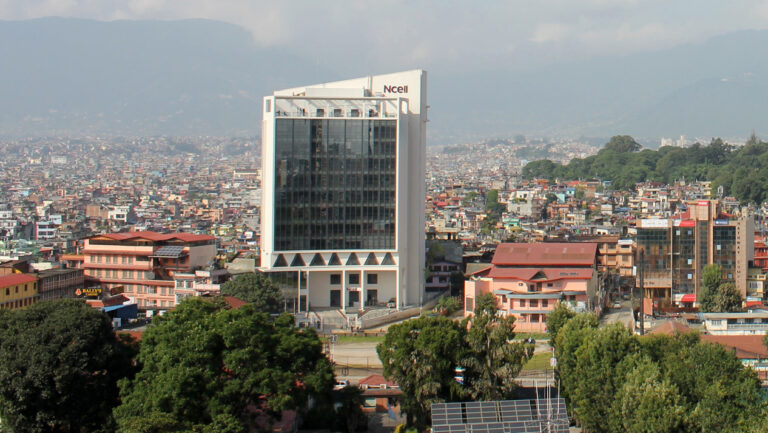
The Ncell headquarters in Lainchaur before it was set on fire during the Gen-Z protest. File photo
The Dangal-led probe committee also recommended immediate legislative overhauls to smooth Ncell’s nationalization, urging the government to expedite a new telecom bill that was stuck in the drafting phase. On March 20, 2023, the Ministry of Communication and Information Technology had secured cabinet approval to draft a comprehensive new Telecommunications Bill. The probe panel insisted this draft be fast-tracked into law.
Former committee chair Khatiwada emphasizes that a dedicated legal architecture is vital to manage Ncell once it is nationalized. “We do not know what model or policy the current government will adopt regarding foreign investors. It labels itself a revolutionary and nationalist government, so one expects they will do something,” he remarked.
From ‘Mero Mobile’ to ‘Ncell’
Spice Nepal Pvt. Ltd. was incorporated on June 18, 2001, with an authorized capital of Rs 500 million. Its original shareholding structure was split between two Indian firms—Modi Corp Ltd (55 percent) and Spice Cell (5 percent)—and Nepal’s domestic Khetan Group, which held the remaining 40 percent.
The NTA subsequently granted Spice Nepal a cellular mobile license effective from September 1, 2004. Spice Nepal originally launched commercial services under the brand name ‘Mero Mobile’. However, less than three months after securing the license, on November 19, 2004, the Khetan Group and Modi Corp liquidated their combined 95 percent stake, selling it entirely to Raj Group Company Pvt. Ltd.—a firm owned by Raj Bahadur Singh, the son-in-law of the former King Gyanendra Shah.
Barely two months after taking over, the Raj Group offloaded 57 percent of its 95 percent stake to Cyprus-registered Dalto Trade Limited. In July 2005, Dalto Trade sold 40 percent of its holdings to Reynolds Holdings, an offshore shell company registered in Saint Kitts and Nevis. That same year, the Raj Group sold 18.6 percent of its remaining 38 percent stake to Reynolds Holdings, boosting Reynolds’ total stake in Spice Nepal to 58.6 percent.
By 2006, Reynolds bought an additional 1.4 percent from the Indian firm Spice Cell, and on July 16, 2008, it bought out Dalto’s remaining 20 percent, consolidating its total ownership to 80 percent.
During this period, a local firm named Synergy Nepal Pvt. Ltd. entered the picture. Over the course of the fiscal year 2005/06, Synergy executed two separate transactions to buy a 19.4 percent stake from the Raj Group. In the following fiscal year 2006/07, the remaining 0.60 percent stake held by India’s Spice Cell was transferred to Synergy, bringing its total shareholding to exactly 20 percent. On October 27, 2010, the company formally rebranded from Spice Nepal to Ncell Pvt. Ltd.
On March 20, 2012, Upendra Mahato, the founding president of the Non-Resident Nepali Association (NRNA), bought Synergy Nepal’s 20 percent domestic stake in Ncell. However, just nine days later, on March 29, 2012, Mahato flipped those exact shares to Niraj Govinda Shrestha. Shrestha held the 20 percent domestic stake until March 30, 2016, when he sold it to Sunivera Capital Ventures Pvt. Ltd.—the firm owned by Satish Lal Acharya’s wife, Bhawana Singh Shrestha.
Shortly thereafter, on April 11, 2016, Malaysia’s Axiata Group Berhad completed its acquisition of Reynolds Holdings from TeliaSonera, automatically absorbing the accompanying 80 percent stake in Ncell.
On August 3, 2020, Ncell Axiata Pvt. Ltd. added seven new shareholders to its roster to meet the statutory requirements to transition into a public limited company. Since then, Ncell’s share structure has been formally maintained with Reynolds Holdings holding 79.99 percent, Sunivera holding 19.99 percent, and the remaining dummy shareholders holding a nominal 0.0011 percent.
It is this 80 percent stake held under Reynolds Holdings that became the center of the recent fire sale. On December 1, 2023, Spectrlite UK—incorporated in Britain—acquired Reynolds Holdings from Axiata. Thus, the controlling stake of Ncell (formerly Mero Mobile)—which began in the hands of a consortium of Nepali and Indian corporations—has been aggressively routed through Cyprus, Saint Kitts and Nevis, Malaysia, and ultimately to a British shell company.
Since 2001, Ncell’s shares and underlying ownership have changed hands 14 times. The vast majority of these transactions were executed entirely offshore as closed-door deals outside Nepal’s borders. Crucially, the granular details of these multi-million dollar transactions were never disclosed to Nepal’s regulatory authorities. The high-level government probe committee discovered that the actual financial clearing and settlements for these transactions bypassed Nepal’s banking system entirely, with payments made directly into foreign bank accounts.
Operating on an initial capital foundation of just Rs 20 million in domestic investment and Rs 80 million in foreign capital, Ncell has extracted a staggering Rs 113.58 billion in net profits from the Nepali market. Out of this, it declared Rs 93.50 billion in dividends. To date, Ncell has successfully repatriated Rs 66.95 billion out of the country as foreign dividends, along with an additional Rs 2 billion under various other financial heads. Meanwhile, local Nepali shareholders have received Rs 19.95 billion in dividend payouts.
According to its corporate filings, Ncell claims to have contributed over Rs 340 billion in various taxes to the state treasury since its inception. Additionally, the company claims to have spent over Rs 2 billion on corporate social responsibility (CSR) initiatives within Nepal.