Kathmandu
Wednesday, June 24, 2026





Despite government claims of an online transition, citizens still face the same old hassles of physical presence and paperwork.

KATHMANDU: On May 4, following a two-day weekend, service seekers at the Department of Passports in Tripureshwar were complaining about not getting their turns at the designated time. Since Sunday was a holiday, a massive crowd had already gathered to shove and push their way through as soon as office hours began on Monday, seeking to apply for new passports or renewals.
To apply for or renew a passport, one must first fill out personal details in an online form. Regarding the subsequent process, a notice issued by the Department states: “After submitting the form, you will receive a complete copy of the form including a barcode and QR code. Print said form and come to the registration center at the scheduled time. If printing facilities are unavailable, you may bring it saved on your mobile phone. When bringing it on a mobile, bring the original form, not a screenshot.”
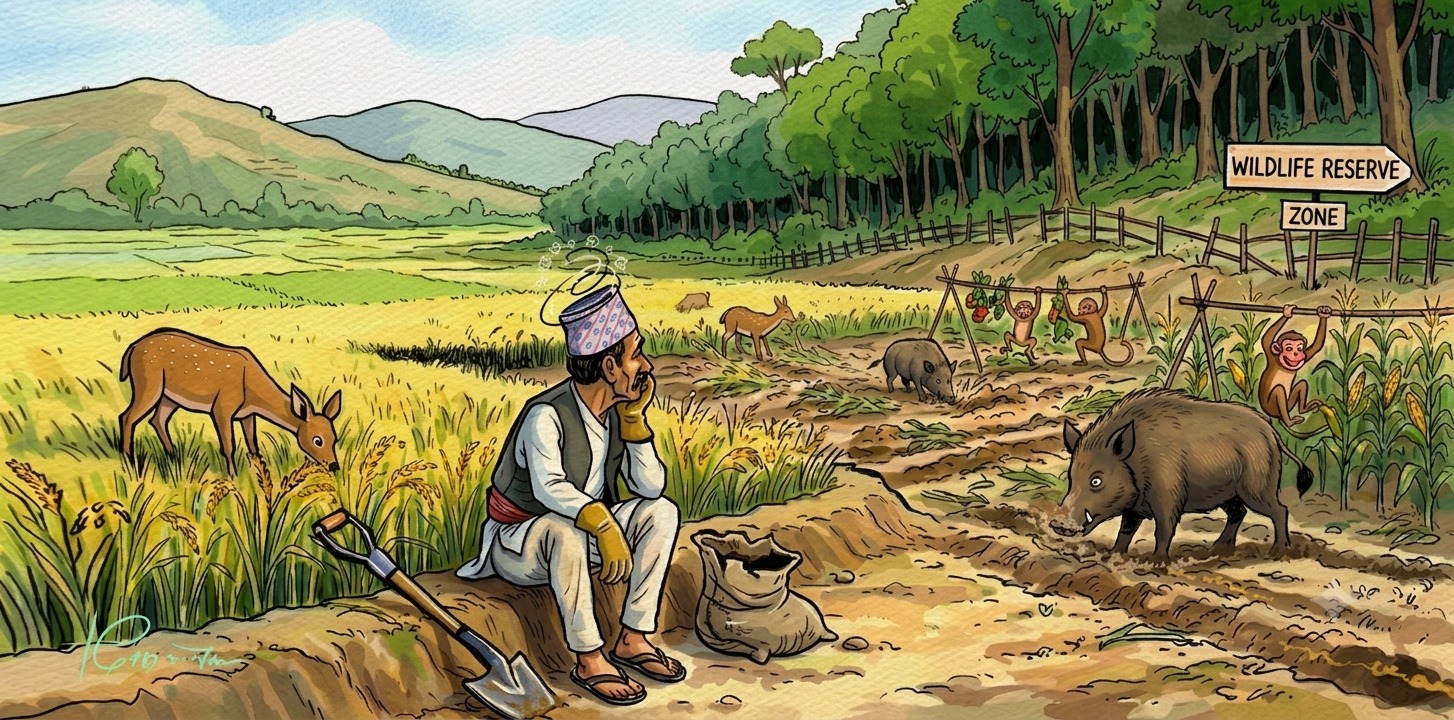
Despite the provision for filling out forms online, the rush of service seekers at the Department shows no sign of thinning due to the mandatory requirement of physical presence for the following procedures.
A similar mandatory condition appeared in a recruitment notice issued by the Nepali Army on May 1. In point number 14 of the application call for military and various ‘follower’ positions, while an online form system is provided, it states: “If a candidate only ‘submits’ the application form online and fails to submit the printed form at the recruitment selection center, the form submitted only online will not be recognized.”
The ordeal faced by Rupa Thapa, a resident of Ghattekulo, Kathmandu originally from Rupandehi, while applying for a driving license further clarifies the issues with government online services. According to the Department of Transportation Management’s online system, she created a profile and registered her mobile number, but the One-Time Password (OTP) never arrived. After continuous attempts, it took a week to receive the OTP. In the process, she discovered that despite being called an “online service,” it does not function on holidays.
These are representative examples where, despite the government providing online services for passports, national ID cards, and driving licenses, the hassle of physical documents and presence has not diminished.
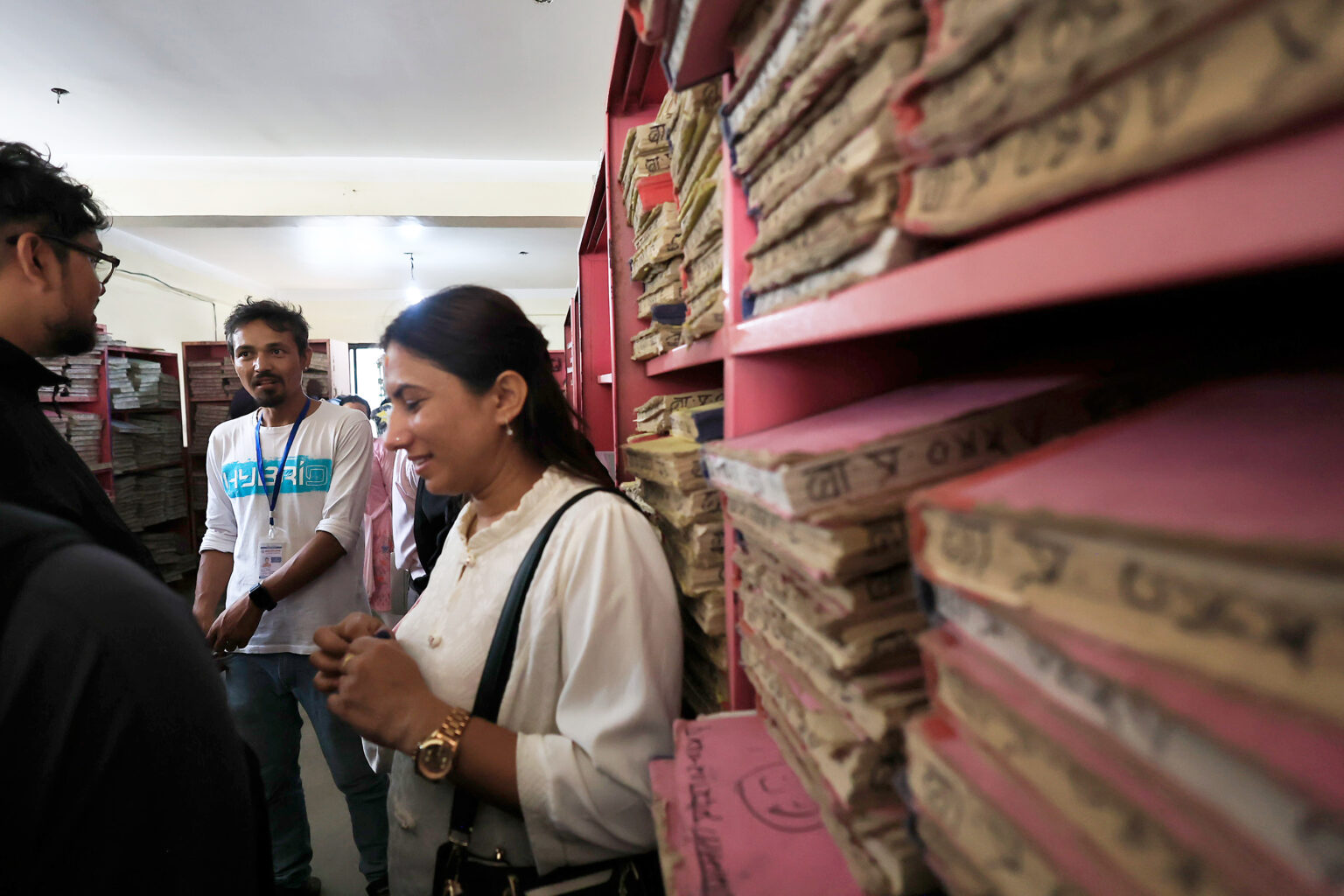
Service seekers waiting for their turn at the Transport Management Office,Motorcycle, Gurjudhara. Photo: Bikram Rai
The struggle of filling out online forms is equally significant. In areas without easy internet access, uploading details like citizenship certificates and photographs remains a problem.
While it is possible to pay revenue online for driving license renewals, the old practice of having to visit the transport office with a ‘printout’ to get a stamp on the ‘blue book’ (vehicle registration) persists. There are also lingering questions regarding the security of personal details and documents, such as citizenship copies, that are submitted physically.
Meanwhile, the government led by Balendra Shah has prioritized plans to transform services like passports, citizenship, and driving licenses into a digital system. This was included in point 26 of the hundred-point governance reform agenda approved by the first cabinet meeting held on March 27, 2026. It reads: “Implement arrangements to provide services like passports, citizenship, and driving licenses to citizens in a fast, easy, and middleman-free manner within predictable timeframes, and transform the entire service process into a faceless, time-bound, and digital system.”
Digital name, physical work
Digital Architect Bibek Rana points out that while current online services are labeled ‘digital,’ the work remains ‘physical.’ “A true digital service would be when a person submits an online request from home, pays the fee, and only visits the office for the final collection,” says Rana. “But there are numerous hurdles while filling out forms. One must show up in person carrying a printout of that very form. 90% of the work is done physically. Calling this digital is just a delusion.”
Concluding that Nepal’s digital services are in a preliminary stage, he emphasizes the need for strong infrastructure. He puts forward three pillars for this: First, Access for citizens—citizens from any remote corner of the country should easily access services. Second, Coverage—there should be no technical barriers to filling in details, uploading documents, and paying fees. And third, Digital Literacy—the importance must be explained to citizens through digital literacy to make them tech-friendly.
However, his understanding is that the state’s attention has not reached the aspect of how to provide fast service to citizens and where they are facing hassles and obstacles during the process.
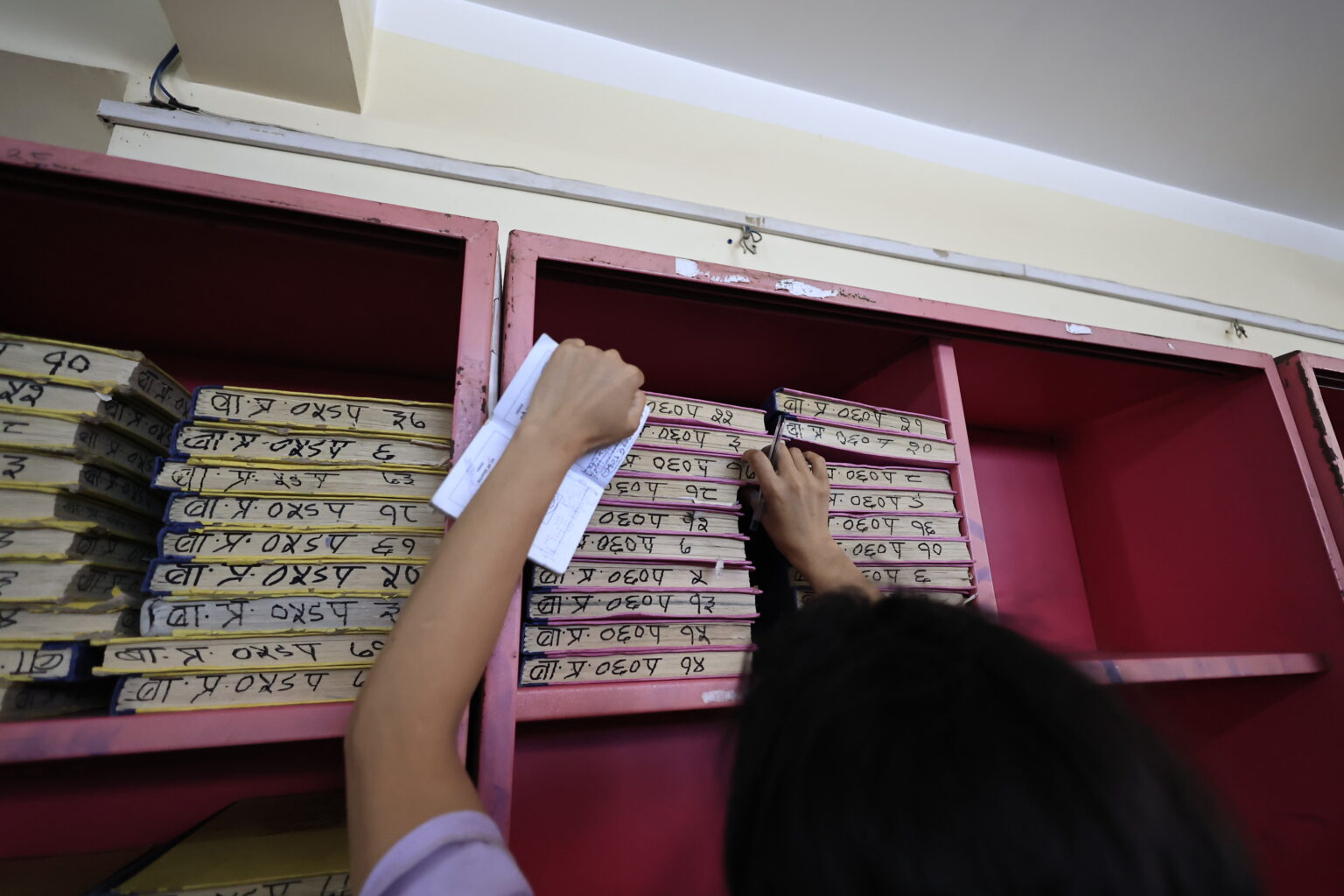
An employee searching for a file in a ledger at the Transport Management Office,Motorcycle, Gurjudhara. Photo: Bikram Rai
Advocate Santosh Sigdel, Executive Director of Digital Rights Nepal, considers the gradual move of land records and vital event registrations to online systems as positive. However, he emphasizes that the government must be cautious to ensure that service seekers lacking digital literacy are not deprived of their civil rights.
Recalling a case that reached the Supreme Court regarding the denial of elderly allowances due to the lack of a National ID card, he says, “The government has brought a plan for ‘faceless delivery,’ meaning receiving services without being physically present. While implementing this, it must be ensured that an 80-year-old senior citizen living in a remote area can also receive services easily.”
Previously, the government had made the National ID mandatory for social security allowances. On August 25, 2024, the Supreme Court issued an interim order to the government not to stop social security allowances for citizens who had not yet made National ID cards.
Prakash Dawadi, an officer at the Department of Information Technology, admits that government services are currently in a ‘semi-digitized’ state due to a lack of infrastructure and resources. However, he claims there have been significant achievements recently. He says, “The online system has reduced 60% of the hassle compared to before. Although physical presence is mandatory for biometrics and revenue payment for passports, a service seeker only needs to visit the office twice if they fill out the form from home.” He claims they are in the process of reducing physical presence to zero by taking biometrics and personal details from the National ID records.
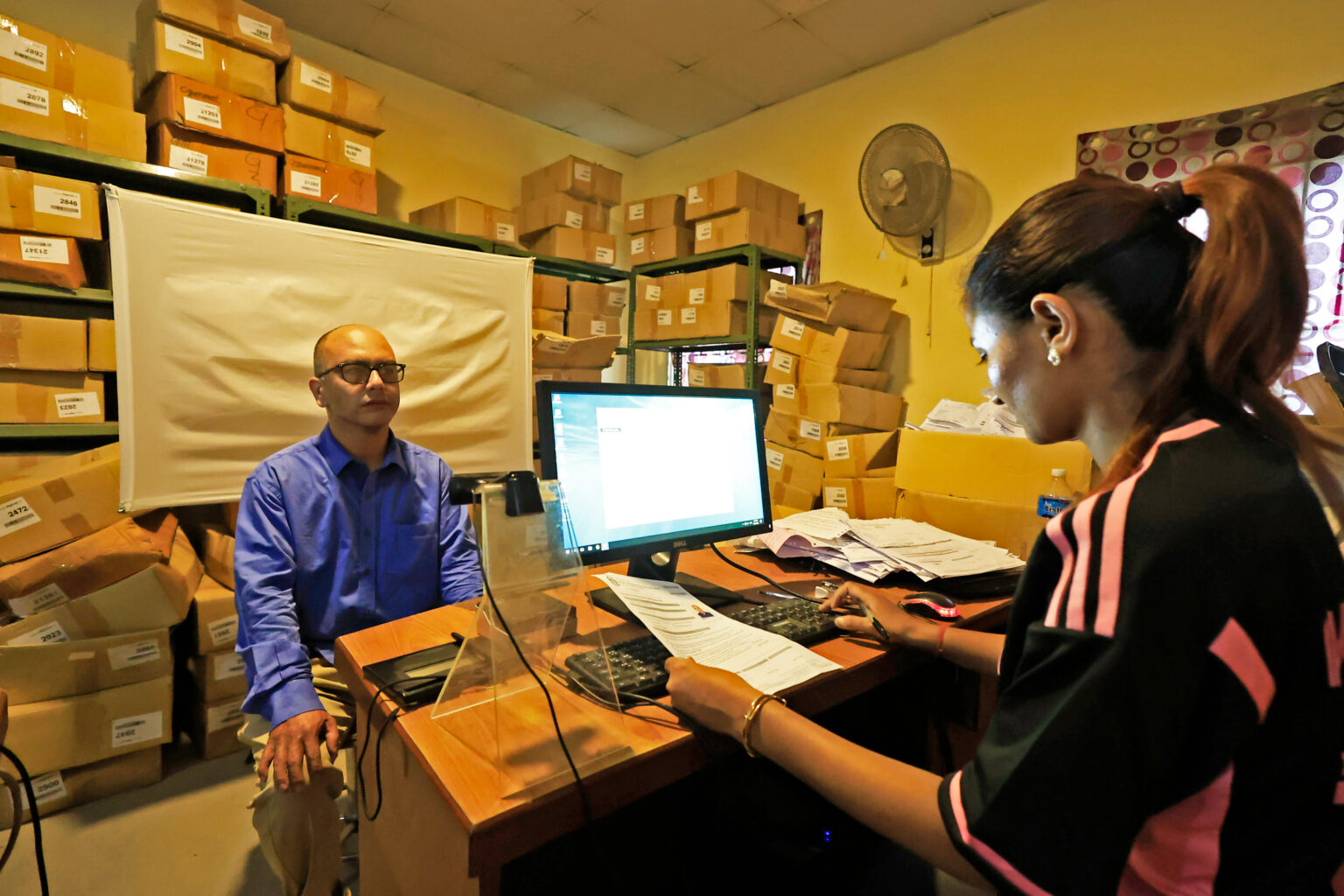
A service seeker getting their photo taken for embossed number plates at the Transport Management Office, Motorcycle, Gurjudhara. Photo: Bikram Rai
Following Prime Minister Shah’s instructions to implement the hundred-point agenda, Dawadi notes that arrangements have already been made to obtain Engineering Council certificates and Public Service Commission admit cards through the ‘Nagarik App.’ According to him, the goal mentioned in point 30 of the agenda—to ‘strengthen government apps or portals so they can be used by persons with disabilities and citizens with low technical knowledge’—has been met. He states that a Government Integrated Website Management System has been built accordingly, and new features have been added and running since April 16.
Digital literacy
Infrastructure alone is not enough for digital services; literacy is equally essential. Advocate Santosh Sigdel believes the government has failed to prioritize this. Arguing that digital literacy remains limited to paper, he says, “The government talks about digital literacy, but those programs haven’t reached the target citizens.”
The ‘Nepal Multi-Indicator Cluster Survey 2024/25’ released by the National Statistics Office on February 9, 2026, mentions that smartphone access has expanded to 85.1% of households and internet access to 82% in Nepal.
Digital Architect Rana also emphasizes the mandatory need for digital literacy, as access to devices alone is not sufficient for utilizing services. He says, “It is necessary to inform citizens about services and make them capable of taking services using technology.”
However, studies show that digital literacy in Nepal is very low. A research article titled ‘Current State of Digital Transformation, Opportunities, and Challenges Faced,’ published in the research journal of Rajarshi Janak University (Issue 1, May 2025), mentions a lack of clear policy and legal frameworks.
The article, prepared by Binod Shah, Kiran Kumari Sah, and Manisha Jha through interactions with 200 participants, concludes that along with lack of infrastructure and policy, traditional workstyles, fear of personal data theft, and the threat of cyberattacks hinder digital transformation. Their study concludes that while urban areas have access to technology, a digital divide persists in rural and remote areas due to limitations in internet and electricity.
The question of how capable citizens are of consuming services as access expands is also vital. Prakash Dawadi of the IT Department believes digital literacy should be targeted according to the needs of different classes and communities. “Someone might not know how to use a mobile, someone might not know about OTPs. Some might be at risk of digital fraud,” says Dawadi. “It is necessary to run different types of literacy campaigns to cover all these aspects.”
Past efforts
It is not just the Shah-led government; previous governments have also spent considerable time and budget on ‘e-governance’ or ‘digital governance.’
Nepal’s digital journey, which began with the use of computers in the 1971 National Census, saw the government bring the ‘Electronic Governance Master Plan’ in 2006 to develop it timely. The master plan, introduced to promote the use of electronic systems in public service delivery and government operations, aimed to remove the cumbersome and procedural complexities of service delivery. Refining that, the government created the Information Technology Policy and the ‘Digital Nepal Framework.’ The ‘Electronic Governance Commission’ was also formed with the goal of making service delivery faceless, paperless, and contact-free.
The then-government led by KP Sharma Oli issued the ‘Digital Nepal Framework 2019,’ putting forward a massive plan to take the country into the digital age. The main goal of the framework was to transform and modernize broader dimensions of the economy by increasing service delivery, production, and productivity through the use of digital technology. The framework identified eight major sectors, including agriculture, health, education, energy, and tourism, as digital initiatives.
IT Department Information Officer Dawadi claims the current government is working based on the foundation of that same framework. He says, “We are now moving forward according to the spirit of Digital Framework-2. We are working according to the government’s plan to make services as fast and efficient as possible.”
The government’s dream
The government has covered ‘Digital Governance, Data Governance, and Communication’ in points 28 to 42 of its governance reform agenda. This includes a commitment to strengthen and make existing systems user-friendly within 100 days in all agencies from federal and provincial to local levels to make public services fast, transparent, paperless, and interconnected. Specifically, the agenda mentions implementing ‘auto-fill’ arrangements for citizens’ personal details (e.g., other details filling automatically when entering a citizenship number) within 60 days and ensuring citizens do not have to submit the same details repeatedly. Furthermore, the government aims to arrange for police reports, passports, and driving license applications through the ‘Nagarik App’ within 45 days.
For this purpose, the cabinet meeting on April 5, 2026, decided to accept a concessional loan of 50 million USD from the World Bank and 40 million USD from the Asian Development Bank (approximately Rs 13.57 billion) for the ‘Digital Nepal Transformation Project’ under the Ministry of Finance.
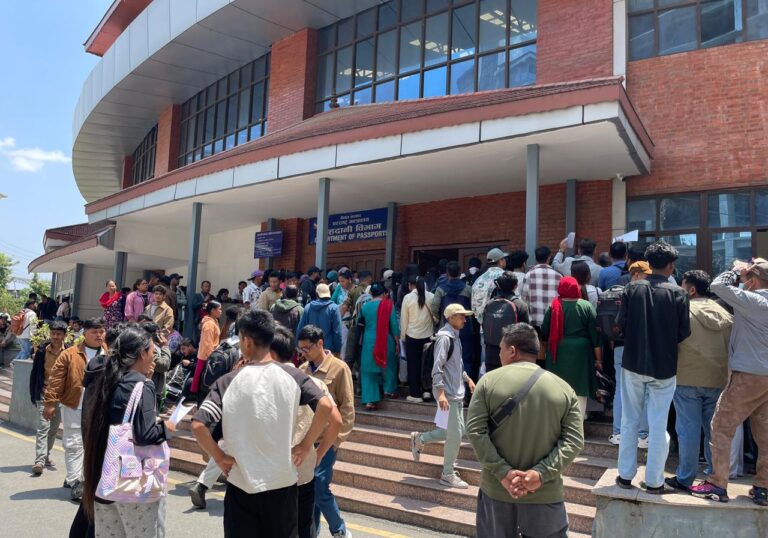
Service seekers standing in line at the Department of Passports in Tripureshwar. Photo: Bhasha Sharma
The government, which has placed ‘Electronic Governance and Technology’ on the national priority list, considers communication and public infrastructure, data centers, cloud services, and cybersecurity as the main pillars for building a digital economy. Additionally, the government’s plan shows a priority investment in the privacy and security methods of personal details and high-speed ‘connectivity.’ Not only that, the goal of establishing its own satellite to ensure basic telecommunications and digital access in remote areas of the country is included in the government’s agenda. The government also promises to develop the Nagarik App as a multi-purpose ‘Super App’ to provide all government services in one place.
Policy hurdles
Dreaming of digital governance, the previous government had also issued an ‘E-Governance Blueprint’ on February 25, 2025. Before that, documents like the Information and Communication Technology Policy in 2015 and the ‘Government Enterprise Architecture’ in 2019 were created.
Policy arrangements were made to link government work and public services to technology by creating the Electronic Transactions Act and the ‘Digital Framework.’ However, technology expert Bibek Rana asserts that the pace of digital transformation has been slow due to weak legal aspects.
He says, “Currently, most work is being done based on guidelines. Provisions should be made in the Act itself to include penalties if services cannot be provided.” He emphasizes that strong laws must also be made for the security of personal details.
In Nepal, the Statistics Act, 2022, and the Individual Privacy Act, 2018, are in implementation. “Both these Acts have failed to adequately address the need to enhance service delivery efficiency through data security and data exchange,” the E-Governance Blueprint itself states. “Security to protect citizens’ personal details and to shield businesses and government services from cyber risks has not been ensured.”
Sigdel, Executive Director of Digital Rights Nepal, emphasizes that for public services to become fully digital, policies and laws must be as strong as the availability of infrastructure and skilled manpower. He concludes that challenges in digital transformation persist due to a lack of adequate laws regarding digital rights and the security of personal details.