Kathmandu
Monday, June 15, 2026





Eradicating the evil practice of dowry requires a mix of grassroots awareness and legal frameworks, alongside their effective implementation.
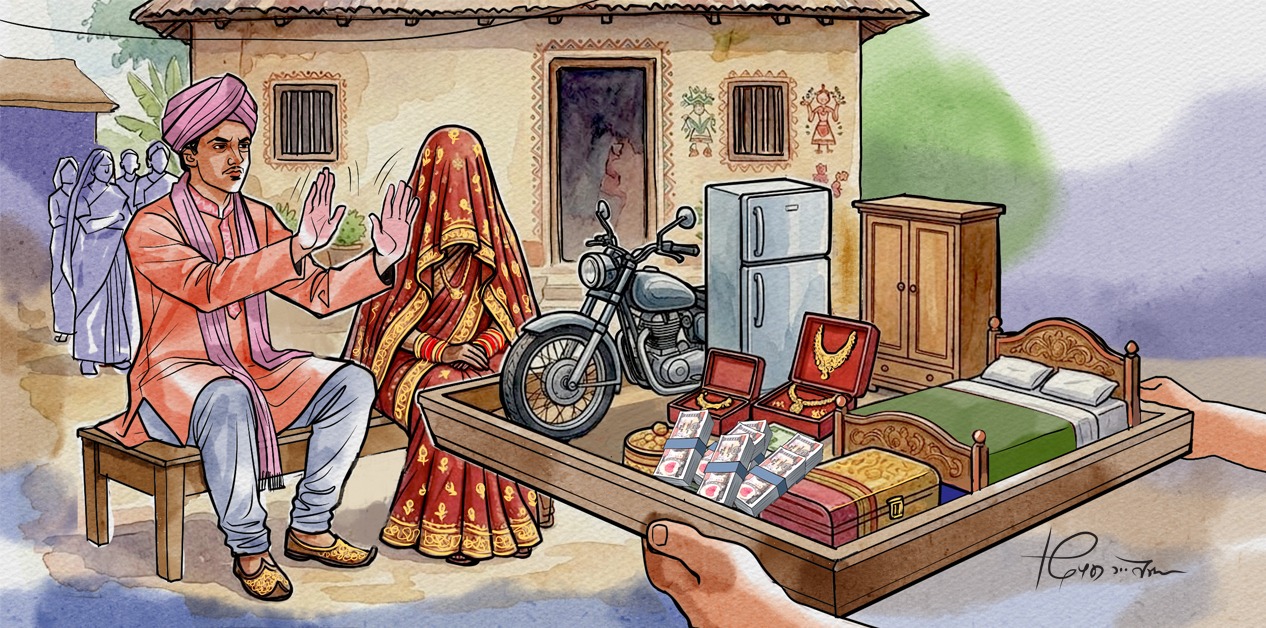
KATHMANDU: Thirty-eight years ago, during my stay in India, my family—living in a mixed community—and my husband’s family, who grew up in a similar environment, agreed to our marriage after a casual conversation. There was no exchange of dowry in our wedding. Similarly, we married off our daughter four years ago and our son two years ago entirely without dowry. In fact, in our indigenous community, particularly among the Rai people, the custom of dowry simply does not exist. Because of this, parents within our community never have to worry about dowry during weddings, unlike others.
Since the dowry system has been absent from our community since the time of our ancestors, the upbringing and care of sons and daughters have been equal since childhood. There is no discrimination in education. This yields multi-faceted and far-reaching benefits. Because daughters receive the same opportunities as sons to get educated and develop their personalities, there is no room for discrimination. Instead, it equally boosts their self-confidence and makes them self-reliant.
In the Rai community, many educated and independent daughters continue to fulfill their responsibilities toward their maternal homes after marriage, just like sons do. This is considered completely normal among the Rai people. In other communities, such supportive behavior by married daughters toward their maternal families is rarely seen or heard of. I, too, fulfilled such a role in the past. After my mother passed away while I was studying in the first year of my Bachelor’s degree, I had to become the guardian of my younger siblings. Likewise, even after my marriage, I had to maintain a parental role for my brother and sister for a few years.
In Nepalese society, a vast majority of daughters are still forced to spend a discriminatory childhood and adolescence due to illiteracy in some places and poverty in others. Following that, they suffer further torture and violence because of the dowry system. This problem runs exceptionally deep within the Madhesi community. All three tiers of government and civil society appear indifferent to the plight of women and young girls in the Madhesi community, who have been living tormented lives for generations due to the dowry system. Even more disheartening is the fact that even ministers and elected representatives hailing from this very community show no concern or anxiety toward minimizing or eradicating this evil practice.
In the Terai-Madhesh region, the dowry system continues either overtly or covertly. While it does not exert financial pressure on the affluent class, they actually fuel this malpractice in local society by exchanging dowry backed by strict conditions and demands. The brunt of such ostentatious practices is borne by the working-class poor. Due to social pressure and the desire to mimic others, financially weak households give dowries during their daughters’ weddings even if it means taking on loans far beyond their financial capacity. Consequently, their standard of living continues to deteriorate drastically.
In societies where the dowry system is prevalent, discrimination between sons and daughters is common. Due to the financial burden of dowry, there is a tendency among parents to view the birth of a daughter as a burden. When multiple daughters are born in the pursuit of a son, such families sink deeper into the quagmire of poverty. On the flip side, people live in anticipation of a son’s birth, hoping to receive a hefty dowry at his wedding.
Ruby Kumari Thakur, who rose from the Madhesi community to the dignified position of Deputy Speaker, recently posted on social media stating that she would only attend dowry-free weddings. Not only that, she emphasized that wedding invitation cards must explicitly state “Dowry-Free Marriage.”
Thakur, who began her political journey with the Shram Sanskriti Party, has consistently raised the issue of the torment caused by the dowry system in Madhesh Province, both before and after becoming a proportional-representation Member of Parliament. The buzz she generated regarding dowry-free marriages immediately after assuming the office of Deputy Speaker has set the stage for a nationwide debate on this evil custom.
By coincidence, while preparing this article, Deputy Speaker Thakur wrote on social media that she has started receiving invitation cards from relatives featuring the phrase “Dowry-Free Marriage.” This example demonstrates that when one makes persistent efforts with strong resolve on issues of public concern, it leaves a tangible impact on society. A similar progressive mindset and conduct on social issues is expected from our other elected representatives as well.
Although the dowry system has been deeply entrenched in the Terai-Madhesh region, particularly within the Madhesi community for years, there is no history of a state-level debate on the matter. Rather, certain non-governmental organizations seem to conduct seminars and training sessions from time to time. However, such programs rarely see attendance from the struggling low-income groups of the Madhesi community who keep this practice alive; instead, they are heavily attended by the affluent and educated. Yet, the latter group rarely advocates for the reduction or eradication of the dowry system in practice. As a result, these training sessions and seminars on the dowry system have proven ineffective.
It is not that the Government of Nepal has failed to enact laws to end the malpractice of dowry. However, the intellectual class of the community that perpetuates this tradition routinely flouts the law. Section 174 of the National Penal Code, 2017 explicitly states that ‘Transactions shall not be made in a marriage.’ Subsection (1) of this section reads: “Except for traditional general gifts, offerings, presents, or a single set of jewelry worn on the body according to one’s long-standing tradition, no movable or immovable dowry or any property shall be demanded, or transactions made based on conditions, from the bride or groom’s side to conduct or facilitate a marriage.” Similarly, Subsection (2) provides that “A person who commits an offense under Subsection (1) shall be liable to a punishment of imprisonment for a term not exceeding three years or a fine not exceeding thirty thousand rupees, or both.”
What is the solution?
Despite such clear legal provisions regarding dowry, the communities and families that fuel the system seem almost entirely oblivious to this law. Due to the complacency and laxity of the enforcement agencies and officials, this evil custom continues to persist in society. The law has completely failed to touch those who engage in financial and material transactions in the name of dowry during weddings.
If we are to eradicate the dowry system, all 753 local levels must take this legal provision down to the grassroots level through their citizen charters. Furthermore, continuous discussions and debates on this matter must be held within the judicial committees formed under the local governance structure. Similarly, it is equally vital to coordinate and collaborate with non-governmental organizations that have been actively working to end the dowry system. Young individuals who choose to marry without taking or giving dowry must also be incentivized and encouraged.
It is highly necessary to involve students in schools and colleges in orientation programs regarding the evils of the dowry system. Lately, the number of adolescents entering into love marriages or eloping before completing their school education is on the rise. Among various reasons behind this trend, the dowry system could be one. It has been observed that many young couples run away to marry simply to spare their parents the crushing financial burden of a dowry.
In conclusion, local levels must formulate a strategic blueprint to implement the relevant laws by coordinating and collaborating with non-governmental organizations that have spent years working toward ending the dowry system. Only then will the laws become dynamic forces capable of minimizing or ultimately eradicating this deeply rooted social evil.