Kathmandu
Thursday, June 18, 2026





Even though investment and opportunities are being provided to women's cricket on par with men's, the results remain disappointing.
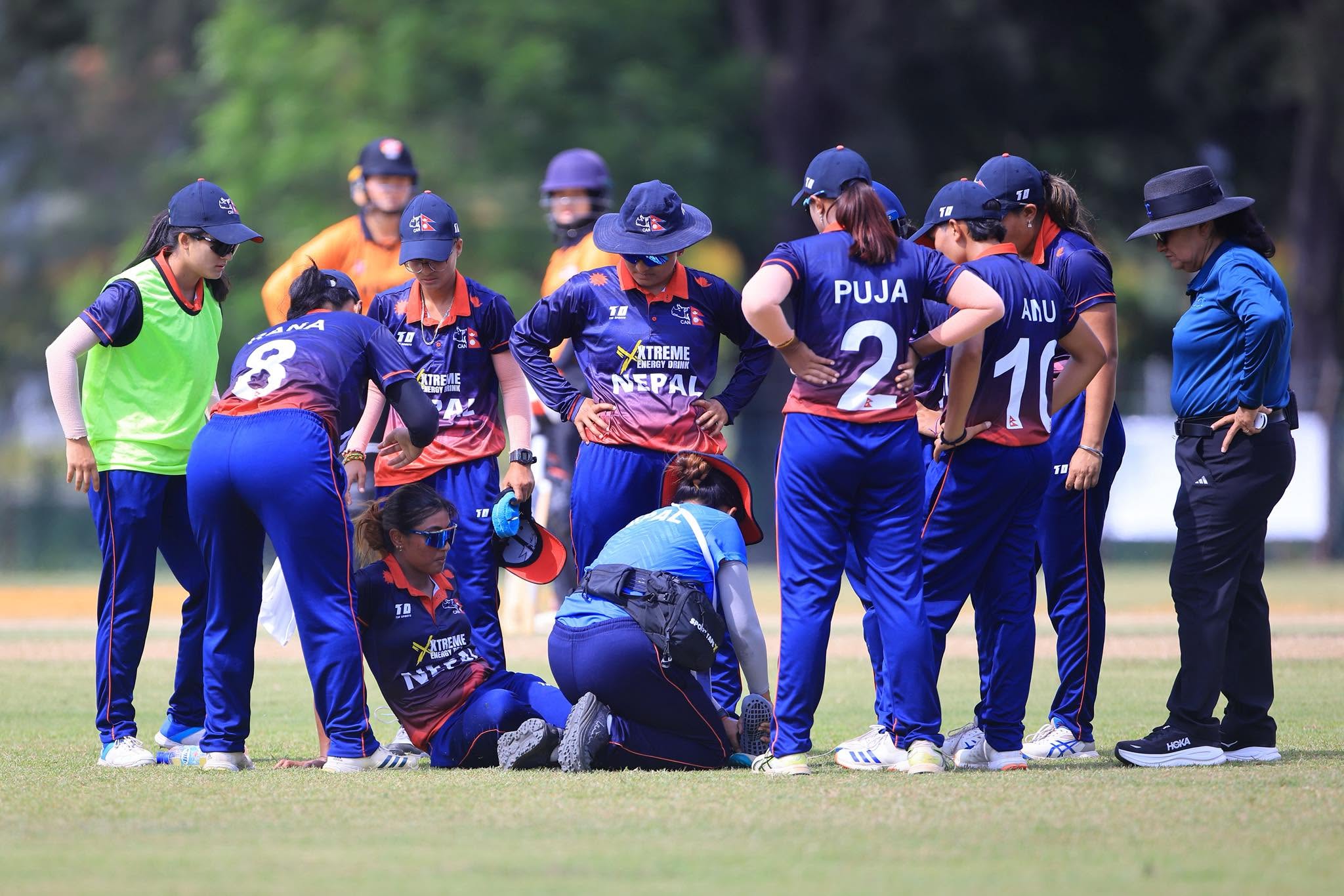
“CAN (Cricket Association of Nepal) has invested heavily. Therefore, we must deliver returns through our results. Once we start delivering results, the team will progress in the truest sense.”
This statement by Indu Barma, captain of the Nepali National Women’s Cricket Team, expressed on May 17 before playing the Asian Games Qualifiers and the ACC (Asian Cricket Council) Women’s Premier Cup in Malaysia, reflected both responsibility and high expectations. However, the performance failed to match those words.
In the Asian Games Qualifiers, Nepal defeated China by 19 runs and Indonesia by four wickets to emerge as the winners of Group ‘B’ and reach the semifinals. However, they suffered a two-wicket defeat against the host nation, Malaysia. In the third-place playoff, Nepal lost by five wickets to China—a team they had already defeated in the group stage—failing even to qualify for the Asian Games.
Right after that, during the ACC Women’s Premier Cup held in Malaysia, Nepal performed well in the initial matches. Defeating Qatar by 8 wickets and Bhutan by 51 runs, Nepal secured a spot in the quarterfinals with one match to spare. However, the team’s momentum was halted when they suffered a crushing 69-run defeat against Hong Kong in their final group-stage match.
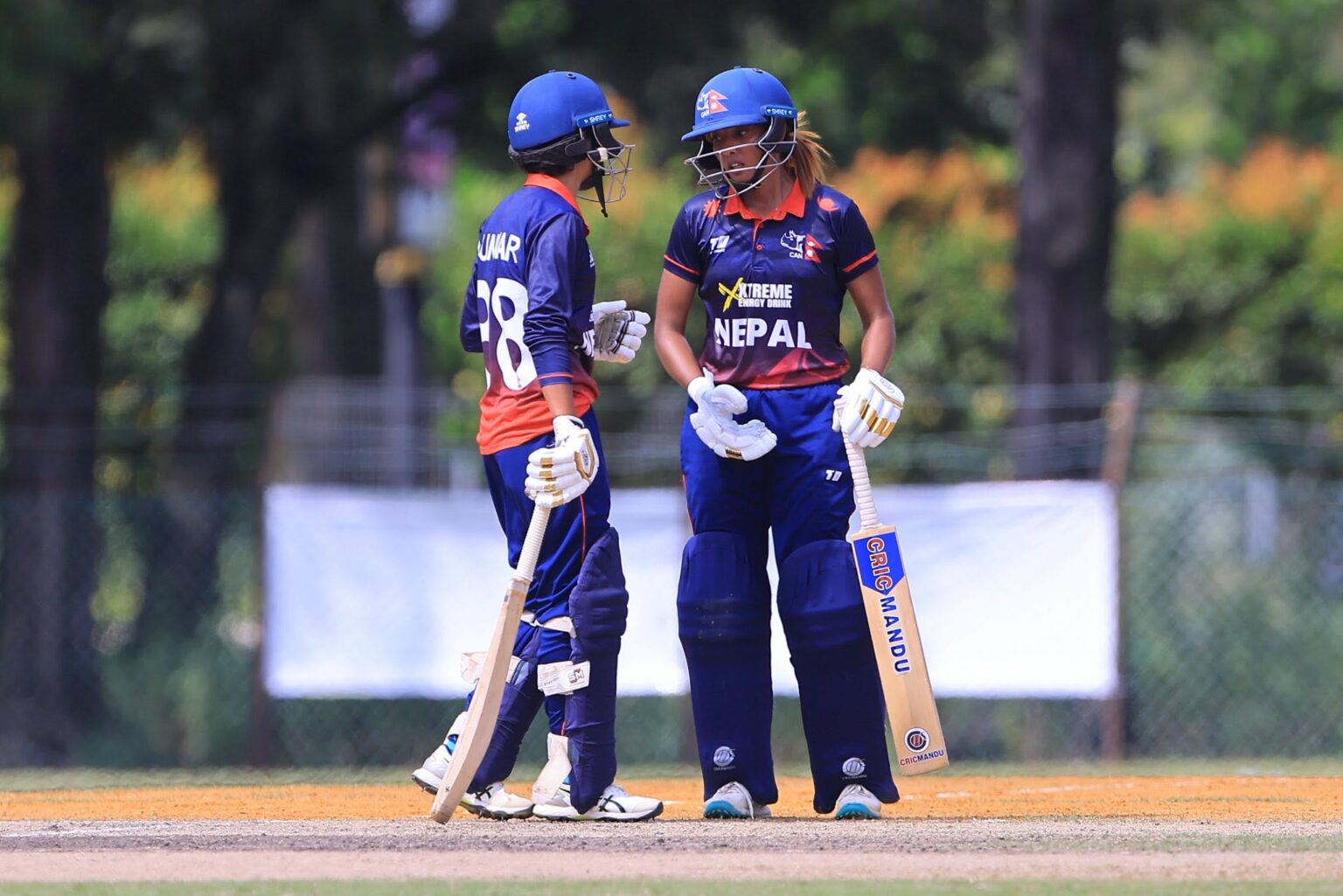
Kabita Kunwar and Captain Indu Barma on the left.
In the crucial match that was considered decisive for qualifying for the Asia Cup, Nepal suffered a 56-run defeat against Thailand, pushing them away from their target once again. China qualified for the Asia Cup, while Hong Kong and Thailand also secured their spots in the tournament.
Returning home with the team on June 13, Captain Indu Barma was visibly disappointed. “When we left, we went with high confidence, and the team’s rhythm during the previous two series was also very good, but we couldn’t translate that into success,” Indu said. “The tour was disappointing.”
A disoriented team
Ever since stepping into international cricket in 2007, expectations for the Nepali women’s team had escalated. Some had even predicted that the women’s team would play in a World Cup before the men’s team. However, to date, the women’s team has not been able to rise beyond the Asia Cup. In the 2024 tournament held in Sri Lanka, Nepal was knocked out in the group stage. This time, Nepal could not even qualify for the Asia Cup. Aside from that, participating in the ICC T20 Global Qualifiers for the first time this year remained their biggest achievement.
On the other hand, the men’s team has continuously marched forward on the path of progress. The men’s team played in the T20 World Cups in 2014, 2024, and 2026. In 2023, they even got the opportunity to play One Day International (ODI) cricket against India and Pakistan in the Asia Cup.
Amidst this, grievances regarding the women’s cricket team not receiving adequate opportunities and investment were repeatedly raised. Captain Indu, along with a few other players, even accused the Cricket Association of Nepal (CAN) of neglecting women’s cricket. The allegations were not entirely baseless. While the men’s team remained busy throughout the year participating in various international tournaments and bilateral series, the women’s team was confined to limited ICC and ACC tournaments.
However, the situation has shifted in recent years. CAN has scaled up its investment in women’s cricket. Currently, CAN allocates an annual budget equivalent to approximately USD 500,000 solely for tournaments to promote women’s cricket. CAN, which has also brought in foreign coach Harshal Pathak, has arranged a system to provide women with the same match fees as the men’s team (Rs 10,000 per match). Women players, who received a salary of Rs 10,000 to 15,000 when they were placed under central contracts for the first time in 2020, now receive between Rs 25,000 to 55,000. Regular training sessions and international series are also taking place.
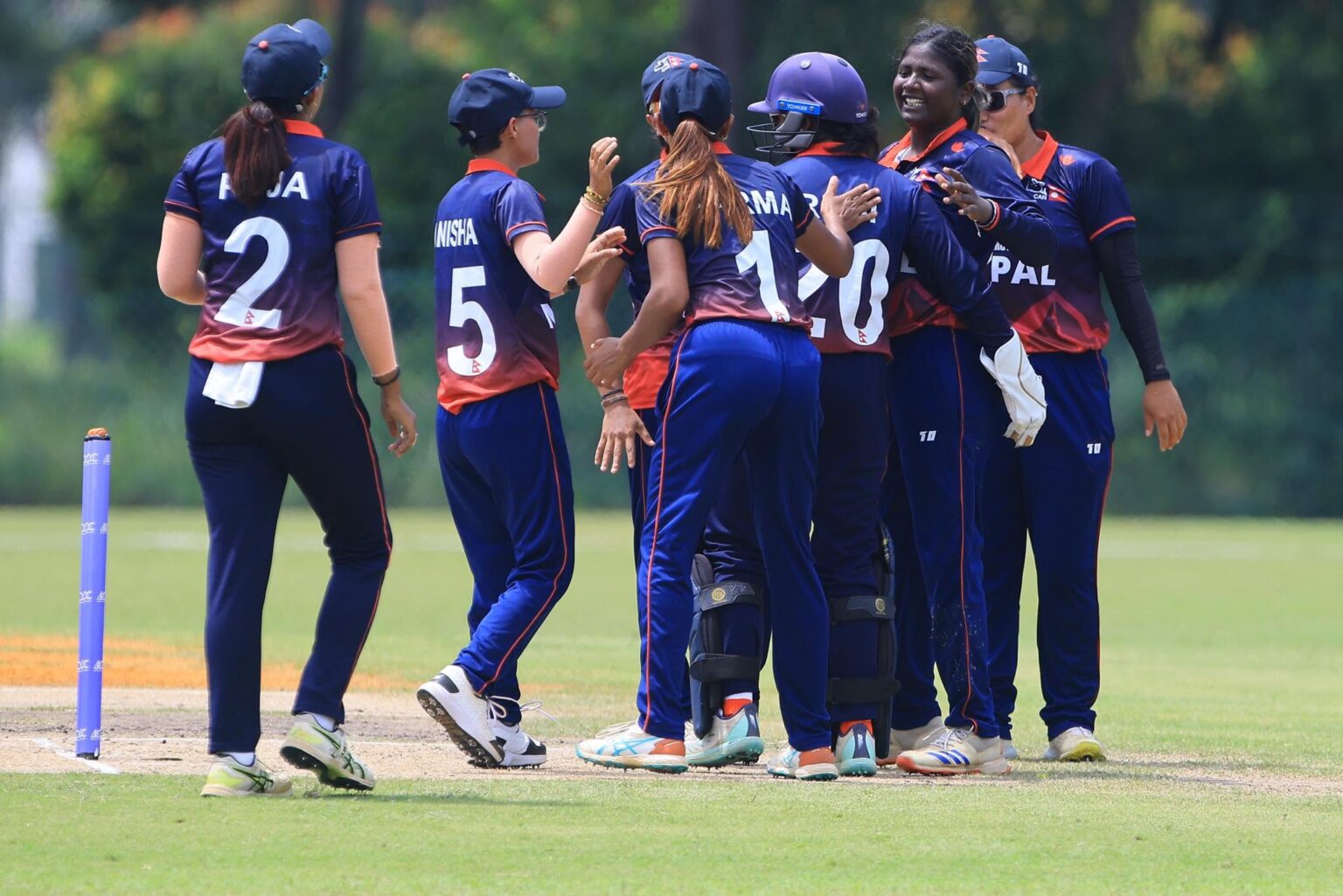
Looking at this year alone, both the Nepali men’s and women’s national teams have played an equal number of 20 international matches. The men’s team commenced their year with the ICC T20 World Cup. Following that, they played a two-match series against the UAE, participated in the ICC Cricket World Cup League-2 matches on home ground, and competed in the Asian Games Qualifiers held in Singapore.
During this period, the women’s team also gathered parallel international exposure. They played the Asia Cup Rising Stars in Thailand, the ICC Champions Trophy in Rwanda, and two T20I series, the Asian Games Qualifiers, and the ACC Premier Cup in Malaysia.
Yet, a stark contrast appeared in the results of both teams. The men’s team boosted their confidence by delivering a competitive performance even against two-time champions England in the World Cup. Winning the home series against the UAE, they secured victories in six out of eight League-2 matches. Remaining undefeated in Singapore, they also secured their spot in the Asian Games.
Conversely, although the women’s team won 11 out of 20 matches, they failed to achieve the expected milestones. Instead, they suffered defeats against Vanuatu and China—teams ranked significantly below them.
Head coach Pathak admits that the main reason behind this lies within the team’s own shortcomings. “Winning and losing are part of the game. However, we must now conduct a serious analysis of our weaknesses,” he says. “We failed to adapt to the situation. A lack of physical fitness was evident, and there was a deficiency in batting awareness. The players were confused about where to accelerate and where to anchor the innings.”

Head Coach Harshal Pathak
The primary issue confronting the Nepali team is physical fitness. To address this issue, CAN brought Monica, a strength and conditioning coach from India, to Nepal. However, despite her arrival over a year ago, its impact has not yet translated onto the team.
Before Harshal’s arrival, Manoj Katwal was coaching the Nepali national women’s team. Appointed as head coach on November 10, 2023, for a two-year tenure, it was under Katwal’s leadership that the team crossed the Asia regional stage of the T20 World Cup Qualifiers for the first time to reach the Global Qualifiers.
Not only that, during his coaching tenure, Nepal also played the ACC Premier Cup, the Asia Cup, and various international series. During this period, Nepal played bilateral series against Hong Kong, Tanzania, Japan, the Netherlands, Thailand, Uganda, and Namibia.
However, Captain Indu publicly stated to the media that working with coach Katwal had failed to take the team to greater heights, and subsequently demanded a foreign coach from CAN. Following this, CAN appointed Pathak as the new coach.
With the arrival of Pathak, who previously guided Thailand to the World Cup, enthusiasm and ambition concurrently surged among the CAN management, the team, and the fans. Pathak himself viewed Nepal as a team capable of reaching the World Cup. However, taking charge of the Nepali women’s team right from the ICC T20 World Cup Global Qualifiers held on home soil last January, he could not deliver the expected results. In that tournament, Nepal suffered an eight-wicket loss to Thailand, a narrow two-run loss to the Netherlands, and a 72-run defeat against Scotland. Nepal’s solitary accomplishment in the tournament was a six-wicket victory against Zimbabwe, who were considered weaker.
Since then, apart from winning two series played against Malaysia, the Nepali team has not achieved notable results on the international stage. Coach Pathak argues that the primary reason for this is the lack of adequate time. “It has only been a short time since I arrived here. New players haven’t come in. I still have to work with the same old squad,” he says.
Same players, similar results
The Nepali squad appears to revolve heavily around the same old players. Among them, the two prominent names are Sita Rana Magar and Rubina Chhetry.
Sita (34), who made her international debut against Thailand on July 12, 2007, in the ACC Women’s tournament, is still a part of the team. Similarly, Rubina (32), who made her international debut against Singapore on July 4, 2009, in the ACC Women’s T20 Championship, has long been a vital pillar of the team. However, of late, these two have failed to deliver the contributions expected of experienced and mature players.
Sita has scored 114 runs in her last 13 matches. Playing seven more matches than Sita, Rubina has scored 90 runs. In bowling, Sita took 6 wickets, while Rubina claimed 17 wickets.
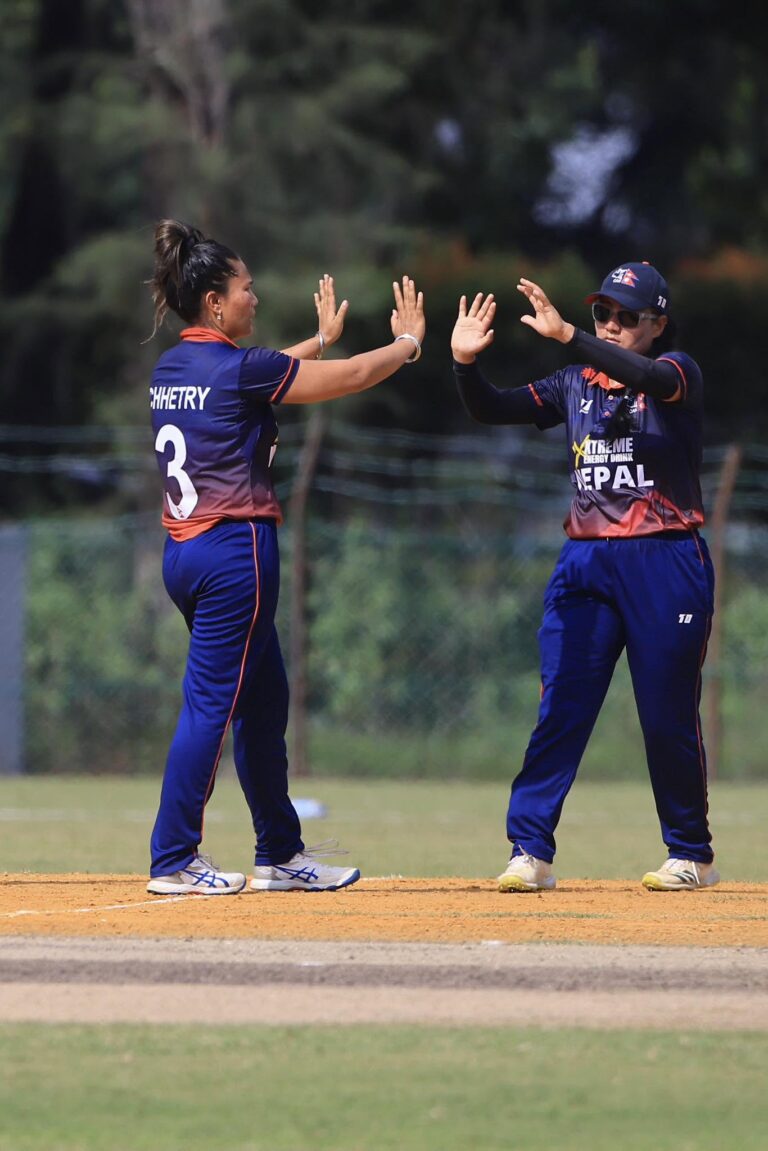
Rubina Chhetry (Right) and Sita Rana Magar
Apart from these two, players who entered the team after 2019 now form the core structure. Among them, Captain Indu Barma, Kabita Kunwar, Bindu Rawal, Kabita Joshi, and Kajal Shrestha have consistently remained a part of the squad.
Currently, questions are being raised even over Captain Indu’s own performance. Looking at the data of her last 18 matches, her only noteworthy innings was an unbeaten 46 runs against Malaysia on May 30 during the Asian Games Qualifiers. Although she hit five boundaries off 41 balls in that match, Nepal was defeated by two wickets. Because she failed to maintain consistency in the remaining 17 matches, critics have pointed out that the expectations tied to her captaincy role have not been met.
Puja Mahato, Ruby Poddar, Sony Pakhrin, and Suman Bista represent the newer generation of players. However, with few exceptions, they have failed to produce match-winning performances. New players like Riya Sharma and Manisha Upadhayay, nonetheless, have shown some promise. These two have claimed 25 and 24 wickets, respectively, over the last five tournaments.
Former batter of the national women’s team, Dolly Bhatta, states that the lack of regular domestic tournaments is the core issue of women’s cricket. “To uplift the standard of women’s cricket, domestic tournaments must be organized regularly. Continuous competitive cricket plays a vital role in identifying new talent, developing players’ skills, and creating healthy competition for a spot in the national team. However, this hasn’t been happening,” she says.
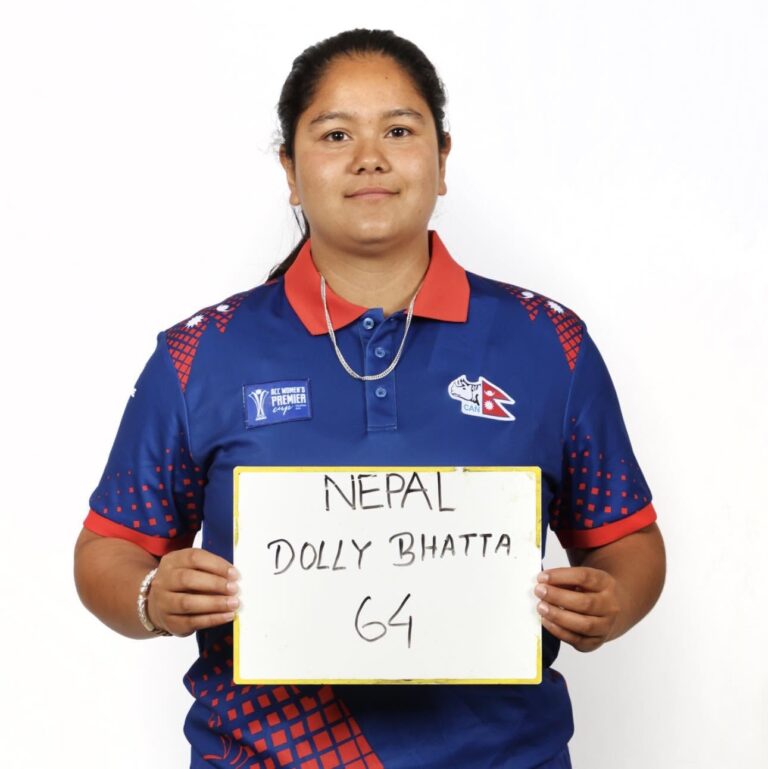
Former batter of the national women’s team, Dolly Bhatta
Senior women cricketers last played the Prime Minister Cup One-Day Tournament from January 14 to 25, 2025, at the Fapla Cricket Ground in Dhangadhi. Seven provinces and two departmental teams—APF and Tribhuvan Army Club—participated in that 20-over tournament. Divided into two groups, APF, Sudurpashchim, Lumbini, Gandaki, and Karnali, who were in Group ‘A’, played four matches each.
However, Army, Bagmati, Koshi, and Madhesh got to play only three matches each. Since the tournament was scheduled to conclude in just 12 days, CAN selected the winners by introducing a ‘Super Four’ stage. Only APF, Sudurpashchim, Army, and Bagmati got the opportunity to play two additional matches. Because these teams mostly comprise national team players, only they received the maximum playing opportunities. The remaining players had to settle for just three or four matches. Since then, CAN has not organized any domestic tournaments. Bhatta, who is currently residing in Australia, states that due to such sporadic tournaments, new players cannot compete with established ones.
“First of all, there are insufficient domestic tournaments. Furthermore, there is a lack of infrastructure. In such a scenario, the development of new players is heavily affected. It is becoming difficult for them to compete with established players to secure a place in the national team,” says the 24-year-old Bhatta, who moved to Australia after playing domestic cricket for five years. During that period, she had featured in 21 T20Is. She also alleges that player selection not being entirely based on performance is another flaw within the women’s team.
“Improvement is impossible until a culture of providing opportunities based on performance is established. With the team revolving around the same group for years, a situation has been created where new talent doesn’t get a chance at all,” says Sanjay Gurung, a former player and umpire of the Nepali team. “The team will not become strong until opportunities are given to the youth who are putting in hard work in domestic cricket.”
What is CAN doing?
CAN Manager Binod Das claims that CAN was unable to organize domestic cricket recently because the national women’s team had to play major qualifiers like the World Cup Qualifiers, Asian Games Qualifiers, and the ACC Premier Cup, which serves as the foundational pathway for the Asia Cup. “This year saw many important tournaments including the World Cup Qualifiers and Asia Cup Qualifiers. Therefore, our focus was directed there. Now that the monsoon season is ending, tournaments for senior players will take place,” he says. He adds that following the conclusion of these tournaments, the process of giving opportunities to new players and expanding the pool will commence.
In fact, CAN has recently concluded the U-19 regional tournaments across provinces. There is a plan to select a few players from the tournament and keep them in a closed-camp training session. “Just naming an ‘A’ team is not everything. Even now, we are calling around 28 players into camps on a rotational basis at different times. Last year, we even kept 32 players in a camp at one point,” says Das, who has also served as a former coach of the women’s team.

CAN Manager Binod Das. Photo: Das’s Social site
However, according to his own statement, the senior team currently has no upcoming international tournaments. Nepal failed to qualify for the Asian Games and will also miss out on the Asia Cup. Domestic cricket tournaments will resume only from mid-September. Generally, Nepal experiences rains from mid-June to mid-September.
CAN’s strategy will now focus heavily on the T20I format. While the men’s team holds both One Day International (ODI) and T20I status, the women’s team holds only T20I status, which is why Das states they will focus entirely on it. “Questions are often raised about tournaments being brief. Currently, everyone’s ultimate goal is to reach the T20 World Cup. Our objective is also to become strong in that very format,” says Das.
Fitness and professionalism remain the key issues: Former Head Coach Katwal
Former head coach Manoj Katwal, who guided the Nepali women’s team to the Asia Cup tournament after a long hiatus, points out that while Nepali women cricketers do not lack skill and capacity, they must improve their physical fitness and professional conduct. Excerpts from the conversation with Katwal regarding the challenges and prospects of women’s cricket:
The women’s team recently played two major tournaments but failed to secure pivotal wins. Why do you think that happened?
Under my coaching, we played the Asia Cup after nine years and successfully reached the Global Qualifiers of the World Cup for the first time. However, coming to a point where we have to compete closely or lose against teams ranked far below us like China, Indonesia, and Vanuatu, or face defeats against Malaysia, is deeply disheartening. We should have beaten these teams comfortably and with confidence.
Our performance still reflects our long-standing weaknesses. Even though the coach is new, the team’s main issue lies in fitness. Skill-wise, our players are not bad. But to compete at the international level, their fitness requires massive improvements. Losing a match against China that we shouldn’t have lost was partly due to fitness. The rain also had some impact.
In batting, the team still relies heavily on senior players like Rubina and Sita. How can this be improved?
Due to the lack of matches, there is a fundamental challenge regarding the criteria for selecting new players, forcing us to rely on veteran players. Within the next one or two years, CAN must prioritize younger players and prepare them thoroughly. Our young women have already played in the U-19 World Cup, and a good performance was observed across all provinces in the recently concluded U-19 National Tournament. Now, based on these performances, we should gradually transition and phase out senior players.
Apart from them, many promising players like Sana Pravin and Sony Pakhrin have emerged. We must give higher priority to such new talents rather than players who have already reached their peak saturation.
Former head coach Manoj Katwal. Photo: Katwal’s Social site
Despite the rise in tournaments and financial investment, why are the expected results not materializing?
To some extent, a lack of professionalism is visible among the players. Most players practice only during national camps lasting 15 days or a month, which is insufficient for real improvement. Even after the camps conclude, they must cultivate a habit of putting in individual effort within their respective districts or provinces. Just like the members of the men’s team, if they pay attention to individual training, fitness, and nutrition, only then will good results follow.
In the men’s national team, the presence of an ‘A’ team exerts a healthy pressure on the senior players. Is women’s cricket suffering from a lack of such ‘bench strength’?
Absolutely, bench strength is highly necessary for the women’s team. Right now, 5 to 6 players in the senior team look entirely complacent, knowing their spots are secured. To develop a mindset among them that their positions are not undisputed, a strong bench is imperative. CAN must take the initiative for this.
What should be the upcoming strategy to take women’s cricket to new heights?
Special investment must be directed toward youth players. In my view, 6 to 8 exceptional players from the U-19 squad should be sent to India for specialized training. Previously, men’s players were also sent there. In India, visa procedures are hassle-free, and costs are relatively low. Specifically, sending them to South India would be beneficial since the weather there isn’t heavily disrupted by rains. If we can put them through 6 to 7 months of specialized training, Nepali women’s cricket can yield good results very quickly.