Kathmandu
Monday, July 13, 2026





KATHNMANDU: In late March 2026, a long-simmering dispute between the All Nepal Football Association (ANFA) and the National Sports Council (NSC) escalated dramatically. ANFA, led by President Pankaj Bikram Nembang, pushed for early executive elections on March 27 despite its tenure ending June 18.
On March 25, the NSC suspended ANFA’s executive committee for three months, citing violations of the National Sports Development Act, 2020, and Regulations, 2022.
The move halted domestic leagues, cancelled friendlies, and prompted a joint FIFA-AFC ultimatum on April 5, threatening immediate ANFA suspension if the NSC did not revoke its decision within seven days.
As of April 9, Nepali football remains paralyzed, with international participation and funding at risk.
What is the core of the Nepali football controversy involving ANFA and the NSC?
The controversy centers on governance autonomy versus state oversight in Nepali football. ANFA, the national governing body, decided in December 2025 to advance its executive committee election by nearly three months to March 27, 2026, originally planned for June.
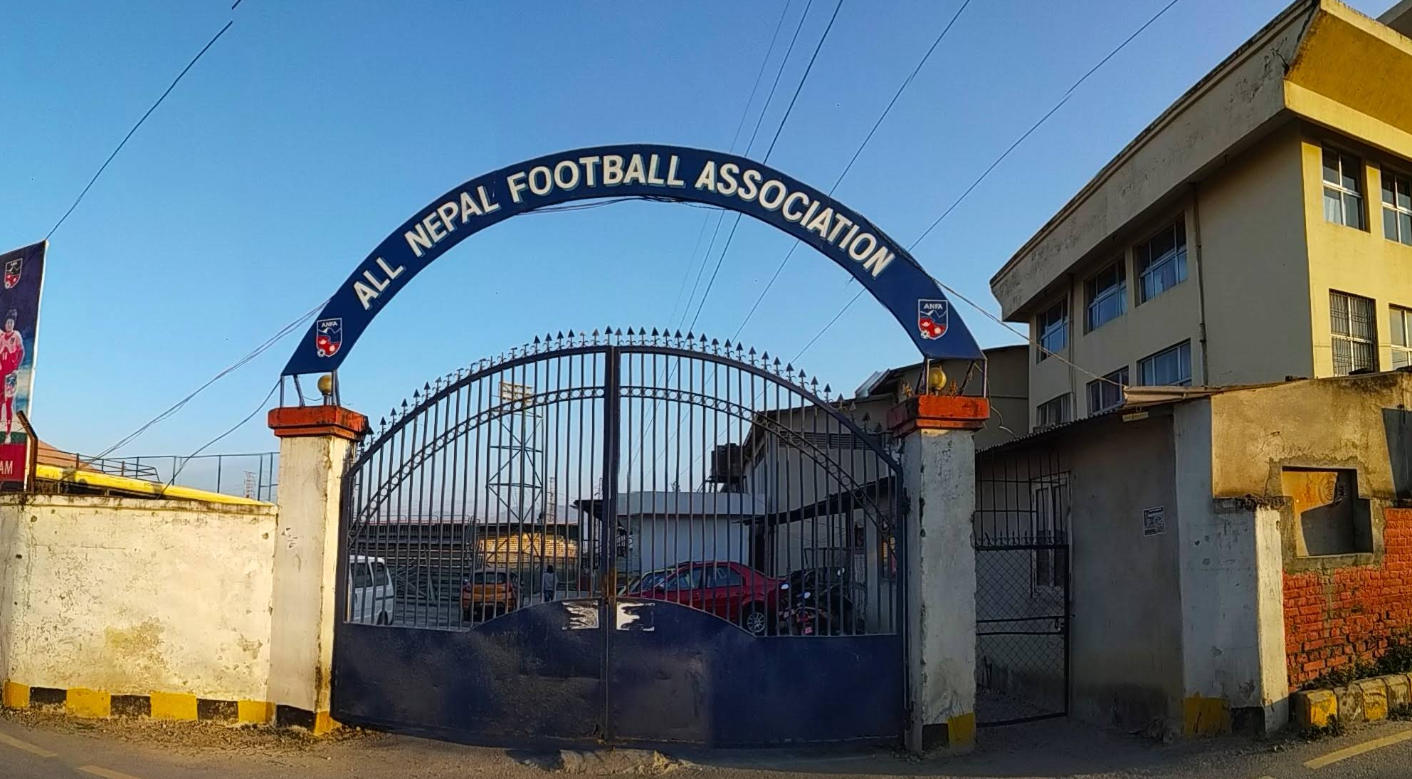
Office of ANFA in Satdobato. File photo
This was intended to ensure stability ahead of FIFA World Cup 2026 qualifiers. The NSC, Nepal’s apex sports regulator, viewed this as defiance of national laws requiring prior approval and compliance with the National Sports Development Act, 2020, and Regulations, 2022.
On March 25, 2026, the NSC suspended ANFA’s entire executive committee (including President Pankaj Bikram Nembang) for three months under Section 29(2) of the Act, accusing it of ignoring repeated directives. This suspension not only halted the election but also blocked NSC recognition and support for any ANFA-organized events.
The clash has exposed deep tensions between ANFA’s reliance on FIFA/AFC statutes (which demand independence from third-party interference) and Nepal’s domestic sports legislation. Without resolution, it risks Nepal becoming the first country in its football history to face FIFA suspension, isolating the national team, clubs, and players from global competitions and funding.
The crisis has already caused postponements of the National League, Martyr’s Memorial Women’s League, and multiple international fixtures, leaving players without income and fans without matches.
ANFA argues the early poll aligns with its statutes and prevents instability during qualifiers, while the NSC insists on legal compliance to curb alleged irregularities.
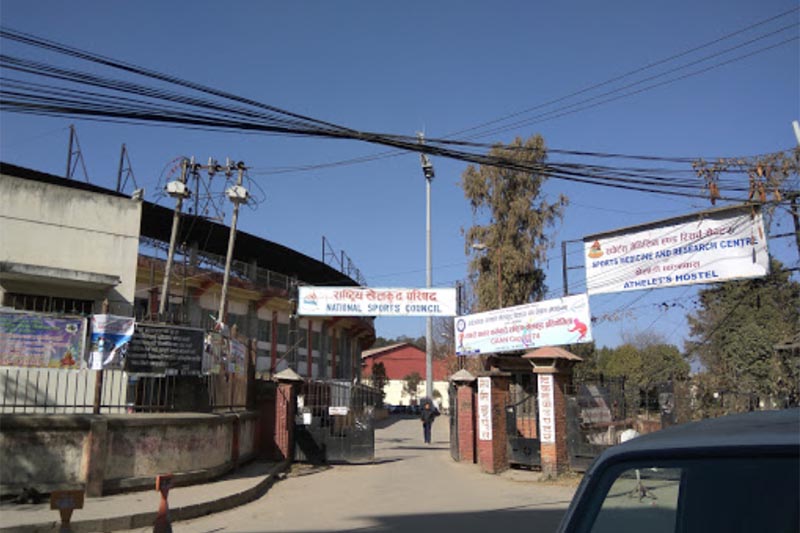
Office of NSC. File photo
This standoff, building since late 2025, highlights systemic issues in Nepali sports governance where international football rules collide with national authority.
Who is Pankaj Bikram Nembang, and what is his role in the current crisis?
Pankaj Bikram Nembang is the current president of the All Nepal Football Association (ANFA), elected to lead the federation’s executive committee. Under his leadership, ANFA pursued an “early election” strategy, announcing the Ordinary General Assembly and executive polls for March 27, 2026, in Jhapa, well before the four-year tenure’s end on June 18, 2026.
Nembang’s administration justified this move as essential for continuity and preparation for FIFA World Cup 2026 qualifiers, claiming it followed ANFA’s internal statutes. However, this decision directly triggered the NSC’s wrath.
The NSC explicitly suspended Nembang and the entire executive committee for three months, holding them responsible for repeated non-compliance with directives issued under the National Sports Development Act, 2020.
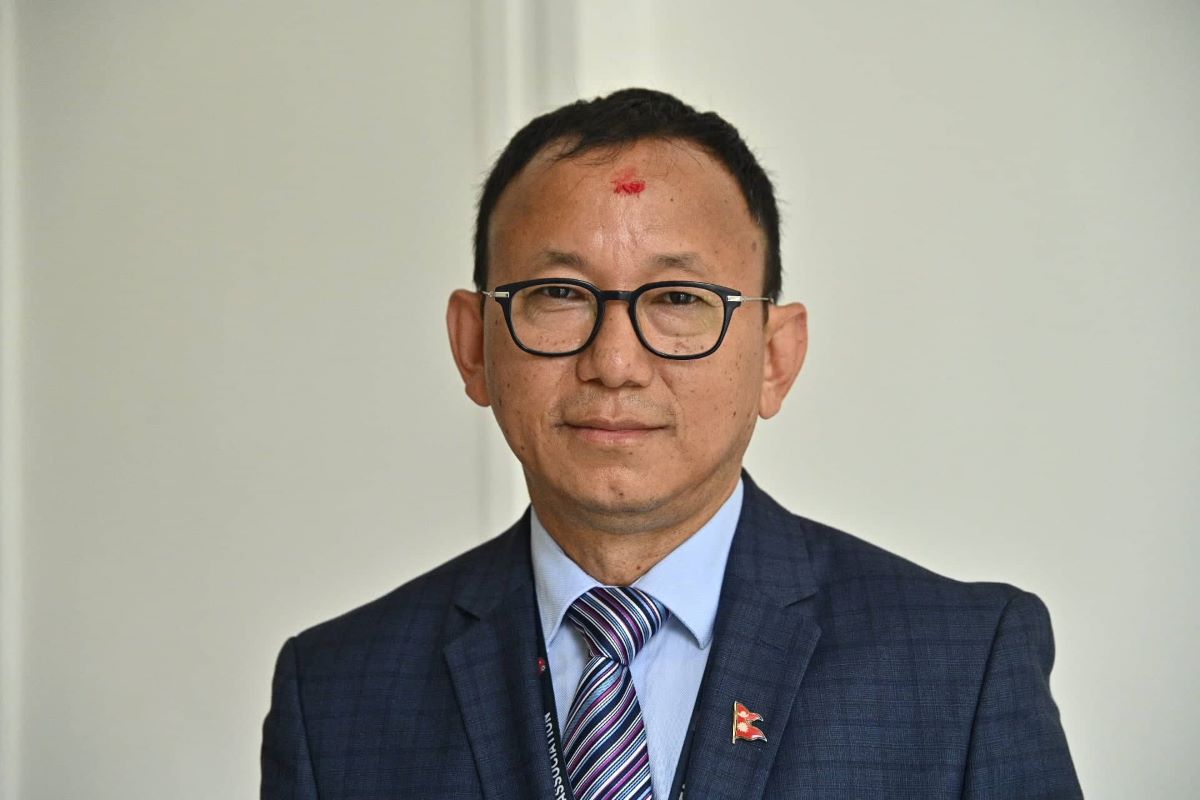
Pankaj Bikram Nembang. File photo
The suspension letter cited ANFA’s failure to seek necessary approvals and its prioritization of FIFA instructions over national regulations. Nembang’s leadership has faced prior criticism for league delays, player protests, and administrative lapses, including visa issues for foreign players in March 2026 that led to further postponements.
His stance that postponing elections could invite FIFA sanctions has been echoed by ANFA officials, but it has not swayed the NSC. As of April 9, 2026, Nembang remains suspended, and the election committee (led by coordinator Ramchandra Gautam) indefinitely postponed the Jhapa polls after receiving the NSC letter on March 26.
Critics argue his push for early polls exacerbated the crisis, while supporters see it as defending ANFA’s autonomy. The outcome will determine whether his tenure survives or if fresh leadership emerges under duress from FIFA.
Why did ANFA decide to hold early elections in March 2026?
ANFA’s executive committee, under President Pankaj Bikram Nembang, voted in December 2025 to advance the election from its scheduled June 18, 2026 date to February 11, initially later adjusted to March 27, 2026, in Jhapa.
The primary rationale was strategic stability ahead of the FIFA World Cup 2026 qualifiers and other international commitments. ANFA argued that holding polls during a busy qualification window could disrupt preparations, coaching staff continuity, and administrative focus.
The association maintained that its statutes permitted such early elections and that the move complied with FIFA and AFC guidelines emphasizing independent governance. In statements, ANFA warned that any delay or external interference risked triggering international sanctions, as third-party involvement violates FIFA Statutes Articles 14 and 19.
The decision came amid broader frustrations: repeated league postponements (National League and Women’s League were delayed multiple times in early 2026 due to technical, visa, and scheduling issues), player protests by the Nepal Football Players Association (NFPA) in March demanding schedules; and A-Division clubs’ hunger strikes.
ANFA viewed the early poll as a proactive step to install a fresh mandate before qualifiers intensified. However, this clashed with NSC directives requiring alignment with national sports laws, including statute amendments and district-level compliance.
What specific actions by ANFA prompted the NSC to suspend it on March 25, 2026?
The NSC’s suspension on March 25, 2026, stemmed from ANFA’s persistent defiance of multiple written directives. Key triggers included ANFA’s unilateral announcement and preparation for the March 27 executive election without NSC approval, despite warnings dating back to December 2025.
On March 23, the NSC had demanded clarification within 24 hours under Sections 28(M) and 29(1) of the Sports Development Act, questioning why action under 29(2) should not be taken.
ANFA’s response was deemed unsatisfactory. The NSC accused ANFA of ignoring the National Sports Development Act and regulations, which mandate regulatory oversight for elections, statute changes, and operations.
Additional grievances involved ANFA’s failure to amend its statutes as directed and proceeding with voting rights based on four-year-old district committees. The suspension letter explicitly targeted the executive committee led by President Pankaj Bikram Nembang, imposing a three-month ban effective immediately.
This also barred NSC support for ANFA tournaments. ANFA had closed its office in preparation for the Jhapa congress, but the NSC letter arrived via the secretariat on March 26, forcing indefinite postponement.
The NSC viewed ANFA’s actions as prioritizing FIFA/AFC instructions over national law, creating a direct conflict. Prior context included stalled domestic leagues, visa controversies for foreign players (leading to Department of Immigration warnings in March), and canceled friendlies like Nepal vs. Hong Kong.
What legal basis did the NSC use to justify suspending ANFA?
The NSC invoked Section 29(2) of the National Sports Development Act (effective 2022) to suspend ANFA’s executive committee for three months. This provision empowers the council to act against member associations for non-compliance with directives issued under the Act and its regulations.
Specifically, the NSC cited ANFA’s repeated failure to adhere to written orders regarding election processes, statute amendments, and alignment with national sports governance norms.
On March 23, 2026, the NSC’s executive meeting had already initiated proceedings under Sections 28(M) and 29(1), seeking clarification on why stronger action was unwarranted.
ANFA’s unsatisfactory reply led to the March 25 suspension. The Act requires federations like ANFA to operate within Nepal’s legal framework, including approvals for major decisions such as elections. The NSC also directed district associations to revise statutes and hold their own polls, viewing ANFA’s early election plan as arbitrary and non-compliant.
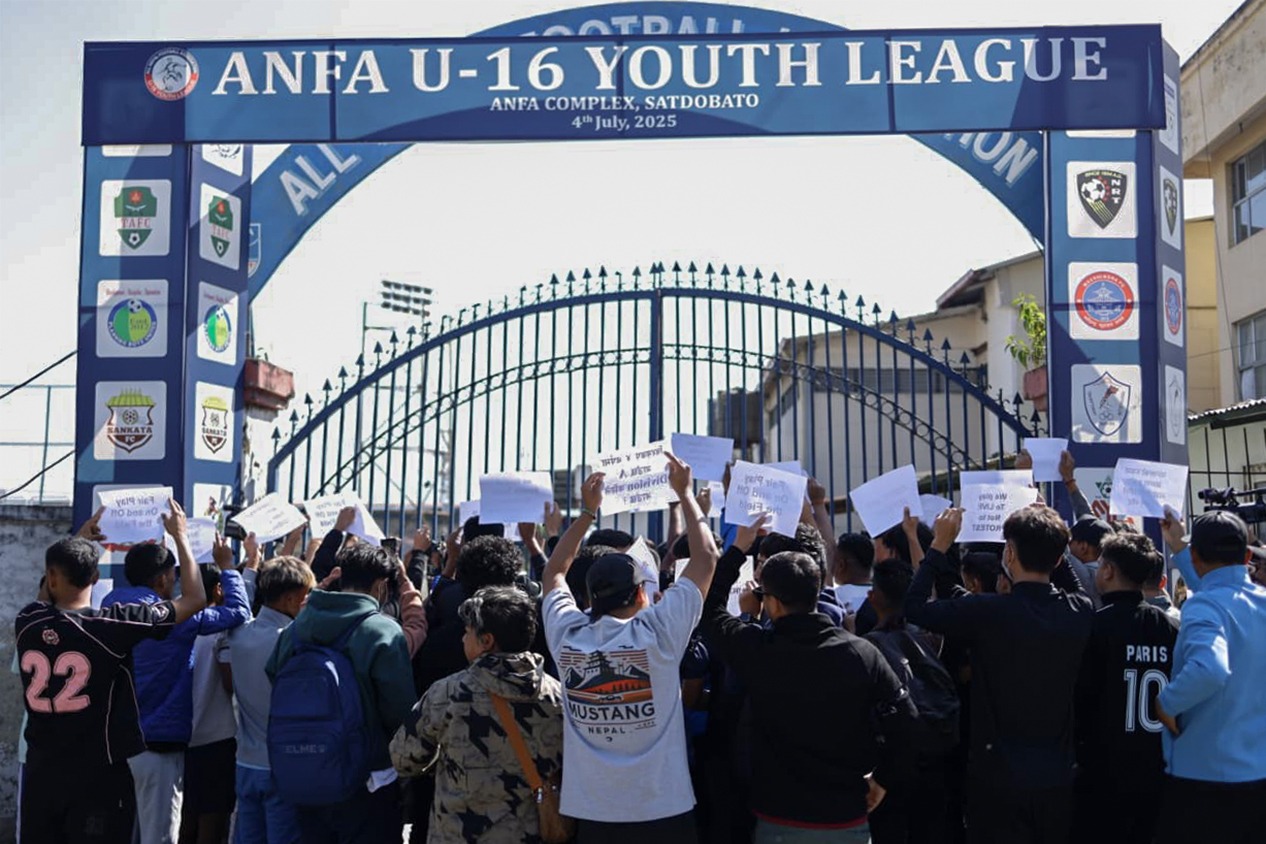
Football fans protesting infront of ANFA’s gate. File photo
This domestic legal framework directly conflicts with FIFA/AFC statutes (Articles 14, 19 for FIFA; 10, 15 for AFC), which prohibit any third-party (including government) interference in member associations’ autonomy.
The NSC maintained that ANFA could not cherry-pick international rules over Nepali law. The suspension letter was formally communicated to ANFA’s secretariat, triggering the election committee’s postponement announcement on March 26.
Legally, the move aimed to enforce accountability but has been labelled “undue interference” by FIFA/AFC, escalating the crisis to international levels.
How did ANFA initially respond to the NSC’s suspension threat and final decision?
ANFA strongly opposed the NSC’s actions from the outset. On March 25, 2026, ANFA urged the NSC not to impose suspension, warning that failing to hold the scheduled election on time could lead to international restrictions from FIFA and AFC.
ANFA emphasized that its executive committee had already prepared for the March 27 congress in Jhapa and that any external halt would violate its statutes and invite global sanctions.
After the suspension letter reached the secretariat on March 26, ANFA’s Election Committee (coordinator Ramchandra Gautam and members) immediately postponed the polls indefinitely via a press statement, citing receipt of the official NSC notice.
ANFA leadership, including President Pankaj Bikram Nembang (now suspended), maintained that the early election complied with internal rules and was necessary for operational continuity.
The association forwarded FIFA/AFC concerns internally, arguing that NSC interference constituted a breach of football’s independence principles. ANFA also highlighted prior cooperative efforts but stressed that national law could not override FIFA statutes.
In subsequent days, ANFA officials reiterated to media that the suspension risked Nepal’s football isolation. This response aligned with FIFA’s later demands but did not prevent immediate fallout: league postponements, match cancellations, and player unrest.
By early April, ANFA was actively engaging with the international bodies, leading to the April 5 joint letter. The federation’s position remains that the NSC must withdraw its decision to resume normal operations.
What were the immediate effects of the March 25 suspension on domestic Nepali football?
The suspension brought domestic football to a standstill. ANFA had already postponed the National League and Martyr’s Memorial Women’s League in mid-March 2026 due to visa issues for foreign players and scheduling conflicts with the Department of Immigration.
The NSC ban exacerbated this by withholding official recognition and support for any ANFA events, effectively freezing all tournaments. A-Division clubs, already protesting via hunger strikes earlier in March over league delays, faced further uncertainty, with foreign players sent back and matches halted.
Youth and women’s leagues, including the U-18 Youth League (which started but was abruptly canceled), were disrupted. Players from the Nepal Football Players Association (NFPA), who had padlocked ANFA offices in March demanding schedules, saw their livelihoods threatened amid a lack of a competitive calendar.
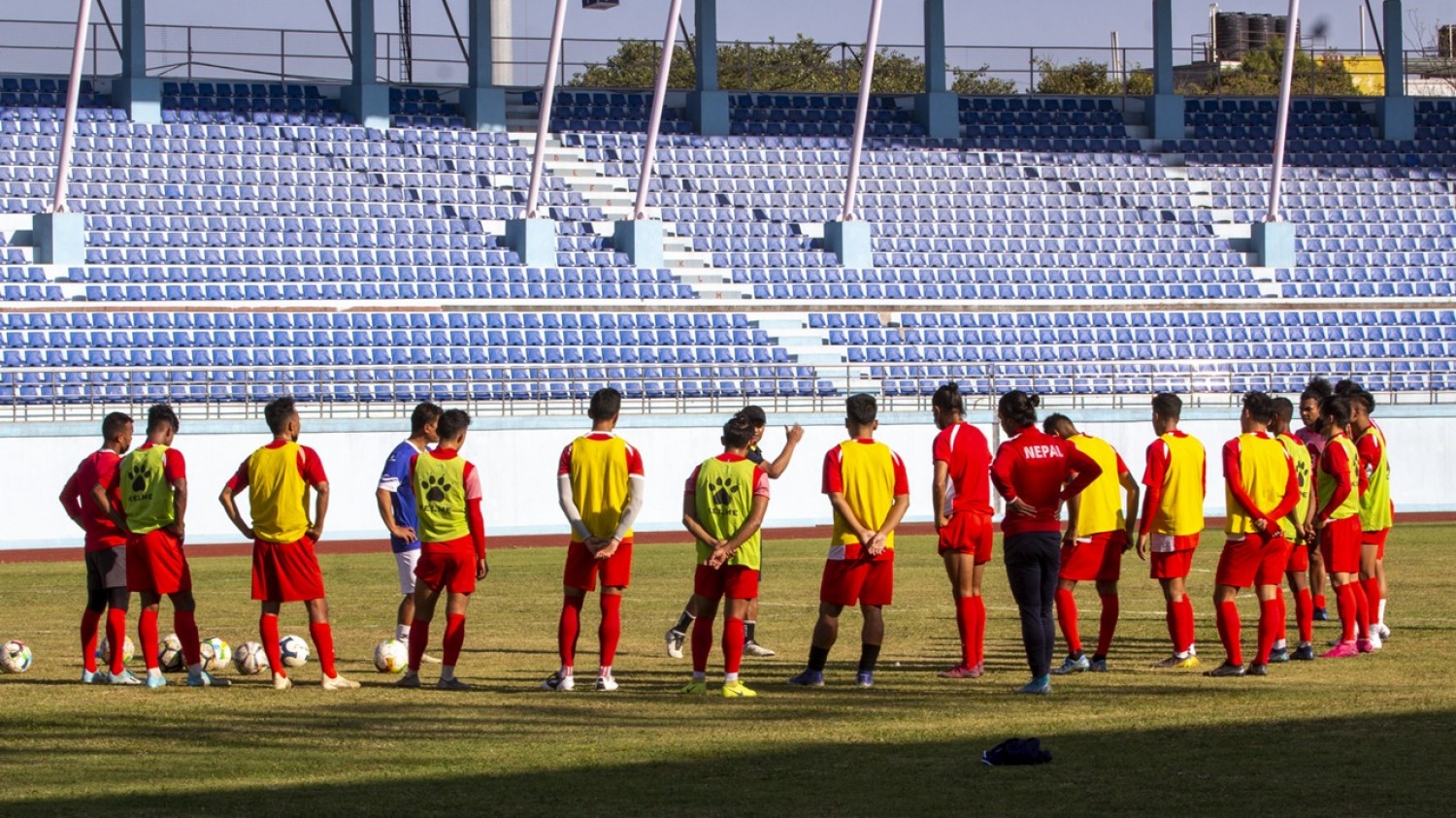
ANFA selects 58 players for closed camp training. File photo
Clubs entered limbo, unable to plan training or contracts. The suspension also impacted grassroots and district-level activities, as the NSC directed statute revisions.
Economically, sponsors and stadium operators suffered losses from cancelled fixtures. By April 9, no domestic competitions had resumed, compounding earlier issues like the March 2026 friendly cancellations.
This has demoralized athletes, reduced match practice, and risked talent migration. The crisis has been described as Nepali football hitting “another low,” with long-term damage to development pipelines from youth to senior levels.
Which international fixtures and tournaments were directly cancelled or withdrawn due to the crisis?
Several high-profile commitments collapsed. The Nepal vs Hong Kong friendly, scheduled for late March 2026 at Dasharath Stadium, was postponed by ANFA, citing the NSC’s failure to provide timely approvals for stadium use, visas, and logistics issues predating but worsened by the suspension.
Nepal officially withdrew from the FIFA Women’s Series 2026 (Thailand, April 2026), replaced by Indonesia; the opening match was set for April 12.
This stemmed directly from ANFA’s inability to operate under suspension. Broader qualifiers for the FIFA World Cup 2026 and SAFF events face uncertainty.
The crisis also affected preparation for the SAFF Women’s Championship (May-June 2026 in Goa). ANFA’s suspension prevented normal coordination, leading to lost exposure for the national team (men’s and women’s).
Earlier, visa and stadium disputes had already disrupted friendlies. These cancellations not only deprive players of international experience but also cut development funding tied to participation. Media reports note neighbors playing fixtures while Nepal sits idle, underscoring the isolation risk.
What are FIFA’s and AFC’s official stances on the ANFA-NSC dispute?
FIFA and the Asian Football Confederation (AFC) have unequivocally condemned the NSC’s actions as “undue third-party interference,” violating their statutes that guarantee member associations’ independence.
In prior letters (January 16 and March 13, 2026), they reminded ANFA of autonomy requirements.
Following the March 25 suspension and cancelled March 27 congress (which FIFA/AFC representatives had planned to attend), they issued a strong joint warning. They view the NSC’s halt of the electoral process, demands for statute amendments, and three-month suspension as direct breaches of FIFA Statutes Articles 14 and 19 and AFC equivalents.
FIFA/AFC stress that no government or external body may influence elections or operations. Their position is that ANFA must manage its affairs freely, and any suspension by the NSC must be annulled.
Failure to resolve risks leads to immediate referral to the FIFA Council for ANFA’s suspension, the first in Nepali history, which would bar Nepal from all international football, funds, and contacts. They have supported ANFA’s election process as compliant with global rules.
This stance prioritizes football’s self-governance worldwide, placing pressure on Nepal’s authorities. As of April 9, no compromise has been reported, leaving the sport in limbo.
What ultimatum did FIFA and AFC issue, and what are the exact demands and deadlines?
On April 5, 2026, FIFA and the AFC sent a joint communication to ANFA General Secretary Kiran Rai. They demanded that the NSC immediately cancel or annul its March 25 suspension decision and provide written confirmation to ANFA that the ban has “no effect.” ANFA must then resume and finalize its electoral process “from the stage reached prior to the suspension,” that is picking up the halted March 27 Jhapa congress preparations.
The NSC and relevant authorities were given exactly seven days from receipt of the letter to comply. If unmet, the matter goes straight to the FIFA Council for “immediate suspension” of ANFA.
The letter explicitly references the joint visit for the canceled congress and labels the NSC move a clear violation. It requests ANFA to forward the contents to authorities and update FIFA/AFC on developments.
This 7-day window (roughly expiring mid-April 2026) is non-negotiable, with suspension meaning loss of membership rights, competition bans, funding cuts, and no sporting contact with other nations.
The ultimatum underscores FIFA’s zero-tolerance policy on interference, forcing Nepal to choose between national law and international football membership.
Who is Kiran Rai, and why was the FIFA-AFC letter addressed specifically to him?
Kiran Rai serves as General Secretary of the All Nepal Football Association (ANFA). As the senior administrative officer, he is the primary point of contact for international correspondence, including from FIFA and AFC.
The joint letter was explicitly addressed to him because FIFA/AFC protocols require official communication through the association’s designated secretary.
Rai’s role involves day-to-day operations, election coordination, and liaison with global bodies. In the letter, FIFA/AFC instructed him to immediately forward its contents to Nepali authorities (NSC and government) and keep them informed of progress.
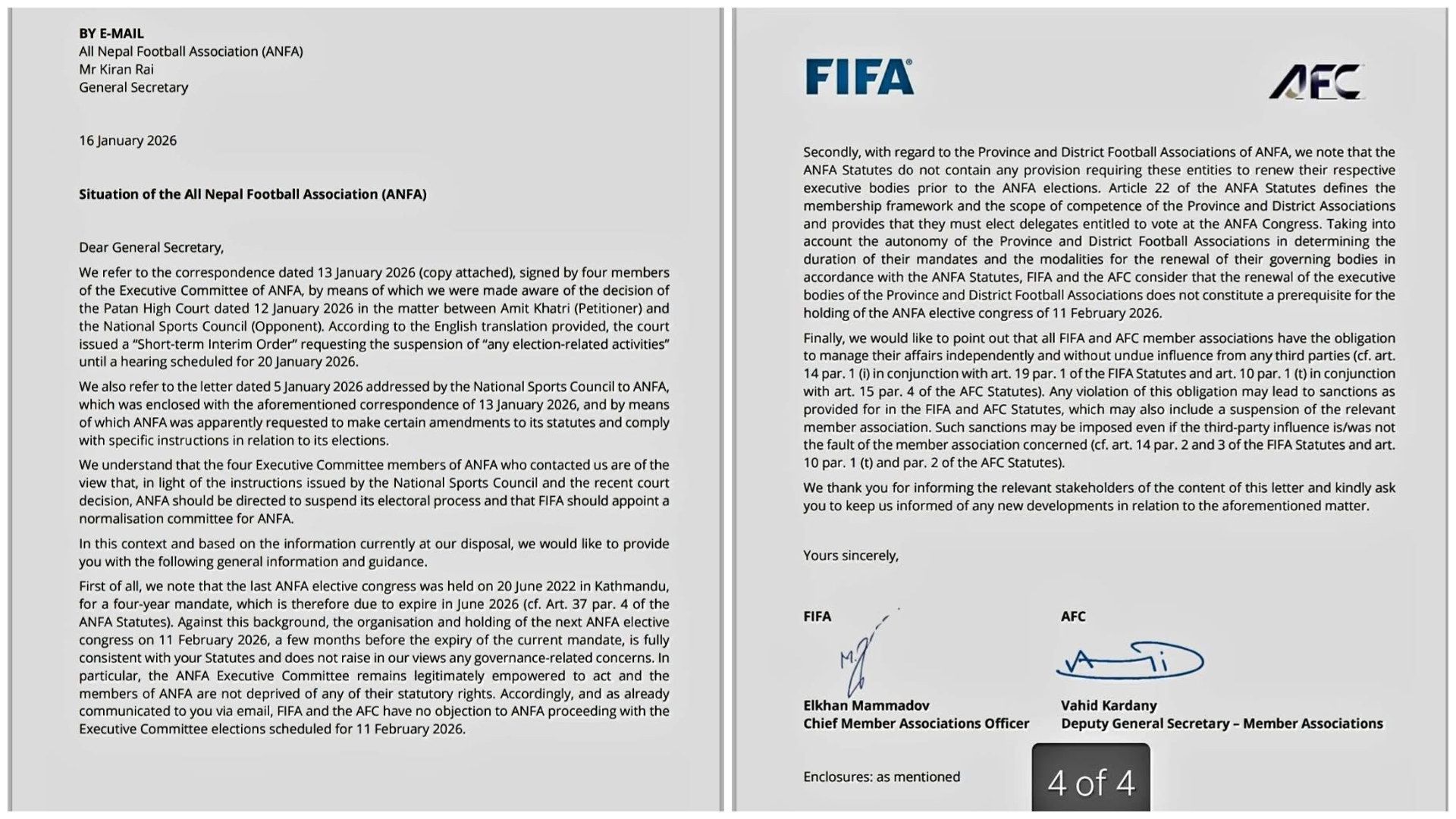
This ensures accountability at the operational level while the suspended executive (including President Nembang) cannot act officially.
Rai has been central in ANFA’s responses to the crisis, relaying warnings about potential bans. His position makes him pivotal in any resolution efforts, as he must facilitate the written assurances demanded.
Addressing him directly maintains formal channels even amid the suspension, reinforcing that ANFA’s internal structure must remain functional under FIFA oversight.
What are the potential consequences if the NSC does not comply with the FIFA-AFC ultimatum?
Non-compliance would trigger ANFA’s immediate suspension by the FIFA Council, with catastrophic effects. Nepal would lose all membership rights, with the national teams (men’s, women’s, and youth) barred from international matches, qualifiers, and tournaments like SAFF or AFC events.
Clubs could not participate in Asian competitions or maintain cross-border contacts. Development funding from FIFA and the AFC critical for infrastructure, academies, and player welfare would be frozen. A full sporting isolation would ensue, prohibiting matches against any FIFA member.
Domestically, this would deepen the current paralysis, with no recognized leagues or events. Players face career stagnation, income loss, and potential exodus. Long-term, talent development halts, reversing recent gains like the 2025 FIFA funding ban lift.
Reputationally, Nepal becomes a cautionary tale of governance failure. The NSC risks broader scrutiny in other sports. ANFA could face internal collapse or court challenges. Experts have warned of “unprecedented uncertainty” and “dire straits” for Nepali football.
Even partial delays risk escalation. Resolution requires the NSC to revoke the suspension in writing within the 7-day deadline, allowing elections to resume. Without it, the current status quo points toward suspension, threatening the sport’s survival in Nepal.
How has the controversy impacted Nepali players, clubs, and the national teams?
Players, clubs, and national teams have borne the brunt. Domestic leagues remain postponed since mid-March 2026, leaving A-Division and lower-tier clubs without matches or revenue.
Foreign players were repatriated due to visa disputes, and local athletes protest via NFPA actions (office padlocks in March). No competitive calendar means lost wages, training disruptions, and skill atrophy, which is especially critical for national team preparation.
Women’s football suffered acutely with the FIFA Series withdrawal (April 2026). Youth programs, already inconsistent, face further setbacks. National teams cannot schedule friendlies or qualifiers effectively under suspension.
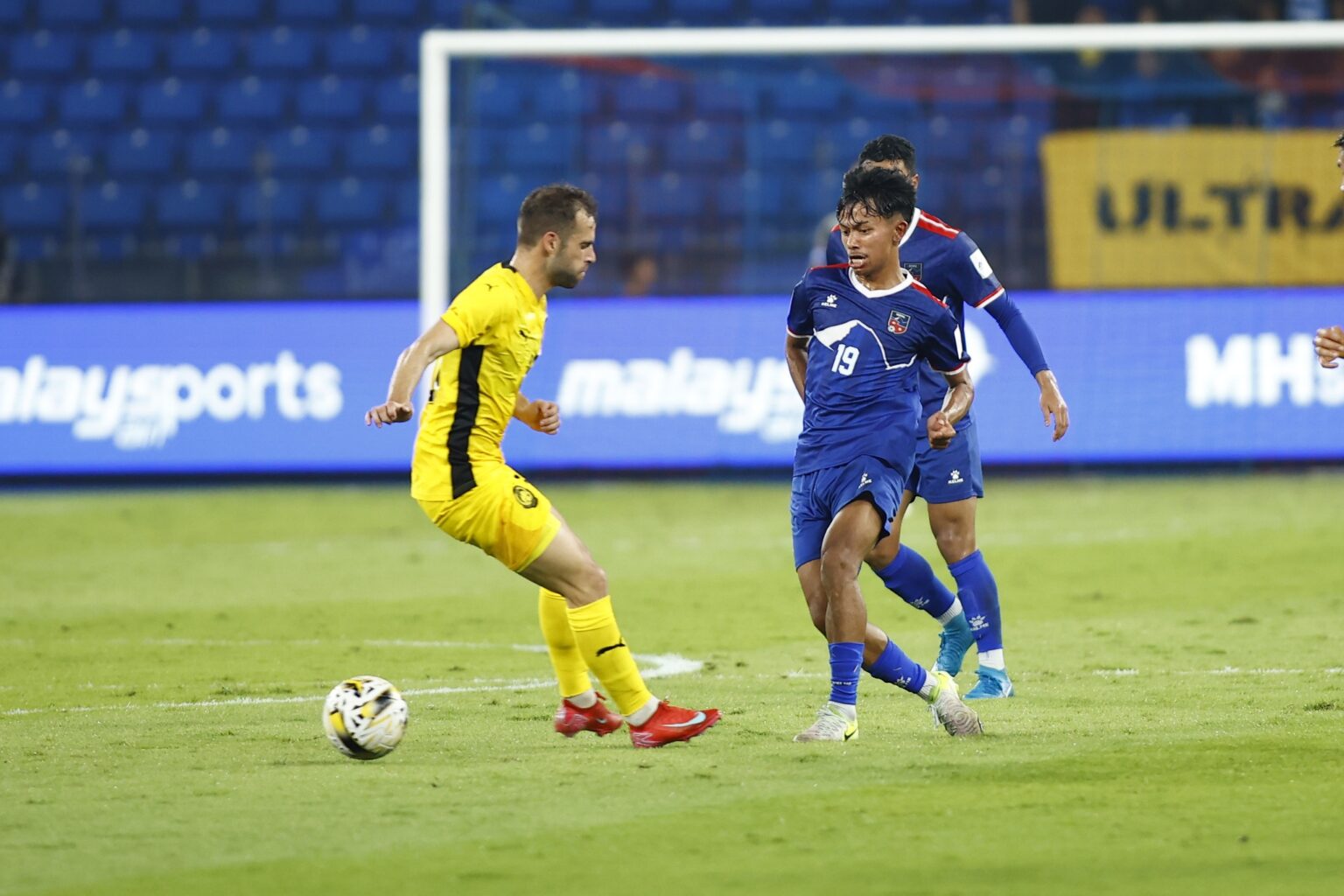
Ayush Ghalan (right) struggles for the ball against Malaysia. File photo
Stars and emerging talents risk demotivation and migration abroad. Clubs report financial strain from stalled sponsorships and operations. The crisis compounds earlier 2026 protests over league delays, eroding trust in ANFA. The uncertainty prevails, with players “under stress.”
Long-term, this could diminish Nepal’s South Asian standing and player pipelines. Recovery demands swift elections and league resumption to restore stability and opportunities.
What economic repercussions has the ANFA suspension caused for Nepali football?
The suspension has inflicted significant economic damage. Leagues generate revenue through tickets, broadcasting, sponsorships, and merchandise; their indefinite halt means lost income for clubs, players, coaches, and support staff.
Stadium operators and local economies tied to match days suffer. FIFA/AFC funding, restored in 2025 after a four-year ban, is now at risk of cutoff if suspension occurs, threatening academy programs, infrastructure (e.g., Dasharath Stadium upgrades), and grassroots initiatives.
Player salaries in professional setups are unpaid amid no fixtures, exacerbating financial precarity in a sport already struggling with limited commercial appeal.
Foreign player visas and imports (key for league quality) have been disrupted, reducing competitive value and sponsorship interest. Broader ripple effects include reduced tourism/sports events and impacts on allied sectors like equipment suppliers. Reports describe clubs “in limbo” and players facing survival issues.
A prolonged crisis could lead to club dissolutions or talent flight, stunting the sport’s economic ecosystem. Resolution via election resumption is essential to unlock funding and restore activity, preventing irreversible losses estimated in the millions for the football economy.
Has there been any resolution to the crisis as of April 9, 2026?
As of April 9, 2026, no resolution has been reached. The NSC’s March 25 suspension remains in force, and ANFA’s elections are still postponed indefinitely. The FIFA-AFC 7-day ultimatum (issued on April 5) has not been publicly confirmed as met, with no reports of the NSC revoking its decision in writing.
Domestic football stays frozen, international withdrawals stand, and media coverage highlights ongoing “brink” status and “uncertainty.” ANFA continues to push for autonomy, while the NSC upholds its legal mandate.
Diplomatic or governmental intervention appears pending, but FIFA’s threat of immediate Council referral looms.
Earlier patterns (example, March 26 postponement) suggest talks may be occurring behind the scenes, yet public updates as of April 8-9 show no breakthrough.
The situation risks escalation into full FIFA suspension if the deadline passes unmet. Stakeholders await official statements from ANFA, NSC, or FIFA confirming compliance or further action.
What is the broader historical context of conflicts between ANFA and the NSC?
Tensions between ANFA and the NSC are longstanding, rooted in recurring governance clashes. Past issues include financial mismanagement (leading to FIFA’s 2021-2025 funding oversight, lifted in July 2025), election delays, and statute disputes.
Similar standoffs over stadium access, league scheduling, and third-party interference have occurred, with ANFA often prioritizing FIFA rules while the NSC enforces national legislation.
Nepal’s football history features turbulent periods; for example, Patan High Court halts elections earlier in 2026, highlighting chronic instability. ANFA’s push for independence frequently collides with the NSC’s regulatory role under the Sports Development Act.
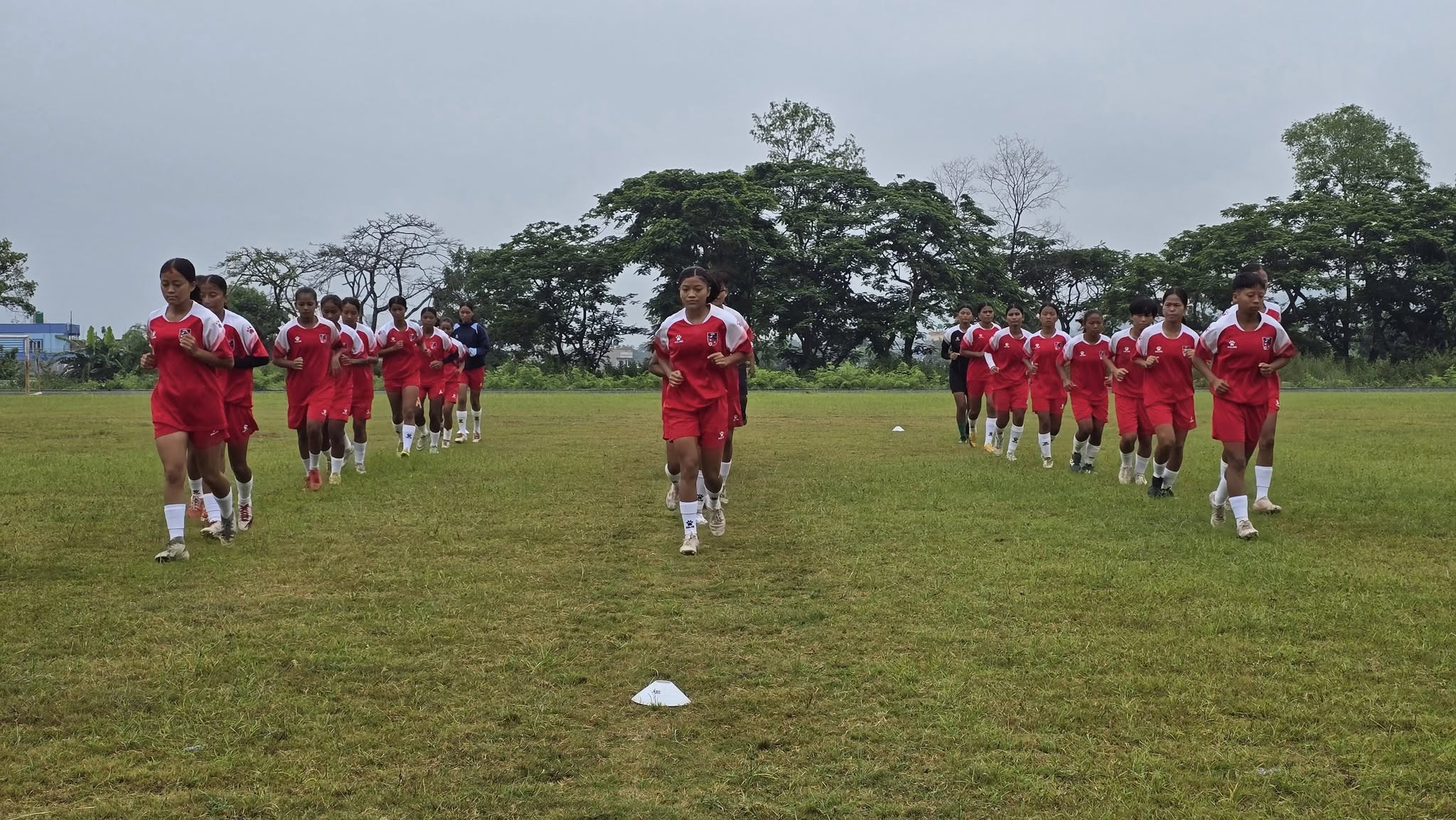
National players in SAFF U-17 training. Photo Courtesy: ANFA
This has repeatedly stalled development, from league postponements to cancelled internationals. The March 2026 events represent the most severe escalation, marking the first full executive suspension and direct FIFA threat.
Historical patterns show temporary resolutions via negotiations, but without structural reforms (clearer delineation of powers), cycles persist.
How does the current crisis compare to previous Nepali football controversies?
Unlike earlier issues such as 2021-2025 FIFA funding bans over mismanagement, player strikes for unpaid dues, or league delays, this crisis is uniquely existential due to the direct FIFA suspension threat.
Past problems were internal (e.g., Sabitra Bhandari funding disputes or A-Division scheduling protests) or financial, resolved without global isolation risk.
The election dispute introduces third-party interference claims, triggering FIFA/AFC’s strictest response. Previous court interventions (e.g., Patan High Court in January) were domestic; here, international bodies are actively intervening with deadlines. Impacts are broader: full activity halt vs. partial delays.
Media calls it an “all-time low” and “unprecedented,” risking the first-ever FIFA ban. While earlier crises affected development, this one endangers Nepal’s entire FIFA membership.
The scale suspension of the full executive, cancelled congress with international observers, and 7-day ultimatum elevate it beyond prior loggerheads over visas or stadiums.
What role do district associations and statutes play in the dispute?
District associations are central, as ANFA’s voting structure relies on them for elections. The NSC directed ANFA to amend statutes and required districts to revise their own and hold fresh general assemblies, moves ANFA resisted as interference.
The suspended executive granted voting rights based on four-year-old district committees, which the NSC deemed non-compliant. FIFA/AFC clarified that statute amendments are not prerequisites for elections, rejecting NSC overreach.
ANFA sees districts as integral to its federal structure under FIFA rules, while the NSC demands alignment with national law for transparency.
The March 27 congress was to include district delegates; its halt froze this process. Resolution requires clarifying these roles to prevent future conflicts, ensuring districts operate independently yet within both national and international frameworks.
Which specific statutes and regulations are at the heart of the ANFA-NSC disagreement?
The conflict pits Nepal’s National Sports Development Act 2020 (and 2022 Regulations) against FIFA Statutes (Articles 14, 19) and AFC equivalents (Articles 10, 15).
The domestic act mandates NSC oversight for elections, approvals, and compliance to ensure accountability. ANFA’s statutes, approved by FIFA, prioritize autonomy and permit early elections per internal rules.
Key flashpoints: election timing/approval, statute amendment requirements, and district voting rights. The NSC insists on adherence to national provisions under Section 29; FIFA/AFC deems any external imposition as interference.
Prior letters reinforced that member associations manage affairs independently. This incompatibility of national sovereignty vs. global autonomy has no easy middle ground without legislative or statutory harmonization.
What steps are needed for resolution and long-term recovery of Nepali football?
Immediate resolution requires the NSC to revoke its suspension in writing within the FIFA deadline, allowing ANFA elections to resume from the pre-March 25 stage. ANFA must then complete polls transparently.
Long-term, Nepal needs dialogue to reconcile domestic laws with FIFA statutes perhaps through amendments or a memorandum clarifying boundaries.
Structural reforms: independent oversight mechanisms, timely league calendars, player welfare funds, and anti-interference safeguards. Rebuild trust via stakeholder consultations (clubs, players, districts). Invest in infrastructure and youth programs once funding resumes. International mediation (FIFA/AFC facilitation) could help.
Without swift action by mid-April 2026, suspension looms, necessitating emergency recovery plans.
Prioritising football’s autonomy while respecting national frameworks is essential to prevent recurrence and restore Nepal’s competitive standing. Stakeholders must collaborate to turn crisis into reform opportunity.
![Niharika Rajput and Binu Yadav stage protest outside Singha Durbar [Photo Feature]](https://english.nepalnews.com/wp-content/uploads/2026/07/745305164_1410029164293095_2856742015611500370_n.jpg)