Kathmandu
Saturday, July 18, 2026





By serving heritage dishes like Siplikan and Koiralo throughout the year, a local eatery keeps traditional culinary culture and historical food preservation knowledge alive
KATHMANDU: A profound craving for home-style comfort food often triggers a deep sense of restlessness for professionals working away from the capital. Having stayed in Besisahar of Lamjung for an extended period for work, nostalgia for Kathmandu began to set in, focused less on the city itself and more on its culinary staple, momo. Observing this intense craving, a local vlogger friend, Arif, offered a solution: “I cannot go myself. I will show you the place to eat momo.”
Being a local, a Muslim, and on top of that, a vegetarian, there was no question of Arif entering; the place he spoke of was near his house in Bhimsenthan named the One Door Momo House or ‘Ek Dhoke Momo Ghar’ in Nepali. However, it was the kind that outsiders would not see on the inside. Dropping me off from the vehicle and showing the place, Arif said, “The boys say it is the place where the best momos are found, do try it.”
However, there were not only boys there; everyone from young men and women to grandfathers and grandmothers was present. Some were enjoying the momo with soup, while some were with only pickles without soup. Seeing me standing near the counter for some time wondering if money had to be paid beforehand like in some momo shops in Kathmandu, a brother of the shop said, “Please sit down. What would you like to have?
“Buff” (buffalo meat), a small voice came out of the mouth. He said to a woman cooking momo together with him, “One plate of buff momo.” Seeing a place for one person to sit among the packed tables, I went that way. The brother sitting there also shifted himself a little toward the corner. The three of them were enjoying momo with cold beer.
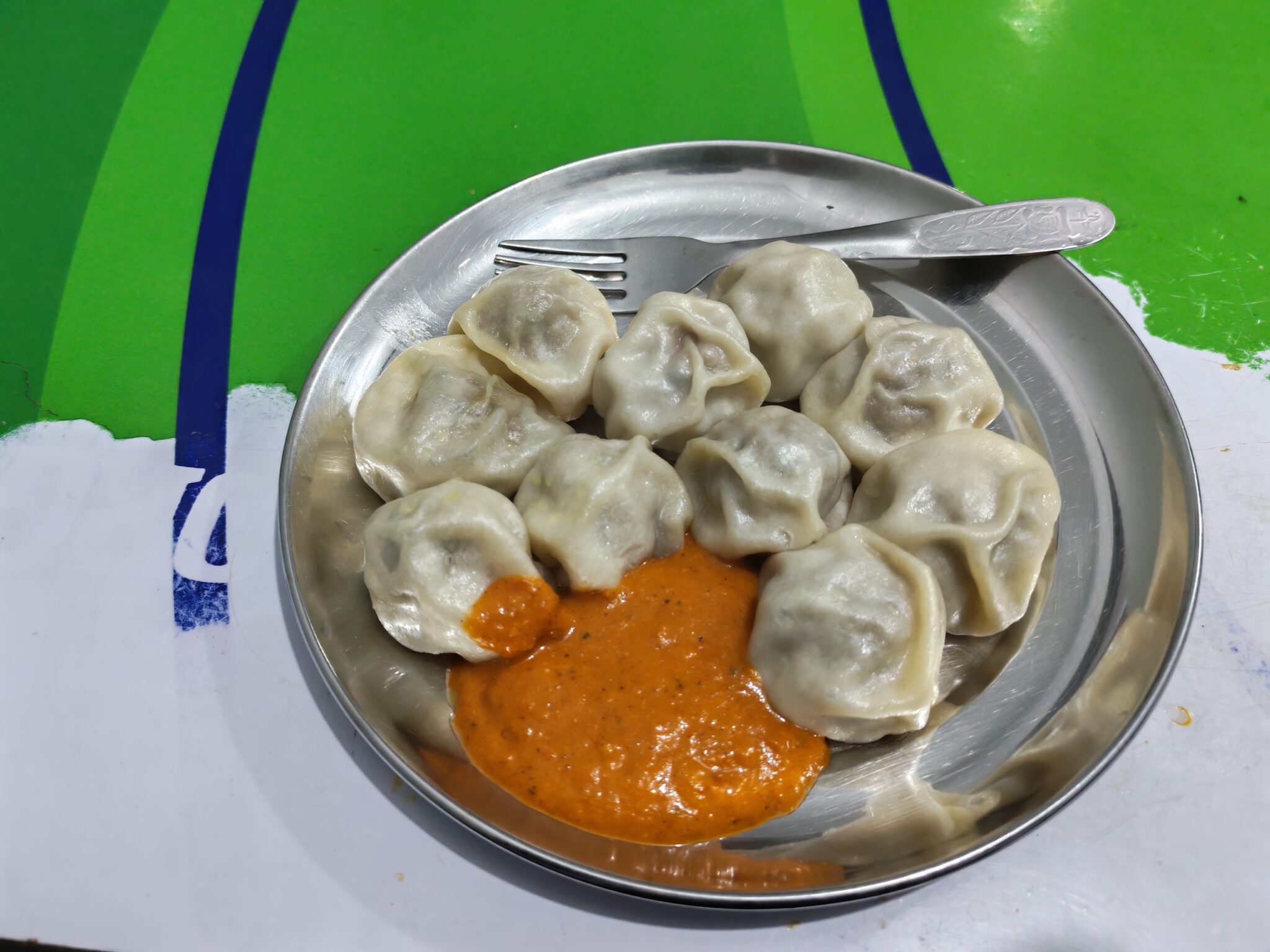
Momo at the ‘One Door Momo House’
At another table, two teenage girls were eating momo while salivating and going “hahahuhu” with the spiciness of the pickle along with a sweet drink; on the table along with the momo plate was a pile of napkins used to wipe their mouths. At a table toward the front, a mother and father, placing their plump baby right on top of the table, were teaching the baby to eat momo.
My mind, which until a while ago was feeling homesick for Kathmandu City and its food, had already started to enjoy itself. The momo arrived, the chutney arrived. It turned out to be an excellent momo with a thin dough wrapper, soft and juicy meat, a spicy-sour pickle, and perfectly cooked momo. It was fun. Everything was licked clean, including the chutney. Then, after paying the money, I went on my way. Truly, it was not called the “best momo” for nothing.
While walking aimlessly on the road with a delicious mouth and a happy mind, I met again the dear brother Om Prakash Gurung of the Ghalegaun Hotel and Lodge in Besisahar. A friendship had formed with this brother, whom everyone calls Ompe and who is half my age, while staying at his hotel a few years ago. Ompe, whom I had just met in the morning to have tea, walked away after giving an authoritative invitation, saying, “Come to eat lunch tomorrow morning around 12 o’clock, okay?” Did he also perhaps see disappointment on my face in the morning?
The next morning, I went walking slowly; they gave a wonderful welcome with hot rice, chutney, buried pickle, vegetables, black lentil, and delicious, juicy goat meat. Since I had stayed in this hotel for seven to eight days and eaten all three meals a few years ago, it feels just like home. The taste of the food from that time had not changed. It was eaten heavily; the stomach was filled but the mind was not filled. Even so, thanking Ompe and chewing fennel seeds, I went toward my work.
The next day after that, I went for the first time with Ompe and Bikram Neupane to Gham-Chhaya Restaurant. It was a place whose name I had heard a lot but had not received an opportunity to go to. While descending from Manange Chautara toward the Sahaji Stream in northern Besisahar, there comes the Sahaji Stadium and the official bus park of Besisahar. Right in front of that very thing is the Gham-Chhaya Restaurant. A midday feast was eaten heartily there. While eating, Ompe was saying, “My friend does not eat rice at all; it makes one embarrassed to add more oneself, and the money does not get recovered at all.” In fact, rather than the rice in the middle of the plate, the green vegetables, pickle, and chutney placed around it are of higher importance, aren’t they? Gham-Chhaya had given all kinds of vegetables and chutney according to the season along with the rice. The mind was enjoying just that. This was a matter of five to six months ago.
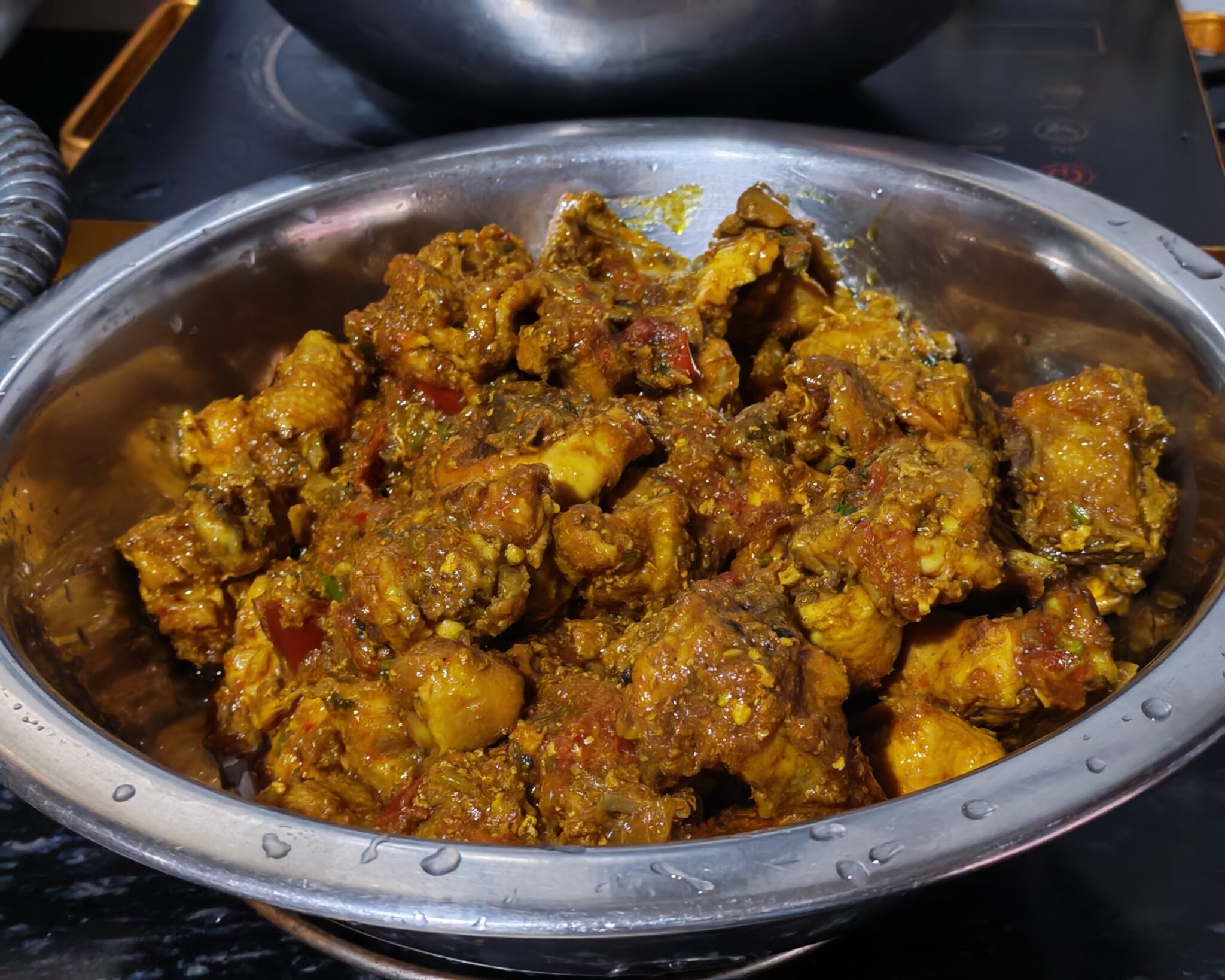
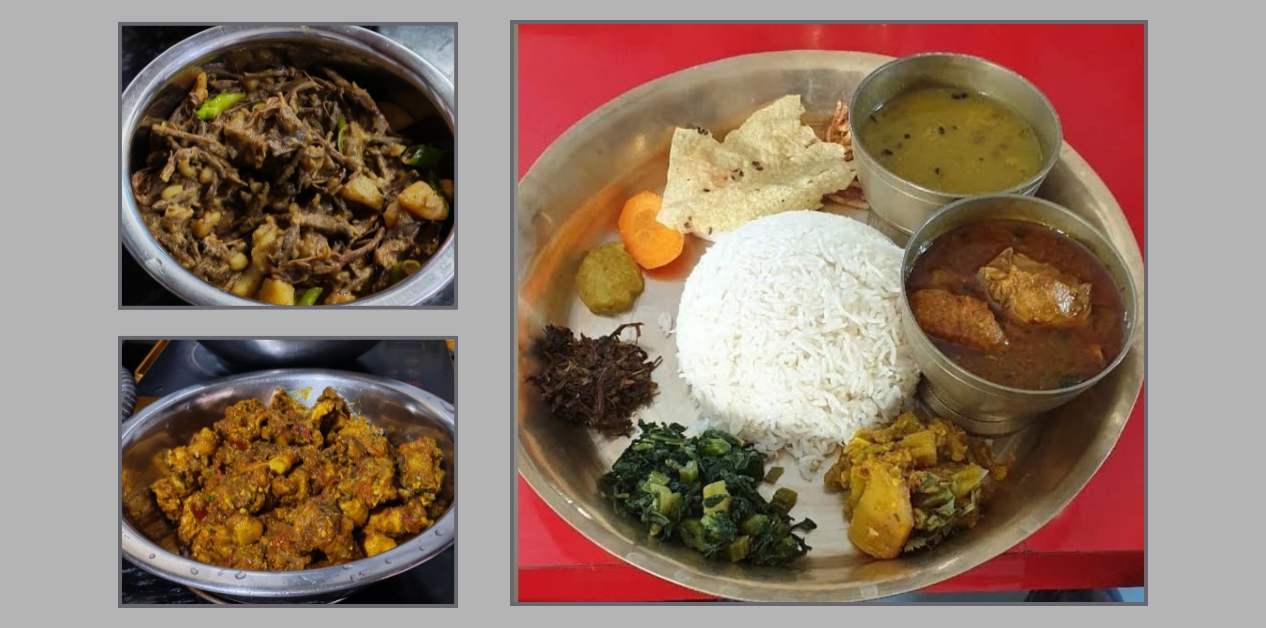
Local Chicken
When going to Besisahar last week, an opportunity arose again to eat rice at Gham-Chhaya. Only after co-owner Kamla Shrestha served the rice and placed it on the table did I remember; Siplikan (Crateva religiosa) and Koiralo (Bauhinia variegata), which are found only in the spring season, were sitting with great pride on that plate. Ethnobotanical (combined study of botany and anthropology) studies, however, have looked at Siplikan and Koiralo, among others, as famine food in Nepal and India.
Around the year 2012, a study conducted by Local Initiatives for Biodiversity, Research and Development (LI-BIRD) regarding the plants eaten by the Chepang community showed that after the harvest from farming became insufficient, among the main sources they collect from the forest to sustain life, Siplikan, Koiralo, and Gittha-Vyakur (Dioscorea) are prominent. An ethnobotanical survey conducted on the Raji community, published in the Journal of Applied Science and Biotechnology, has also shown that when the grain store of the house reaches zero, they manage their meals by eating the flower of Koiralo as a vegetable or pickle.
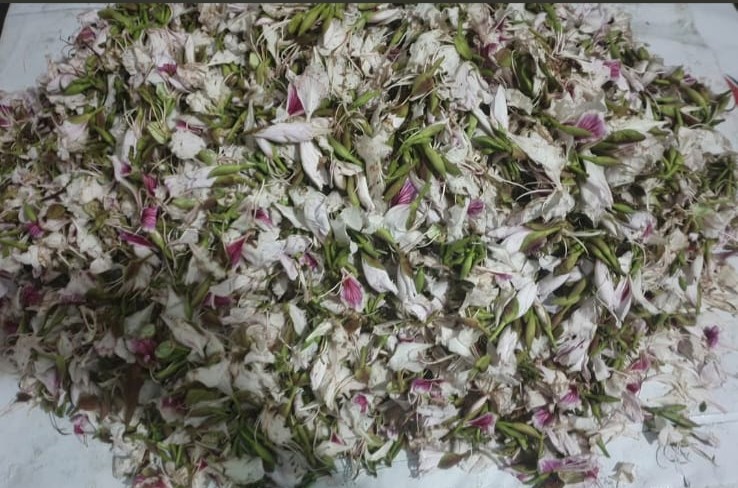
Koiralo (Bauhinia variegata)
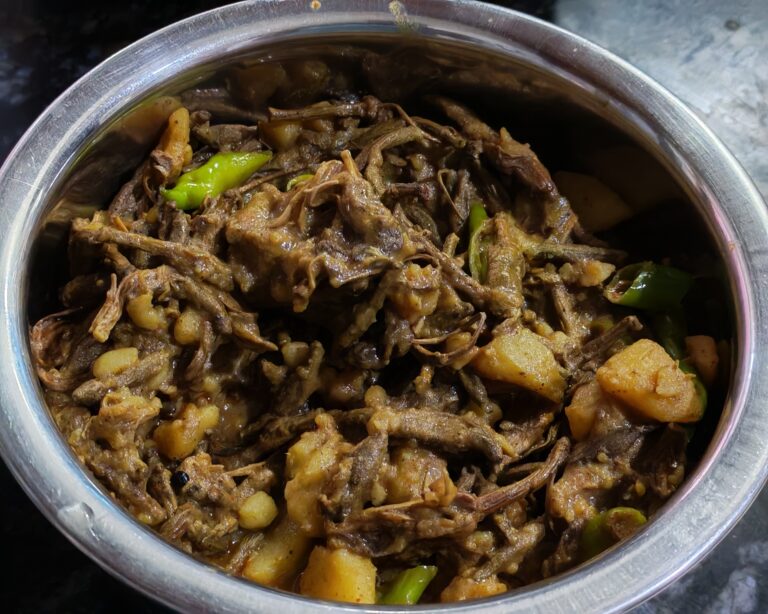
Pickle of Koiralo (Bauhinia variegata)
The young leaves and shoots of Siplikan are rarely eaten elsewhere the way we Nepalis do. Because it is very bitter, was its vegetable eaten only after a famine occurred? The Chenchu tribe of southern India eats it in the exact same way we do. In two districts of the Yunnan Province of southern China, Siplikan is also eaten. Similarly, in China, the young leaves and shoots of Siplikan are collected and mixed with coarse salt to make a pickle-like thing called ‘Sutou Tsai‘, the meaning of which is ‘vegetable plucked from the top of the tree’. In the rest of the world, however, the bark, fruit, root, flower, and leaf of Siplikan, which is described by Ayurveda as Varun, are used for its medicinal properties.
Seeing famine food in one’s own plate, that too during the rainy season, it is natural to be completely astonished. On top of that, even though I stayed in Kathmandu City throughout the spring, that is, the months from March to June, I don’t know from where our father used to bring it, the vegetable of Siplikan was cooked in every meal, and the pickle of Koiralo was made. Therefore, as soon as I tasted the Siplikan served in the platter of the Gham-Chhaya Restaurant, the tastes of childhood came surging throughout the mind, and I remembered mother dropping Siplikan splat on top of the rice while saying, “It is a bit bitter, will you eat it or not?” On top of that, sprouts were not seen anywhere in the market, but the vegetable of sprouts and green soybeans were served in a grand manner in the platter of Gham-Chhaya tender sprouts, sprouts that could be chewed smoothly and tasted without any fiber getting stuck in the teeth.
To gather all these things, the owner of the Gham-Chhaya Restaurant, Tulsi Narayan Shrestha, has to do a lot of hard work. He says, “One wanders around all the surrounding villages. One searches and brings whatever vegetable is found. Many old contacts also bring and give them.”

Asala fish commonly known as snowtrout (Schizothorax richardsonii)
Even when calculating, this time he has bought about Rs 40,000 worth of Siplikan shoots alone. Tulsi Narayan says, “After bringing Siplikan and Koiralo by buying them, we clean them, then steam and dry them to preserve them. Then when needed, we soak them in hot water and make vegetables or pickle.”
Sprouts and Niuro (fiddlehead fern), however, have not been stored that way. Because they are found naturally for a slightly longer time, it has not appeared that necessary. Tulsi Narayan says, “Various species of Niuro are found until the months of September/October.” Rather, Tama (fermented bamboo shoots) is soured and preserved for the whole year at Gham-Chhaya.
That is why the fame of the Gham-Chhaya Restaurant in Besisahar is in the fact that if one must order in time, they will make any kind of food. Whether it is Asala fish commonly known as snowtrout (Schizothorax richardsonii) from places like Dordi, Kisedi, and Khudi, or goats that have eaten only grass in the villages, arrangements for everything are made. This work of Tulsi Narayan’s has been continuous for the past 23 years. The couple Tulsi Narayan and Kamla initially ran a hotel at Manange Chautara for about six years. After that, they came in front of the Sahaji Bus Park, and now, for 17 years continuously, they are sitting and feeding Nepali food that is about to disappear.
The owner of the Gham-Chhaya Restaurant, Tulsi Narayan Shrestha, states that he has not done any advertisement anywhere about Gham-Chhaya. Why does the owner even need to advertise in a place where the food itself starts to advertise? After the desire to eat delicious food was fulfilled, while heading uphill toward Besisahar, I felt that even if he did not advertise, when coming to Besisahar, Gham-Chhaya had already become a destination that one must go to for indigenous food items and our original food culture.