Kathmandu
Thursday, June 4, 2026





Leader over legacy, face over vision
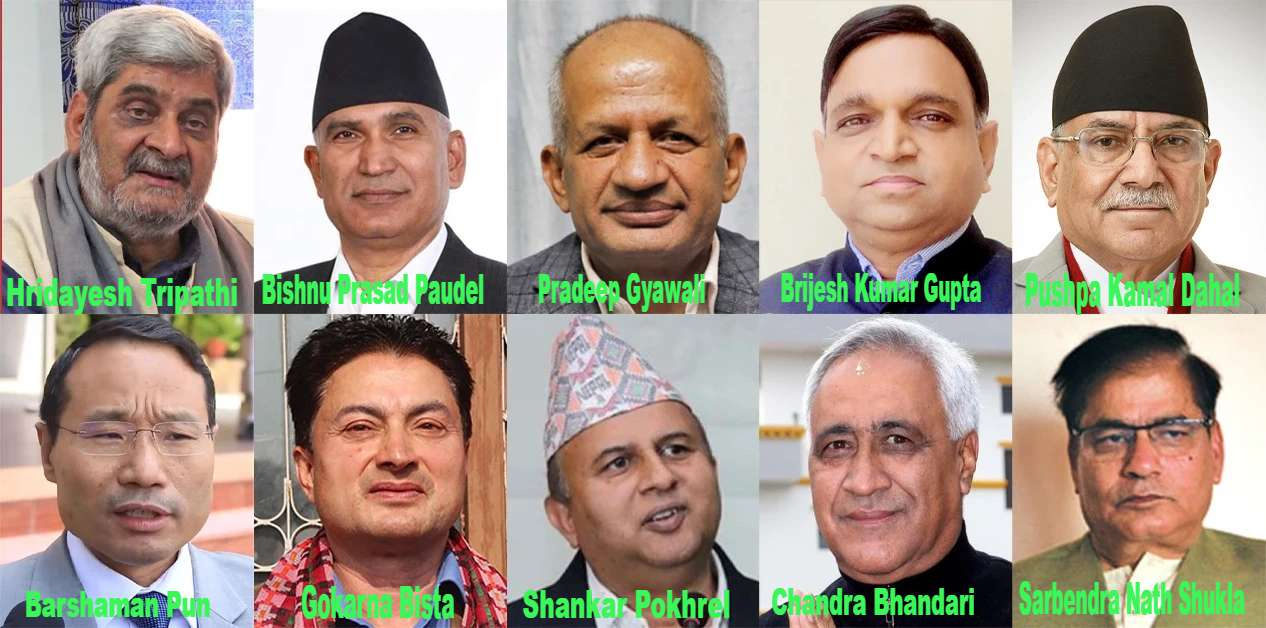
BUTWAL: In Lumbini Province, elections are not just about new faces or fresh promises. They also reflect how the same long-serving leaders continue to hold on to power. For the past 30 to 40 years, many of these politicians have repeatedly returned to voters, seeking mandate after mandate and remaining central to the province’s political landscape.
The past of Hridayesh Tripathi from Nawalparasi, known as a seasoned leader of electoral politics, is similar. A candidate from the Nepal Sadbhawana Party in Nawalparasi Constituency 3 in 1991, Tripathi had defeated Nandlal Mishra of the Nepali Congress and Shanta Manavi of the CPN (UML) at that time. In 1994, he defeated Triyugi Narayan Tharu Chaudhary of the Nepali Congress in the same constituency.
In 1999 as well, Tripathi became a Member of Parliament by defeating Triyugi Narayan. In 2007, after forming the Madhesh-centric party Terai Madhesh Loktantrik Party (TMLP) and contesting in Nawalparasi-6, he became a Constituent Assembly Member by defeating Devkaran Kalwar of the Nepali Congress. However, in 2013, Tripathi suffered a defeat at the hands of the same Kalwar. But in 2017, Tripathi became a Member of Parliament again by defeating Kalwar. In 2022, however, he was defeated by Binod Chaudhary of the Nepali Congress.
Even 39 years after his first electoral experience, there can’t be seen any fatigue in Tripathi. He is in the electoral field again from the Janata Samajwadi Party in Nawalparasi Bardghat Susta Paschim-1. During this period, he has also become a minister five times.
Another clever player in the parliamentary politics of Lumbini is Brijesh Kumar Gupta of Kapilvastu. Having won the election from the Rashtriya Prajatantra Party (RPP) in the parliamentary election of 1999, Gupta is now in the electoral field from Kapilvastu-2. The Nepali Congress leader Deep Kumar Upadhyaya, who fought alongside him in the 1999 election, is no longer in active politics.
Previously, Gupta had won elections from Kapilvastu-3 in the first and second Constituent Assembly elections of 2008 and 2013. Having defeated Nepali Congress leader Surendra Acharya in the 2017 election, Gupta was defeated by Acharya himself in 2022. Although he had announced his resignation from the CPN (UML) during the Gen Z protest after winning as a Member of Parliament (MP) from RPP, TMLP, and CPN (UML) in parliamentary politics, he eventually returned to the CPN (UML). Having won as an MP four times, Gupta has been in parliamentary politics for 26 years.
Having defeated Nepali Congress leader Surendra Acharya in the 2017 election, Gupta was defeated by Acharya himself in 2022.
Another person active in parliamentary politics for decades is CPN (UML) Vice Chairman Bishnu Prasad Paudel. Having won his first election from Palpa-3 in the 1994 election, Paudel has already become an MP five times and a minister eight times. Having become the Minister for Youth and Sports in 1997, Paudel has already served as the Finance Minister two times.
Defeated by Nepali Congress leader Surya Prasad Pradhan in Rupandehi-3 in 1999, Paudel defeated Pradhan himself in the 2008 Constituent Assembly election. Since then, Paudel has been continuously victorious from Rupandehi-2 in the elections of 2013, 2017, and 2022. Having finalized his candidacy in Palpa-2 for the March 5 election, Paudel returned to Rupandehi-2 at the last moment.
Another leader is Gokarna Bista of Gulmi. Having entered electoral politics in 1999, Bista has achieved victory in four out of the five elections in the meantime. Having fought his first election at the age of 34 in 1999, he defeated the then president of the Nepali Congress, Trailokya Pratap Sen. He achieved victory in the elections of 2013, 2017, and 2022. This time, he is in the electoral field in Gulmi Constituency-2 against Bhuwan Shrestha of the Nepali Congress and Govinda Panthi of the Rashtriya Swatantra Party (RSP).
Sarbendra Nath Shukla of Rupandehi is known as another player in parliamentary politics. Shukla is currently in the electoral field from Rupandehi-4. After being defeated while contesting from the Surya Bahadur Thapa-led Rashtriya Prajatantra Party (RPP) in the 1991 election, Shukla was elected as the vice chairman of the District Development Committee of Rupandehi in the fiscal year 1992/93. In the election held in 1994, he was elected as a Member of the House of Representatives from the RPP.
Another leader is Gokarna Bista of Gulmi. Having entered electoral politics in 1999, Bista has achieved victory in four out of the five elections in the meantime.
Having become the Assistant Minister for Water Resources in the fiscal year 1995/96, Shukla had already handled the responsibilities of Commerce Minister, Minister for Information and Communication, Minister for Culture, Tourism and Civil Aviation, Minister for Forests and Soil Conservation, and Land Reform Minister in the fiscal year 1997/98. Having suddenly become the Chairman of the Nepal Electricity Authority in the fiscal year 2004/05, he played a role in the establishment of the TMLP immediately after the 2006 People’s Movement II. When Madhav Kumar Nepal became Prime Minister in 2009, Shukla, who became the Education Minister, was elected as a Member of the House of Representatives from Rupandehi-6 in 2013 and from the Loktantrik Samajwadi Party (LSP) in Rupandehi-4 in 2022.
Having tasted power repeatedly, he is now a candidate in Rupandehi-4 from JSP Nepal, formed after the unification between JSP Nepal and LSP.
A famous player of Nepali politics, former Prime Minister and Coordinator of the Nepali Communist Party (NCP), Pushpa Kamal Dahal, has also arrived in Rukum Purba of Lumbini Province in his travels. Having come to Rukum Purba as the sixth electoral constituency of his political life, he had previously fought elections from Kathmandu, Rolpa, Siraha, Chitwan, and Gorkha.
Barshaman Pun of the NCP was victorious from Lalitpur-1 in the first Constituent Assembly election in 2008. Defeated in Morang-1 in 2013, Pun won the elections from his home district, Rolpa-1, in 2017 and 2022.
Pun is among the leaders who receive repeated opportunities from the NCP. Having become the Minister for Peace and Reconstruction in the Council of Ministers led by Jhala Nath Khanal in 2011, Pun handled the Ministry of Finance in the government led by Baburam Bhattarai in 2011 itself. In 2018, he became the Minister for Energy, Water Resources and Irrigation in the government led by KP Sharma Oli. Pun is a candidate in Rolpa-1 on behalf of the NCP this time as well.
Another leader who has been fighting elections for a long time in his political journey is CPN (UML) General Secretary Shankar Pokhrel. This is the seventh election for Pokhrel, who is a candidate in Dang-2 this time. Victorious from Dang-2 in 1994, he was defeated by Krishna Kishore Ghimire of the Nepali Congress in 1999. In the second Constituent Assembly election of 2013, he was defeated by Buddhiram Bhandari of the Congress in Dang 4. In the first Constituent Assembly of 2008, however, he was a proportional representative. At that time, he became the Minister for Information and Communication.
In the general election of 2017, Pokhrel fought the election for the Provincial Assembly. Elected as a member of the Lumbini Provincial Assembly by defeating Kamal Kishore Ghimire of the Nepali Congress with the strength of the Left Alliance, Pokhrel became the Chief Minister from February 15, 2018, to August 11, 2021. Having fought the election for Member of the House of Representatives again in 2022, he was defeated by Rekha Sharma of the then CPN (Maoist Center) by 193 votes.
Another leader who has been fighting elections for a long time in his political journey is CPN (UML) General Secretary Shankar Pokhrel. This is the seventh election for Pokhrel, who is a candidate in Dang-2 this time.
The Nepali Congress leader Chandra Bhandari and CPN (UML) leader Pradeep Gyawali of Gulmi are clashing for the fifth time. Since the election of 2008, these two have been each other’s competitors. Elected in 1999, Gyawali was victorious by defeating Bhandari in the elections of 2008 and 2017. When Bhandari was victorious in 2013 and 2022, the nearest rival was Gyawali himself.
A leader of Banke who started electoral politics from the first Constituent Assembly election of 2008 is Mohammad Istiyak Rai. An expert in changing parties, he has become a candidate from the CPN (UML) in Banke-2 this time.
In terms of candidacy, this is Rai’s fifth election. In the election of 2022, he won the election as a candidate from the Janata Samajwadi Party (JSP), Nepal. Having started politics from the Rashtriya Prajatantra Party (RPP) in 1996, Rai entered the Upendra Yadav-led Madhesi Janaadhikar Forum during the People’s Movement of 2006. Having given his candidacy from the Forum in the first Constituent Assembly election of 2008, he was elected from Banke-2. In 2011, he became the Minister for Labor and Transport Management in the government led by Jhalanath Khanal. In the election of 2013, however, he was defeated.
Elected from the same constituency in the parliamentary election of 2017, he became the Minister for Urban Development in the government led by KP Sharma Oli. In 2022, he handled the responsibility of Minister for Physical Infrastructure and Transport in the government led by Sher Bahadur Deuba. In 2026, two days before the registration of candidacy, he left the post of General Secretary of the Janata Samajwadi Party and entered the CPN (UML).
Another old leader of electoral politics is Ghanshyam Yadav Ahir of the NCP. This is the sixth election for Yadav, who has given his candidacy from Rupandehi-1. After being defeated as a candidate for Member of the House of Representatives in Nawalparasi from Rashtriya Janamorcha in 1994, he entered the CPN (UML) and became a candidate again from Rupandehi-1 in 1999. However, at that time too, he was defeated by a narrow margin by Duryodhan Singh Chaudhary of the Nepali Congress. After that, he entered the then CPN (Maoist Center).
Another old leader of electoral politics is Ghanshyam Yadav Ahir of the NCP. This is the sixth election for Yadav, who has given his candidacy from Rupandehi-1.
Elected from Rupandehi-1 in the 2008 election, he became the then Minister of State for Local Development when Baburam Bhattarai was Prime Minister. In the subsequent elections held in 2017 and 2022, however, he suffered defeats.
This electoral picture of Lumbini Province shows the real image of the country’s parliamentary culture. This trend in Lumbini, where the leader is stronger than the party, personal access is more decisive than the organization, and voters choose familiar faces over new alternatives, seems to be challenging the transition of generations and the development of new political ideas.
Analysts say that due to the administrative access of leaders who have been in the house and power for decades in Lumbini Province, their influence on the development budget, the protection and network expansion of cadres and supporters, and contracts for development projects and political appointments, they are always in power.
Analyst Ram Chandra Shrestha says that the fact that the same person has been a candidate for years makes the internal system within the party clear. Saying that some leaders have captured the party and politics, he says, “They are in the mindset of limiting the youth to being cadres and leaders always ruling over them. To some extent, this is also the cause of the Gen Z protest.”