Kathmandu
Tuesday, July 21, 2026





Nepal today stands at a quiet but decisive turning point. The latest electoral churn has once again shown a familiar pattern of fluid coalitions, assertive nationalism, renewed emphasis on sovereignty, and sharp rhetoric around borders and foreign influence. Yet beneath the shifting alliances and campaign slogans lies a deeper question: what kind of Nepal do Nepalis want to build in the next decade? And in that journey, what kind of partnership best supports that aspiration?
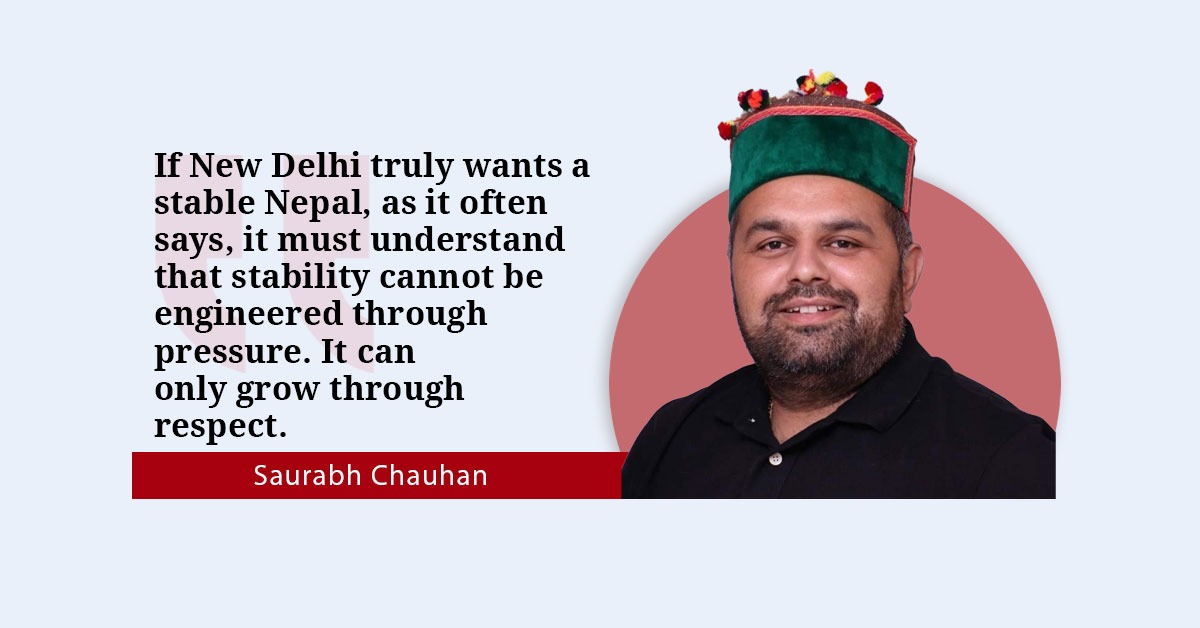
For many Nepalis, sovereignty is not a slogan; it is memory. It is rooted in the fact that Nepal was never colonized. It is expressed in constitutional maps and border debates. It is defended in election speeches that promise dignity in dealing with both India and China. Any external engagement that appears heavy-handed or patronizing naturally triggers resistance. This is where India must reflect honestly. If New Delhi truly wants a stable Nepal, as it often says, it must understand that stability cannot be engineered through pressure. It can only grow through respect.
At the same time, Nepal’s choices are not abstract ideological ones; they are economic and structural. China’s Belt and Road Initiative has offered Nepal ambitious connectivity visions of cross-border railways, tunnels, and industrial parks. The imagery is grand, the announcements impressive. But implementation has been slow, feasibility concerns persistent, and debt sustainability an open debate within Nepal’s own policy circles. The Himalayas are not flat terrain. Infrastructure here is expensive, environmentally fragile, and financially risky. A project that looks transformative on paper can become burdensome if revenue projections fail.
India’s engagement, by contrast, has often been quieter and less dramatic. Cross-border rail links, integrated check posts, power trade agreements, petroleum pipelines, community development grants, and educational scholarships may not capture global headlines, but they touch daily life. India is Nepal’s largest trading partner, its biggest source of remittance linkages, and its most accessible labor market. The open border allows movement without visas. Millions of Nepalis work, study, and serve in India. Economic interdependence is not theoretical; it is lived reality.
This does not mean Nepal should choose India “over” China. Nepal’s strategic autonomy is legitimate and necessary. But when comparing long-term benefits, India’s model of grant-based assistance, deep social integration, shared cultural space, and energy cooperation arguably aligns more closely with Nepal’s economic structure. It avoids heavy sovereign debt. It builds on existing social familiarity. It respects Nepal’s federal democratic framework.
However, for India to remain the more beneficial partner, it must abandon any lingering perception of a “big brother” posture. History has moments that left scars, perceived blockades, political commentary, and over-visibility in domestic transitions. Whether justified or exaggerated, such memories shape public psychology. The new generation of Nepalis is assertive and globally connected. They respond poorly to condescension but positively to partnership.
If India genuinely steps back, allowing Nepal policy space, listening more, and engaging provincial governments and youth entrepreneurs rather than only central elites, it will find that Nepal naturally gravitates toward it. Cultural gravity does not require force. It requires reassurance.
Nepal’s global significance is often underestimated. As the birthplace of the Buddha at Lumbini and as the land historically linked to Janakpur and the Ramayana tradition, Nepal carries immense symbolic capital. In a world where the Global South is seeking alternative narratives of cooperation that are less coercive and more culturally rooted, Nepal can play an outsized role. It can position itself as a spiritual and diplomatic bridge between South Asia and East Asia, between Buddhist-majority societies and plural democracies, and between emerging economies seeking non-aligned cooperation.
India’s own outreach to the Global South through G20 initiatives, development partnerships, and civilizational diplomacy could meaningfully integrate Nepal not as a junior partner but as a co-architect. A Buddhist cultural bloc, linking Lumbini with Bodh Gaya, Sarnath, Kushinagar, and extending toward Sri Lanka and Southeast Asia, could create a powerful soft-power corridor. Nepal would not be a satellite in such a vision; it would be central. The birthplace of the Buddha cannot be peripheral to a Buddhist diplomacy strategy.
The latest elections in Nepal reveal something important: voters are not rejecting engagement with India, nor are they blindly embracing China. They are demanding dignity, delivery, and development. They want roads that work, jobs that pay, institutions that function, and foreign relations that respect national pride. Any partner that helps meet these aspirations without appearing intrusive will be welcomed.
India’s strategic patience is therefore its greatest asset. If it demonstrates that it supports Nepal’s stability without micromanaging its politics, that it invests without indebting, and that it cooperates without overshadowing, it will remain Nepal’s most natural partner. Geography, culture, economy, and human movement already bind the two societies. What is needed now is psychological comfort.
Nepal, for its part, must recognize that proximity matters. Trade routes, energy grids, labor mobility, and supply chains are easier to sustain with the neighbor across an open border than with a distant power across the Himalayas. Balanced diplomacy is wise; reactive diplomacy is not. Stability at home will enhance Nepal’s bargaining power abroad.
In the end, this is not about competition between India and China on Nepali soil. It is about Nepal’s confidence in shaping its own path. A stable, self-assured Nepal can be a pillar of the Global South, a central voice in Buddhist diplomacy, and a democratic example in the Himalayan region. India benefits from that stability, but Nepal benefits first.
If India chooses humility over hegemony and Nepal chooses steadiness over short-term political theater, the partnership will not need enforcement. It will endure naturally, as it has for centuries, which is not imposed but embraced.