Kathmandu
Wednesday, July 22, 2026





I have to admit, I’m not a political expert. But lately, I feel like no Nepali can stay away from politics. The Gen Z moment changed that. Suddenly, the cracks in our system, the decades of inefficiency, corruption, and stagnation, became impossible to ignore. People who had stayed away from politics for years are now following news feeds, social media, and debates closely. I’ve been observing this both from Norway, where I work, and in Nepal, and it’s hard not to notice that something is shifting.
This election caught my attention because it feels like a paradigm shift. A new party, the Rastriya Swatantra Party (RSP), led by young leaders with little traditional political experience, won a landslide victory. It was unexpected, not by older parties, not by analysts, and perhaps not even by the leaders of the RSP themselves. As someone who has studied ICT for development (ICT4D) in Nepal for years, I couldn’t help but see a connection to what Hartmut Rosa calls social acceleration.
Rosa talks about how life today moves fast. Technology, communication, work, and even social expectations are all accelerating. People and institutions feel constant pressure to keep up. In politics, this means voters reward leaders who can respond quickly, connect meaningfully, and resonate with society, rather than those who rely on experience, tradition, or slow bureaucratic processes.
In Nepal, the young leaders seemed to understand this instinctively. They used social media in ways that felt personal and immediate, reaching voters directly instead of relying solely on rallies or party machinery. Among them, Balen, the former mayor of Kathmandu, stood out. He spoke less than traditional politicians, but his words were sharp, direct, and connected instantly with young voters. His popularity on social media became a phenomenon, showing how resonance in an accelerated society works in real time. A lot of young Nepalis live abroad, and they’re used to digital communication, fast information, and rapid decision-making. Many of them influenced their parents or relatives back home, helping shape how people thought about candidates and issues. Older, established parties, meanwhile, were slower to act. They couldn’t connect past promises, present concerns, and future plans in a way that felt meaningful. In Rosa’s terms, they failed to temporalize political time, to make citizens feel that their vote mattered in the larger arc of the country’s future.
Among them, Balen, the former mayor of Kathmandu, stood out. He spoke less than traditional politicians, but his words were sharp, direct, and connected instantly with young voters.
I should also be honest. I didn’t predict this outcome either. I’m part of Gen X, after all. But even from my ICT4D perspective, watching the social media hype around candidates like Balen gave me a sense that something different was happening. Traditional ways of analyzing politics, looking at party loyalty, past performance, or old alliances, just didn’t capture the pace of change. This is where Rosa’s ideas help make sense of things. Society is moving fast, and the political system is being forced to catch up.
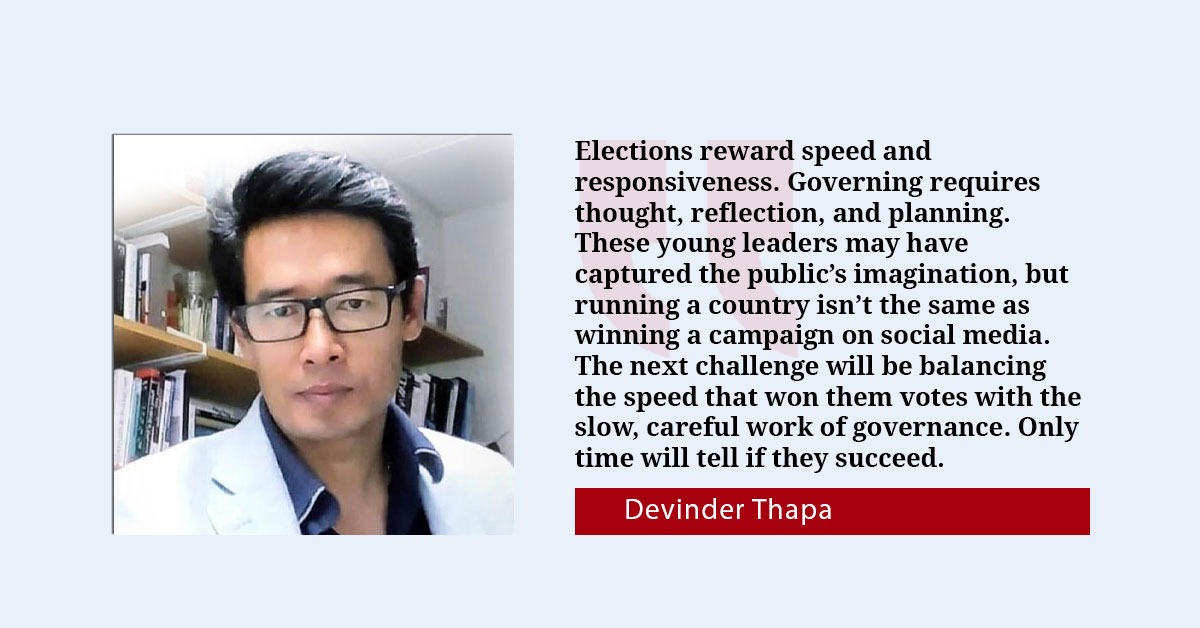
At the same time, Rosa warns about what he calls the paradox of political time. Elections reward speed and responsiveness. Governing requires thought, reflection, and planning. These young leaders may have captured the public’s imagination, but running a country isn’t the same as winning a campaign on social media. The next challenge will be balancing the speed that won them votes with the slow, careful work of governance. Only time will tell if they succeed.
What I find particularly noticeable is how this election illustrates resonance, another idea Rosa emphasizes. People feel connected when leaders respond in ways that matter to their daily lives. In Nepal, that connection mattered more than experience, age, or political lineage. Young voters, and those influenced by tech-savvy diaspora relatives, felt that the new leaders understood their world, their frustrations, and their aspirations. That kind of resonance can make a huge difference in an accelerated society.
Watching this unfold, I can’t help but reflect on my own journey. I grew up thinking politics was untouchable, sacred, and distant. Then I thought it was dirty, full of power games, corruption, and betrayal. Over the years, I’ve learned that politics itself isn’t dirty. It’s human. It carries both potential and flaws. Blaming politics is easy. Staying away is easier. But when we ignore politics, the space is filled by those who see it only as a game. The Nepalese election reminds me that society, and its politics, can surprise us when people, especially young people, engage in new ways.
I also see this personally, as someone who has observed Nepal from both inside and outside. Watching the younger generation and diaspora engage, adapt, and influence political outcomes gives me hope that people are not passive. They are shaping the country’s future through ideas, discussions, and connection, even if they can’t directly vote from abroad. The next few years will show if the speed that won the election can be translated into sustained governance, ethical decision-making and meaningful change.
Technology, generational change, and citizen engagement are reshaping how power works. For Nepal, this is a moment to reflect on how the system can adapt, how governance can meet public expectations, and how citizens can participate responsibly.
Of course, it is not my place to say if this shift is inherently good or bad. The world is changing, and our old ways of predicting or understanding politics aren’t working anymore. Social acceleration is real. Technology, generational change, and citizen engagement are reshaping how power works. For Nepal, this is a moment to reflect on how the system can adapt, how governance can meet public expectations, and how citizens can participate responsibly.
From my perspective, grounded in ICT4D research, this is revealing. The election shows how technology, social change, and generational shifts can intersect to produce something new, unexpected, and transformative. Leaders who understand the speed of society, who can resonate with citizens, and who can respond meaningfully, gain an advantage. Older, more established actors risk irrelevance if they cannot adapt to this accelerated pace.
For now, I’m content to watch and reflect. This isn’t about predicting outcomes or judging winners and losers. It’s about noticing how Nepalese politics is moving faster, more connected, and more responsive than ever, and how ideas from social theory, like Rosa’s, can help us make sense of it. The country is reminding all of us that politics is no longer something that happens “out there.” It is happening in real time, across borders, through technology, and in the hands of citizens, young and old. And maybe, just maybe, that is the kind of change Nepal needs.