Kathmandu
Sunday, July 19, 2026





Political faces change, but the system remains rigged to enrich the elite. A critical look at how structural exclusion and trade misalignments are fueling a quiet anger outside Kathmandu.
KATHMANDU: A government plagued by capitalist monopolism, which enriches the wealthy while breaking the backs of the poor, is treating state resources as its private property and the general public as beggars.
When the games of coalitions and equations concluded and a new government was formed in Kathmandu following the parliamentary elections, a sense of hope emerged even in the heart of twenty-five-year-old Ganesh Nepali, living in a remote corner of Mugu. He felt that the long-suppressed burden of his Dalit identity, the hardship of geographical remoteness, and the generational web of poverty might finally loosen, even if just a little. The slogans of economic reform, job creation, and the upliftment of the common man, broadcasted by the new ministers on radio and television, had reached his ears as well.
However, no matter how modern and optimistic the Kathmandu regime appears, the view from the cliffs of Mugu always reveals its form to be ugly and discriminatory. Just a few months ago, while reading the budget statement in the Federal Parliament, Finance Minister Swarnim Wagle declared with great pride, “This time, we have adopted bold policies to encourage the private sector, increase capital expenditure, and bring economic liquidity to the market. This budget will steer the country’s economy in a new direction.”
Hearing this, it seemed as though the nation was already racing down the path of prosperity. However, analyzing the inner side of these so-called ‘bold policies’ taken by the Finance Minister makes it evident that the same old, cruel face of capitalism—known as neoliberal capitalism—is hidden there. To understand how state policies are formed and whom they serve, one only needs to look at the theories of capitalist critics like David Harvey. According to Harvey, modern capitalist states employ a policy of “accumulation by dispossession,” where public resources, public health, and education are privatized to fill the pockets of a handful of wealthy elites.
The recent policies of the Government of Nepal appear to be based exactly on this principle: tax policy and the protection of large corporate houses. The government’s manipulations of tax rates and the policy exemptions granted to major business conglomerates might flow money into the market, but that money will not reach the hands of proletarians like Ganesh Nepali. That money pours directly into the bank accounts of those very capitalists.
Despite grand declarations of relief and subsidies in the Finance Minister’s speech, social security programs brought for the impoverished, like health insurance, have in practice been left stranded under the pretext of a lack of resources. The affluent undergo treatment by spending millions of rupees in private hospitals, while the poor are left writhing in government hospitals without even receiving a paracetamol tablet.
Under this system, the government and its operators strike the hardest blow against the self-respect of the citizens. Those in power do not view the lower class as empowered citizens, but rather as mere consumers of welfare schemes for their own political interests. Their conduct is as if the state is the private inheritance of the well-to-do, and whatever they give to the poor is not a right, but charity and alms given out of pity. In reality, however, they are merely managers elected for a limited time to run the state system. This feudal and capitalist mindset of someone giving and someone receiving is shameful in itself.
No matter how high the development indices and economic growth graphs are shown to climb in the government offices of Kathmandu, the data on the ground tells a completely different story. According to the National Statistics Office, nearly one-fifth of Nepal’s population (20.3 per cent) is still below the poverty line, and this condition is even more horrific in Karnali. At a time when the youth unemployment rate has reached 20.8 per cent, and in the absence of any concrete employment policies, the nation’s youth are either forced to sell their labor in the scorching sands of the Gulf, or are compelled to take extreme decisions like self-immolation out of helplessness within the country. The common man taking to the streets in tears and the youth resorting to self-immolation at the height of despair is the greatest evidence of this state’s failure.
This story of Ganesh Nepali is not a fable from a faraway land. It is the bitter truth of the present, written by the current government’s anti-poor policies, capitalist interests, and the state’s helplessness. Until the government emerges from grand and heavy rhetoric and brings practical and concrete plans to improve the living standards of the remote, poor, and Dalit youth, the face of this system will remain ugly. If the government continues to treat this sensitive issue as a joke, this anger of the youth could shake the foundations of Singha Durbar any day.
The cruel face of the state
A remote hill village in Mugu. Added to the blows of geographical adversity is Ganesh Nepali, a youth from the Dalit community. He is not just an individual, but rather a vivid and crystal-clear mirror reflecting millions of Nepali youths trapped in the country’s ancient social structure, the ruthless character of the capitalist state power, and the vicious cycle of poverty.
Major political transformations took place in the country. The elections concluded. A new government was formed, carrying the widespread participation and immense hope of the youth. Amidst the despair, it did feel as though rays of hope were emerging here and there. However, as the days passed, it turned out that only the chairs and the faces had changed; policies to alter the destiny of the poor and the marginalized were never made. Indeed, it was not easy to fix this political and administrative system, entrenched for decades, overnight; however, seeing flaws in the very intent is a mockery of democracy itself.
The ugliness of Capitalism
Which path is our state system currently taking? To find the answer, it is enough to look at some dark sides of capitalist theory. German philosopher Karl Marx explicitly stated in his theory that the capitalist system always protects the interests of the upper class and exploits the labor and existence of the proletariat. As French sociologist Pierre Bourdieu noted, the upper class uses the strength of the cultural and economic capital in their hands to mold state policies to their own advantage, forcing the poor to remain excluded from social mobility.
Today, the conduct of Nepal’s government and policy-makers looks exactly like that. The representatives of the upper class who have reached power are treating the state as their private property and the general public as ‘beggars’. They formulate policies as if they are the donors and the rest of the citizens are beggars.
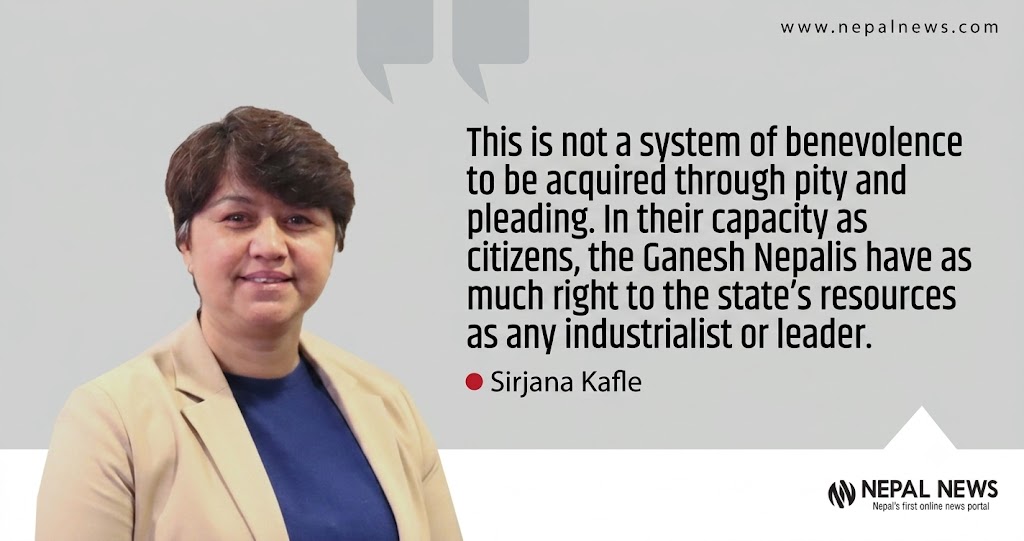
This state is not the private property of the well-to-do or the elite class. Those sitting in Singha Durbar and Parliament are merely operators chosen for a specific timeframe to run this country’s governance and system. This is not a system of benevolence where someone receives out of mercy and pleading. By virtue of being citizens, the Ganesh Nepalis have an equal right over the state’s resources as any industrialist or leader. Unfortunately, the character of the current government is plagued by a form of capitalist monopolism that enriches the wealthy and breaks the backs of the poor. This is the most frightening and ugly face of this system.
No matter how grand the talk, the ground reality is highly terrifying. Recent national and international statistics indicate that this state of Nepal is heading towards failure. According to the Living Standards Survey of the National Statistics Office, about 20.3 per cent of the population in Nepal still lives below the national poverty line. Furthermore, in Karnali Province, where Mugu is located, this rate stands near 26.7 per cent. The unemployment rate among youth aged 15 to 24 in Nepal has crossed 20.8 per cent. This is significantly higher than the global average. Due to the lack of employment opportunities within the country, more than 1,500 youth are forced daily to go and sell their sweat in the Gulf and Malaysia.
While slogans of ‘Digital Nepal’ and ‘Prosperity’ echo in speeches, the minimum health right of the common man—the health insurance program—has been left stranded. Landless settlers are forced to walk around weeping like refugees on their own land. Due to the lack of concrete work in solving the problems of poverty and unemployment, the same old despair persists among the people. It is tragic that a situation has arisen where youth, feeling helpless inside the country due to frustration and psychosocial problems, resort to self-immolation.
However, self-immolation and suicide are not solutions. One must secure their rights by living, by keeping the struggle and hope alive, by questioning the state, and by making it accountable. Having said this, it becomes highly sensitive when a situation arises where citizens lose hope and take wrong steps because they fail to feel the presence of the state. This situation is ‘state failure’.
Become serious, government!
There are hundreds of crippling problems in society. Until concrete and practical plans are brought forth to reach the root of those problems and lift the living standards of the poor, marginalized, Dalit, and remote citizens, political transformation holds no meaning.
Without instilling hope in the lives of the youth and without creating an environment for them to labor within their own country, this nation is going nowhere, no matter how grandly the leaders speak. Therefore, the government must stop its jokes or tactical maneuvers regarding this sensitive and serious issue concerning millions of youths like Ganesh Nepali. This system and government stand on the blood and sweat of the poor; the game of starving them to nourish a handful of capitalists must be stopped immediately. Government, become serious now!