Kathmandu
Thursday, July 16, 2026





Nepal's energy success story has outpaced its economic impact. The next phase of development depends on turning surplus electricity into jobs, industries, local enterprise, and sustained economic growth.
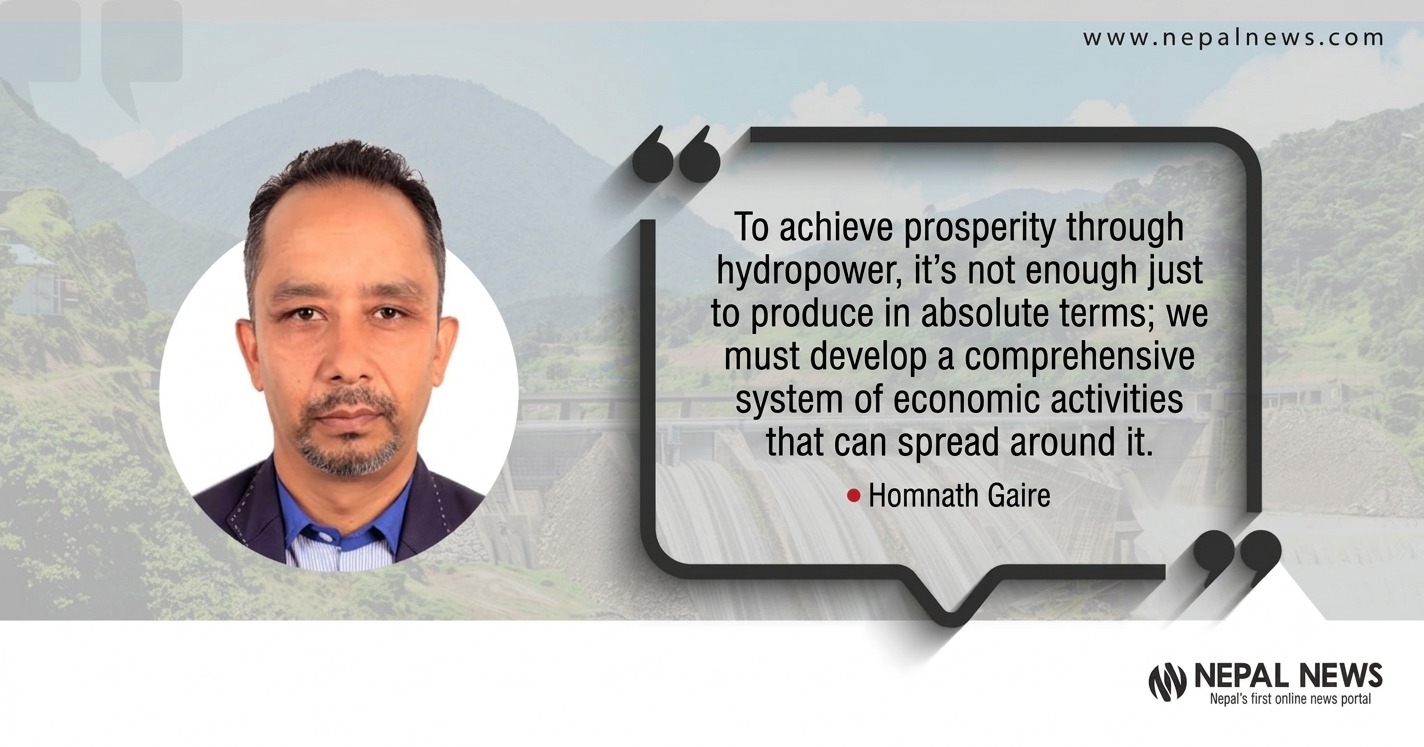
KATHMANDU: Hydropower is frequently championed as the ultimate engine of economic prosperity in Nepal’s development discourse. This perspective is not without merit, given that Nepal’s perennial Himalayan rivers make it one of the world’s richest countries in water resources. Emerging from the economic liberalization of the 1980s, Nepal’s hydropower sector has made monumental leaps in electricity generation. Driven by private sector entry, expanding foreign investment, policy reforms, and transmission and distribution infrastructure development, the country has successfully transitioned from severe electricity deficits to a structural power surplus.
Generation capacity continues to rise, private investments are pouring in, and the energy sector is widely recognized as the backbone of the national economy. A nation that once endured up to 18 hours of daily load shedding now faces a reality where surplus electricity goes to waste during the monsoon season. On the surface, this is a phenomenal success story. However, a deeper look raises a critical question: Have we mistaken hydropower generation itself for the ultimate goal of development, failing to use it as a tool for broader economic transformation? Or, by failing to link this generated electricity with economic productivity, local value chains, and citizens’ living standards, is this massive investment turning into a systemic risk for the economy?
The current 16th Five-Year Plan (Fiscal Year 2024/25 – 2028/29) identifies agriculture, tourism, energy, and information technology as the primary drivers of economic transformation to achieve the national aspiration of a “Prosperous Nepal, Happy Nepali.” The implication is clear: energy is not an end in itself; rather, it must stimulate agriculture, industry, tourism, information technology, and local enterprises. Rising hydropower generation must be consumed domestically to drive productivity, employment, entrepreneurship, and socioeconomic transformation at the community level. Yet, Nepal’s current practice is drifting away from this core philosophy. We have prioritized celebrating energy generation as an isolated achievement rather than integrating it into the broader economy. This sectoral isolation has emerged as a major vulnerability for the hydropower sector.
Surging production, but where is the consumption?
Nepal’s installed electricity generation capacity has neared 4,500 megawatts. However, domestic peak demand—even during high-consumption evening hours—remains limited to around 2,500 megawatts, dropping significantly during off-peak hours. While around 1,000 megawatts are being exported to India and Bangladesh, another 1,000 megawatts of electricity are regularly wasted. Due to the flawed historical mindset of equating power generation with absolute development, the Nepal Electricity Authority is now forced to direct private producers to curtail their generation.
Conversely, during the dry winter season, domestic demand cannot be met without importing electricity from India. This paradox of wet-season surplus and dry-season deficit is not a production failure; it is the consequence of a mindset that treats energy generation as the sole metric of success, relegating consumption and utilization upgrades to secondary priorities. As a result, billions of dollars invested in hydropower fail to yield the expected economic returns, raising serious questions about the viability of these investments. This misalignment between energy production and utilization has become the greatest challenge of Nepal’s energy policy.
Export trapped in geopolitical currents
Many present electricity export as the ultimate solution. Regional energy trade is undoubtedly an opportunity for Nepal. Power trade with India is expanding, and a tripartite electricity sales agreement has been signed with Bangladesh. However, signing an agreement and actually delivering electricity are two very different things.
To transport electricity to Bangladesh, Nepal is entirely dependent on India’s transmission infrastructure. Existing infrastructure constraints and limited regulatory approvals prevent Nepal from exporting based on actual demand. To the north, energy demand is rising in Tibet, China, but the lack of year-round stable generation, cross-border transmission lines, and effective diplomatic initiatives has left that potential untapped. This highlights a stark reality: while expanding generation capacity might be easy, building an economy based on production alone—without local value-chain market expansion, adequate transmission infrastructure, and skilled energy diplomacy—is economically unsustainable.
Hydropower’s failure to touch the local economy
Most of Nepal’s hydropower projects are located in remote mountainous regions. Project construction brings roads, bridges, and transmission lines to these villages, but the local economy remains largely disconnected from this supply chain. Aside from the mandatory 10% share allocation reserved for local residents during public offerings, the communities in project-affected areas usually receive the least economic benefit.
For local citizens, electricity remains primarily a means to light their homes. The connection between electricity and power-driven agricultural processing, cold storage, irrigation systems, rural tourism, digital enterprises, small and medium industries, or other local economic activities remains weak. Consequently, the very geographies generating the power are missing out on economic transformation. If the generated electricity were channeled into local value-chain industries, agriculture, and services, it would not only create local energy demand but also generate employment, boost incomes, and expand the local government’s tax base.
Another severe flaw in the current development model is the tendency to view infrastructure construction as the final objective. When large hydropower projects are built, roads, tunnels, dams, and transmission lines are constructed. Yet, in the process, local irrigation canals, footpaths, grazing lands, drinking water sources, pedestrian trails connecting farms, and other minor infrastructures are often destroyed. While these structures appear small, they are the lifelines of the local economy and production systems. When these lifelines are severed, local economic activities grind to a halt, leading to the rapid depopulation of villages—a crisis Nepal is actively facing.
Paradoxically, in projects worth hundreds of millions of dollars, virtually no budget is allocated to restore these critical local community assets. As a result, the livelihoods of marginalized communities are further compromised. Today, rural Nepal presents a painful contrast: roads are paved, but villages are emptying; electricity has arrived, but fields lie barren; massive projects are built, but local economies are hollowed out.
Lessons from Budhigandaki
The Budhigandaki project is a glaring example of the heavy economic toll paid when treating hydropower as an isolated engine of prosperity. For years, this project has been trapped in a political carousel, shifting between the authority model and the company model. The debates around it have been dominated by compensation, land speculation, and political self-interest, with decision-makers facing allegations of buying land in the project-affected areas to profit from compensation payouts.
Although the project was identified decades ago and has been heavily politicized, a fundamental question was never prioritized: How do we turn this project into an engine for the local economy? Instead, Arughat Bazar—the second largest economic hub in Gorkha district after the district headquarters—turned into a ghost town because it was designated for inundation, while actual construction never began. The current government is reportedly preparing to convert the project, initially planned as a company-model venture, into a multipurpose development by reducing its electricity generation capacity to maximize local value capturing. If energy is to truly drive economic prosperity, this concept must be applied to all hydropower projects and commercial infrastructure.
By transforming Budhigandaki into a multipurpose project that integrates reservoir tourism, fisheries, irrigation, agro-processing, local industries, water transport, and regional economic development, its economic return will be manifold compared to merely producing 1,200 megawatts of electricity. It could serve as a model for transforming not just the Gandaki and Bagmati provinces, but the entire national economy. Unfortunately, previous administrations and leaders ignored this perspective, focusing instead on scaling up the project’s size to claim political credit or seek illicit gains, completely ignoring the broader economic value the project could create.
Paying the price for siloed thinking
A chronic weakness in Nepal’s policy formulation is compartmentalization. The Ministry of Agriculture designs agricultural policy, the Ministry of Energy drafts energy policy, the Ministry of Industry shapes industrial policy, and the Ministry of Tourism handles tourism policy. Each measures success using its own isolated metrics. But economies do not operate in ministerial silos; they function through integrated value chains. It is these value chains that link hydropower to industry, industry to agriculture, agriculture to tourism, and tourism to intangible local cultural resources. Only when all sectors collaborate to strengthen these value chains will employment, income, and overall productivity rise, enabling the country to achieve its goals of sustainable and inclusive development.
The path forward
With a new generation of leadership in government, the hydropower development model must be redefined.
First, when approving new hydropower projects, the mandatory evaluation must focus on local economic impact and “value capturing” rather than just generation capacity. Instead of measuring a project solely by the megawatts it produces, equal weight must be given to metrics such as how many jobs it creates, how many local enterprises it stimulates, its impact on agricultural productivity, and how much it expands the local government’s tax base.
Second, energy-based industrial clusters must be developed in project-affected areas. This will lower operational costs for agro-processing, cold storage, food industries, digital services, tourism, and small-scale manufacturing, while directly linking generated electricity to immediate markets.
Third, the restoration of local irrigation canals, footpaths, grazing lands, drinking water systems, and other community assets destroyed during construction must be classified as a mandatory project cost. This should not be treated as a voluntary corporate social responsibility initiative, but as an integral cost of the project.
Fourth, genuine coordination must be established among energy, industrial, agricultural, and tourism policies, alongside local government development plans. The Ministry of Energy must transition from merely managing electricity generation to driving the economic activities enabled by energy consumption.
Finally, the private sector must be encouraged to participate not just in electricity generation, but in expanding the industrial utilization of energy. This means formulating policies that transition today’s Independent Power Producers into Independent Energy Entrepreneurs. When private investors are given the rights and incentives to expand their own energy markets, they will naturally invest beyond generation—channeling capital into energy-consuming industries, agro-processing, electric transport, green hydrogen, data centers, cold storage, tourism, and cross-border power trade. This will reduce the risk loaded onto the state-owned Nepal Electricity Authority and resolve the current demand-supply imbalance through market-driven mechanisms.
The experiences of Bhutan and Norway offer valuable lessons. Bhutan has linked its hydropower to neighboring markets to secure a long-term source of national income. Similarly, Norway leveraged its energy resources to build an industrialized economy, engaging in regional power trade and high-value green industries to turn energy into a national competitive advantage. While Nepal cannot copy these models exactly, the core lesson is clear: to achieve prosperity through hydropower, we must move beyond isolated electricity generation and focus on developing the entire economic ecosystem surrounding it. The future strategy must balance project construction with energy trade, domestic demand creation, value-chain expansion, and private sector innovation.