Kathmandu
Sunday, July 12, 2026





As young Nepalis face uncertainty about careers and opportunities, universities must become institutions that rebuild trust through knowledge, dialogue, and meaningful engagement with society.
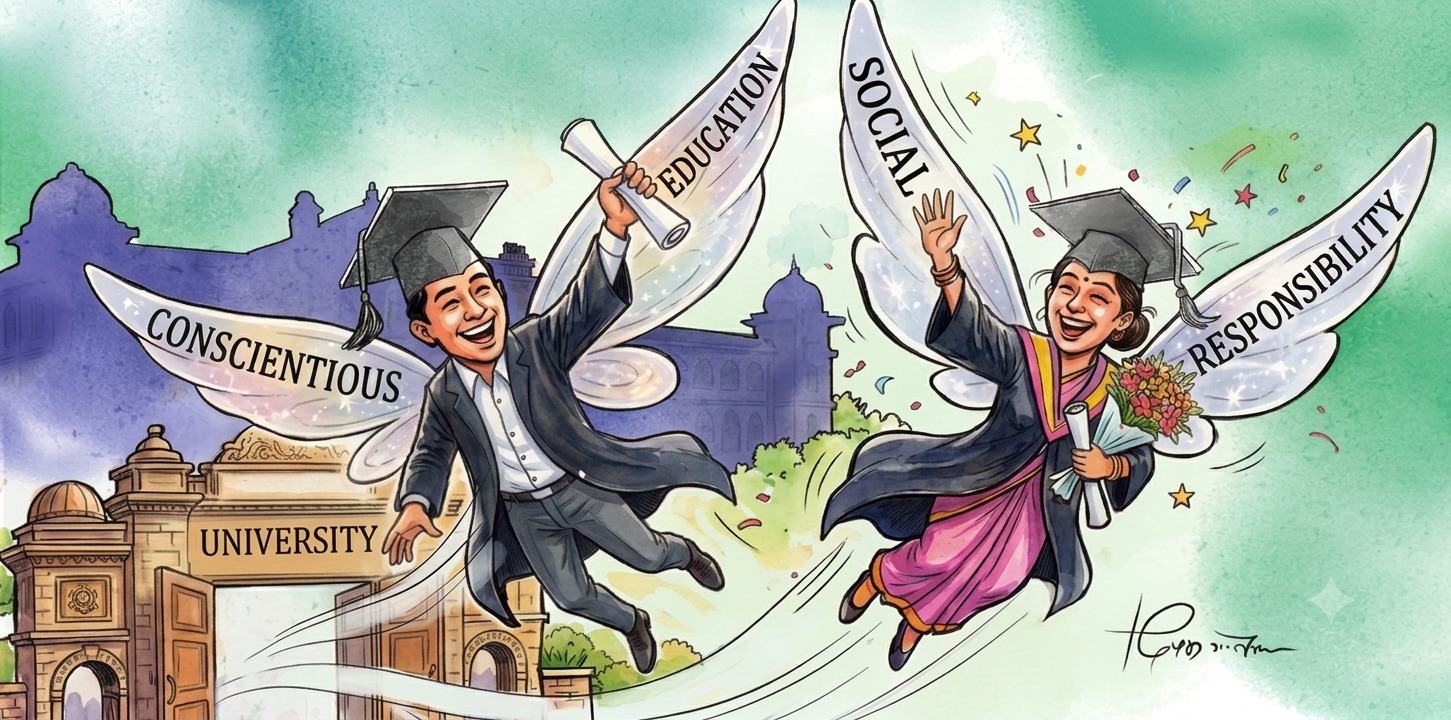
KATHMANDU: Nepali society is currently passing through a crisis of trust. A large segment of the youth is uncertain about the future. Their faith in education, employment, politics, public institutions, and social leadership is weakening. In such times, the role of a university does not diminish; rather, it becomes even more crucial. A university is not merely an institution that grants degrees; it is a public space where society thinks about its future, asks questions, learns from mistakes, and builds new possibilities.
This perspective on universities is not new. In his work The Idea of a University, published in 1873, John Henry Newman argued that the purpose of university education is not just to provide professional training, but to raise the intellectual tone of society. According to him, a university forms a public mind, purifies national taste, and strengthens the intellectual foundation of society. In the Nepali context, this means it is not enough for a university to merely produce employable human resources; it must also contribute to building society’s conscience, restraint, and public awareness.
John Dewey, a leading thinker of progressive and modern education, also stated that education cannot be understood in isolation from life. According to him, education is not just preparation for life, education is life itself. Students learn not only from classrooms and textbooks but also from social experiences, communities, problems, and collaboration.
If a university confines youth only to textbooks, exams, and certificates, it may impart information and knowledge, but it cannot build wisdom. The purpose of education is fulfilled only when young people learn to understand the real problems of society, seek solutions, collaborate, and believe in their own capabilities.
In today’s Nepali context, this question is even more serious. Just because someone graduates with a university degree does not mean a red carpet will be rolled out to offer them a job. The market is limited, opportunities are unequal, and many youths find the social utility of their qualifications unclear. In such a situation, universities must give them the capacity not just to look for jobs, but to create opportunities. Where ready-made jobs do not exist, it is the responsibility of the university to prepare youth who can create new work, services, enterprises, knowledge practices, and public dialogue.
Paulo Freire’s critical pedagogy reminds us that education is not just the transfer of information, but a process of building consciousness. Freire criticized the “banking model” of education, where teachers deposit knowledge and students passively receive it. For him, education is a process linked to dialogue, questioning, experience, and a liberated consciousness.
This idea is equally relevant for Nepali universities. If students are merely made to memorize answers, they may succeed in exams, but they will not be capable of confronting society’s complex questions. A university must provide an environment to question, to disagree, to make creative mistakes, and to think of new paths. In this sense, a university is also a safe space where youth can dare to dream. The society outside can be harsh, divided, and in some cases, cruel. Introducing new ideas brings criticism, experimenting brings fear of failure, and differing perspectives are easily rejected. However, within the university, students must have the opportunity to experiment, fail, rethink, and rise again. If the university itself is guided by fear, sycophancy, factionalism, positional greed, and silent self-interest, how will the youth learn freedom and wisdom there?
In this very context, an uncomfortable yet necessary question arises regarding the Nepali academic sector: Is our academic community maturing, or is the institutional development of academia still incomplete? This question can be understood through three words: academic (Pragyaik), equanimous/steadfast in wisdom (Sthitaprajna), and institutional academic wisdom (Sthitipragyaatika).
Being an academic is not just about having a position, a certificate, a title, or an identity associated with a university. Academic nature is the summation of clarity of thought, integrity of action, honesty toward knowledge, and public accountability. Only a person who understands knowledge not as a tool for personal prestige, but as a medium to build society’s conscience, can be an academic in the true sense.
Equanimity (Sthitaprajnata) is an even deeper trait. In academic life, opportunities and deprivation, praise and neglect, respect and rejection, gains and losses continuously occur. Maintaining wisdom despite these conditions, not becoming unbalanced in reaction, and not reducing institutional questions to personal profit and loss is the sign of equanimity. The journey of knowledge is long-term, but the politics of positions and opportunities is often fleeting.
An even more important word in today’s context is institutional academic wisdom (Sthitipragyaatika). This is not just personal patience; it is institutional conscience. Sthitipragyaatika refers to a state where an academic individual or community is capable of rising above personal aspirations, factional equations, immediate gains, or emotional reactions to prioritize the long-term interest of knowledge, the institution, and society.
The selection of university leadership, the appointment of Vice-Chancellors, and the reactions surrounding them have intensified this very question. The effort to select leadership through open competition can be positive in itself. However, it is not enough for a process to be formally open. It also requires clear criteria, transparency, testing for conflicts of interest, public accountability, and post-appointment performance evaluation.
The role of the academic community begins right here.
However, our reactions sometimes appear more person-centric than institutional. Some offer congratulations as if issuing a certificate of extraordinary leadership capacity even before the appointed person begins work; others express silent dissatisfaction simply because they or someone close to them was not appointed. Somewhere, questions are raised about political, familial, or other potential conflicts of interest, but even those questions remain confined to personal commentary rather than factual institutional analysis. This raises a fundamental question: Are we evaluating the process, or the person, relationships, and equations?
The concept of the “Public Sphere” by German thinker Jürgen Habermas provides further understanding of the action, essence, and character of public institutions. According to him, the public sphere is a space where citizens engage in rational dialogue on matters of common concern. A university is a vital institution that builds such public conscience. But if the space for dialogue within the university is taken over by factions, the space for logic by access/influence, and the space for institutional evaluation by personal reactions, how can a critical public sphere be built for society?
Henry Giroux, a scholar of critical pedagogy, has also urged us to view higher education as a democratic public sphere. According to him, the responsibility of higher education is not limited to the search for truth. It must be able to turn students into critical citizens who can hold power, authority, and institutions ethically and politically accountable.
This idea is extremely relevant for Nepali universities. If a university only makes youth employable, that remains an incomplete education. Making them conscientious, responsible, and questioning citizens is also the responsibility of the university.
Ronald Barnett, a British scholar of higher education, has described modern society as an age of “supercomplexity,” where knowledge, values, institutions, and the future are all uncertain and contested. In such an era, a university should not just provide information; it must create critically conscious beings capable of living, thinking, and making decisions amidst uncertainty. This idea is even more important in a transitional society like Nepal. Giving youth the capacity to make wise decisions in an uncertain world, rather than just giving fixed answers, must be the objective of a modern university.
Therefore, resolving the crisis of the university does not mean merely selecting professional and scholarly leadership; it also means correctly evaluating academic character. Weak leadership can ruin an institution. However, even capable leadership cannot succeed in the long run within an institution that has a weak academic culture.
A university is not an institution built solely by the Vice-Chancellor, Registrar, Dean, or Department Head. It is the collective creation of teachers, researchers, students, staff, administration, and the public knowledge culture. If the collective culture itself is not mature, a change in leadership alone will not bring transformation.
The academic community must now redefine its role. The dignity of a university is not protected merely by buildings, acts, convocation ceremonies, or officials. It is built through the seriousness of daily teaching, the integrity of research, accountability toward students, the standard of public debate, the transparency of institutional decision-making processes, and academic restraint. If we remain silent on these matters but react intensely only to positional changes, our academic priorities become unbalanced.
UNESCO has been urging that higher education be understood as a public and common good. From this perspective, a university is not just an institution to build an individual’s career; it is a public asset that shapes the shared future of society. Therefore, the debate about universities should not be limited to positions, appointments, and power equations; it must become a debate about youth trust, public conscience, knowledge production, social responsibility, and academic character.
Ultimately, the question is what kind of academics we are—defined by position, guided by opportunity, or driven by institutional conscience?
A person who earns respect through their actions, is clear in thought, and can place the interest of the institution above personal aspirations is a true academic. But such academic nature is not born automatically. It requires institutional culture, self-discipline, and public accountability.
The future of Nepali universities will not depend solely on new leadership. It will also depend on the kind of culture the academic community creates. If a university is to be made a place that builds social consciousness, the first consciousness must awaken within the university itself. In a crisis-ridden society, the university must be able to create a new language of trust, a new foundation of wisdom, and a new horizon of possibilities for the youth.
(The author, Dr. Dahal, is an Associate Professor in the Department of Languages and Mass Communication under the School of Arts at Kathmandu University, and holds a PhD in Information and Communication Technology for Development.)