Kathmandu
Sunday, June 21, 2026





Even today, the state remains indifferent to the memory of football fans who lost their lives in Asia’s one of the biggest stadium disasters, which occurred 38 years ago today at Dasharath Stadium.
KATHAMNDU: It was the month of March – a gloomy day – with weather that looked like it might rain at any moment.
For some residents of Tripureshwor, Kathmandu, such weather in March still brings fear. The horrifying incident they can never forget tightens their chest, and a storm of anxiety begins to rise within them.
Whenever dark clouds gather in the sky, 66-year-old Bhagwati Luintel of Tripureshwor still tells her son Binod, “Don’t go toward the stadium.”
Even today, Bhagwati sometimes feels that if she had also told her husband not to go to the stadium that day… perhaps things would have been different.
That day was March 12, 1988, a Saturday.
At that time, Bhagwati was only 28 years old. The only thing she had said to her husband before he left was: “Have some tea before you go.”
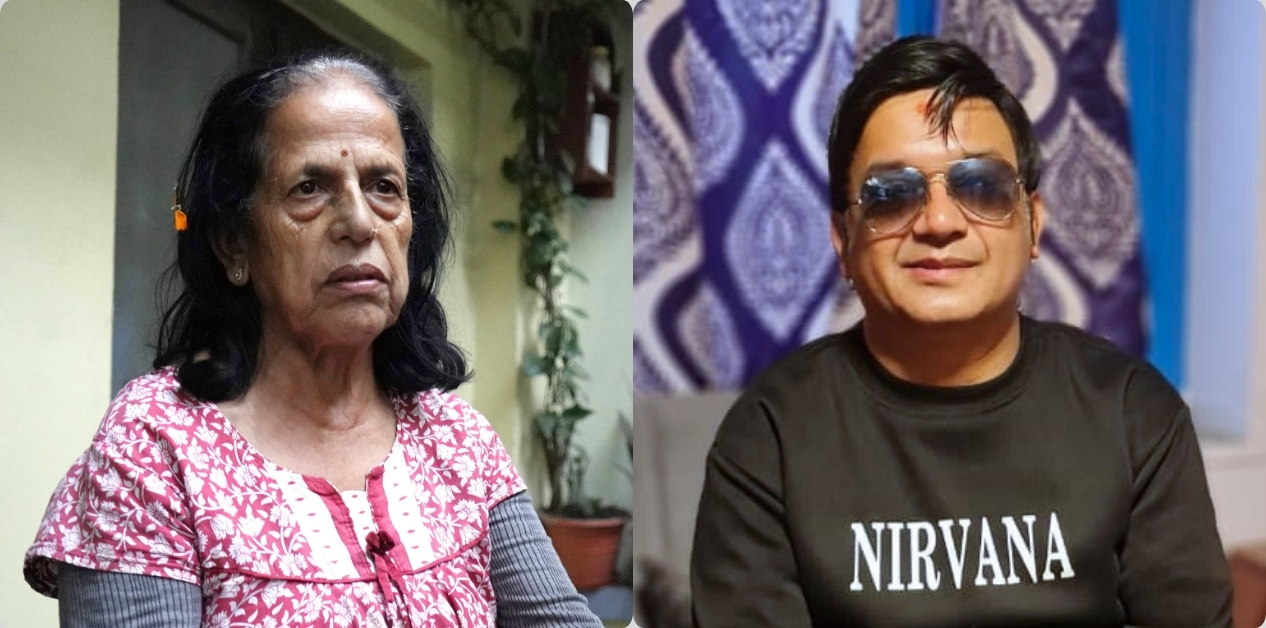
Bidula Mishra (left) and Binod Luintel. Photo: Bikram Rai.
Her husband Kapil Sharma (nicknamed Kalu Prasad Luintel) replied: “If I start drinking tea, I’ll miss the football match.”
That day, the final of the Tribhuvan Challenge Shield Cup was being played at the stadium. The teams competing for the title were Janakpur Cigarette Factory (JCF) and Bangladesh’s Mukti Joddha Club.
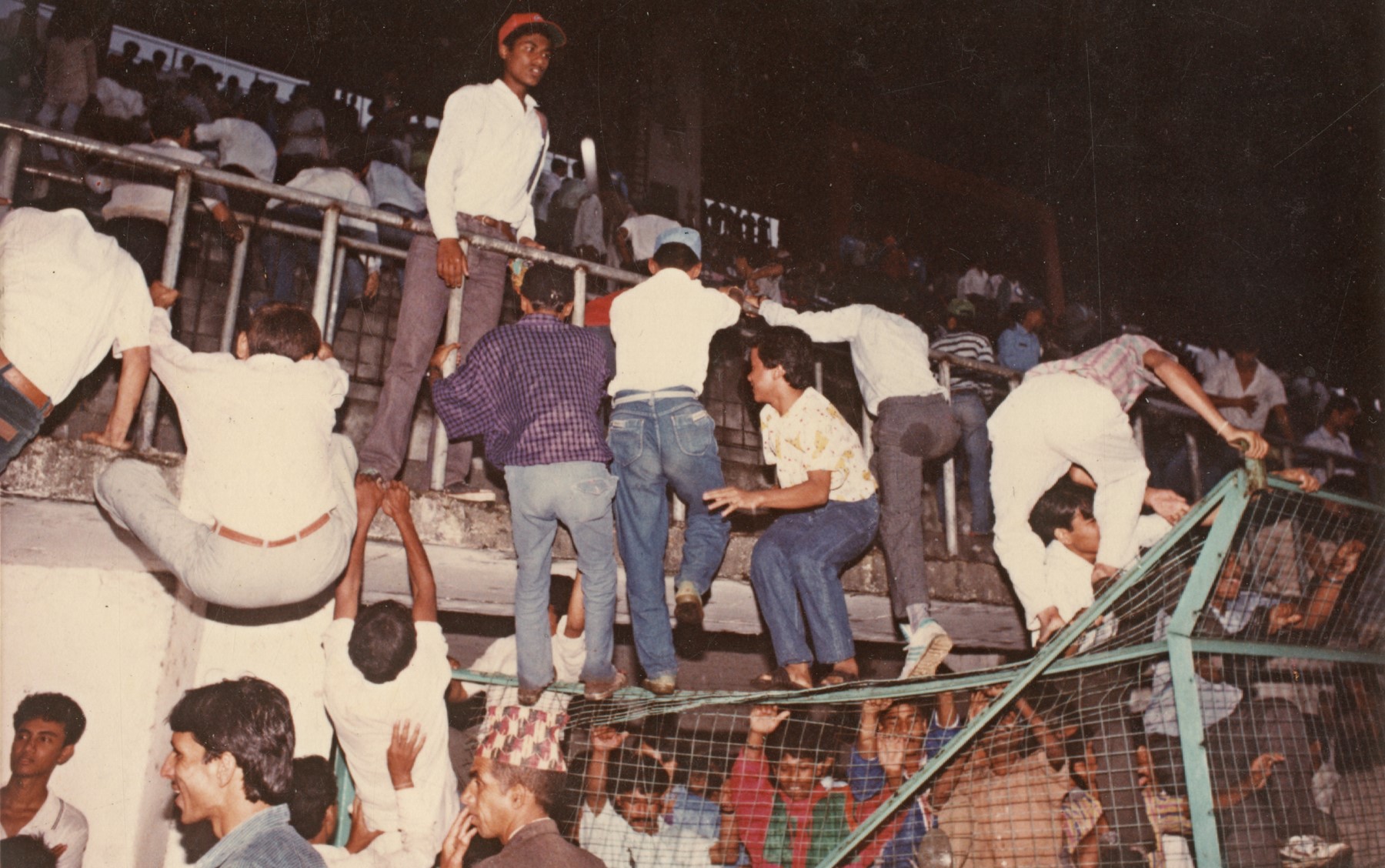
While the match was still underway, a violent storm with hailstones suddenly struck. Panic spread throughout the stadium, and people began running in all directions. More than 70 spectators lost their lives.
Bhagwati’s husband was one of them. Only three days earlier his leg cast had been removed. Even today she wonders, perhaps, he might have survived if his leg had been stronger.
“My mother still tells me not to go toward the stadium. In March, she becomes even more worried,” says Binod, who now runs a watch shop in Tripureshwor.
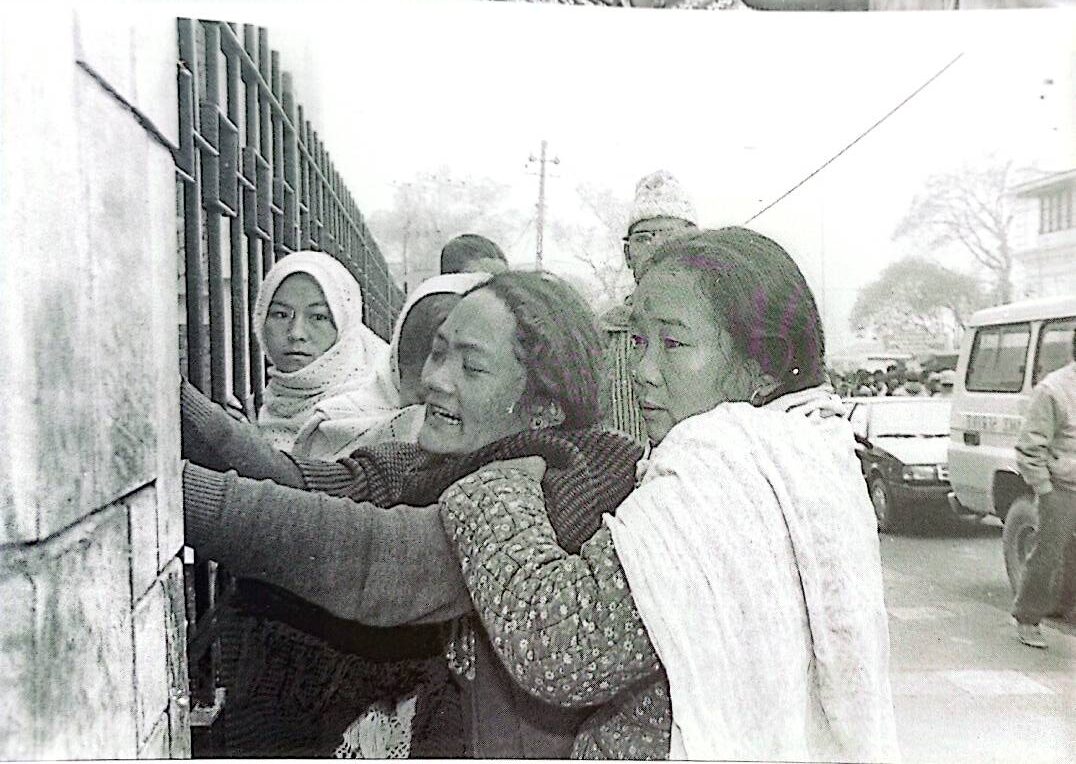
Relatives of the victims. Photo courtesy: Pariwartit Nepal / Gorkhapatra Corporation.
According to him, 11 people from Tripureshwor, either residents or tenants, died that day after going to watch the match. Two of them were his friends who lived in the same house where his shop now stands.
It is estimated that around 27,000 people were present in the stadium that day.
Many spectators had come to support the Nepali side after Mukti Joddha defeated Boys Union in the semifinal and JCF defeated RNAC.
The match was scheduled to start at 1:00 PM, but when the referee blew the whistle to begin, it was already 3:25 PM. Outside the stadium, long lines of spectators holding tickets were still waiting to get in.
About 17 minutes after kickoff, Mukti Joddha stunned Nepali players and fans by scoring the first goal.
Dhan Bahadur Basnet, JCF’s coach who was watching from near the western parapet, recalls, “Within five to seven minutes after Nepal conceded the goal, a sudden violent storm began. The match was stopped, people started running everywhere, and then the terrible tragedy happened.”
Bidula Mishra, whose house is located southeast of the stadium, was in Teku at that time. She worried about her son Roshan. Her son was safe, but her home was filled with mourning that day.
Although her own family survived, four people from the tenant family living in her house, including the young daughter of Harisharan Wagle and relatives, became victims of the disaster.
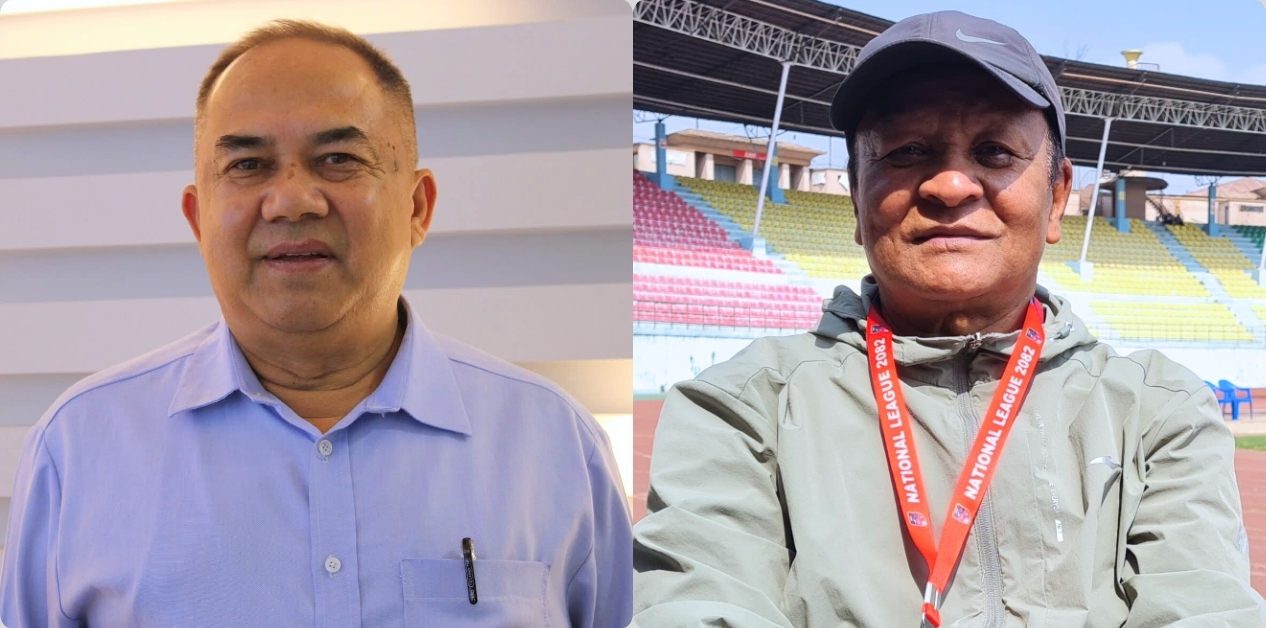
Sports journalist Raju Silwal (left) and former national player Shriram Ranjitkar.
She recalls, “Four out of the six people were caught in the crowd. In grief, they were crying loudly, shouting ‘Our family is destroyed!’”
Her house stood in a lane connecting the stadium to the main Tripureshwor road. The ground floor was rented by Harisharan Wagle from Tanahun.
Just a few days earlier, Wagle had brought his daughter Krishna Kumari from Tanahun to enroll her in school in Kathmandu. A few days before the incident, Wagle’s aunt’s son had also arrived from Jumla. On that Saturday itself, his sister and brother-in-law came from Kalanki. All of them went together to watch the football match.
Shriram Ranjitkar, a player from RNAC that JCF had defeated in the semifinal, is also a witness to that day.
“The weather was already gloomy, just like today’s weather,” he recalls. “Before the storm started, the sky suddenly turned extremely dark. Thunder began to roar. The weather felt very unusual.”
Even today, every year during March, the memory of that painful event returns to him.
Raju Silwal, who has spent 35 years in sports journalism, still feels uneasy in large crowds. He tries to avoid crowded places because he fears that a similar uncontrolled situation might occur again.
At the time, Silwal was a reporter for Nepal Television. Together with cameraman Siddhartha Shakya and sound technician Roshan Jung Thapa, he walked to the stadium carrying equipment weighing over 20 kilograms.
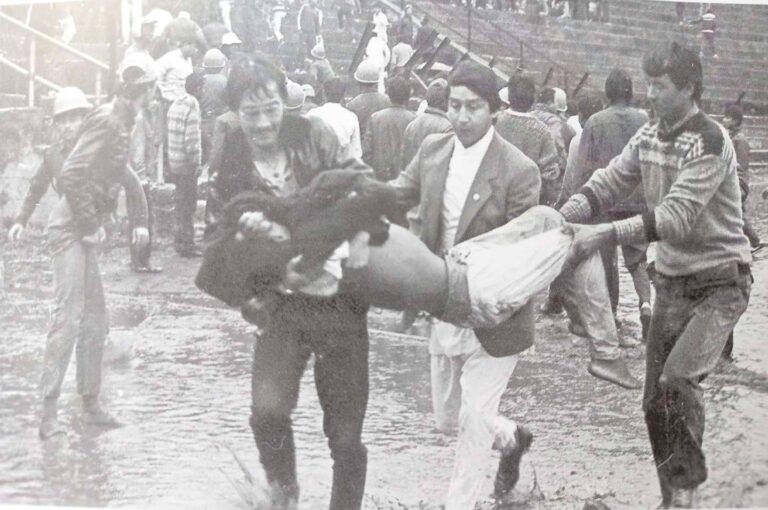
Scene of the incident site. Photo courtesy: Pariwartit Nepal / Gorkhapatra Corporation.
According to him, the number of journalists present was not very large. Representatives from Gorkhapatra, the national newspaper, and a few weekly newspapers were there.
They were working from the VIP parapet on the western side of the stadium.
“Football was the most popular sport at that time,” Silwal says. “The number of spectators for the final seemed to exceed the stadium’s capacity.”
During the match, a dark whirlwind appeared. A violent storm with hail began. Panic spread and people started running everywhere.
At that time, only the western parapet had a roof.
Many spectators ran across the field toward that side seeking shelter, even jumping over barbed wire fences. Those who couldn’t cross the fence rushed toward the only exit – the southern gate.
But that gate opened only halfway.
That same south gate (now marked B-04) became the main site where many people were killed or injured.
Helena Basnet, who lived just south of the gate and was only 9 years old then, remembers the day clearly.
She had wanted to go watch the match but her mother didn’t allow her.
“Suddenly there was a storm and hail. The electricity went out. Dust filled the air, so we closed the windows,” she recalls. “After a while we heard loud chaos. When I peeked out of the window, I saw a very frightening scene.”
People climbing on each other’s backs, bodies piled on top of other bodies. Amid the pushing and panic, people were crying out for help. She also saw vehicles being vandalized.
At that time there were gaps between the stairways of the parapet. As panicked people rushed to escape, many feet got stuck in those gaps. People fell over one another, piling up.
The crowd became even more terrified and uncontrollable.
“Everywhere there were people crushed under others. Dead bodies that were unbearable to look at,” Silwal says. “We had gone there to cover news, but we ended up witnessing a horrifying human catastrophe.”
The whole incident lasted about 10 minutes. Only after the weather calmed slightly did news spread that many people had been killed or injured. Police, sports officials, players, local residents, and ordinary citizens all joined the rescue effort. The injured were rushed to hospitals by cars, taxis, motorcycles, bicycles, or even by running, by any means possible.
“Seeing a mother crying beside the body of her teenage son at Bir Hospital, I couldn’t hold back my tears,” recalls Raju Silwal. “The boy had just taken his SLC exams. His mother kept crying, saying she had told him not to go, but he didn’t listen.”
The situation at the hospital had also become terrifying. Bodies of the dead and injured were laid in rows across the floor. Their faces had turned dark and bluish. People searching for their relatives cried out in agony.
Navaraj Thapa, who worked for 37 years at Bir Hospital and has now retired, was an ECG technician at the time. He remembers the chaotic scene, “People were being brought in one after another and just laid down. It was difficult to even tell who was alive and who had already died.”
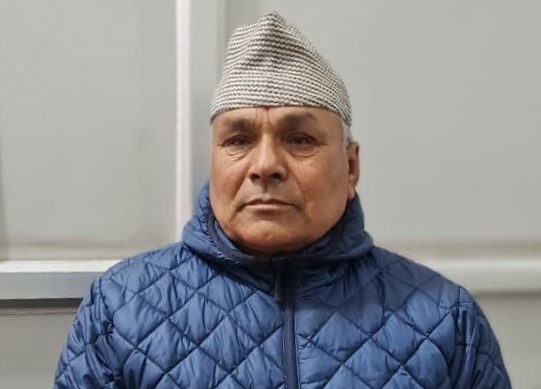
Navaraj Thapa, a former employee of Bir Hospital. Photo: Prabhakar Gautam.
At that time, the emergency ward at Bir Hospital had only six beds, and the shortage of health workers was understandable. Besides Bir Hospital, the injured and dead were taken to Tribhuvan University Teaching Hospital at Maharajgunj, Teku Hospital, and Patan Hospital. Officials ranging from the Health Secretary and Health Minister to the Prime Minister and even the King and Queen visited the hospitals to inspect the situation. They also visited the stadium.
The government announced 10,000 rupees as relief for the families of the deceased and 2,000 rupees for the treatment of the injured. It also formed a single-member investigation commission led by Judge Bhairav Prasad Lamsal.
According to the book Nepali Khelkudko Brittanta by sports journalist Nabin Aryal, the commission’s report, made public on 17 May 1988, concluded that the human and material losses were caused by a natural disaster and no individual had a direct responsible role.
However, the report pointed out several problems such as the stairs and gates on the eastern and southern parapets of the stadium had not been properly repaired or maintained, adequate security arrangements from the organizers were lacking, the rescue operation at the time was unsatisfactory, and medical treatment arrangements at Bir Hospital were inadequate.
Based on this report, Prime Minister Marich Man Singh Shrestha submitted a proposal to King Birendra to dismiss ministers of the concerned ministry as well as officials of the National Sports Council (NSC) and ANFA (All Nepal Football Association). The proposal was approved.
First, NSC department chief Donus Grandon and senior security officer Mahendra Jung Rana were removed from their posts. Dr Badri Raj Pandey, director of Bir Hospital, was also dismissed.
Later, Education and Culture Minister Keshar Bahadur Bista, who had already submitted his resignation on moral grounds, had his resignation accepted.
From ANFA President Kamal Thapa to Member Secretary Sharad Chandra Shah, several officials were forced to resign. The stadium disaster became a major scandal that created waves not only in the sports sector but also in national politics.
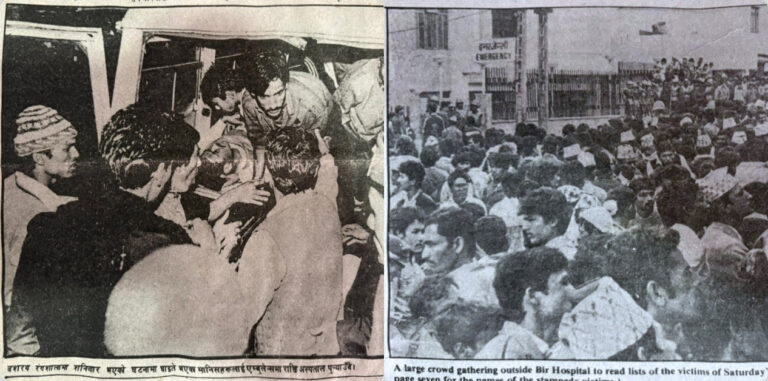
Photo courtesy: Pariwartit Nepal/Gorkhapatra Corporation.
What happened at Dasharath Stadium was not just a tragedy for Nepal; it was one of the largest stadium disasters in Asia. Sports journalist Aryal writes that it is considered the sixth-largest disaster in the history of world sports.
Because of this, the incident received widespread international attention.
World leaders including US President Ronald Reagan, Chinese President Li Xiannian, and Indian Prime Minister Rajiv Gandhi expressed condolences. International sports bodies such as FIFA and the International Olympic Committee (IOC) also expressed sorrow.
On 21 May 1988, the Indian newspaper Navbharat Times published a report praising the work of the Lamsal Commission.
Within Nepal as well, the incident was widely reported. The newspaper Gorkhapatra published the main headline: “Sixty-nine spectators die after being crushed by a crowd at Dasharath Stadium.”
However, the media environment was not like today’s era of flash news and scrolling updates. Silwal recalls that footage collected for Nepal Television could only be broadcast in the evening. Because of the delayed broadcast, many players who had been at the stadium only learned the full details later by watching Nepal Television.
The government also ordered Radio Nepal and Nepal Television to suspend entertainment programs the next day and instead broadcast mourning music.
Although there was agreement that 69 people died on the first day, there is no precise figure for how many deaths were later added.
The American newspaper Los Angeles Times published a report titled: “Ninety-Three Die in Stadium Stampede: Soccer Fans Rush to Locked Exits in Sudden Hailstorm.”
However, author Aryal compiled a list of 76 confirmed victims in his book Nepali Khelkudko Brittanta. The number of injured was more than 200.
Now, as 38 years have passed since the incident, questions naturally arise: What has been done to preserve such a major tragedy in public history? What lessons were learned from it?
“After the disaster that day, the final match could not be played again,” says Shriram Ranjitkar. “At first, we didn’t even dare to play football in the stadium. For years, whenever a tournament was held in March, we feared another storm like that might come.”
“For a long time, we couldn’t even walk through that southern gate. We avoided it completely. Later other routes opened, so we tried not to go that way.”
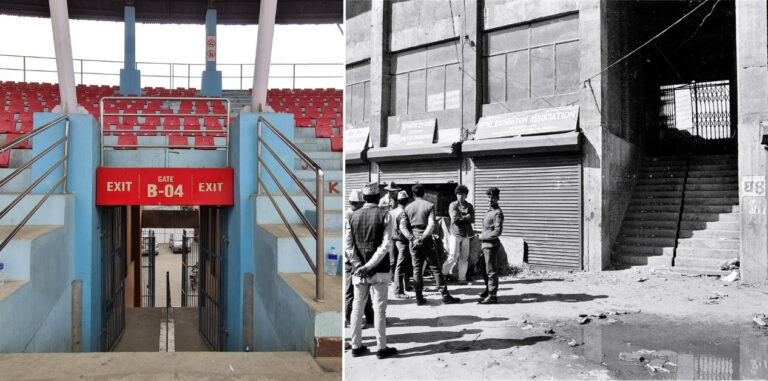
The current condition of the south gate where spectators were killed and injured. Photo: Bikram Rai.
Within three or four months, football gradually returned to normal. But nothing significant was done to heal the wounds of the families of the dead and injured.
After the incident, some improvements were made to prepare for natural disasters or sudden accidents, such as larger windows and doors were required in public buildings and government schools, the holes in the stadium parapets were closed, stadium gates had to remain open, and ambulances began to be stationed near sports venues.
However, despite such physical and preparedness improvements, victims and eyewitnesses say the government and sports authorities failed to preserve the tragedy in public memory.
Sports journalist and lecturer Raju Silwal expresses regret that the state and sports organizations have not properly remembered those who lost their lives simply while going to watch a football match.
“In Nepali society, people who die in various incidents are remembered in different ways,” he says. “But even after such a massive tragedy at the stadium, the names of those who died were not even engraved on a single stone.”
Among the victims was the father of national badminton player Chandra Chakradhar. A passionate football fan, he had left his tea shop in someone else’s care that day and gone to the stadium saying he would return soon after a quick break.
“I knew him personally,” Silwal says. “His death shook me for many days. Even now, remembering him makes my heart heavy.”
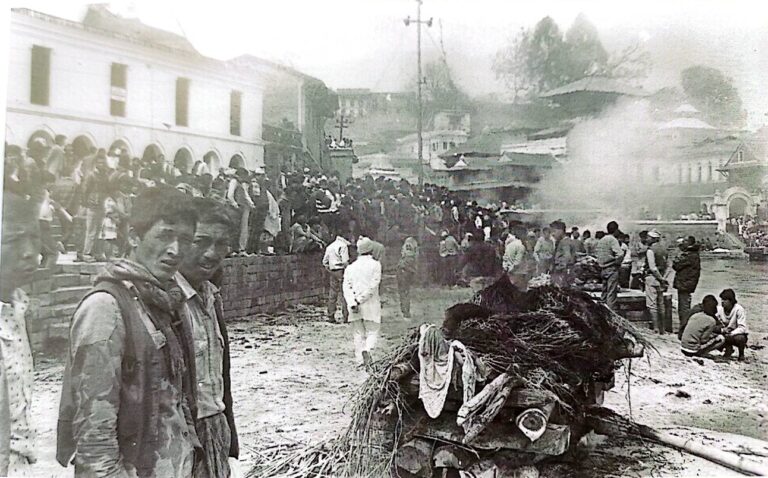
Final rites of the deceased being performed at Pashupati Aryaghat. Photo courtesy: Pariwartit Nepal / Gorkhapatra Corporation.
“He died while trying to save others. For football lovers like him, perhaps even a small memorial space in the stadium could have been created.”
The state has commemorated those who died in events such as earthquakes and political movements. Yet in a country where tournaments and awards are often named after kings or political leaders, it is tragic that no sporting event exists to collectively remember those who died in the stadium disaster.
Binod, who lost his father in the tragedy, feels the same way. “Even if it were just an award in their name, it could have been established. If the names of the deceased were engraved on a stone and placed in the stadium, it would also remind future spectators to remain aware of possible dangers,” he says.