Kathmandu
Tuesday, July 21, 2026





Impunity or accountability? This is not only a rhetorical question; it is a defining test for the Rastry Swatantra Party (RSP)’s Government to be headed by Balendra Shah (Balen). In Nepal, ending impunity and promoting good governance has long remained a shared aspiration of citizens. This aspiration has repeatedly been voiced through people’s movements and struggles. Yet, even today, impunity and poor governance stand like a mountain obstacle on the path of prosperity and development.
In the context of the Gen-Z movement, a commission formed under the chairpersonship of former judge Gauri Bahadur Karki has already submitted its report to the government. However, such an important document of public concern has still not been made public. It remains concealed under various pretexts. Demands from Gen-Z groups to disclose the report are intensifying day by day. Yet, the government led by Sushila Karki has failed to fulfill its own commitment to make the report public and implement its recommendations.
In the initial days, the government had taken a clear position in favor of publishing the report. But once it received the document, it hesitated. It showed reluctance and attempted to delay the process. This has deeply disappointed victims and Gen-Z activists. Although the government earned some credit for conducting elections on time, it has become a subject of sharp criticism on this issue.
The problem of impunity in Nepal has deep roots. Many past inquiry reports on serious violations have never been made public. In some cases, those who should have been held accountable were instead rewarded. When impunity becomes a culture, violations are bound to repeat.
In this background, there was a legitimate expectation that the Karki Commission would function effectively, its report would be timely, and the government would publish it without hesitation and implement its recommendations to ensure justice and prevent recurrence. Denying even the right to know what the report contains is, in fact, a betrayal of the victims of the incidents of Bhadau 23 and 24.
Even a government portrayed as a “citizen’s government” has shown such behavior. This has raised concerns whether the upcoming RSP-led government might also engage in political trade-offs that ultimately protect impunity. Such fears are not baseless.
The vicious cycle of impunity is eroding the credibility and legitimacy of the state. Instead of strengthening the rule of law, a culture of benefiting from impunity has taken root. When those responsible for serious violations are not investigated, prosecuted, or punished, the rule of law collapses.
In such a situation, transparency of the Karki Commission report and its implementation is not merely an administrative matter. It is a crucial step toward establishing the rule of law, delivering justice to victims, and breaking the cycle of impunity.
After the end of the Maoist armed conflict, addressing transitional justice was a priority. Yet, even after two decades, thousands of victims are still waiting for truth, justice, and reparations. Despite commitments made in the Comprehensive Peace Accord, credible transitional justice has not been delivered.
Institutions like the Truth and Reconciliation Commission and the Commission on Investigation of Enforced Disappeared Persons have been formed repeatedly. However, due to lack of independence, resources, and political will, they have remained largely symbolic. As a result, impunity has become institutionalized.
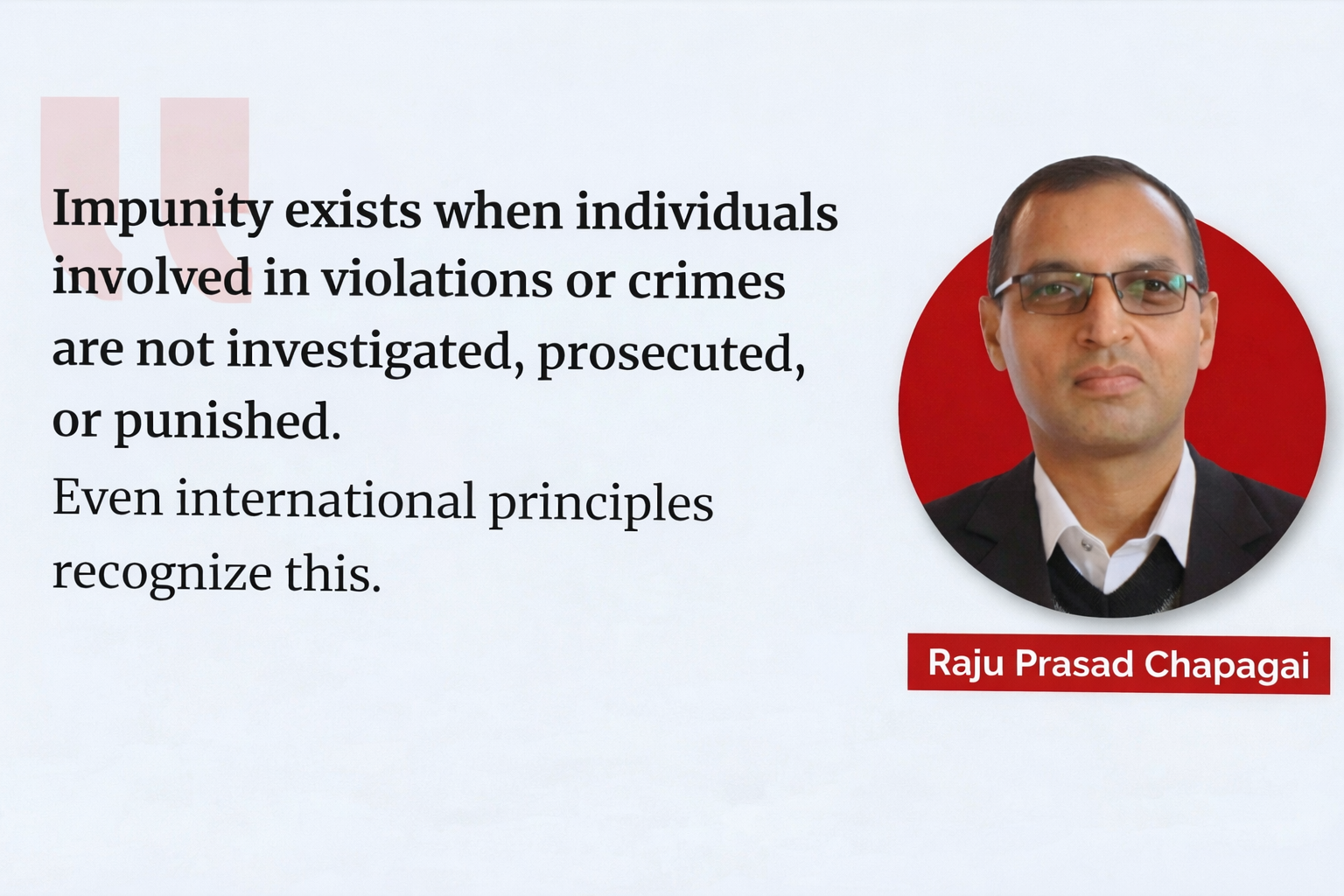
Impunity exists when individuals involved in violations or crimes are not investigated, prosecuted, or punished. Even international principles recognize this. Nepal’s Supreme Court has also identified impunity as a core enemy of the rule of law, stating that position, uniform, or status cannot shield crime. Yet, in practice, accountability is often determined not by the gravity of crime but by power and position.
Without ending impunity, good governance, prosperity, sustainable peace, and development are not possible. This is an established truth. However, a troubling tendency is growing in political circles—to seek impunity for oneself while demanding accountability from others.
Impunity is no longer limited to conflict-era violations. It has spread widely—from petty corruption affecting ordinary citizens to high-level policy corruption, from domestic violence to organized caste and religious violence, from custodial torture to excessive use of force leading to extrajudicial killings. Those involved continue to enjoy protection.
Eliminating this deeply rooted culture requires strong commitment. But in Nepal, there has always been a gap between commitment and action. Political alliances were formed not to end impunity but to protect it. Transitional justice itself stands as a striking example of this failure.
Since 1990, impunity has contributed to cycles of conflict, dissatisfaction, and instability. If impunity had been addressed earlier, perhaps movements like the Gen-Z protests would not have been necessary. If impunity continues even now, similar events are bound to recur.
Efforts that ignore impunity cannot yield meaningful results. Public trust in state institutions declines. Citizens feel insecure. Migration increases, and frustration can lead to unrest. The Universal Declaration of Human Rights also recognizes that protecting human rights under the rule of law is essential to prevent rebellion against injustice.
Ending impunity is therefore not optional—it is fundamental. Without it, development, peace, and equitable prosperity remain unattainable. Society begins to operate under the logic of “might is right.” The burden falls disproportionately on ordinary citizens, while inequality, favoritism, and patronage flourish.
A government that adopts zero tolerance toward impunity is truly governance-oriented. Such a government facilitates investigation and prosecution, respects judicial independence, avoids interference, and ensures that no one is above the law. It does not misuse the justice system selectively or obstruct the natural course of law enforcement.
Political parties, including the RSP and major opposition forces, have promised to end impunity and strengthen the rule of law. But these are not new commitments—they are recycled promises. The real question is whether these promises will finally translate into action.
Will the new government merely repeat slogans, or will it take concrete steps? Will it internalize the principles of rule of law, or limit them to rhetoric? Will it stand the test of accountability, or weaken it for political convenience? These are serious questions. The success or failure of the upcoming government will largely depend on how it answers them.
Way forward: Immunizing the system against impunity
To replace the culture of impunity with accountability, rule of law, and good governance, the government and parliament must not fail to act on the following measures:
Only through these concrete steps can Nepal truly immunize itself against impunity and move toward a just, accountable, and democratic future.
(Senior advocate Chapagain is the coordinator of the Accountability Watch Committee)