Kathmandu
Tuesday, July 21, 2026





Debt is the fuel of development, but if the engine is not good, the fuel will not drive the vehicle; it will only cause a fire. Nepal must now focus on building the engine; project management capacity, revenue administration, and institutional accountability must be strengthened. If debt keeps growing without improvement in all three of these areas, Nepal too could become Sri Lanka.
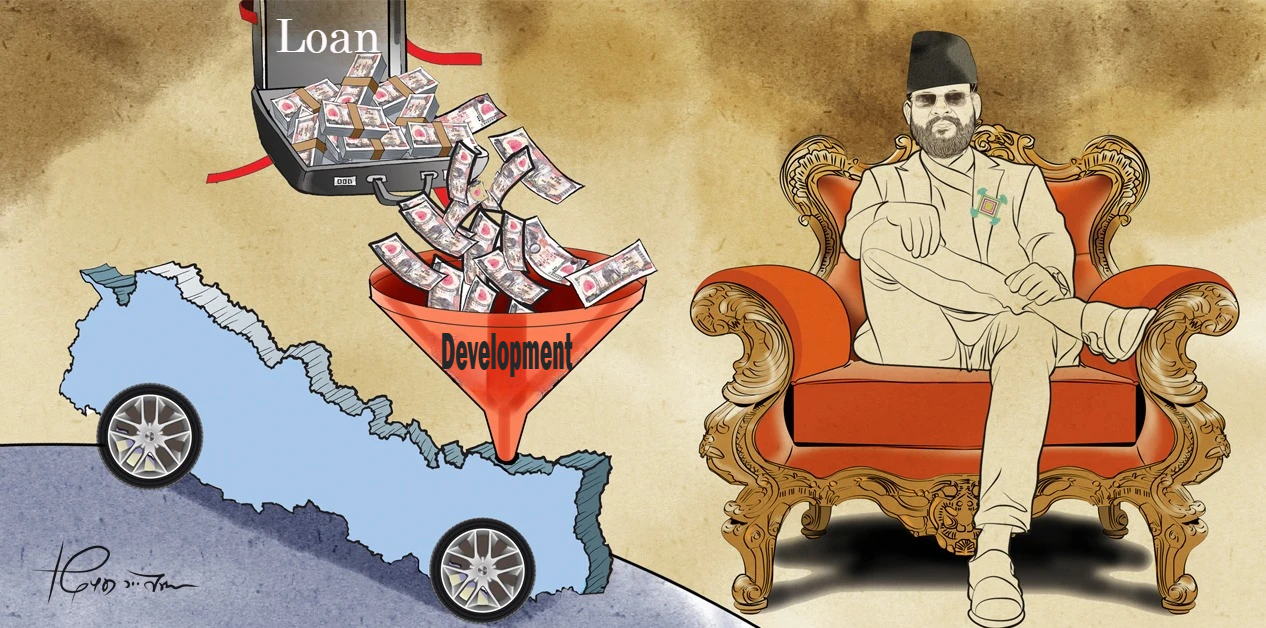
Nepal’s capital budget has been seen to be shrinking year after year due to the long-term scarcity of development spending. The tendency for basic infrastructure projects, from road expansion to sewage systems, to stall, be delayed, or remain incomplete due to inadequate resources seems almost entrenched. Against this backdrop, two separate decisions of the Council of Ministers on two different dates recently told a somewhat different story. On April 5 and 7, two loans worth approximately Rs 40 billion were easily approved with the World Bank and the Asian Development Bank – Rs 27.5 billion for Digital Nepal and financial inclusion, and Rs 12.75 billion for greater Lumbini development. With interest rates in the range of 1 to 1.5 percent, long repayment periods, and attractive terms, hearing this news one thinks: cheap money has arrived, development will pick up pace.
Real economics goes far beyond these attractive terms. With Nepal’s public debt having already reached the range of Rs 2.5 to 3 trillion, a question arises – have we managed to build the debt ‘engine’, or are we merely adding to the debt burden tempted by cheap interest rates? Five years ago, this figure was around Rs 1 to 1.2 trillion rupees. Our debt burden has grown abnormally in a short period of time, which is certain to create serious pressure on the flexibility of future budgets.
Do these favourable terms alone justify the debt? What truly needs to be understood is not the quantity of debt but its use and outcome. Because the economic justification of debt is not proven until it has the capacity to generate additional national income and pay itself off.
Background to debt growth
There are three major structural reasons behind Nepal’s public debt growth. First, post-earthquake reconstruction after 2015. According to National Reconstruction Authority data, the earthquake caused damage worth approximately Rs 900 billion. A large portion of that was raised through external assistance and loans. This expenditure was unavoidable, but since it had to focus on restoration rather than productive sectors, it could not deliver immediate economic returns. Second, the COVID-19 pandemic. Due to COVID-19, revenue collection in 2019/20 fell by around 15 to 20 percent on the one hand, while resources were needed for health expenditure and relief distribution on the other. The dual pressure of revenue contraction and expenditure expansion intensified debt dependence. Third, large investments in infrastructure. Significant debt was mobilized over the past decade for road, hydropower, and urban development projects. The economic logic of these projects is that they increase the overall productivity of the economy in the long run by reducing production costs and increasing market access, but it takes time for these returns to materialize.
Questions arise here. Did all this debt go to productive sectors? Did the respective projects deliver expected returns? The Public Debt Management Office’s report of Falgun 2080 BS (mid-February to mid-March 2024) shows that approximately 45 percent of total public debt went to the transportation and energy sectors. These sectors have the potential to boost economic growth in the long run, but they do not deliver immediate returns.
During this interval, a large portion of revenue begins going toward debt service. This creates a dangerous cycle between fiscal deficit and debt service obligations – the situation of having to take more loans to repay debt or having to cut development spending. In fiscal year 2022/23, approximately 14 percent of total revenue went toward principal and interest payments. This ratio is on an increasing trend. According to IMF standards, if this ratio exceeds 20 percent, the country is considered to have entered a debt crisis risk zone.
The silent risk of exchange rates
The true burden of debt cannot be understood through low interest rates alone. Nepal’s external debt is primarily denominated in US dollars and SDRs (Special Drawing Rights). When the rupee weakens, the amount that needs to be repaid automatically increases. This risk is particularly relevant for an import-oriented economy like Nepal. According to Nepal Rastra Bank data from Magh 2080 BS (mid-January to mid-February 2024), exchange rate changes alone have added an additional burden of approximately Rs 90 billion to public debt. This amount is nearly one-third of the country’s annual capital expenditure. The economic meaning of this is that the government has had to bear an additional liability of approximately Rs 90 billion solely due to currency depreciation without adding any new projects. This has a direct impact on the budget, because additional money must be found to pay principal and interest on foreign debt. That amount is raised by cutting development expenditure. In economic terms, this is called the ‘crowding out effect’.
In fiscal year 2022/23, capital expenditure could only reach approximately 60 to 65 percent of the target. Officials at the Ministry of Finance cite the growing burden of debt service as the primary cause. This shows that exchange rate risk cannot be underestimated. Nepal’s monetary policy and debt management strategy must place this risk at the center.
The reality of project implementation
The Pokhara Regional International Airport is a glaring example of this. First discussed in 1976, this project only came into operation on January 1, 2023. The initial cost estimate was approximately Rs 6.2 billion. By the time construction was completed, costs had reached the range of Rs 8.9 to 9 billion – a cost overrun of more than 40 percent. A portion of the loan taken from China’s Exim Bank went into this project. In the first year of operation, the number of flights and passenger traffic at the airport could not even reach 30 percent of what was expected. According to the Civil Aviation Authority of Nepal report (mid-December 2023 to mid-December 2024), there are only 14 weekly international flights, with daily average passenger numbers around 300. In such a situation, income from the project is barely enough to cover operating costs, let alone repay debt. The economic conclusion is that this project has now become a ‘white elephant’, an asset that carries great burden but has low utility, continuously creating pressure on the state treasury.
The Melamchi Water Supply Project can also be cited as another example. This project, which began with a concessional loan of approximately USD 150 million from the Asian Development Bank, has been running for more than two decades. Costs rose to approximately three times the estimate. Although the tunnel construction was completed, the water distribution system has still not been finished. According to Kathmandu Upatyaka Khanepani Limited’s Poush 2080 BS (mid-December 2023 to mid-January 2024) data, while 170 million liters of water per day should be supplied from the project, currently only around 100 million liters is arriving.
The two examples above show that weaknesses in project management in Nepal have reduced the effectiveness of debt. The triangle of cost overruns, time delays, and low utilization makes the actual return rate on debt negative. As a result, debt ends up becoming a source of financial burden rather than an engine of economic growth.
International comparison
Sri Lanka’s experience is a vivid lesson for Nepal. From 2010 to 2019, Sri Lanka took large amounts of Chinese loans. Billions of dollars were invested in projects like Hambantota Port and Mattala Airport. With low utilization, these projects could not become sources of debt repayment. From an economic perspective, the debt service ratio of these projects was well below 1, meaning they demanded more debt service expenditure than they earned. By 2022, Sri Lanka’s foreign exchange reserves were exhausted. The country declared it could not repay its debt. Inflation reached 70 percent. People had to queue for fuel and food. What Sri Lanka’s collapse teaches is that it is not the quantity of debt but its sectoral distribution and the quality of projects that determines sustainability.
The opposite can be found in Vietnam’s example. Since 2000, Vietnam also took large amounts of external debt but linked it strategically to export-oriented industries and infrastructure. According to World Bank data, Vietnam’s exports were approximately USD 14 billion in 2000. By 2022, exports reached the range of approximately USD 370 billion. The debt-to-GDP ratio there has remained stable at around 40 percent. Vietnam adopted rigorous economic criteria for project selection. Cost-benefit analysis was made mandatory, and institutional capacity to complete work within time and budget was strengthened.
The main difference between Vietnam and Sri Lanka is that Vietnam mobilized debt in productive sectors while Sri Lanka did so in unproductive infrastructure. Nepal stands at a contested crossroads between the two. We have not yet become Sri Lanka, but the direction toward becoming Vietnam is also not clear.
Nepal’s public debt-to-GDP ratio is in the range of approximately 40 to 45 percent. By international standards this is not yet a dangerous level, but the pace of growth is concerning. In five years, this ratio rose from approximately 25 to 30 percent to the range of 40 to 45 percent. If it continues growing at this rate, an uncomfortable situation could arise within a decade. According to IMF analysis, a debt-to-GDP ratio above 50 percent for developing countries significantly increases the probability of a financial crisis.
Structural weakness of revenue
The greatest risk of debt is the weak revenue base. Nepal’s tax revenue is in the range of approximately 17 to 19 percent of GDP. This is slightly higher than the South Asian average of 14 percent, but in developing countries like South Korea and Malaysia this ratio is 20 to 25 percent. The major problem is the narrow tax base. According to the Labour Force Survey 2017/18, approximately 80 percent of employment in Nepal is in the informal sector. These workers and businesses do not pay regular taxes. This means a large portion of the economy is outside the formal financial system, which has seriously limited the government’s tax collection capacity.
The growth of the platform economy has added new challenges. Services like Pathao, InDrive, and Foodmandu have given employment to thousands, but most of them are outside the tax net. According to the Inland Revenue Department’s 2022/23 report, Pathao paid approximately Rs 250 million in VAT, but this amount is negligible compared to the total transactions on its platform. Ride-share companies present themselves as technology companies and argue that they are merely intermediaries between drivers and customers. This has complicated tax assessment. This problem is not unique to Nepal but is worldwide, yet developed countries have already created legal mechanisms to regulate it.
If even one-quarter of the informal sector could be brought into the tax net, it is estimated that annual revenue could increase by approximately Rs 50 to 70 billion – nearly half of the current annual principal and interest payments. This means revenue reform itself is the most reliable and sustainable means of debt management. If debt keeps growing without expanding the tax base, in the future the compulsion will arise to either increase tax rates or cut other expenditure to repay debt, which will further obstruct economic growth.
Potential and limits of digital investment
The Rs 27.5 billion loan approved for the Digital Nepal project aims to expand digital infrastructure. This includes broadband expansion, strengthening of digital payment systems, and ‘digitization’ of government services. These investments have the potential to increase productivity in the long run. According to a 2021 World Bank study, digital service expansion can add 0.5 percentage points annually to Nepal’s economic growth. This seemingly small number can make a significant difference over decades, but this benefit does not come automatically. For this, a triangle of infrastructure, skills, and institutional capacity is required.
There are some structural barriers to digital service expansion for us. First, internet access and quality. According to the International Telecommunication Union’s 2023 report, only approximately 25 percent of Nepal’s population has access to quality broadband internet. In rural areas this rate is below 10 percent. This means the benefits of digital investment will primarily be concentrated in urban areas, which could further increase income inequality.
Second, digital literacy. According to the National Census 2021, only approximately 35 to 40 percent of the population above 15 years of age uses the internet. The number who use online services is even lower.
Third, operational capacity. There is a shortage of technical human resources in government offices. Only approximately 40 percent of approved positions are filled at the Department of Information Technology. These barriers can significantly reduce the marginal return on digital investment.
These barriers can limit the returns on digital investment. Past experience also warrants caution. Many digital systems installed in government offices have not come into full use. According to the Financial Comptroller General’s Office audit report for 2022/23, the government warehouse management information system started in 2018 – despite being installed in more than 60 offices – is not in regular use. This shows that building infrastructure alone is not enough; the capacity and practice to use it is also needed. Otherwise, investment becomes a ‘sunk cost’ that neither improves service delivery nor creates sources for debt repayment.
The complexity of the Lumbini project
The goal of the Rs 12.75 billion loan approved for developing the Lumbini area, listed as a World Heritage Site, is tourism promotion. As the birthplace of Gautam Buddha, this area can attract large numbers of tourists. According to World Tourism Organization data, religious and cultural tourism is growing globally at an annual rate of 10 to 15 percent – an opportunity Nepal can exploit.
According to Lumbini Development Trust data, approximately 1.6 million tourists visited Lumbini in 2019. After COVID-19, in 2023 this number only reached approximately 1.2 million – just 20 percent of capacity. This signals that due to lack of infrastructure and weak promotion, Lumbini is currently utilizing only a small fraction of its true tourism potential.
The first problem is that air access is poor. Gautam Buddha International Airport has been operational for two years, but there are no regular international flights. This has obstructed the direct arrival of foreign tourists.
Second, the road network condition is poor. It takes 8 to 10 hours to reach Lumbini from Kathmandu. Both the time and cost discourage even domestic tourists.
The third problem is limited hotel and tourism infrastructure. There are fewer than 10 international-standard hotels in the Lumbini area.
The fourth problem is weak promotion and marketing. Countries like Thailand and Cambodia have done good marketing of Buddhist tourism. Nepal lags far behind in this. All four of these barriers are interconnected and are limiting Lumbini’s tourism potential.
Investing debt without resolving these barriers risks limited outcomes. Consider Thailand’s example. Before investing debt in Ayutthaya historical city development, the government-built access roads, rail links, and gave tax exemptions to hotel investors. As a result, tourist numbers nearly doubled between 2015 and 2019. Nepal must also adopt such an integrated approach. A single project alone cannot increase tourism. A comprehensive package of infrastructure, service quality, and marketing is necessary. Otherwise, investment cannot deliver expected returns and only adds to the debt burden.
Institutional reform
Responsibility for debt management is fragmented in Nepal. The Public Debt Management Office keeps data, the Ministry of Finance signs agreements, the National Planning Commission selects projects, and the concerned ministry implements. This fragmented structure reduces accountability. When a project fails, it is not clear who is responsible. In economic terms this is called the ‘agency problem’. On the other side, it introduces a lack of discipline in project selection and implementation.
According to the Auditor General’s 60th report, in 2021/22 approximately 35 percent of development projects experienced cost overruns. Approximately 40 percent of projects were not completed on time, yet there is no record of anyone being held accountable. This shows that without institutional reform; it is difficult to increase the effectiveness of debt. The cost of project failures ultimately has to be borne by ordinary taxpayers, yet no one takes accountability for it. This situation cannot be sustainable.
Some concrete steps can be taken for this. First, a national debt policy must be formulated that clearly specifies how much debt to take in which sector, the criteria for project selection, and how to monitor. This policy must set the maximum limit of debt, sectoral distribution, and risk management criteria.
Second, every major loan agreement must be presented to a parliamentary committee. This ensures public scrutiny and debate. Parliamentary oversight increases the quality and transparency of project selection.
Third, project implementation units must be given autonomy and accountability. A mechanism is needed to reward good performance and penalize poor performance. This improves both the quality and speed of implementation.
Conclusion
Approving Rs 40 billion worth of loans in a single week is not in itself good or bad. What matters is what change that debt brings. The facts show that Nepal has both opportunities and risks in debt mobilization. Investment in areas like digital infrastructure and tourism development is necessary, but planning, implementation, and operational capacity must be strengthened. The economic justification of debt is only proven when it creates additional national income and can bear its own service costs.
The path forward must rest on three pillars. First, expanding the revenue base. Digital payment systems and simplified tax administration must be used to bring the informal sector into the tax net. This will not only increase government income but also contribute to the formalization of the economy.
Second, rigor in project selection and implementation. Cost-benefit analysis must be made mandatory; those who complete work within time and budget must be incentivized. The criteria for project selection must be based on economic returns rather than political priorities.
Third, exchange rate risk management. Foreign currency earnings from exports and tourism must be increased; attention must be paid to hydropower exports and service trade. Only these three pillars can make debt a fuel for development rather than a burden.
Debt is the fuel of development, but if the engine is not good, the fuel will not drive the vehicle. It will only cause a fire. Nepal must now focus on building the engine; project management capacity, revenue administration, and institutional accountability must be strengthened. If debt keeps growing without improvement in all three of these areas, Nepal too could head down Sri Lanka’s path. If a disciplined and strategic approach like Vietnam’s can be adopted, debt will guide the nation toward prosperity. Otherwise even concessional debt can become a burden. The core principles of economics and global experience teach exactly this. Nepal must not delay in learning these lessons.
(Professor Dhakal holds a doctorate in statistics.)