Kathmandu
Thursday, July 9, 2026





Juggling her husband’s costly treatment, debt, and daily wage work in Kirtipur, Gulabi Bista struggles to enroll her India-educated son—caught between missing documents, language barriers, and a system that keeps turning them away
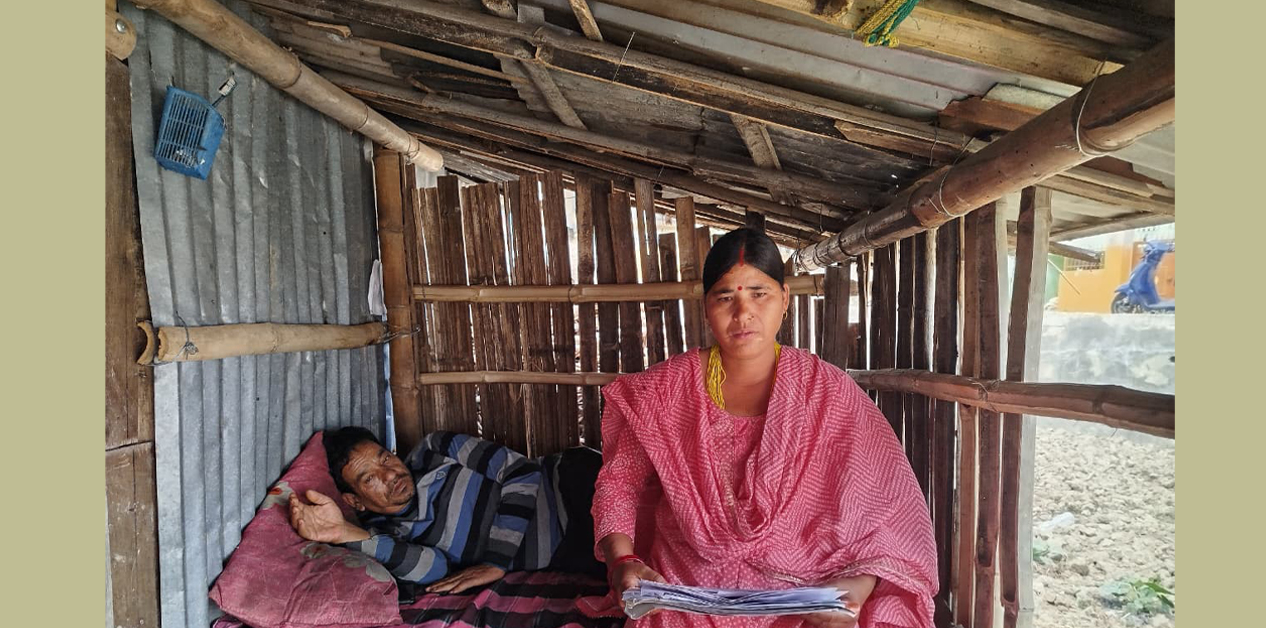
KATHMANDU: Twelve-year-old Binod Bista, who completed up to grade 4 in Bangalore, India, and has returned to Nepal, is wandering from school to school in Kirtipur with his mother, Gulabi, trying to get enrolled. With the new academic year already under way and schools refusing to admit him, his educational future has become uncertain.
Schools have refused to admit Binod on the grounds that he has no record in Nepal’s Integrated Educational Information Management System (EMIS), because he studied in India. The schools he has tried to enroll in have also argued that he is weak in both Nepali and English.
“It turns out you have to sit an entrance exam for new admission, and they refused because he was weak in Nepali and English,” says Gulabi. “He studied in Hindi, English, and Karnataka’s Kannada language in India, so that must be why.” She suspects that because they also speak in the Bajhangi dialect at home, he may not have the language proficiency the schools are looking for. “It’s as if we don’t even know the Nepali language!” she says.
The family, whose permanent home is in Jayapithvi Municipality-1 of Bajhang, had been living in Bangalore, India. Gulabi had gone there with her husband Dhani Bista 13 years ago, and Binod was born there.
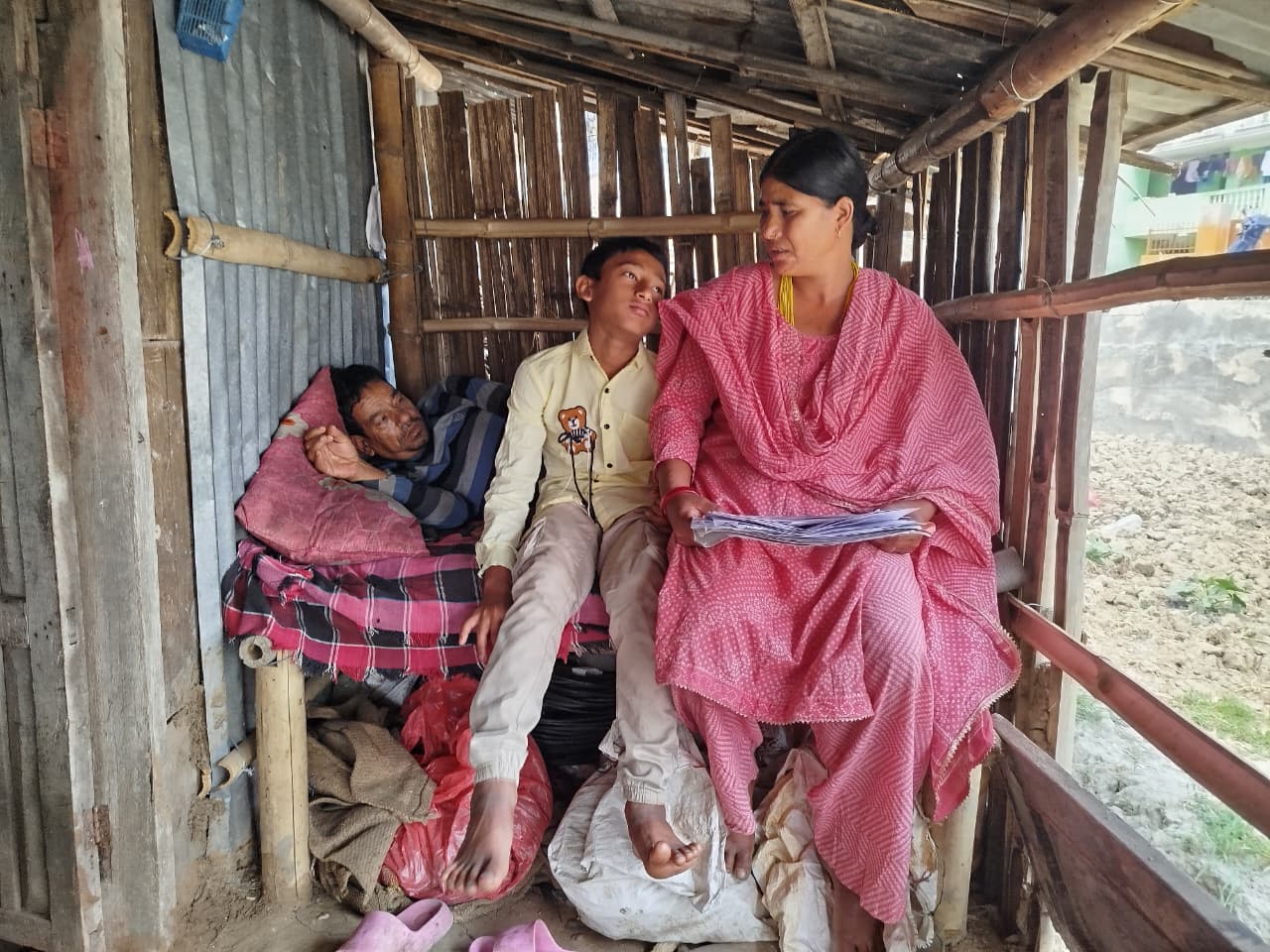
Gulabi, Binod and Dhani. Photo: Bidhya Rai
The family returned to Nepal after Dhani fell ill. He is currently receiving treatment at BP Koirala Memorial Cancer Hospital in Chitwan. Already shattered by the news of her husband’s blood cancer, Gulabi now carries the additional fear that her son may not get to study.
Because traveling from Bajhang to Chitwan is both far and expensive, with roads blocked during the monsoon, Gulabi has decided to stay in Kathmandu. “We thought that being in Kathmandu, we might find work and also manage my husband’s treatment,” she says. They have been staying with a niece and her husband in Chargharhe, Kirtipur, for the past two months.
A pile of worries
A sick husband on one side, fear that her son may not get to study on the other — worries keep piling up for Gulabi one after another. Now that she is staying in Kathmandu, she has been trying to enroll her son in whichever school, community or private, will take him.
For this, she went to Janasewa Higher Secondary School in Kirtipur on April 19, where Binod sat an entrance exam for grade 6. According to Binod, the exam had questions in Nepali, English, and mathematics. But Gulabi says the school refused to admit him, saying his answers in Nepali were unsatisfactory. Her understanding that his good academic performance might mean he could be enrolled in grade 6 in accordance with his age was rejected by the school.
“I’ve already been to two schools and neither would take him. How am I going to enroll him? Where am I going to get him educated?”
Janasewa head teacher Dev Raj Maharjan says that because EMIS records need to be updated, there can be procedural problems with admitting a student who studied in India. “It’s not that a student who passes the entrance exam cannot be admitted. But because the student’s details don’t show up in EMIS, there may be procedural complications for admission,” he says.
Director of the Ministry of Education, Science and Technology’s Education and Human Resource Development Center, Shyam Prasad Acharya, says it is also in accordance with regulations that a student who was studying in grade 4 cannot be admitted directly to grade 6.
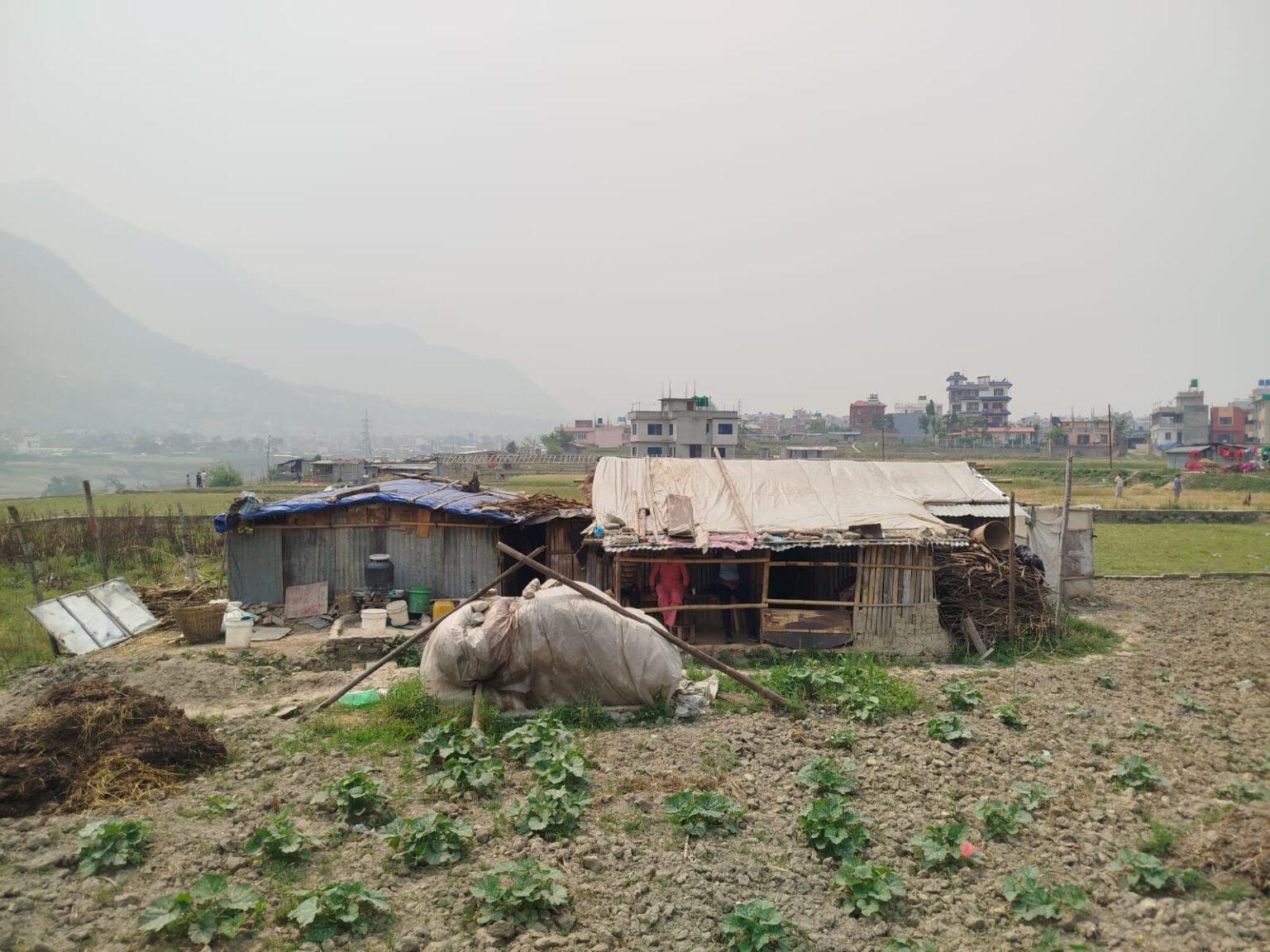
The hut where Gulabi, Binod and Dhani have been living. Photo: Bidhya Rai
Unaware of all these procedures and distressed by Janasewa’s refusal, Gulabi took her son to Kirtipur’s private Ujjwal Shishu Niketan Academy on April 22. There too she was unable to enroll him. The academy did not only cite his weakness in both Nepali and English, it also said his family’s difficult financial situation made admission impossible. “On one side they said our financial situation was poor, on the other that my son was weak in both Nepali and English, and they turned us away,” she says bitterly. “I’ve already been to two schools and neither would take him. How am I going to enroll him? Where am I going to get him educated?”
Ujjwal Academy principal Dil Man Maharjan also says that students who studied in India having no EMIS record creates complications for admission. The entrance exam is still important, he says. “We don’t determine pass or fail. The entrance exam is to assess the student’s level of understanding. A student must be qualified for the level they’re being examined for. If not, admission becomes difficult,” he says.
Director Acharya says a certificate of study in India is all that is needed for admission and there should be no barrier because of no EMIS record; the record gets updated once the student starts studying here. “You do need the certificate of study in India, but you shouldn’t be denied admission just because there’s no EMIS record that gets updated once studying here begins,” he says. According to the EMIS Operations Directive 2022, once a student is registered in the system their learning achievement details are also recorded there. But Gulabi says that in the rush to come to Nepal for her husband’s treatment, she was unable to bring her son’s academic certificates. “We left while he was still midway through grade 4, he didn’t even get to sit the final grade 4 exam. Whether he can sit it now I don’t know and even if he can, how do I find the money to go and collect it?” she says, at a loss.
In the course of running around trying to enroll her son, she went to Vaishnavi Higher Secondary School in Kirtipur on April 24. The school told her to consult the education section of Kirtipur Municipality and come back. She went to the education section with her son. The staff there gave an assurance that if he passes an entrance exam, they would facilitate his admission to grade 5. “Grade 6 won’t be possible, but if you want grade 5, come to the school for an entrance exam on April 27. ‘If he passes he can be admitted’ they told us. Let’s see what happens,” Gulabi said, expressing hope and apprehension in the same breath.
Having had to run from school to school for admission, Binod is growing frustrated. “Will I get to study or not? If not, let’s just go back to India; I’ll study there,” Gulabi quotes her son as saying. “But how can I leave my sick husband and go?”
The worry of livelihood and health
When Nepal News visited the family in Chargharhe, Kirtipur on April 23, Dhani was resting on a cot outside a makeshift shed built by the niece and her husband on rented land for keeping cattle. Now taking regular medication, Dhani says he is still troubled by back pain. He had initially been suffering from fever at night, burning sensations in his limbs, and low blood pressure. They had him examined at a local hospital in Bangalore. The hospital gave him injections saying it was typhoid, but there was no improvement. After waiting a month with no recovery, the family assumed it was a spiritual affliction and returned to Bajhang. There too they spent about a month on shamanic remedies and consulted astrologers. As the illness grew worse, they went to Seti Hospital in Dhangadhi in the second week of November 2025. Blood tests at Seti Hospital revealed that Dhani had blood cancer. The hospital referred him to Kathmandu, saying treatment was not possible in Dhangadhi.
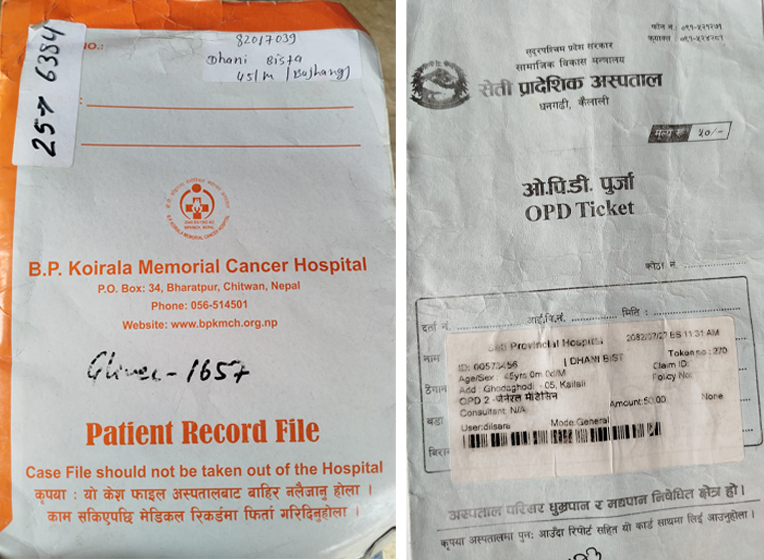
Shattered by the blood cancer diagnosis, she took her husband on a relative’s advice to Rajiv Gandhi Cancer Hospital in New Delhi hoping for better treatment. Dhani, who arrived there in the third week of November, grew weaker as medication was administered. He reached a point where he could not even stand and walk on his own. When the doctors said complete treatment would cost IRs 10 million, she was helpless. “Where would we get that kind of money?” she says. “I completely lost my senses. So I came back to our own country, whatever happens.”
Their farming in Bajhang was not enough to feed them through the year, so they had gone to Bangalore for seasonal labor, a long-established practice in Bajhang. In Bangalore, Dhani worked as a security guard in an apartment complex while Gulabi cleaned and mopped other people’s homes. That income covered their living expenses and their son’s education costs.
Binod, Gulabi and Dhani’s only child, was born there and studied in local schools. “Our son’s annual school fees came to 60,000 to 70,000 rupees, and we had to pay 8,000 Indian rupees a month in room rent,” she says.
After going to India, the family had returned to Bajhang for festivals for three years, but after Dhani’s parents and siblings all passed away, they had not been back to Bajhang for the last 10 years.
Gulabi herself is unwell. No matter how hard they worked in Bangalore, the earnings only just covered food, clothing, and their son’s education. The stress drove her into mental health difficulties, and she has been taking psychiatric medication for a year. Learning of her husband’s blood cancer has tightened the grip of her mental illness further.
Each follow-up means being called back to collect another month’s medication, but a lack of money has prevented Gulabi from attending the April follow-up.
Unable to afford treatment at Rajiv Gandhi Hospital, she admitted her husband to BP Koirala Memorial Cancer Hospital in Chitwan on 24 November 2025 on the advice of relatives, where he received treatment until 7 December 2025. The hospital has advised Dhani that he will need to take medication for life to fight the blood cancer.
Each follow-up means being called back to collect another month’s medication, but a lack of money has prevented Gulabi from attending the April follow-up. “We couldn’t make it to this April follow-up because we have nothing. When this month’s medication runs out, I don’t know what we’ll give him,” she says. “Whatever land we had in the hills, whatever nose and ear jewelry — all of it went on treatment. There’s nothing left.”
Gulabi says a single trip from Kathmandu to Chitwan, including transport, food, treatment, and medicine, costs Rs 30,000 to 35,000. She says Dhani’s treatment has already cost the equivalent of Rs 1.3 million. “Of that, 400,000 rupees is debt alone; how I’ll repay it I don’t know,” she says.
She is getting by on day laboring, digging fields and weeding, to cover morning and evening meals. Since Dhani fell ill September/October last year, 35-year-old Gulabi has had to carry the responsibility of earning, arranging her husband’s treatment, and educating her son all at once. She is looking for better-paid work. “Even house cleaning work by the hour or two, I would do it,” she says.