Kathmandu
Wednesday, June 17, 2026





Formed in 2001 amid the Maoist insurgency, APF has evolved into a key force for border security, disaster response, elections, and international peacekeeping

KATHMANDU: The Armed Police Force, Nepal, was established in 2001 during the Maoist insurgency to bridge the gap between Nepal Police and the Nepal Army.
Over time, it has expanded its role into border security, internal order, disaster response, revenue support, and UN peacekeeping, becoming a central pillar of national security.
This is the comprehensive timeline of the Armed Police Force (APF), Nepal, from its establishment to the present day.
February 13, 1996 — The Communist Party of Nepal (Maoist), operating as the United People’s Front of Nepal, declares the start of its armed “People’s War” against the Nepali state, launching an insurgency in Rolpa, Rukum, and five other districts. This armed conflict directly motivates the eventual creation of a specialized paramilitary force capable of filling the gap between the civil police and the army.
1996-2000 — Nepal Police, severely under-equipped and untrained for guerrilla warfare, struggles and is largely placed on the defensive by Maoist rebels who seize control of numerous rural police posts and district headquarters across the hills and terai. The security gap makes clear that an intermediate paramilitary force is urgently needed.
2000 — The Government of Nepal (then His Majesty’s Government) constitutes an Armed Police Force Establishment Suggestion Task Force, charged with studying the security situation and recommending the creation of a formal paramilitary organization under the Ministry of Home Affairs.
April 21, 2000 — The Armed Police Force Establishment Suggestion Task Force submits its formal report to the Government of Nepal, recommending in concrete terms the formation of a new, independent paramilitary force with defined mandates distinct from both Nepal Police and the Nepal Army.
January 21, 2001 — The Government of Nepal promulgates the first Armed Police Force Ordinance, providing an emergency legislative basis for the new paramilitary force before a full Parliamentary act can be passed.
February 1, 2001 — Krishna Mohan Shrestha, who was serving as Additional Inspector General of Nepal Police, is promoted and officially designated as the first Inspector General (IGP) of the Armed Police Force, Nepal, establishing the founding leadership of the organization.
February 5, 2001 — The Armed Police Force headquarters office is formally established in Kathmandu, marking the beginning of active administrative operations. An initial medical branch for APF personnel is also planned from this base.
February 23, 2001 — The Council of Ministers approves 25,000 sanctioned posts for the Armed Police Force, setting the authorized strength of the new organization.
April 2, 2001 — The APF Service Commission is formally established to conduct competitive open recruitment of new APF personnel, enabling the force to expand its manpower beyond those transferred from Nepal Police and the Nepal Army.
April 12, 2001 — The Government of Nepal issues the second Armed Police Force Ordinance, which contains amendments strengthening and refining the legal and structural provisions of the first ordinance.
July 2, 2001 — Raju Aryal, who had joined Nepal Police as an Inspector on March 31, 1998, is transferred to the Armed Police Force and promoted to the rank of Deputy Superintendent (DSP) of APF, becoming part of the foundational officer cadre of the new force.
August 22, 2001 — The Armed Police Force Act, 2001, receives Royal Assent from then King Gyanendra Bir Bikram Shah Dev, giving the organization full permanent legal recognition and replacing the earlier ordinances.
September 10, 2001 — The Government of Nepal allocates the National Communication Centre Nepal (NCCN) premises at Halchok, Swayambhu, Kathmandu, to the Armed Police Force for construction of its permanent headquarters building.
September 21, 2001 — The APF headquarters officially moves from the Nepal Police Academy at Maharajgunj to the newly allocated NCCN premises at Halchok, Kathmandu, establishing a more permanent administrative base.
October 23, 2001 — King Gyanendra Bir Bikram Shah Dev bestows the Baglamukhi Bhagwati insignia and the organizational color upon the Armed Police Force at a formal ceremony, providing the force with its distinctive institutional identity and symbols.
October 24, 2001 — The Armed Police Force, Nepal, is formally and officially founded as a paramilitary organization, with an initial strength of approximately 9,934 personnel (9,814 transferred from Nepal Police and 120 from the Nepal Army, significantly fewer than the planned 25,000). This date is celebrated annually as the APF’s founding anniversary.
November 2001 — The Royal Nepal Army is mobilized against the Maoist insurgency following a Maoist attack on the Dang Army barracks on November 23, 2001. The APF, barely a month old, is simultaneously deployed in joint counterinsurgency operations alongside the Army, marking its very first active operational engagement.
November 26, 2001 — The Government of Nepal declares a state of emergency following escalating Maoist attacks. The APF operates under the emergency framework alongside the Royal Nepal Army in what becomes Nepal’s first full-scale military campaign against the Maoist insurgency.
February 14, 2002 — A medical branch is formally established within the APF headquarters at Halchok to provide basic healthcare services to APF personnel and their dependents, offering OPD services, emergency care, X-ray, physiotherapy, and pharmacy services.
April 2002 — The APF Service Commission becomes fully operational and begins conducting formal open competitive examinations to recruit fresh APF constables and officers, supplementing the initial transferred personnel.
October 2002 — The Armed Police Force begins its participation in United Nations peacekeeping missions by deploying personnel to the UN Guard Contingent in Iraq (UNGCI), beginning what will become a long and distinguished tradition of Nepalese APF service under the UN flag.
October 4, 2002 — King Gyanendra dismisses then-Prime Minister Sher Bahadur Deuba and takes direct control of the government, citing the failure to hold elections on schedule. The APF continues its counterinsurgency role under the new political arrangement.
January 29, 2003 — The government of Nepal and the Maoist rebels agree to a ceasefire, temporarily halting active combat operations. The APF transitions from active counterinsurgency to monitoring and security maintenance roles during the ceasefire period.
January 26, 2003 — First IGP Krishna Mohan Shrestha is shot and killed by Maoist insurgents while taking his morning walk near his home in Kathmandu. His bodyguard and wife are also killed in the targeted attack. Shrestha becomes the first and highest-ranking APF martyr. His loss represents a major blow to the newly formed organization.
January 27, 2003 — Sahabir Thapa is appointed as the second Inspector General of the Armed Police Force, Nepal, succeeding the martyred IGP Krishna Mohan Shrestha and assuming command of the force in a critical period.
May 26, 2003 — The Cabinet of Nepal approves the first formal amendment to the Armed Police Force Regulations, refining the administrative procedures for promotion, transfer, and personnel management within the APF.
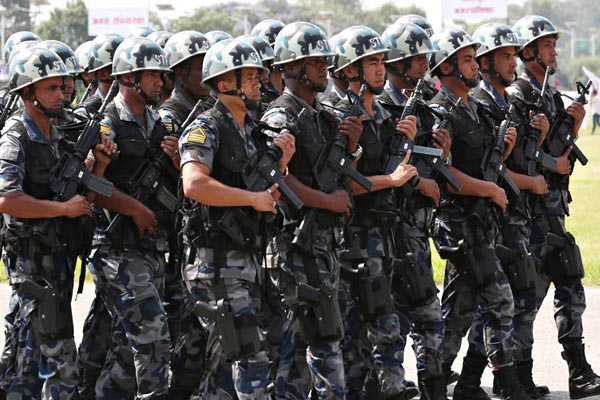
August 2003 — APF and Nepal Army forces conduct a major counterinsurgency operation in the Ramechhap District in which 39 Maoist rebels are killed. Five APF constables also lose their lives in the engagement, demonstrating the continued combat danger to APF personnel even after the failed ceasefire.
August 2003 — The Maoist rebels formally withdraw from peace talks with the government and end the seven-month ceasefire, plunging Nepal back into full-scale armed conflict and requiring the APF to resume aggressive counterinsurgency operations.
December 15, 2003 — The APF’s medical branch at Halchok is formally upgraded and renamed the APF Hospital, recognizing the growth of its services and the expanding healthcare needs of the force’s rapidly growing personnel.
December 18, 2003 — King Gyanendra Bir Bikram Shah Dev inaugurates the new Armed Police Force headquarters premises at Halchok, Kathmandu, in a formal ceremony, providing the force with a dedicated institutional home.
December 2003 — Two APF Formed Police Unit (FPU) contingents, each comprising 120 personnel, are deployed to the United Nations Mission in Liberia (UNMIL), marking the APF’s first deployment of a full Formed Police Unit to an international peacekeeping mission.
2004 — The Armed Police Force begins deploying Individual Police Officers (IPOs) to the United Nations Mission in Kosovo (UNMIK), broadening the range of mission types and geographical regions where APF personnel serve in UN peacekeeping.
February 1, 2005 — King Gyanendra dismisses the democratically elected government of Prime Minister Sher Bahadur Deuba and assumes direct executive power, declaring another state of emergency. The APF continues its constitutional mandate under the new political arrangement and is deployed to manage civil unrest in various parts of the country.
February 16, 2005 — The then government sanctions the construction of a dedicated APF Hospital at Balambu, Kathmandu, with a capacity of 110 beds, five of which are reserved for National Investigation Department personnel and locals, with the remaining 100 beds for APF staff. This marks the beginning of the permanent healthcare infrastructure for the force.
2005 — The APF, alongside the Royal Nepal Army and Nepal Police, participates in counterinsurgency operations at the height of the civil war. Nepal’s combined paramilitary strength reaches approximately 62,000 personnel (15,000 APF, 47,000 Nepal Police), supporting an army that has expanded to about 69,000 troops.
April 2006 — Mass popular protests (Jana Andolan II) sweep Nepal, forcing King Gyanendra to restore Parliament and hand power back to a multi-party government. The APF is deployed across Kathmandu and other cities to manage civil order during an extremely volatile period. The political change sets the stage for the end of the decade-long civil conflict.
May 11, 2006 — Second IGP Sahabir Thapa completes his tenure as Inspector General of the Armed Police Force, having led the force through the most difficult and violent years of the Maoist conflict.
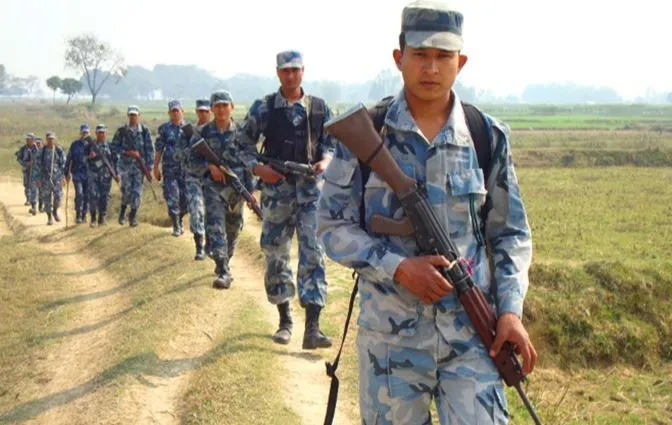
May 12, 2006 — Bashudev Oli is appointed and assumes command as the third Inspector General of the Armed Police Force, Nepal, the first APF chief to lead the force during the transition to a post-conflict political environment.
November 21, 2006 — The Government of Nepal and the Communist Party of Nepal (Maoist) sign the Comprehensive Peace Agreement (CPA) in Kathmandu, formally ending the decade-long armed insurgency that had been the primary reason for the APF’s establishment. The APF’s operational focus begins to shift from counterinsurgency toward border security, disaster management, and election security.
2007 — The APF Command and Staff College is established to provide higher professional and academic training to senior APF officers, significantly upgrading the intellectual and leadership development capacity of the organization.
2007 — Raju Aryal, following his early career advancement, is promoted to the rank of Superintendent (SP) within the Armed Police Force, continuing his trajectory through the officer ranks.
April 10, 2008 — Nepal holds its first Constituent Assembly election, a historic post-conflict democratic exercise. The APF is deployed in the outer security ring across the country, managing highway security and inter-district movement of security forces, while Nepal Police secures polling stations.
August 2008 — Severe floods on the Koshi River in eastern Nepal cause catastrophic damage and displace hundreds of thousands of people. APF personnel are deployed for search and rescue, relief distribution, and maintenance of security in the affected districts of Sunsari, Saptari, and Siraha.
April 15, 2009 — Third IGP Bashudev Oli completes his tenure. Sanat Kumar Basnet is appointed and formally assumes command as the fourth Inspector General of the Armed Police Force, Nepal.
2010 — APF personnel are deployed to the United Nations Stabilization Mission in Haiti (MINUSTAH) following the devastating January 2010 earthquake in Haiti. APF formed police units assist in maintaining security during the humanitarian response.
2010 — The APF significantly expands its border security operations, establishing new permanent border outposts along Nepal’s frontier with India and China and introducing joint patrolling arrangements with India’s Sashastra Seema Bal (SSB) along the southern border.
2011 — Nepal begins the process of drafting a new constitution through the elected Constituent Assembly. APF is deployed in security roles across all 75 districts to support the constitutional process and prevent disruption by fringe groups.
July 6, 2011 — Fourth IGP Sanat Kumar Basnet completes his tenure and retires. Kishor Kumar Lama is immediately appointed as the fifth Inspector General of the Armed Police Force, Nepal, though his tenure will last only a very short time due to administrative circumstances.
July 16, 2011 — Kishor Kumar Lama formally assumes the duties of the fifth IGP of the Armed Police Force after completing the required handover process.
July 30, 2011 — Shailendra Shrestha assumes command as the sixth Inspector General of the Armed Police Force, Nepal, succeeding Kishor Kumar Lama whose extraordinarily brief tenure lasted only about two weeks.
2012 — The APF anti-smuggling units seize large quantities of contraband, counterfeit currency, and illegal goods along the border, demonstrating growing effectiveness of the revenue support mandate under the BIRD framework.
May 27, 2012 — The first Constituent Assembly, having failed to produce a new constitution by its extended deadline, is dissolved. APF personnel are deployed to manage political tensions and protests that erupt across the country in response to the constitutional deadlock.
April 10, 2012 — Sixth IGP Shailendra Shrestha completes his tenure. The APF prepares for another command transition.
April 11, 2012 — Kosh Raj Onta assumes command as the seventh Inspector General of the Armed Police Force, Nepal. His tenure will prove to be the longest of any APF chief until Shailendra Khanal’s four-year term.
November 19, 2013 — Nepal’s second Constituent Assembly election is held. APF is again deployed in the outer security ring as part of a massive integrated security operation involving Nepal Police, APF, and the Nepal Army. The election passes largely peacefully with dramatically less violence than in 2008.
2014 — Raju Aryal is promoted to the rank of Senior Superintendent (SSP) within the Armed Police Force, continuing his steady advancement through the officer corps.
September 20, 2015 — Nepal promulgates its new federal democratic republican constitution through the second Constituent Assembly. APF is deployed across the country to manage security during the constitutional promulgation ceremonies and subsequent protests by Madhesi communities in the southern plains.
December 18, 2015 — Seventh IGP Kosh Raj Onta completes his tenure, having served through the critical 2013 election and the 2015 earthquake response. Durja Kumar Rai is appointed and assumes command as the eighth Inspector General of the Armed Police Force, Nepal.
December 19, 2015 — The Armed Police Force Act, 2015, is passed under Nepal’s new constitution framework, replacing the original 2001 Act. This updated legislation provides the APF with a comprehensive and constitutionally grounded legal mandate defining 14 specific duties, formally codifying the BIRD framework: Border security, Internal security, Revenue support, and Disaster management.
April 25, 2015 — A devastating 7.8 magnitude earthquake strikes Gorkha district approximately 76 kilometers northwest of Kathmandu, killing nearly 9,000 people and injuring over 22,000. APF personnel are immediately deployed for search and rescue operations in all 14 severely affected districts. The APF, alongside Nepal Police and the Nepal Army, is credited in the national Post-Disaster Needs Assessment as a primary responder conducting effective search and rescue operations.
May 12, 2015 — A powerful 7.3 magnitude aftershock again strikes Nepal, killing additional hundreds of people and collapsing thousands more structures. APF extends its rescue and relief operations as new areas are affected and access routes collapse.
2016 — The APF deploys Formed Police Unit contingents to the United Nations Mission in South Sudan (UNMISS), continuing Nepal’s strong contribution to UN peacekeeping in Africa. By this time, the total number of APF personnel to have served in UN missions exceeds 5,000.
February 25, 2017 — Eighth IGP Durja Kumar Rai completes his tenure. Singha Bahadur Shrestha is appointed and assumes command as the ninth Inspector General of the Armed Police Force, Nepal.
May 2017 — Local government elections are held in Nepal in three phases, the first local elections in nearly two decades. APF is deployed in the outer perimeter security ring across all 753 local government units, with over 60,000 total security personnel mobilized.
November 26, 2017 — Nepal holds federal parliamentary and provincial elections in the first phase, with the second phase following on December 7, 2017. APF provides critical outer security, highway patrolling, and mobile security during what is Nepal’s first federal election under the new constitution.
2017 — The APF establishes provincial offices in each of Nepal’s seven provinces as part of its structural reorganization to align with the new federal framework, creating Provincial APF Offices responsible for coordinating border security and internal security at the provincial level.
April 11, 2018 — Ninth IGP Singha Bahadur Shrestha completes his tenure and retires.
April 12, 2018 — Shailendra Khanal, an officer from the very first APF batch formed in 2001, is appointed as the tenth Inspector General of the Armed Police Force, Nepal. His appointment under Rule 53 of the APF Regulation is notable as he is one of the original APF founding batch officers to reach the top position.
2019 — Raju Aryal is promoted to the rank of Deputy Inspector General (DIG) within the APF, positioning him as a future contender for the Additional Inspector General rank and ultimately the top post.
March 2020 — COVID-19 reaches Nepal. APF personnel are deployed across the country to enforce lockdowns, manage quarantine facilities, staff border health checkpoints, and assist in the distribution of essential supplies. The APF hospital at Balambu is designated as part of the Unified Command Hospital system for COVID-19 treatment.
2020 — The APF begins conducting integrated anti-smuggling operations along the northern and southern borders, seizing large quantities of contraband goods, counterfeit currency estimated at over 1.5 million banknotes, and illegal substances, demonstrating growing effectiveness in the revenue support and border security mandates.
2021 — The APF Command and Staff College inaugurates Nepal’s first dedicated professional journal for paramilitary studies, the Journal of APF Command and Staff College, furthering institutional knowledge-sharing and research within the force.
November 20, 2022 — Nepal holds federal and provincial elections. The APF is deployed across all seven provinces in the outer security ring, supporting a massive integrated election security operation with tens of thousands of security personnel mobilized.
April 11, 2022 — Tenth IGP Shailendra Khanal reaches mandatory retirement after completing his four-year term as Inspector General and his 30-year total service limit. AIG Pushpa Ram KC is given acting charge of the APF pending cabinet appointment of a new permanent IGP.
April 13, 2022 — The Cabinet of Nepal formally appoints Pushpa Ram KC as the eleventh Inspector General of the Armed Police Force, Nepal. KC, who joined Nepal Police as an Inspector on April 26, 1992, and subsequently transferred to APF, is the most senior AIG at the time. KC’s mandatory retirement on May 1, 2022, means his tenure as formal IGP will be only 19 days, the shortest in APF history.
May 4, 2022 — The Home Ministry promotion committee headed by Home Ministry Secretary Teknarayan Pandey recommends DIG Narayan Dutta Poudel for promotion to Additional Inspector General (AIG). Although two AIG posts are vacant, only Poudel is recommended based on seniority in accordance with Rule 39(1)(A) of the APF Police Regulation 2072. Other competing DIGs including Banshiraj Dahal, Chandra Prakash Gautam, and Kishor Pradhan are passed over for the time being.
May 1, 2022 — The Cabinet of Nepal formally approves the appointment of AIG Raju Aryal as the twelfth Inspector General of the Armed Police Force, Nepal, after Pushpa Ram KC’s 30-year service limit expires at midnight. Aryal is selected as the sole AIG available after KC’s retirement.
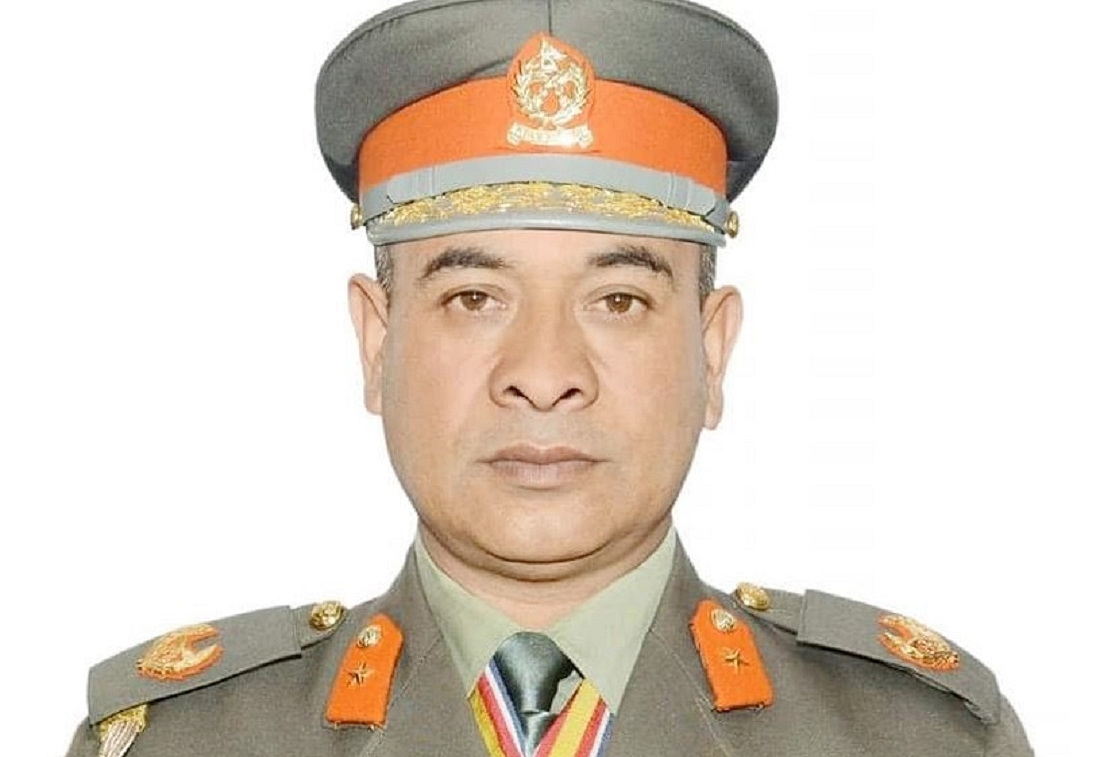
IGP Raju Aryal
May 2, 2022 — Raju Aryal is formally conferred with the insignia of Inspector General of the Armed Police Force at an investiture ceremony at the Ministry of Home Affairs in Singha Durbar, officiated by Home Secretary Tek Narayan Pandey. Simultaneously, Dhiraj Pratap Singh receives his insignia as the newly appointed Inspector General of Nepal Police, marking the transition of leadership in both major security organizations.
May 20, 2022 — The Cabinet of Nepal approves the promotion of Narayan Dutta Poudel from Deputy Inspector General to Additional Inspector General (AIG) of the Armed Police Force, formally implementing the promotion committee’s recommendation. Poudel takes charge of the Human Resource Development Department, the first of several senior departmental positions he will hold.
July 14, 2022 — IGP Raju Aryal formally confers rank insignia on newly promoted APF officers at a ceremony at APF headquarters, attended by AIGs Narayan Dutta Poudel and Chandra Prakash Gautam alongside other senior officers.
October 14, 2022 — Nepal holds local level and provincial assembly elections in provinces. APF is deployed in the outer security ring, with Aryal emphasizing human rights compliance and zero tolerance for excessive force in election security protocols.
October 2022 — AIG Banshiraj Dahal is promoted to Additional Inspector General, becoming the second active AIG in the APF after Narayan Dutta Poudel. Dahal is approximately five months junior to Poudel in seniority, a gap that will become significant in the future IGP succession race.
2023 — IGP Raju Aryal publicly introduces and promotes the BIRD concept as the official institutional framework for the APF’s 14 mandated duties: Border security, Internal security, Revenue support (formerly Riot Management), and Disaster management. The BIRD framework becomes the APF’s defining self-description and communication tool.
2023 — The APF intensifies border outpost construction and expansion along Nepal’s frontiers, establishing new permanent outposts and upgrading existing facilities. IGP Aryal publicly advocates for increasing APF strength from 37,000 to 60,000 to meet growing border security demands.
2023-2024 — The APF Sahabir Thapa Oncology Unit is established and operationalized within the APF Hospital at Balambu, Kathmandu, named in honor of former second IGP Sahabir Thapa, significantly expanding the hospital’s medical services to include cancer treatment.
2024 — The Ministry of Health and Population grants formal permission to the Armed Police Force to operate a 300-bed hospital at Balambu in September-October 2024, tripling the hospital’s authorized capacity and marking a major expansion of healthcare infrastructure for APF personnel and their families.
2024 — The APF Nepal Institute of Health Sciences is established within the APF Hospital in Balambu, launching Proficiency Certificate-level nursing studies and marking the APF’s entry into formal healthcare education.
2024 — The APF establishes telemedicine services connected to all APF offices through its intranet and internet systems, allowing personnel at remote border outposts across the country to access medical consultations without traveling to Kathmandu.
May 29, 2025 — The Home Ministry promotion committee recommends DIG Ganesh Thada Magar for promotion to the rank of Additional Inspector General, filling one of the three AIG posts. This makes Thada Magar the third active AIG, five years junior in seniority to Poudel and Dahal, but positioned as a potential future IGP after both seniors complete their respective future tenures.
September 4, 2025 — The government of Nepal bans 26 major social media platforms, triggering widespread public outrage and igniting the so-called Gen-Z youth movement against government censorship and perceived corruption.
September 8-9, 2025 — Mass youth-led protests erupt across Kathmandu and other cities, with clashes between security forces and protesters near the Parliament Building. APF is deployed alongside Nepal Police to manage the civil unrest. Serious human rights concerns are raised about the use of force by security agencies during the protests. The then prime Minister KP Sharma Oli is rescued by the Nepal Army helicopter and taken to undisclosed location.
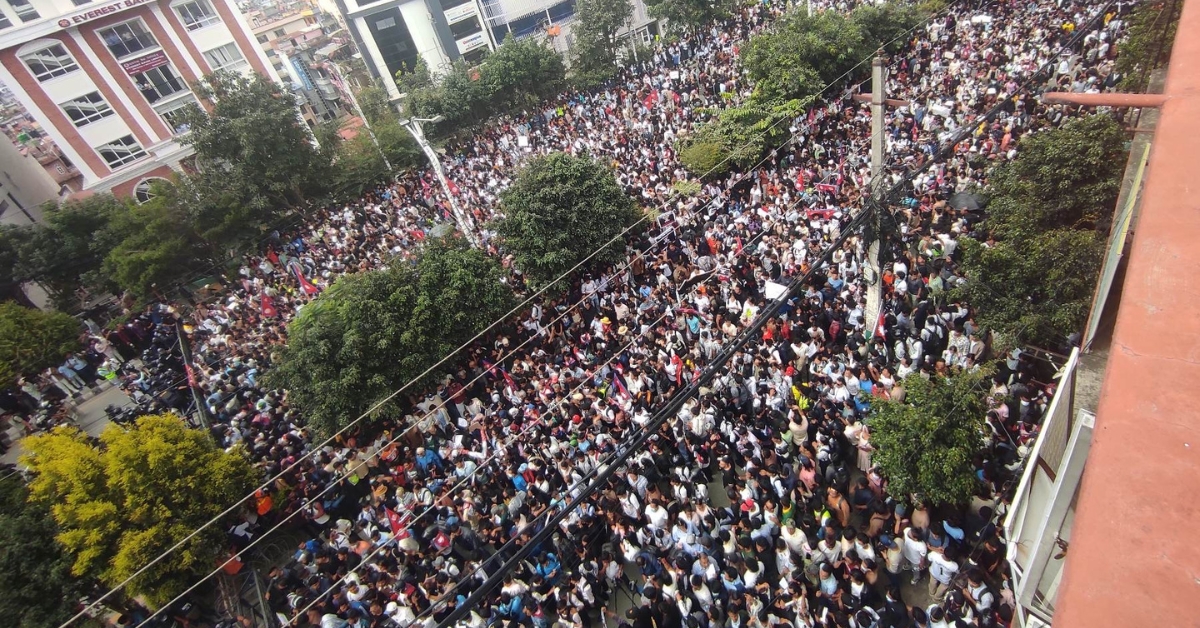
Youth gathered in New Baneshwar during the Gen Z movement. Photo: Bikram Rai / Nepal News.
September 12, 2025 — Following massive public pressure from the Gen Z protests, the government undergoes a significant political transition. Former Chief Justice Sushila Karki is appointed as the interim Prime Minister.
October 2025 — AIG Chandra Prakash Gautam of APF reaches mandatory retirement age and formally retires from service, leaving the Border Security Department AIG post vacant. The remaining two senior AIGs, Narayan Dutta Poudel and Banshiraj Dahal, continue in their respective departmental roles.
January 7, 2026 — Several Deputy Inspector Generals of the APF, including Kamal Giri, Kul Bahadur Nembang, and Shambhu Subedi, reach mandatory retirement age and formally leave service, creating multiple vacancies in the DIG tier of the APF that require promotion-based filling.
March 5, 2026 — Nepal holds fresh general elections under PM Sushila Karki’s government. The APF is deployed in a massive integrated election security operation alongside Nepal Police and the Nepal Army. In Koshi Province alone, 2,561 armed police and 5,649 election police from APF are deployed across 4,270 polling centers and 1,907 polling stations.
March 27, 2026 — A new cabinet is sworn in under Prime Minister Balendra Shah, with Sudan Gurung taking charge as Home Minister. The new Home Ministry team begins preparations for the APF IGP transition, including reviewing the promotion committee process and seniority records.
April 7, 2026 — APF AIG Narayan Dutta Poudel presides as chief guest at the launch of the “APF IGP Cup Sports Tournament. IGP Raju Aryal officially closes the tournament on April 13, 2026, in one of his final public functions as the head of the Armed Police Force.
April 13, 2026 — APF Sub-Inspector Nim Diki Sherpa successfully summits Lobouche Peak (6,119 meters) at 8:57 AM, becoming a notable achievement for an APF woman officer and reflecting the force’s involvement in mountaineering as part of personnel development activities.
April 27, 2026 — The Cabinet of Nepal under Prime Minister Balendra Shah formally decides in its cabinet meeting to appoint AIG Narayan Dutta Poudel as the new Inspector General, the 13th IGP, of the Armed Police Force, Nepal. The appointment is made in accordance with Rule 53 of the Armed Police Force Regulation, which mandates appointment from among the AIGs based on seniority and work efficiency.
IGP Raju Aryal will formally complete his four-year tenure as the twelfth Inspector General of the Armed Police Force, Nepal, and will retire on May 1, 2026, after approximately 28 years of total police service.